The Campaign Brief Template That Keeps Teams Aligned

A campaign brief is your marketing campaign's playbook. It keeps your team focused, cuts down on revisions, and ensures everyone - from founders to creators - knows the plan. Without one, campaigns risk delays, inconsistent messaging, and wasted time. Here's what to include:
- Objectives: Use SMART goals to define success (e.g., "Increase lead velocity by 30%").
- Audience: Know your Ideal Customer Profile (ICP) and anti-persona to target the right people.
- Messaging: Nail down your Unique Selling Proposition (USP) and align content with the buyer journey.
- Timeline: Map out milestones (e.g., strategy, launch, optimization) for a smooth process.
- Budget: Allocate funds using the 70/20/10 rule - 70% proven methods, 20% new ideas, 10% experiments.
- KPIs: Track metrics like MQLs, SQLs, and CPA to measure performance.
A great brief isn’t set-it-and-forget-it. It’s a living document - updated as campaigns progress and lessons are learned. Want your team aligned and campaigns running smoother? Start with a solid brief.
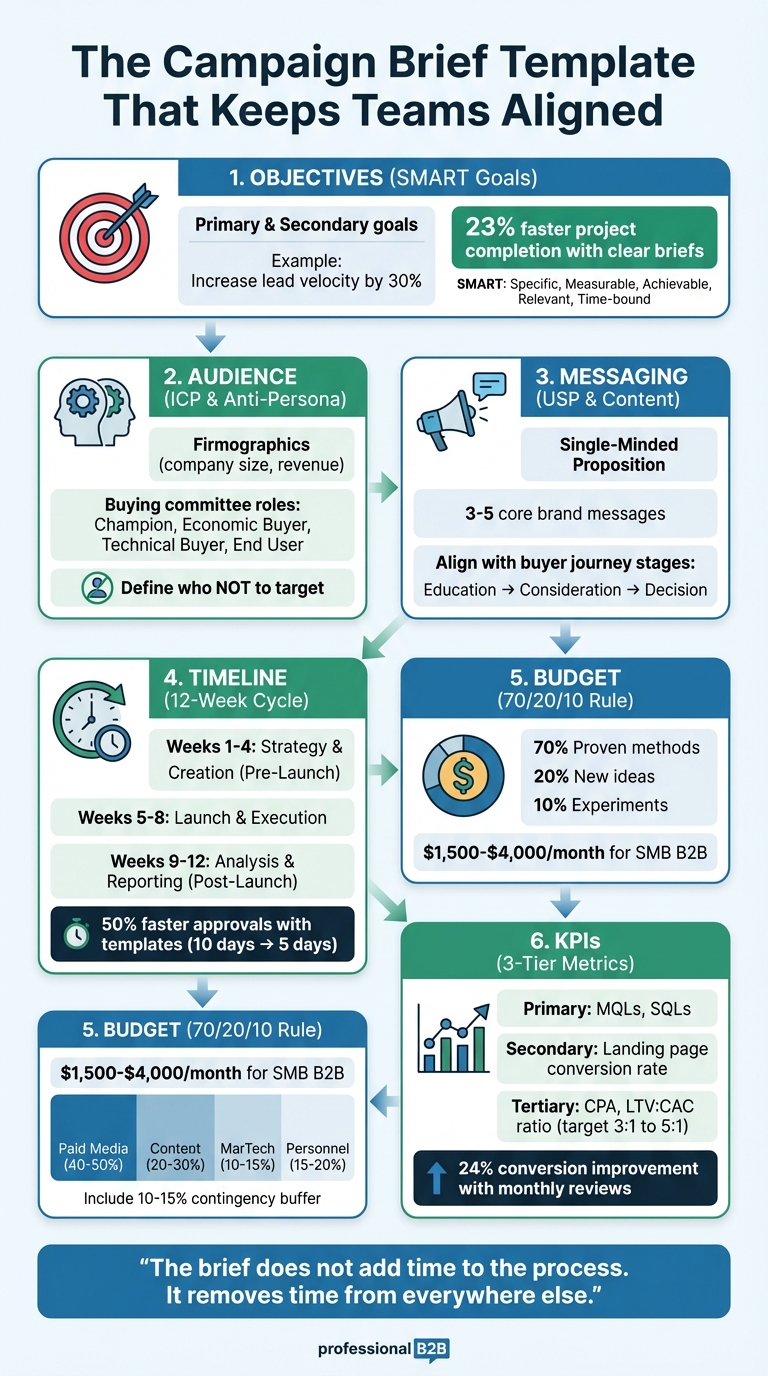
Complete Campaign Brief Template: 6 Essential Components for Marketing Alignment
How to Create a Professional Marketing Brief Step By Step
sbb-itb-9354cf2
What to Include in Your Campaign Brief Template
A well-structured campaign brief is essential for keeping everyone aligned. The most effective ones lay out clear objectives, define the target audience, and establish a messaging framework with key deliverables. Here’s how to organize your brief into sections that drive clarity and efficiency.
Campaign Objectives and Goals
Start by setting SMART objectives: Specific, Measurable, Achievable, Relevant, and Time-bound. These goals act as a shared agreement on what success looks like. For instance, instead of a vague aim like “improve lead quality,” you could specify: “Increase lead velocity from the education phase to the consideration phase by 30%”.
Break your objectives into two categories: primary and secondary. Primary objectives might focus on revenue growth or increasing qualified leads, while secondary ones could include expanding an email list or boosting social engagement. Prioritize these goals based on their importance to the business. This ranking becomes especially useful when budget constraints or shifting priorities arise.
"A campaign brief is a thought exercise for you as much as it is an explainer document for everyone else."
Research shows that teams using clear briefs complete projects 23% faster than those without them. Well-defined objectives act as a guiding light, helping to streamline creative decisions and avoid scope creep during execution.
Once your objectives are clear, the next step is to define exactly who your campaign is targeting.
Target Audience and Ideal Customer Profile (ICP)
To resonate with your audience, you need to know them inside out. Start by outlining firmographics - details like company size (employee count, annual revenue), key departments, and the tools or technology they use. For B2B campaigns, dive deeper by mapping out the buying committee. This typically includes the Champion (who feels the pain), the Economic Buyer (who approves the budget), the Technical Buyer (who ensures compliance), and the End User.
Go beyond surface-level pain points. Be specific. Instead of saying "inefficient processes", pinpoint something like "manual data entry consuming 20 hours per week". Also, identify buying triggers - events like leadership changes, funding rounds, or new regulations - that make your product or service an urgent need.
Don’t forget to define your anti-persona - the audience you don’t want to target. For example, if solopreneurs or companies with budgets under $100/month aren’t a fit, make that clear to avoid wasting time and resources.
"Never start a project if you don't know who it's for. Take your time to think carefully about your target audience."
Messaging Framework and Key Deliverables
For teams led by founders or small marketing groups, a focused messaging framework simplifies communication and execution. Start by outlining your Unique Selling Proposition (USP) and 3–5 core brand messages. Your messaging should center on a "Single-Minded Proposition" - the one idea you want your audience to remember. Include common customer objections and pre-crafted responses to ensure alignment between sales and marketing.
Tailor your content to the buyer journey. Specify which stage - education, consideration, or decision - each piece of content addresses and align your call-to-action accordingly. Then, list your deliverables. For example, your brief might include LinkedIn carousels, email sequences, whitepapers, or customer testimonial videos.
Here’s a practical example: In January 2026, a B2B SaaS company targeting marketing directors at companies with 100–500 employees launched a LinkedIn campaign. Their brief outlined three posts per week (Tuesdays, Thursdays, Fridays at 8:00 AM EST), with 60% educational carousels, 30% thought leadership, and 10% testimonials, aiming for a 5–8% engagement rate.
Finally, include stakeholders and approval workflows. Clearly outline who reviews and approves each part of the brief to avoid bottlenecks, especially for distributed teams. Don’t forget to specify any “non-negotiables,” like brand guidelines, restricted topics, or mandatory logo placements - this is particularly important when working with external partners.
Setting Timelines, Budgets, and KPIs
Once you've nailed down your objectives, audience, and messaging, it's time to set up timelines, budgets, and KPIs. These elements transform your campaign plans into a clear roadmap for execution, ensuring every step is mapped out and measurable.
Timelines and Milestones
Start with your launch date and work backward. This method helps you identify dependencies and allocate time for each stage efficiently. Many B2B campaigns stick to a 12-week cycle: the first four weeks for strategy and asset creation, the next four for launch and execution, and the final four for performance analysis and reporting.
Break your timeline into three key phases: Pre-Launch (strategy and asset creation), Launch (campaign activation), and Post-Launch (optimization and reporting). Within each phase, set specific checkpoints. For example, schedule a "Technical Setup" milestone a week before launch to confirm that tracking pixels, UTM parameters, and CRM integrations are ready to go. Using standardized templates can save time, cutting approval cycles by up to 50% - from an average of 10 days to just 5.
For distributed teams, establish clear feedback deadlines (e.g., "Comments due by Thursday 5:00 PM EST") to keep things moving. Also, include a Service Level Agreement (SLA) between marketing and sales in your plan. This agreement sets criteria for lead qualification and follow-up timing, which can significantly boost conversion rates when leads are contacted within the first hour of engagement.
Here's an example of a LinkedIn content campaign timeline:
| Milestone | Timing | Deliverable/Action |
|---|---|---|
| Kickoff | Day 1 | Align on target audience (e.g., CMOs at mid-market firms) and core message. |
| Content Creation | Days 2–10 | Develop 60% educational carousels, 30% thought leadership, 10% testimonials. |
| Review/Approval | Days 11–13 | Final sign-off on creative assets and ad copy. |
| Posting Schedule | Ongoing | Post 3x weekly (Tue, Thu, Fri) at 8:00 AM EST. |
| Monitoring | Daily | Review comments and respond within 4 business hours. |
This structured approach ensures your campaign stays on track from start to finish.
"A great template doesn't stifle creativity; it channels it. By setting the boundaries - budget, timeline, and goals - it frees up your team to innovate within a framework that's built for success."
Budget Planning
For small to medium-sized B2B campaigns, plan to spend between $1,500 and $4,000 per month. Instead of relying on past spending habits, align your budget with revenue targets. On average, B2B companies allocate 7–12% of their projected revenue to marketing.
Use the 70/20/10 rule to distribute your budget: 70% for proven strategies, 20% for promising tactics, and 10% for experimental ideas. Divide your total budget into these main categories:
- Paid Media: 40–50%
- Content Creation: 20–30%
- Marketing Technology: 10–15%
- Personnel/Agency Fees: 15–20%
Always account for a 10–15% contingency buffer to handle unexpected changes, like platform updates or resource shortages. Research shows that successful campaigns allocate their budgets fully before launch, with 72% following this practice. To stay on top of spending, track your budget weekly using a "Planned vs. Actual" table, allowing for quick adjustments if needed.
Defining and Measuring KPIs
Your KPIs should directly reflect your campaign's objectives. Organize them into three levels:
- Primary Metrics: Measure your main goal (e.g., total leads generated).
- Secondary Metrics: Support primary goals (e.g., landing page conversion rate).
- Tertiary Metrics: Provide additional context (e.g., cost per lead).
For B2B campaigns, focus on metrics like Marketing Qualified Leads (MQLs), Sales Qualified Leads (SQLs), and Cost Per Acquisition (CPA). High-performing teams aim for a 3:1 to 5:1 LTV:CAC ratio. Establish benchmarks before launching to track progress accurately.
Implement a two-tiered review process to stay on track. Hold weekly 15–30 minute tactical meetings to check task progress, and schedule monthly strategic reviews to evaluate live data against your KPIs. Sync your planning templates with live data sources like Google Analytics or CRMs to simplify reporting. Regular monthly performance reviews can improve conversions by as much as 24%.
"To be successful as a marketer, you have to deliver the pipeline and the revenue."
How to Customize the Template for Your Team
Tweaking your campaign brief to match your team's unique workflows and decision-making style is essential - especially for founder-led teams. A generic brief isn’t going to cut it. The trick is to adjust the template to fit your team’s rhythm, not the other way around.
Step-by-Step Template Customization
Start by talking to your founder and department leads. Ask them what success looks like, what constraints exist, and what’s non-negotiable when it comes to messaging and brand positioning. This conversation will help you nail down the founder’s vision, budget boundaries, and key priorities.
Then, organize your template by campaign type. Different campaigns need different levels of detail. For example, a nurture campaign might require a focus on cadence planning and exit criteria, while an ABM campaign will need account-level personalization and tight coordination between sales and marketing. Don’t rely on a one-size-fits-all template. For a product launch, include sections for launch-day logistics and a breakdown of key features and benefits.
Clarify decision-making roles in your team structure to avoid delays. Define who signs off at each stage - like Team Lead → Founder/Executive Sponsor → Legal - and set clear timelines for approvals (e.g., 24–48 hours per step). Communication breakdowns are a common pain point, with 78% of marketing agencies citing it as their top internal challenge.
Swap vague goals for measurable ones. Instead of saying, "increase brand awareness", aim for something like, "boost demand for pre-sales engagements by 200%". Use this simple formula to align with your founder’s vision: "Our objective is to [Goal] by launching [Campaign], which will [Impact]".
Include a checklist with specific deliverable details. For instance, instead of just saying "social media posts", specify "3 LinkedIn carousel posts, 1080x1080 pixels, with captions under 150 characters". Add contingency plans too - like backup creators or alternative channels - so you’re ready if your main approach doesn’t deliver. Skipping this level of detail can lead to spending three times more time on revisions compared to teams that invest in well-thought-out briefs upfront.
Once your customized template is ready, make it a core part of your workflow to keep everything running smoothly.
Adding the Template to Your Workflow
A brief isn’t meant to sit in a folder gathering dust. It should be a dynamic tool that guides the team throughout the campaign. Store it in a collaborative platform like Google Docs or Notion, where team members can leave comments and track changes in real time.
Use a state-based locking system - like marking the document as "Draft", "Ready", or "Published" - to prevent accidental edits once work kicks off.
Connect the brief to your execution tools (like your CRM or project management software). This way, audience segments, tasks, and deadlines automatically sync with your team’s daily workflows. For distributed teams, establish clear communication protocols to keep everyone on the same page.
Turn the completed brief into your agenda for the kickoff meeting. Walk through it with your team, confirm roles, and address any last-minute questions. When the campaign ends, archive the brief along with performance metrics. This process builds a library of insights, making your briefs sharper and more effective over time.
"The brief does not add time to the process. It removes time from everywhere else."
Conclusion: Using Campaign Briefs to Keep Teams Aligned
A well-structured campaign brief does more than outline tasks - it serves as the bridge between strategy and execution, ensuring your team stays focused and aligned. For many brands, the absence of clear direction leads to missteps like inconsistent messaging, wasted budgets, and endless revisions. A thoughtfully crafted brief eliminates these pitfalls by providing clarity and focus at every stage of the campaign.
By defining objectives, audience insights, and the process in detail, the brief becomes your guiding compass throughout the campaign lifecycle - not just at the start. Whether you’re reviewing creative work or assessing new tactics, the brief acts as a filter: if something strays from the strategy, it’s discarded. This approach avoids the dreaded "moving goalposts" problem, which often triples the time spent on revisions.
For founder-led B2B teams, where asynchronous communication can create bottlenecks, the brief is a game-changer. Clear documentation cuts through time-zone challenges and reduces the need for constant back-and-forth. It provides a single source of truth, enabling sales, product, and creative teams to execute confidently without waiting for constant approvals. This aligns seamlessly with the template elements discussed earlier, ensuring everyone is on the same page.
"The campaign brief is the single most important document in any marketing campaign. It is the contract between strategy and execution."
As the campaign unfolds, the brief should adapt, incorporating lessons learned to maintain alignment. Treat it as a living document - one that evolves with each campaign. Archiving completed briefs alongside performance metrics allows you to refine strategies and improve efficiency in future projects. Over time, this practice not only sharpens your planning but also ensures smoother execution and more consistent results. When your team knows the "who, what, why, and how" from the outset, alignment becomes second nature instead of a constant struggle.
FAQs
How long should a campaign brief be?
A campaign brief should strike a balance between being short and informative, providing just enough detail to steer decisions and execution without bogging down the team. Keep it focused on the essentials: objectives, target audience, key messaging, and timelines. This approach ensures everyone stays aligned and the campaign runs smoothly.
Who should own and approve the brief?
The brief should be managed and approved by the person or team in charge of the project - usually from the marketing or creative department. This approach ensures there's clear accountability and that the project stays aligned with its strategic objectives.
How often should the brief be updated?
When it comes to updating a campaign brief, there’s no one-size-fits-all answer. However, it’s essential to revisit and revise the brief whenever there are major changes - like adjustments to the campaign’s scope, messaging, target audience, or objectives. It’s also smart to refresh the brief at critical points, such as before launching new phases or reaching key milestones. This keeps everyone aligned and ensures the campaign remains on track and impactful.