The Exec Bench Playbook: Building Visibility Across the Leadership Team

Want to close deals faster, attract top talent, and build trust in your brand? Get your leadership team active online. By 2026, 87% of decision-makers will research executives online before meetings, and posts from leaders get 561% more engagement than company pages. If your execs are invisible, you're losing control of your narrative. Here's how to fix that:
- Visibility drives revenue: Companies with active leaders see 48% higher revenue growth and 15% higher margins.
- Buyers trust people, not logos: 78% of decision-makers trust companies with socially active leaders.
- Talent follows leadership: 82% of employees research a CEO’s online presence before joining a company.
Start by auditing your execs' online presence, crafting standout narratives, and focusing on LinkedIn strategies. Use speaking events, scalable content systems, and tight sales-marketing alignment to amplify their impact. The result? Faster deals, stronger trust, and a leadership team that’s impossible to ignore. Let’s dive in.
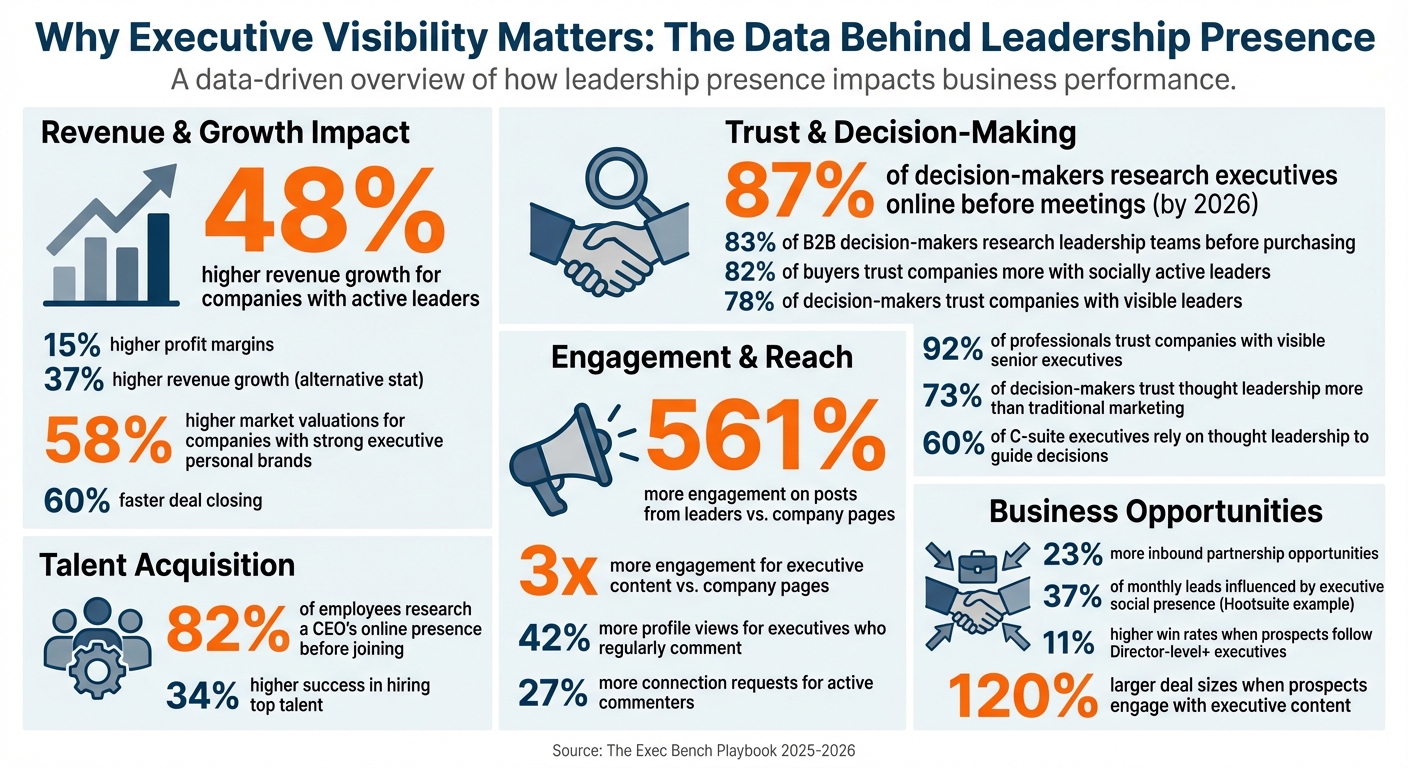
Executive Visibility Impact: Key Statistics for B2B Leadership
Step 1: Audit Your Leadership Team's Current Visibility
Take a close look at your leadership team's online presence. This step helps you see what buyers, candidates, and partners find when they search for your executives.
Review Existing Executive Platforms
Start by identifying where your executives are already visible. LinkedIn should be a priority since it’s the top platform for B2B executive visibility. Check that their LinkedIn profiles are up-to-date with professional headshots, compelling headlines, and Creator Mode turned on. Then, Google their names to spot any inaccuracies - research shows that 53% of CEOs without a social media presence deal with inconsistent profiles.
Expand your review beyond LinkedIn. Look at earned media appearances in outlets like Forbes or Bloomberg, past speaking engagements at industry events, and any owned content, such as blogs or podcast guest spots. For example, in early 2026, a fintech founder working with OBA PR built a strong presence through Forbes articles and conference speaking engagements. This visibility shifted investor perceptions and cut their Series A fundraising timeline from six months to just eight weeks.
Quality matters more than quantity. A whopping 92% of professionals trust companies with visible senior executives. Dive into comments from key accounts and peers to ensure the engagement is meaningful and not just surface-level chatter.
Once you’ve mapped out where your executives are active, the next step is to ensure their messaging aligns with your brand.
Check for Messaging Consistency
After identifying your executives' platforms, assess if their messaging reflects your company’s narrative. Review their last 20 posts to see if they offer unique insights or simply repeat corporate updates. Keep in mind that 71% of decision-makers say less than half of the thought leadership content they see delivers useful insights. Your executives need to stand out with content that’s more than just PR fluff.
Be on the lookout for "strategic drift" - when leadership messaging feels fragmented or out of sync. The most effective executive presence strikes a balance between personal expertise, genuine passion, and alignment with your company’s mission. A great example is General Motors CEO Mary Barra, who in 2025 combined high-profile features in the Wall Street Journal with personal, relatable content like behind-the-scenes moments with interns. This approach reached an audience of 20 million in just six months.
To keep messaging on-brand while maintaining authenticity, set clear "guardrails." Define "red lines" (e.g., confidential financials, unannounced products) and "yellow lines" (e.g., political opinions, competitor mentions) to avoid potential missteps. This ensures your executives stay aligned with the company’s values while still being relatable and engaging.
sbb-itb-9354cf2
Step 2: Create Executive Positioning and Narratives
Once you've assessed your leadership team's visibility, the next step is crafting narratives that highlight each executive's strengths. These stories should not only showcase their expertise but also align seamlessly with your company's brand, creating messaging that resonates with your audience.
Identify Each Leader's Expertise
Begin by categorizing your executives into archetypes that reflect their natural abilities. For instance:
- The Visionary: Focuses on future trends and the industry's direction.
- The Operator: Shares tactical strategies and actionable frameworks.
- The Analyst: Delivers insights grounded in data and analytics.
- The Evangelist: Advocates for innovation and fresh approaches.
- The Insider: Offers seasoned perspectives based on years of experience.
To pinpoint each leader's unique perspective, use the formula: "Most people in [industry] think [X], but I believe [Y] because [Z]." This method helps uncover contrarian insights that stand out in a crowded space. Considering that 82% of B2B buyers expect unique points of view and only 15% of thought leadership meets quality standards today, this approach can make your executives' content more impactful.
Capture each executive's unique frameworks and methodologies by scheduling short monthly sessions - 15 to 30 minutes - where they share raw insights on specific topics. These sessions serve as the foundation for authentic and engaging content. Align their expertise with their functional roles: CEOs tackle peer-level business challenges, CFOs address financial audiences, and CTOs engage technical communities. From there, establish 3–5 key content pillars for each leader, balancing their focus as follows:
- 40% on core expertise
- 30% on industry trends
- 20% on leadership and culture
- 10% on personal journey
Once their expertise is documented, weave it into your company's broader positioning to create a cohesive and repeatable narrative.
Align Individual Narratives with Company Positioning
For consistency, each executive's narrative should support a unified worldview, even when addressing different topics. Develop a concise "thirty-second thesis" for each leader - a single, memorable sentence that encapsulates their professional identity. For example: "We help legacy manufacturers regain margin by turning field data into prescriptive maintenance." This type of statement becomes the cornerstone of their public messaging.
Balance their content using the 70-20-10 framework:
- 70%: Industry insights and analysis
- 20%: Company perspective and experience
- 10%: Personal reflections
This approach ensures the narratives remain valuable and avoid sounding overly promotional.
"Your CEO's podcast episode, your product marketer's webinar, and your campaign landing page don't all need to say the same thing, but they should all pull from the same worldview."
Focus on defining high-level themes and content pillars rather than micromanaging every post. This allows each executive to maintain their authentic voice while staying aligned with the brand. Additionally, map these narratives to specific personas by identifying the outcomes that matter most to your buyers, hidden evaluators, and potential talent. Then, attach proof points from your executives that address these priorities. This is especially important given that 83% of B2B decision-makers research leadership teams before making a purchase. When they do, they should find narratives that speak directly to their concerns.
Step 3: Use LinkedIn to Build Executive Presence
LinkedIn has evolved far beyond being a digital resume - it's now a powerful platform where content from executives gets three times the engagement compared to identical posts from company pages. With 87% of business decision-makers researching executives online before meetings, a strong LinkedIn presence for your leadership team can directly influence deal opportunities, hiring efforts, and trust in your brand. Authenticity trumps corporate polish here. Let’s break down how to create a content strategy, drive engagement, and use video to elevate executive presence on LinkedIn.
Build a LinkedIn Content Strategy
Start with clear goals. Each executive's LinkedIn activity should tie back to specific business objectives - whether that's attracting top talent, establishing thought leadership, or warming up potential clients. From there, identify 2–4 core content areas where each leader can genuinely contribute. For instance, a CEO might focus on industry trends and company vision, while a CTO could share insights on technical advancements and product strategy.
Fresh ideas are key. 89% of decision-makers say thought leadership improves their view of an organization, but only when it offers something new rather than rehashing common industry topics. Use a 70/15/10/5 approach for content: 70% industry insights, 15% personal experiences, 10% company updates, and 5% engagement prompts. This mix ensures your content stays relevant without feeling overly promotional.
Consistency beats volume. Instead of churning out daily posts, aim for 1–3 high-quality updates per week. To make this manageable for busy leaders, simplify content creation by recording quick voice memos about client interactions or industry trends. Tools like Otter.ai or Rev.com can transcribe these into structured LinkedIn posts. This method keeps the leader's authentic voice intact without requiring them to draft posts from scratch.
Once your strategy is set, amplify its reach by actively engaging with your LinkedIn network.
Set Up Engagement Workflows for Audience Growth
Posting is just the start. Executives who regularly comment on industry content get 42% more profile views and 27% more connection requests than those who only post their own updates. LinkedIn rewards active participation, and thoughtful comments on others' posts can attract the attention of your target audience.
Commit to a daily 30-minute routine: spend 5 minutes scanning your feed, 10 minutes commenting on posts from industry peers or prospects, and 15 minutes responding to comments on your own posts within two hours to boost LinkedIn's algorithm. Engaging with 10–20 posts daily can boost visibility by 50% and increase engagement by 10%.
Be strategic with your interactions. Focus on posts from top clients, key prospects, influential industry voices, and strategic partners. After establishing rapport through public interactions, take it private. By week three of consistent engagement, send direct messages to five contacts you’ve connected with to explore collaborations, such as podcast features or webinar partnerships. This approach turns public visibility into meaningful business relationships.
"At its best, social media is a telephone, not a megaphone. The executive should be a participant, not just a performer."
Use Video Content on LinkedIn
Video content can supercharge your LinkedIn presence. Videos generate 1.4 times more engagement than other formats and are shared 20 times more often than text posts. Upload videos directly to LinkedIn for maximum reach. The best part? Authenticity matters more than flashy production. Smartphone videos often outperform polished corporate clips because they feel more relatable.
Keep videos short and mobile-friendly. Videos under 15 seconds have a 57% completion rate, and LinkedIn’s vertical video feed favors content under 60 seconds. Since 75–85% of social media videos are watched without sound, always include captions using tools like CapCut, Rev, or LinkedIn’s built-in captioning tool. Start with a 2-second hook, deliver a clear message, and finish with a call to action.
Take advantage of LinkedIn Live. Live broadcasts get 7 times more reactions and 24 times more comments than pre-recorded videos. Use Live for Q&A sessions, panel discussions, or streaming events. Combining engaging video content with active participation creates a momentum loop that significantly boosts an executive's visibility on the platform.
Step 4: Build a Scalable Leadership Content Engine
Executives rarely have the bandwidth to churn out weekly blog posts. Instead, create a system that turns one high-quality input into months of content. By building on your strategies for individual presence, this engine amplifies leadership visibility across all platforms. Think of your marketing team as the "producer" and your executives as the "talent." The producer takes care of research, content briefs, and distribution, while the executive provides insights and personal anecdotes. This setup ensures top-notch content without overwhelming your leadership team. It also complements your LinkedIn efforts by maintaining a steady stream of high-quality posts.
Choose the Right Content Formats for Thought Leadership
Not every content format resonates equally with B2B buyers. Original research - like surveys or benchmark reports - stands out because it offers exclusive data that competitors can't mimic. In fact, 58% of B2B buyers say they choose vendors who publish original research. While creating research reports takes time, using a mix of formats ensures you're engaging buyers at every stage of their journey.
Here’s a breakdown of effective formats:
| Format | Best Stage of Buyer's Journey | Primary Benefit | Recommended Cadence |
|---|---|---|---|
| Original Research | Awareness | Media attention, exclusive data, high authority | Annual |
| White Papers/Guides | Consideration | Solves problems, helps vet vendors | Quarterly |
| Webinars | Consideration/Decision | Interactive, humanizes the brand, captures leads | Monthly |
| LinkedIn Posts | All Stages | Builds visibility and relationships | 3–5x per week |
| Short Videos | Awareness | Engaging; boosts landing page conversions by 80% | Weekly |
| Case Studies | Decision | Offers proof of success and credibility | Ongoing |
For busy executives, the "anchor asset" approach works wonders. Focus on one major piece each quarter - such as a research report, webinar, or white paper - and use it as the foundation for other content. For instance, a 45-minute CEO interview can yield 4–6 blog posts, a gated deep-dive document, an FAQ article, an email series, and over 10 LinkedIn assets like polls and quote graphics. This strategy maximizes output from a single idea while minimizing executive involvement.
"One good idea, multiple outputs. You don't need more ideas. You need a better flywheel."
Keep executives involved only for a focused input session and a final review for accuracy. The marketing team handles the rest - transcribing, drafting, and formatting. Tools like transcription software can turn voice notes or meeting recordings into raw material, saving leadership time.
Distribute Content Across Multiple Platforms
Having a content engine is just step one. The next challenge? Making sure your insights reach the right audience through effective distribution. Start with LinkedIn, where executive profiles consistently outperform company pages - engagement is 2–3x higher, and reach can be up to 8x greater. From there, repurpose your anchor content for email newsletters, your company blog, YouTube, and podcasts to expand your reach.
Take OneIMS as an example. For their "Coffee with Closers" podcast, they interviewed entrepreneur Mike "C-Roc" Ciorrocco. That single conversation became an SEO-optimized blog post, a social media image carousel, a newsletter feature, a full YouTube video, and multiple LinkedIn posts. In essence, one interview turned into weeks of content spread across multiple channels.
Tailor your distribution to where your audience spends time. If they subscribe to industry newsletters, transform a webinar into a detailed email series. If they’re active on LinkedIn, break a white paper into a five-part post series with visuals. The goal is to make your content accessible in formats your audience prefers.
"Making it quick and easy to absorb is cited by decision makers as the No. 1 way to make thought leadership content more valuable."
Here’s a pro tip: share an internal version of your marketing newsletter with employees. When your team sees what executives are publishing, they’re more likely to share it within their own networks, boosting your organic reach without adding to your ad budget.
Step 5: Increase Visibility Through Speaking and Events
Speaking engagements offer a level of validation that owned content simply can’t match. When your CEO is invited to speak at an industry conference or by a trade association, it’s a clear signal that their expertise is respected and worth showcasing. This kind of credibility carries more weight than any blog post or LinkedIn update. In fact, 73% of executives believe thought leadership is a more trustworthy way to assess a company’s capabilities than traditional marketing materials.
The value of a single speaking event doesn’t stop at the podium. It can generate weeks of content - blog posts, social media clips, and more - that keeps the momentum going. Plus, it puts your leadership team in front of potential investors, partners, and customers they might not otherwise meet.
Position Executives for Speaking Engagements
To land speaking opportunities, your executives need to look the part online. Make sure their LinkedIn profiles and other platforms reflect their credentials as speakers. Create a professional speaker kit that includes:
- A detailed bio and a short version (under 100 words)
- High-resolution headshots
- A list of 3–5 presentation topics
- Video clips of past talks
- Testimonials from previous events
Event organizers are more likely to choose speakers with a strong online presence, consistent LinkedIn activity, published articles, and a clear perspective on industry trends. A polished speaker kit simplifies the decision for conference planners.
Timing is everything when pitching speakers. Large conferences typically book 6–10 months in advance, while local events plan closer to 2–6 months out. Submitting early gives you an edge - being first on an organizer’s desk can increase your chances of securing a prime slot.
"The early bird truly does get the worm. Be meticulous in your applications and aim to be first on the organizer's desk."
Your pitch should focus on the audience, not just your executive’s resume. Use a subject line that highlights the value they’ll provide, like “Speaker Proposal: AI Implementation Strategies for Enterprise Security,” instead of a generic request. Clearly outline the problem your executive will address and the actionable takeaways attendees will gain.
Warm introductions can make all the difference. If you have connections through a PR agency or professional network, leverage them to introduce your executive to event organizers. If not, try reaching out via LinkedIn DMs or even sending physical branded mailers to stand out in a crowded digital space.
Finally, align the speaking format with your executive’s strengths. Confident, polished speakers may thrive in keynote roles, while conversational leaders might excel in fireside chats. Panels, on the other hand, are a great entry point for executives new to public speaking, as they require shorter, more concise contributions.
Get the Most Out of Events
To maximize the impact of each event, focus on building connections and capturing content. Engage with other speakers and organizers ahead of time, and ensure you have high-quality video and photos from the event for future use. These connections often lead to more opportunities down the line.
After the event, follow up quickly. Respond to attendee questions, exchange contact information, and send follow-up messages within 48 hours. Share your presentation slides on LinkedIn, write a blog post summarizing the session, and send personalized thank-you notes to organizers to strengthen those relationships.
Don’t underestimate the power of smaller, more focused gatherings. Executive dinners or roundtables with 15–25 participants often lead to deeper, more meaningful connections than larger conferences. These settings encourage real dialogue rather than one-way presentations.
"Executives contribute when they're part of a conversation, not an audience."
Lastly, measure the results. Track the number of inbound leads, demo requests, or partnership discussions that come from each speaking engagement. If a specific type of event proves successful, prioritize it. If another format falls flat, adjust your approach accordingly.
Step 6: Align Sales and Marketing Teams Around Executive Visibility
To make executive presence impactful, sales and marketing must work hand-in-hand. When these teams are out of sync, even the most insightful executive posts can backfire. Imagine your CEO sharing a thoughtful LinkedIn post about a market trend, only for your sales team to contradict it during a discovery call. Or your marketing team promoting content that sales reps aren’t even aware of. This kind of misalignment can confuse prospects and derail efforts. Companies that align their sales and marketing teams effectively are almost 3x more likely to exceed new customer acquisition goals.
The solution? Shared accountability. Assign someone to bridge the gap - whether it’s a Head of CEO Content or a RevOps Director. In fact, 32% of companies report that having a liaison role spanning both teams is their go-to strategy for alignment. Marketing can also tap into sales as a goldmine of insights. Regularly interview sales reps to uncover objections, pain points, and recurring questions they hear from prospects. These insights can shape executive posts that tackle real buyer challenges head-on. When executives address the same issues sales teams face daily, their content becomes far more impactful than generic thought leadership.
To ensure this alignment pays off, establish clear performance metrics that both teams can track.
Set Up Shared KPIs and Dashboards
Measure executive visibility with both leading and lagging indicators. For example, track metrics like Share of Voice on key themes (leading) and pipeline value or win-rate improvements (lagging).
In 2024, TechNexus Venture Collaborative implemented a measurement framework for their thought leadership efforts. The results? A 100% increase in inbound leads tied to marketing content and a 50% jump in meetings booked. Dan Fogarty led this initiative, focusing on boosting deal flow and partnerships through executive visibility.
"The best single KPI is usually pipeline influenced, but only when paired with deal velocity or win-rate lift to show it's not just correlated engagement - it's changing outcomes."
To connect content to results, tag executive posts, webinars, and newsletters as campaign activities in your CRM. This allows you to track how leadership engagement influences opportunities as they move through the pipeline. Don’t overlook "dark social" signals either - like prospects mentioning an executive’s post during a discovery call. Train sales reps to ask, "What shaped your thinking before this call?" to capture these insights.
| KPI Category | Specific Metric | Business Outcome |
|---|---|---|
| Pipeline | Content-Influenced Revenue | Direct ROI and attribution |
| Efficiency | Sales Cycle Velocity | Reduced time-to-close |
| Quality | Lead Quality Score | Higher fit prospects and better conversion |
| Authority | Share of Voice (SOV) | Market presence and category leadership |
| Trust | Discount Rate Reduction | Increased pricing power and buyer trust |
With performance metrics in place, focus on ensuring consistent messaging across teams.
Maintain Consistent Messaging Across Teams
For executive thought leadership to succeed, sales and marketing must align on the same core narratives. Equip your teams with enablement kits - think briefings, slide decks, and Slack-ready talking points - that reinforce the 3–4 key content themes for each leader. These "brand pillars" act as guardrails to keep messaging consistent. Assign specific topics to different executives: for instance, your CEO could focus on the company’s vision, the CTO on innovation, and the CMO on market trends. This avoids overlap and ensures each leader has a clear, distinct voice.
"Marketing and sales alignment happens when teams have fluid dialogue and agreement around messaging and strategy."
Create feedback loops between sales and marketing to refine messaging based on what resonates with prospects. Since 82% of B2B buyers expect vendors to offer unique insights rather than generic marketing fluff, your messaging must reflect the expertise of your executives. And both teams need to deliver it in lockstep for maximum impact.
Step 7: Measure and Improve Executive Visibility Efforts
Once you've aligned your teams and set common KPIs, it's time to gauge the impact of your efforts. The challenge? Proving executive influence in a world where 83% of a buyer's journey happens during independent research - long before they ever reach out to you. Much of this influence takes place in spaces like LinkedIn or other "dark social" channels, where interactions leave little to no digital trail.
To measure success, shift your focus from vanity metrics to indicators of true influence. As Mark Anthony Karam, Senior Content Manager at Prestidge Group, explains:
"Popularity is 'I average 7,000 impressions on my posts on LinkedIn.' Influence is 'John changed how he did [action] because of something I shared on LinkedIn.'"
This distinction is critical because 60% of C-suite executives rely on thought leadership to guide their decisions, and 73% of decision-makers trust thought leadership content more than traditional marketing. Your measurement framework must capture this trust-building process instead of just tallying likes or impressions.
Track Key Metrics for Visibility Impact
To assess visibility, break metrics into three categories: Perception, Interest, and Revenue. Here’s how each plays out:
- Perception: Measure share of voice on key topics and profile views from your ideal customer profile (ICP).
- Interest: Track connection requests from ICPs and the quality of comments - thoughtful discussions outweigh simple likes.
- Revenue: Focus on metrics like the pipeline influenced by executive content, win rate improvements, and faster deal cycles.
For example, in early 2025, Hootsuite CEO Irina Novoselsky generated over 10 million LinkedIn impressions in three months. Her team found that 37% of monthly leads were influenced by her social presence, and deals closed faster when buyers mentioned her content. Similarly, at Sendoso, former SVP of Marketing Kacie Jenkins discovered that prospects following Director-level executives or higher on LinkedIn resulted in 11% higher win rates and 120% larger deal sizes.
To gather insights, add a "How did you hear about us?" field to inbound forms and encourage sales teams to ask prospects directly during discovery calls. Peep Laja, CEO of Wynter, uses this tactic and found that 80% of signups or demo requests specifically mentioned his LinkedIn content.
"If 20%+ of your pipeline mentions your content, you've won."
Before scaling, establish a 90-day baseline to track metrics like pipeline velocity, win rates, and branded search volume. Tag executive content in your CRM to monitor conversion rates, sales cycle duration, and revenue impact. Use cohort analysis to pinpoint which themes lead to quicker deals or larger contracts.
Adjust Based on Performance Data
Once your baseline is set, implement a 30-60-90 day review cycle for ongoing optimization. Here's how to structure it:
- First 30 days: Define and track your metrics.
- Days 30–60: Identify influence on specific cohorts.
- Days 60–90: Link themes to revenue outcomes.
Monthly reviews help you identify underperforming topics and pivot quickly. For instance, compare sales opportunities where prospects engaged with executive content against those where they didn’t. This analysis shows whether your efforts are speeding up sales cycles or boosting deal sizes.
At TechNexus Venture Collaborative, consultant Dan Fogarty helped the firm implement a similar framework, leading to a 100% increase in inbound leads from marketing content and a 50% improvement in meeting efficiency.
"Without KPIs tied to business objectives, thought leadership remains an unproductive art project."
Drill down further by evaluating performance at the theme level. If posts about AI governance consistently attract qualified leads while market trend posts don’t, double down on AI governance and retire less impactful topics. LinkedIn’s analytics can also reveal whether your audience matches your ICP - if not, tweak your strategy.
To amplify success, identify high-performing organic posts and use Thought Leader Ads to scale them to a larger audience. Startups with active LinkedIn directors see 33% more leads from paid campaigns, and LinkedIn Thought Leader Ads deliver 1.5x higher click-through rates and 5x higher video engagement compared to standard sponsored ads. These adjustments can solidify executive authority while driving measurable business outcomes.
Conclusion: Turn Executive Visibility Into a Competitive Advantage
Executive visibility isn’t just a buzzword - it’s a powerful tool that can accelerate deals, build trust, and attract top talent. The numbers back it up: 82% of buyers trust a company more when its executives are active on social media, and companies with visible leaders see 37% higher revenue growth. In a world where 83% of decision-makers check out executives online before meetings, having a strong leadership presence online is no longer optional - it’s essential.
This guide offers a system you can rely on to establish long-term authority. Unlike ad campaigns that stop delivering the moment you cut the budget, executive visibility creates lasting benefits, from recruiting to closing deals. Companies with executives who cultivate strong personal brands enjoy 58% higher market valuations and close deals 60% faster. These steps lay the groundwork for staying ahead of the competition.
Key Takeaways You Can Implement Now
Action is everything. Start with these three steps:
- Clarify your message: Craft a 30-second thesis that captures your unique perspective and speaks directly to your audience.
- Optimize your LinkedIn profile: Highlight your expertise (e.g., "Scaling B2B SaaS") instead of just listing your job title. Use the "About" section to tell your leadership story.
- Adopt a 30-minute daily strategy: Spend 15 minutes engaging with relevant posts and set aside 1–2 hours weekly to write 2–3 original posts.
Streamline your approval process to speed up low-risk content while reserving legal reviews for sensitive material. Focus on sharing proof-based content, like decision memos or lessons learned, to establish instant credibility. Consistency is the name of the game - posting 2–3 times a week works better than sporadic bursts of activity.
The Long-Term Value of Leadership Visibility
"Thought leadership is not an HR vanity project; it's a commercial lever."
Over time, a thoughtful approach to executive visibility delivers real results. As highlighted earlier, content shared by executives gets three times more engagement than the same content shared by company pages. This translates into 34% higher success in hiring top talent and 23% more inbound partnership opportunities. In today’s AI-driven world, where generic content is everywhere, an executive’s genuine voice becomes a beacon of quality that sets your company apart.
Think of executive visibility as a long-term investment, not a one-off campaign. Assign someone to manage the process, stick to a repeatable framework (Position, Pillars, Proof, Distribution, Conversion), and focus on 3–5 core themes over time. Leaders who commit to this now won’t just close more deals - they’ll shape the future of their industries and influence how decisions are made.
FAQs
Which executives should we spotlight first?
Start by identifying senior leaders who can genuinely represent your company’s expertise and vision. Look for executives with established industry reputations, an active presence on social media, or a readiness to engage with the public. Focus on individuals who can offer genuine insights, strengthen credibility, and motivate others. CEOs or other C-suite leaders who frequently produce thought leadership content or take part in speaking events are often excellent choices.
How do we keep exec posts authentic but on-brand?
To create executive posts that feel both real and aligned with the brand, focus on blending personal insights with professional expertise. Sharing genuine experiences and perspectives helps establish trust and shows the leader’s authenticity.
At the same time, it’s important to ensure the content reflects the company’s values. Keeping a consistent brand voice while staying true to the leader’s personality can strike the right balance. A clear framework can help guide this process, ensuring the messaging stays on point while supporting broader strategic goals.
How can we tie executive visibility to revenue?
Tying executive presence to revenue involves demonstrating how leadership visibility influences business results. When leaders share their expertise, it builds trust and strengthens credibility, which can accelerate pipeline growth and shorten sales cycles. By using attribution models to measure ROI and syncing leadership insights with marketing strategies, businesses can link visibility efforts to tangible metrics like deal progression and revenue generation. This transforms executive visibility into a measurable force contributing to the company's bottom line.