The Executive Activation Plan: Turning CEO Insight Into Repeatable Campaigns

The secret to standing out in B2B marketing? Put your CEO front and center. This guide breaks down how to turn your CEO’s expertise into a repeatable system that drives real business results - faster sales cycles, bigger pipelines, and higher pricing power. Here’s the playbook:
- Capture CEO insights: Use interviews, meetings, and voice memos to gather ideas without wasting their time.
- Turn insights into themes: Focus on 3–5 key topics your CEO knows deeply and create content around them.
- Build LinkedIn presence: Optimize their profile, grow the right audience, and post consistently (8–12 times a month).
- Design campaigns: Use sequenced posts, event-based strategies, and direct outreach to spark conversations.
- Measure results: Track metrics like pipeline influenced, deal velocity, and win rates to see what’s working.
The numbers don’t lie - executives have 4x the LinkedIn reach, and CEO-led campaigns can outperform traditional marketing by a mile (147 leads vs. 12, $420K pipeline vs. $38K). With tools like RevBoss, you can scale this system without overwhelming your team or your CEO. Ready to turn your CEO into a revenue-driving force? Let’s dive in.
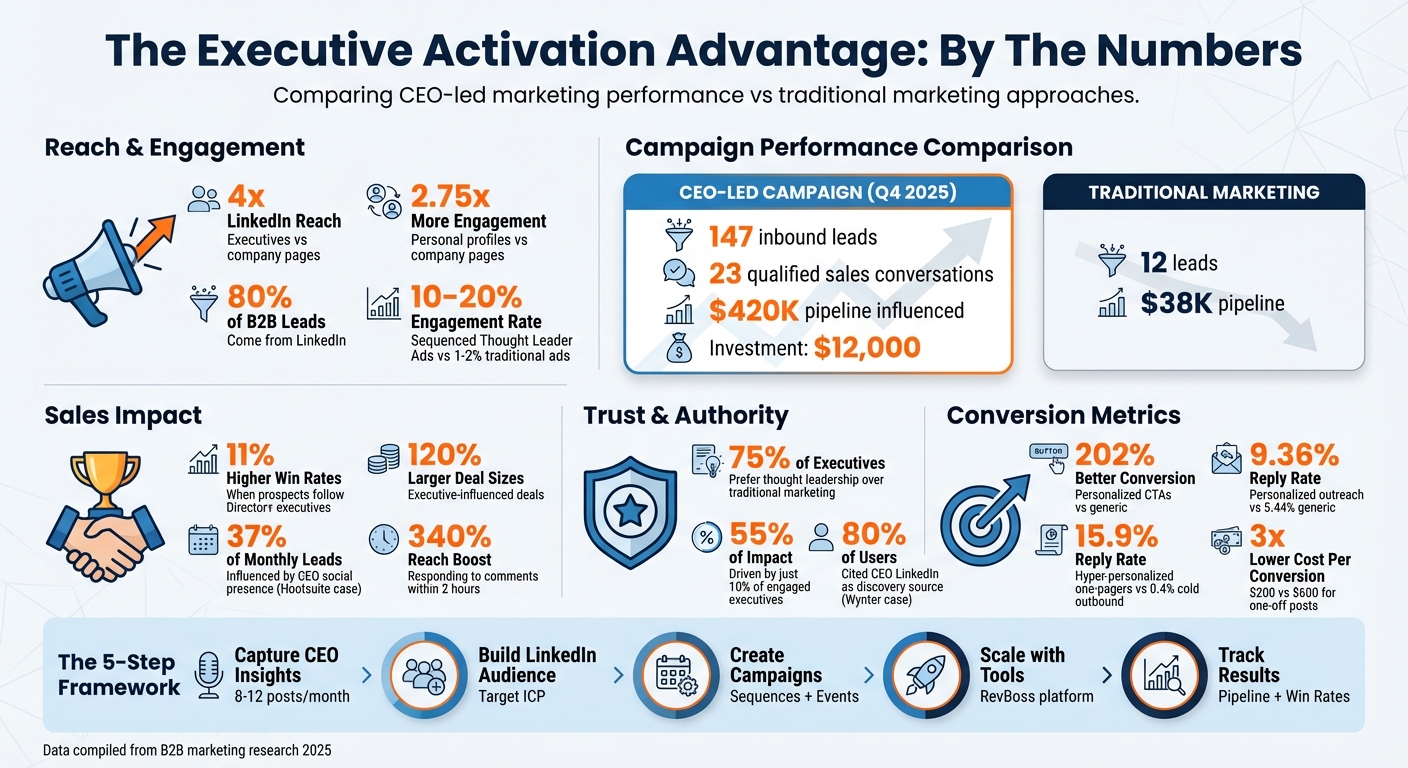
CEO-Led Marketing Performance Metrics and ROI Comparison
A Marketing Director’s Playbook to Getting Her CEO Posting on LinkedIn
sbb-itb-9354cf2
Step 1: Turn CEO Knowledge Into Content
Getting your CEO's insights into content form without eating up their time can be tricky. Most executives won't sit down to write a blog, but they’re usually happy to share thoughts they’re already discussing. The key? Work with what you’ve got - tap into their existing conversations and commitments instead of starting from scratch.
Capture Insights Through Interviews and Recordings
Start by mining your CEO's daily interactions - calls, meetings, or negotiations are goldmines for fresh perspectives. These moments often reveal insights that are tough to replicate elsewhere. Set up a Slack or Teams channel for quick notes and aim for a monthly 30–45 minute interview to gather their best stories. During these sessions, comb through their calendar together. Look for moments like hiring decisions that highlighted blind spots, customer feedback hinting at market changes, or debates over product direction that clarified strategy. Even quick voice memos after key events can capture invaluable insights while they’re still fresh.
Take a page from Will Fuentes of Maestro Group, who used this approach to gather insights in just 1.5–2 hours weekly. The result? Four LinkedIn posts a week, generating 2–3 qualified enterprise leads and one post hitting 150,000 views.
"The reality is if you are open to learning, there are a lot of lessons being taught, whether it is in the business world, at your son's game, or your daughter's game. You just have to be open to accept them and then connect them."
Once you’ve captured these insights, the next step is to organize them into a clear strategy.
Organize Insights Into 3-5 Core Themes
Take all those raw insights and shape them into structured campaigns. Focus on 3–5 recurring themes your CEO can confidently speak to over time - these will be your content pillars. The best themes tackle tough, high-stakes challenges where standard advice falls short, like navigating pricing during budget cuts, managing burnout, or hiring in a tight labor market.
Align these themes with your CEO’s strengths. For example:
- Category Leadership: Defining the market and setting trends.
- Execution Leadership: Sharing strategies for operational efficiency.
- People Leadership: Discussing culture and team-building.
Keep a running list of 10–20 subtopics for each theme to avoid repetitive content. You can even use AI tools to sift through interview transcripts and cluster insights into logical groups like pricing, team dynamics, or ethics.
For each theme, try a simple positioning framework:
- Enemy: The outdated mindset holding the industry back.
- Promise: A vision of what’s possible.
- Mechanism: Your CEO’s unique approach to achieving that vision.
A good rule of thumb? Use the "dinner test." If your CEO wouldn’t say it at dinner, it shouldn’t be a core theme. Executives trust thought leadership more than traditional marketing, with 75% preferring it, and over half of B2B marketers plan to boost their investment in this area by 2025 to build trust and authority.
Produce 8–12 LinkedIn Posts Per Month
With your themes nailed down, you’re ready to create a steady flow of content. Aim for 3–5 posts per week and batch them for a quick 10–15 minute review from your CEO. This system keeps things efficient while delivering consistent thought leadership, which can shorten sales cycles, justify premium pricing, and strengthen your brand.
Mix up your content to keep it engaging. Rotate through categories like:
- Industry Vision: Bold takes on where the market is headed.
- Behind the Scenes: A peek into the day-to-day of running the business.
- Lessons Learned: Sharing missteps and wisdom gained.
- People & Culture: Insights on hiring and company values.
- Customer Stories: Trends and patterns observed in the market.
Consider creating a "flagship" piece each month, like a long-form article or memo. Break it into smaller pieces for LinkedIn posts to stretch its impact.
Don’t underestimate the power of a strong hook. On LinkedIn, grab attention with a sharp opening line and wrap up with a question to spark engagement. Stats back this up - 10% of engaged executives drive 55% of their company’s employee advocacy, and a CEO can generate as much reaction as a company page with just 1.67% of its follower count. Plus, much of the real impact happens in "dark social", where prospects quietly absorb content before reaching out - so focus on the quality of conversations, not just likes.
Step 2: Build Your LinkedIn Audience
Once your content pipeline is flowing, the next step is ensuring it reaches the right people. Even the most insightful posts from your CEO won’t deliver results if they’re landing in front of the wrong crowd. Building a LinkedIn network isn’t about amassing random connections - it’s about forming strategic relationships with the people who genuinely need what you offer.
Define Your Ideal Customer Profile (ICP)
Before your CEO starts hitting that “Connect” button, you need to define exactly who you’re trying to reach. Start by analyzing your top 5–10 customers. Look at the ones who bring in the most revenue, close deals quickly, and are loyal advocates. What do they have in common? Pay attention to factors like company size, industry, location, and even the tools they rely on for their business. This process helps you zero in on companies that are a perfect fit - not just ones that might work.
Next, identify the triggers that indicate a company is ready to buy. Examples include recent funding announcements, new leadership hires (like a VP of Sales), or regulatory shifts that create urgency. Keep in mind that B2B decisions often involve 6–10 stakeholders, so it’s important to map out the entire buying committee. Focus on key roles like the Champion (your internal advocate), the Economic Buyer (the one holding the purse strings), and the Technical Buyer (the person evaluating feasibility).
Don’t stop there - create a negative ICP as well. This helps avoid wasting time on prospects who aren’t a good fit, such as solopreneurs or companies that fall below your minimum budget threshold. With B2B sales cycles often stretching beyond a month - and sometimes up to 18 months - targeting the right accounts from the start is essential.
Once you’ve nailed down who you’re targeting, it’s time to focus on how to convert those connections into real advocates.
Grow and Engage Your LinkedIn Network
Your CEO’s LinkedIn profile isn’t just a digital resume - it’s a landing page designed to convert. Start by optimizing the headline to highlight value, like “Helping [specific audience] achieve [specific goal],” instead of simply listing a job title. Profiles with professional photos get 21x more views, so invest in a high-quality headshot. The “About” section should tell a compelling leadership story, emphasizing results and impact over responsibilities.
Building relationships on LinkedIn requires consistent, thoughtful engagement. Use the 5-5-5 Rule: spend 15 minutes daily - 5 minutes leaving meaningful comments, 5 minutes replying to comments on your posts, and 5 minutes sending personalized connection requests. Avoid generic reactions like “Great!” or “Nice post!” - they add no value. Instead, craft comments that are 2–3 sentences long and either share a perspective or ask a thoughtful question.
When sending connection requests, personalization is key. Generic messages see a 5.44% reply rate, while personalized ones jump to 9.36%. Take it a step further by engaging with someone’s content for a couple of weeks before sending a request. This warms up the connection and significantly improves your chances of acceptance.
"Marketing isn't about fishing for leads anymore. In 2026, it's about owning the map, being visible everywhere AI and humans make decisions."
LinkedIn dominates B2B social media, driving 80% of leads in this space. Personal profiles, in particular, generate 2.75x more reach than company pages. Focus on creating small, tight-knit groups of aligned voices. Engage with posts that your target decision-makers are reading, and let LinkedIn’s relevance algorithms amplify your reach.
Step 3: Create Campaigns That Drive Conversations
Once you've established a strong LinkedIn presence, it’s time to turn your CEO’s insights into meaningful conversations that can lead to sales. The idea here isn’t to bombard your network with pitches. Instead, focus on creating campaigns that feel authentic, provide value, and naturally spark interest. Think of it as shifting gears from building visibility to fostering dialogue.
Simple Engagement Sequences
Random posts won’t cut it if you’re aiming to drive real sales conversations. Instead, use sequenced messaging to guide prospects through a natural journey: awareness (who is this?), interest (this is valuable), consideration (could this solve my problem?), and finally, action (let’s talk sales). A simple formula to keep in mind: Recognition = Reach × Frequency × Sequence.
One effective strategy is the 7-episode narrative sequence:
- Start with a problem introduction.
- Share a personal experience.
- Dive into the investigation.
- Highlight key discoveries.
- Showcase implementation.
- Reveal results.
- Wrap up with future implications.
This isn’t about posting seven times and hoping for the best. It’s about crafting a story arc that builds trust over time. Research shows that prospects often engage with content for weeks before reaching out to start a sales conversation.
"The reality is I'm taking the experiences that I'm having, whether professional or personal, and bringing that into a newsletter. It resonates enough with people to say, 'I want to talk to you.'"
– Will Fuentes, Founder and Managing Partner, Maestro Group
To amplify this approach, consider using Thought Leader Ads (TLA). Sequenced TLA campaigns outperform traditional company-branded ads, achieving engagement rates of 10–20% compared to the typical 1–2%. They also reduce the cost per conversion by three times - averaging $200 per conversion versus $600 for one-off posts. These campaigns turn your CEO’s content into a valuable tool for sales teams, helping reps re-engage cold prospects by sharing relevant posts or insights as non-intrusive touchpoints.
And don’t underestimate the power of the "invisible audience." Many high-value leads consume content silently for weeks or even months before reaching out directly. Adding a "How did you hear about us?" field to inbound forms can help capture these leads, even if they didn’t click on a post.
This structured narrative approach sets the stage for more interactive, event-driven campaigns.
Event-Based Campaigns
When done right, trade shows, webinars, and industry events can deliver huge results. The key is to create interconnected campaigns that build momentum before, during, and after the event.
Start with a hero asset - a standout piece like a research report or playbook tailored to the event. For example, in Q4 2025, a CEO launched a 90-day campaign centered on "enterprise zero-trust architecture." The campaign featured a 5,200-word playbook based on original research from 150 security leaders. By the end of Week 12, it had generated 147 inbound leads, 23 qualified sales conversations, and $420,000 in pipeline - all from a $12,000 investment.
Once you have your hero asset, repurpose it across multiple formats: create slide decks for booth discussions, break it into a blog series, design social carousels, and build email nurture sequences. Plan your campaign delivery in four stages:
- Pre-event: Focus on booking meetings.
- During the event: Amplify activity with real-time social posts.
- Post-event: Send tiered nurture sequences.
- Sustained follow-up: Share value-driven content over the next 90 days.
Tailor follow-up messaging based on engagement level. For example, booth visitors might get different messages than session attendees. Equip your sales and customer success teams with "Slack-ready" talking points tied to the event narrative. Also, responding to comments within the first two hours of posting event-related content can boost reach by 340%.
After the event buzz dies down, shift your focus to personalized outreach to convert interest into sales conversations.
Direct Outreach Through LinkedIn and Email
Direct outreach works best when it’s personal. Generic messages typically result in a 5.44% reply rate, but personalized ones can hit 9.36%.
One way to stand out is by using hyper-personalized one-pagers tailored to specific executive roles. This approach has been shown to boost cold outbound reply rates from 0.4% to 15.9%. The key is to anchor your message to the priorities of the recipient’s role - for example, addressing a CRO’s challenges versus a COO’s. Keep these one-pagers concise, explaining the value in under a minute.
Don’t limit yourself to one channel. If a prospect isn’t responding to emails but is active on LinkedIn, engage with them there. Personalized calls to action are also incredibly effective, converting 202% better than generic ones. Additionally, recording short voice notes after key meetings can capture valuable market insights, which can then be repurposed into authentic outreach material.
Step 4: Use Tools to Scale Your Campaigns
Once you've nailed your content strategy and audience engagement, the next step is scaling your campaigns. But let’s be honest - managing everything manually can get messy fast. Between gathering insights, publishing posts, tracking leads, and managing outreach, things can spiral out of control. That’s why having a centralized platform is a game-changer. It takes those scattered efforts and turns them into a streamlined, repeatable system, making scaling not just possible, but manageable.
How RevBoss Simplifies Campaign Management
RevBoss steps in as your all-in-one campaign hub, keeping everything organized and easy to track. It doesn’t just replace a bunch of tools - it connects the dots between them, creating a system that’s easy to manage and scale.
Here’s how it works: RevBoss captures insights from your CEO - without requiring hours of their time - and turns them into polished, on-brand content. It also automates audience growth, building a network filled with your ideal prospects (ICP). This way, your audience is already familiar with your executive before any outreach begins.
The platform syncs seamlessly with your CRM and calendar, automating data sharing and aligning with your sales team’s schedules. And if you’re ready to expand beyond LinkedIn, RevBoss can scale your campaigns across email newsletters and display ads, giving you a multi-channel strategy. Over the past decade, RevBoss has worked with more than 1,000 clients, earning a 4.6 rating on G2. Fun fact: nearly half of RevBoss’s own new leads now come from its content marketing efforts.
"The RevBoss app ties everything together so the work stays organized, visible, and repeatable."
RevBoss Plans and Pricing
RevBoss offers flexible plans tailored to the level of support you need. Whether you’re looking to dominate LinkedIn or expand into email marketing, there’s an option for you.
- LinkedIn Content + Audience: At $1,500/month, this plan includes weekly strategy calls, 8–12 LinkedIn posts per month, audience growth workflows, and platform access.
- Email Newsletter + Audience: Also $1,500/month, this plan focuses on bi-weekly newsletter creation, audience growth, and platform access.
- Combined Content: For $2,500/month, this integrates both LinkedIn and email into a unified workflow.
- Content + Coaching + Activation: At $4,000/month, this full-service plan covers everything - content creation, direct outreach, event campaigns, and sales offer development.
- Coaching: For founders who prefer a DIY approach, this $1,500/month plan offers weekly advisory calls on GTM strategy, campaign development, and tech stack guidance.
| Plan | Price | Key Features |
|---|---|---|
| LinkedIn Content + Audience | $1,500/month | Weekly strategy calls, 8–12 LinkedIn posts/month, audience growth workflows, platform access |
| Email Newsletter + Audience | $1,500/month | Weekly strategy calls, bi-weekly newsletter creation, growth workflows, platform access |
| Combined Content | $2,500/month | LinkedIn + Email content, integrated workflow, platform access |
| Content + Coaching + Activation | $4,000/month | Full service: content, coaching, direct outreach, event campaigns, sales offer development |
| Coaching | $1,500/month | Weekly advisory calls, GTM strategy, campaign development, tech stack guidance |
All plans are month-to-month, with discounts available for longer-term commitments. These options give founders the flexibility to scale their CEO-led campaigns without the chaos, setting the stage for tracking and refining results in the next step.
Step 5: Track and Improve Campaign Results
You've set up the system, launched the campaigns, and the content is rolling out. Now comes the crucial part - figuring out what’s actually working. Without tracking, you’re essentially guessing, which could mean wasting time and money on efforts that don’t deliver results. The good news? You don’t need to be a data wizard to monitor the right metrics. All it takes is focusing on key indicators and setting up a straightforward review process.
Metrics That Matter
Once your campaigns are live, it’s time to measure their impact. Forget vanity metrics like impressions or follower counts - they might look good on paper, but they don’t show how your efforts are driving business results. Instead, focus on metrics that tie executive visibility to measurable outcomes.
Start by tracking authority metrics, which indicate whether your CEO’s voice is gaining traction. Look at branded search lift (how often people search for your company by name), share of voice on key topics, and engagement from target accounts. These metrics reveal if your message is spreading and building awareness before prospects even enter your sales funnel.
Next, turn to efficiency metrics to see if your content is smoothing the buying process. Keep an eye on sales cycle length, MQL-to-SQL conversion rates, and whether your cost per acquisition (CAC) is dropping as prospects become familiar with your CEO’s perspective. For example, in early 2025, Hootsuite CEO Irina Novoselsky analyzed her LinkedIn activity over three months and found that 37% of monthly leads were influenced by her social presence. Additionally, enterprise deals tied to her content closed faster and had higher average contract values.
Finally, the most telling metrics are commercial metrics like pipeline influenced, win rate lift, and pricing leverage. These lagging indicators often take 60–180 days to show results. For instance, Sendoso found that when prospects followed a Director-level or higher executive on LinkedIn, win rates increased by 11%, and deal sizes were 120% larger. Similarly, Wynter CEO Peep Laja discovered that about 80% of users signing up for the platform cited his LinkedIn presence as their main source of discovery.
"If 20%+ of your pipeline mentions your content, you've won."
To capture insights traditional analytics might miss, add a field like "What prompted you to reach out?" on inbound forms or a “CEO POV referenced” checkbox in your CRM. This helps track the influence of informal conversations, Slack shares, or word-of-mouth mentions that don’t show up in click data but still drive decisions.
| Metrics | Key KPIs to Track | Purpose |
|---|---|---|
| Authority (Leading) | Branded search lift, Share of voice, Target account engagement | Measures whether the CEO’s message is gaining traction |
| Efficiency (Mid-funnel) | Sales cycle length, MQL-to-SQL conversion, CAC reduction | Tracks how content reduces friction in the sales process |
| Commercial (Lagging) | Pipeline influenced, Win rate lift, Pricing leverage | Shows direct impact on revenue and business growth |
Quarterly Campaign Reviews
Once you’ve gathered the data, it’s essential to review it regularly to fine-tune your strategy. Use these insights to figure out what’s working - and why. Quarterly reviews are a great way to ensure your CEO’s content continues to drive measurable results.
In these reviews, compare opportunities influenced by CEO content to those that weren’t. Pay attention to stage conversion rates, deal velocity, and win rates across both groups. If deals influenced by the content are moving faster through the pipeline, double down on the themes driving that engagement. On the other hand, if certain topics get lots of engagement but don’t convert, it might be time to tweak your messaging or shift your audience targeting.
During the first 30 days, establish baseline metrics like branded search volume and inbound conversion rates. From days 30–60, focus on tracking how influenced deals differ from uninfluenced ones. By days 60–90, you should be tying specific content themes to revenue outcomes. For example, in Q4 2025, a CEO with just 847 followers launched a 90-day campaign centered on "zero-trust architecture." By the end, they grew their following to 3,200, generated 450,000 impressions, and secured 147 inbound leads, 23 sales conversations, and $420,000 in influenced pipeline - all from a $12,000 investment.
Act on quick wins as soon as you spot them. If technical deep-dives are outperforming broader overviews, lean into that. If certain target accounts show high engagement but don’t convert, consider launching direct outreach or event-based campaigns tailored to them.
"The best single KPI is usually pipeline influenced, but only when paired with deal velocity or win-rate lift to show it’s not just correlated engagement - it’s changing outcomes."
The goal here is constant refinement. Each quarter, you’re optimizing: cutting what doesn’t work, doubling down on what does, and building a system that consistently turns your CEO’s voice into measurable revenue growth.
Conclusion
Transforming your CEO's expertise into a consistent, repeatable strategy can be the key to building a reliable pipeline. The real challenge isn’t coming up with ideas - it’s creating a system that works without overwhelming your team or executive. That’s where RevBoss steps in. With a decade of experience and over 1,000 clients, RevBoss has perfected a streamlined, hands-off process that requires just a single 30-minute call each week. From there, they handle everything: content creation, audience expansion, and multi-channel campaigns.
"We'll help you build a narrative and turn it into pipeline."
RevBoss’s approach ties everything together into a cohesive system. Their method revolves around three key elements: Content (engaging, trust-building posts), Connections (growing your ideal audience), and Campaigns (personalized outreach sequences). The process kicks off with a structured 30-day onboarding phase to define your CEO’s voice and messaging. From there, it transitions into a 90-day execution plan, ensuring a steady stream of impactful LinkedIn posts. The audience you cultivate through this content becomes the focus for targeted campaigns, creating a powerful cycle of engagement that leads to productive, low-friction conversations.
Executive-led marketing isn’t a quick fix - it’s a long-term play that grows in impact over time. By having your CEO lead the narrative, you can shorten sales cycles, influence key opportunities like RFPs, and even strengthen your pricing power. RevBoss makes the entire process easy with a centralized dashboard that provides weekly updates and analytics, showing exactly how executive visibility contributes to pipeline growth. If you’re ready to leverage your CEO’s insights to fuel predictable growth, RevBoss offers the tools and expertise to make it happen, empowering leaders to drive sustainable success.
FAQs
How do I capture CEO insights without taking too much time?
To gather insights from CEOs without adding to their already packed schedules, work smart by tapping into what they’re already doing. Use recordings of calls or meetings to pull out key takeaways, send them quick prompts they can respond to on their own time, or chat informally to pick up useful ideas. This way, you keep the content flowing while respecting their time.
What should my CEO post on LinkedIn if they’re not a writer?
If your CEO isn't a natural writer, they can still share valuable insights by tapping into their daily activities - things like leadership calls, customer interactions, or observations about industry trends. Tools such as ghostwriting services, content capture techniques, or even simple voice notes can transform these everyday moments into engaging LinkedIn posts. Using a clear framework helps ensure the content feels genuine and requires minimal effort, making it easier to highlight their expertise without needing to start with a blank page.
How do I tie CEO LinkedIn content to pipeline and revenue?
To link a CEO's LinkedIn content directly to pipeline and revenue, consider using a structured approach like the CEO Content Framework. This system helps transform insights into impactful assets that foster trust, generate demand, and ultimately drive sales. The key lies in delivering clear, genuine messaging through consistent, high-quality posts that tackle market trends and address your buyers' specific needs. To gauge success, track metrics like attribution and influence signals, ensuring the CEO's visibility translates into measurable pipeline growth and revenue outcomes.