The Quarterly Campaign Calendar: A Practical Pipeline Rhythm

The secret to consistent pipeline growth? A 90-day campaign calendar. Here’s the quick rundown:
- Why it works: Quarterly planning aligns with B2B buying cycles - think budget approvals, seasonal trends, and decision-making rhythms. It bridges big-picture goals with actionable steps.
- Core idea: Focus on one clear theme per quarter (e.g., Q1 = awareness, Q2 = nurturing) to avoid scattered efforts and build momentum.
- How to do it:
- Set SMART goals for awareness, consideration, and decision stages. Break them into measurable targets like MQLs, SQLs, and opportunities.
- Map out key dates (e.g., fiscal deadlines, industry events) and align campaign themes.
- Use a simple calendar to track campaigns, owners, and KPIs.
- Execute in phases: content creation, workflows, engagement, and review.
- Review metrics quarterly - adjust based on what’s converting and where gaps are.
Tools like RevBoss streamline this process with LinkedIn content, audience growth, and automation. Weekly tracking prevents surprises, while quarterly reviews ensure you’re always improving. The result? A steady, predictable pipeline that keeps you ahead.
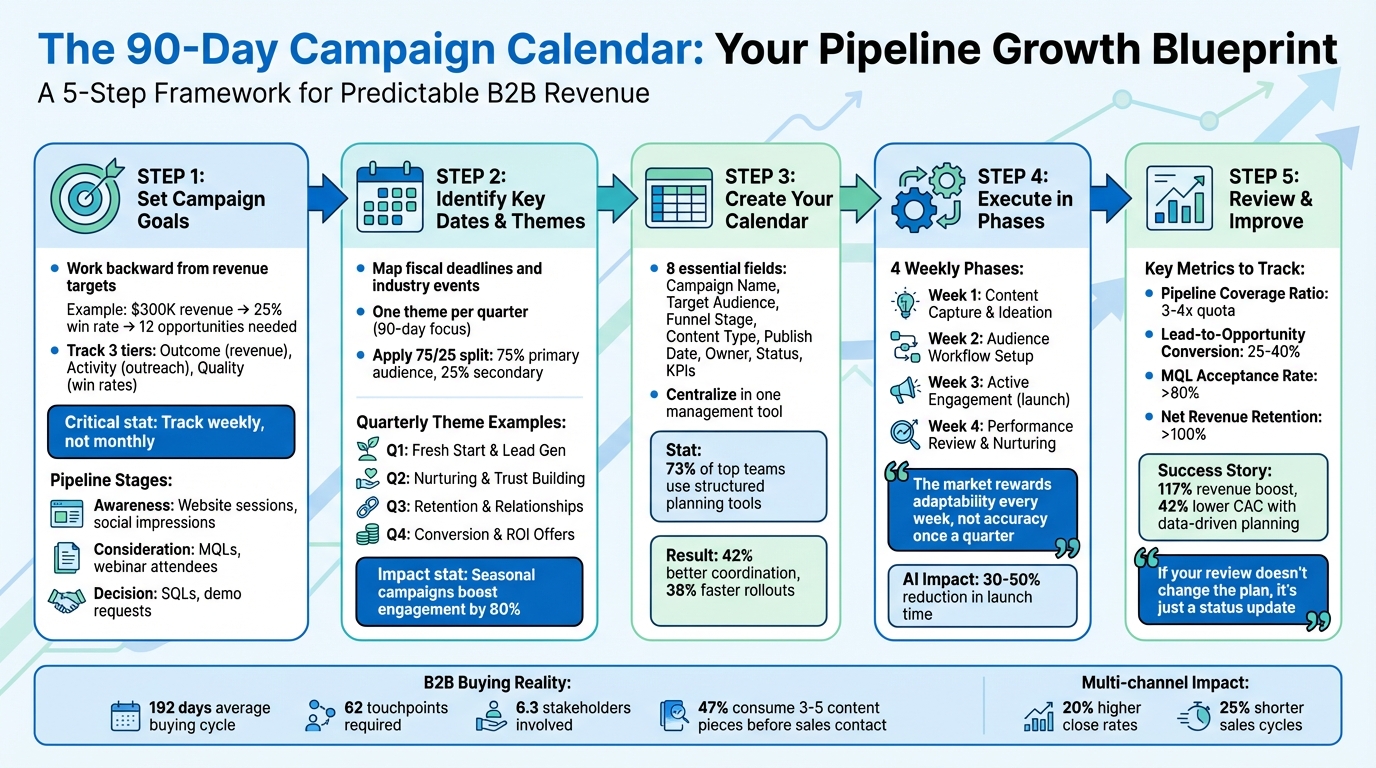
5-Step Quarterly Campaign Calendar Framework for B2B Pipeline Growth
How 90-day Marketing Plans Drive Predictable Growth in B2B
sbb-itb-9354cf2
Step 1: Set Campaign Goals for Each Pipeline Stage
To build a quarterly campaign calendar that consistently grows your pipeline, start by setting clear goals for each stage: awareness, consideration, and decision. Without specific targets, your content efforts might not deliver the results you need. As Semir Jahic, CEO of Salesmotion, aptly explains:
"If a rep can't calculate what they need to do this week to hit their quarterly number, the goal isn't actionable".
These measurable goals form the backbone of your quarterly campaign strategy.
Setting SMART Goals for Each Quarter
Start by working backward from your revenue target. For instance, if your goal is $300,000 in revenue, with a 25% win rate and an average deal size of $100,000, you’ll need 12 qualified opportunities to hit the mark. From there, calculate how many meetings are required per opportunity and how many touches it takes to secure each meeting. These activity benchmarks ensure your goals are realistic and actionable.
Organize your goals into three key tiers:
- Outcome: Focus on revenue and pipeline creation.
- Activity: Measure outreach volume and meeting bookings.
- Quality: Track win rates and deal sizes.
A great example comes from Frontify, which saw a 42% boost in sales velocity by prioritizing high-intent accounts. Instead of focusing solely on activity volume, they used signal-driven account targeting to concentrate their efforts where it mattered most.
It’s essential to track pipeline creation weekly rather than monthly. As Tate Stone, CEO of RevBlack, cautions:
"There are few things more frustrating than getting to the end of the quarter, thinking you are going to hit it, and then missing. It can sneak up on you if you are not careful".
Weekly tracking helps you identify potential revenue gaps early, giving you time to adjust before they derail your quarterly goals.
| Pipeline Stage | Goal Objective | SMART Metric Examples | RevBoss Alignment |
|---|---|---|---|
| Awareness | Build Audience | Website sessions, social impressions, new subscribers | LinkedIn Content + Audience ($1,500/mo) |
| Consideration | Build Trust | MQLs, webinar attendees, guide downloads | Educational Nurture Campaigns |
| Decision | Generate Conversations | SQLs, demo requests, proposals sent, ROI calculator usage | Founder-Led Outreach / Demos |
Matching RevBoss Programs to Pipeline Stages
Once you’ve defined your SMART goals, align the right tools and programs to support each stage of the pipeline.
The LinkedIn Content + Audience program ($1,500/month) is a great example. It supports both the awareness and consideration stages by consistently delivering content that builds authority, grows your audience within your ideal customer profile (ICP), and nurtures connections before sales conversations even begin. This approach acknowledges the reality of today’s B2B buying journey, which involves 192 days, 62 touchpoints, and 6.3 stakeholders on average.
Using a multi-channel strategy can dramatically improve outcomes. Compared to single-channel efforts, multi-channel approaches deliver 20% higher close rates and 25% shorter sales cycles. RevBoss integrates LinkedIn, email, and direct outreach to ensure your quarterly goals are met with coordinated execution. For example, Unity implemented a structured multi-stakeholder engagement strategy in 2026 and saw a 29.9% increase in win rates along with 209% larger deal sizes.
Step 2: Identify Key Dates and Campaign Themes
After setting your pipeline goals, the next step is to map out the key dates and overarching themes that will guide your quarterly campaigns. This planning shifts your efforts from being reactive to operating with purpose. Steve Phipps, CEO of Wayfind Marketing, puts it like this:
"A campaign is your 90-day theme - one audience, one problem, one focus. It's the story you're telling this quarter and the strategy behind it."
This method ensures all your initiatives work together to build momentum over the quarter. Let’s dive into how to pinpoint critical dates and craft strong campaign themes.
Finding Critical Dates and Milestones
Start by identifying fiscal and industry-specific dates that naturally push buyers to act. For example:
- Mid-January: The "Back-to-Work Week" is when companies reassess goals and consider new partnerships.
- March 31 (End of Q1): A prime time for urgency as budgets are set to expire.
- June (Mid-Year Planning): Companies often adjust their strategies and budgets at this checkpoint.
Industry events can also serve as excellent campaign anchors. For instance:
- Customer Contact Week (January 27–29, Orlando) and Sales Enablement Summit (February 11–12, Austin) provide opportunities to engage with timely insights.
- Gartner CSO & Sales Leader Conference (May 20–21, Las Vegas) offers data-backed strategies for driving revenue.
Daniel Rose, Sales Writer at Pipedrive, emphasizes the importance of planning:
"Planning ahead with a calendar helps businesses keep campaigns organized and timely so they never miss a deal."
For example, if you’re running an email campaign to capitalize on the urgency of March 31, you’ll need to prepare weeks in advance. This includes drafting copy, designing templates, and securing approvals. One agency reported cutting its sales cycle by half and boosting revenue by 133% simply by centralizing their campaign tracking.
Developing Quarterly Campaign Themes
Once you’ve identified key dates, align your campaign themes with both your pipeline goals and seasonal opportunities. Here’s a breakdown of how themes typically evolve throughout the year:
- Q1: Focus on brand awareness and generating leads with themes like "Fresh Start, Goal Setting, and New Year Reset".
- Q2: Shift to nurturing trust through educational content, such as guides and webinars.
- Q3: Strengthen relationships by sharing value-driven case studies and content.
- Q4: Drive conversions with ROI-focused offers, renewals, and seasonal rewards.
To avoid overloading your team, apply a 75/25 split: dedicate 75% of your efforts to your primary audience and 25% to a secondary audience. Rotate this focus each quarter to keep your messaging fresh without doubling the workload.
Platforms like RevBoss can help streamline this process. For example, their LinkedIn Content + Audience program ensures your content aligns with quarterly themes. Weekly strategy calls keep everything on track, and the platform’s workflows maintain visibility into campaign activities. For awareness campaigns, posting 8–12 LinkedIn updates per month can establish authority around your theme. For consideration-stage efforts, workflows nurture connections before making any sales pitches.
To ensure your themes resonate, talk to recent customers - both those you’ve won and lost. Their feedback will help you align your messaging with actual priorities rather than assumptions. For example, Spark Interact, a digital agency, increased annual revenue by 12% by segmenting leads from trade shows and digital channels, then tailoring follow-ups to match validated themes.
| Quarter | Primary Focus | Theme | RevBoss Integration |
|---|---|---|---|
| Q1 | Brand Awareness & Lead Gen | Fresh Start, Goal Setting, New Year Reset | LinkedIn posts on industry challenges; audience growth workflows |
| Q2 | Nurturing & Trust Building | Educational Guides, Webinars, Spring Growth | Thought leadership content; engagement campaigns |
| Q3 | Retention & Relationship Strength | Value-Driven Content, Case Studies, Fall Focus | Customer success stories; direct outreach to warm connections |
| Q4 | Conversion | ROI-Driven Offers, Renewals, Winter Rewards | Event-driven asks; demo campaigns; limited-time consultations |
Seasonal and event-based campaigns can boost audience engagement by up to 80%. By anchoring your themes to critical dates, you’ll keep your pipeline flowing consistently and predictably.
Step 3: Create Your Quarterly Campaign Calendar
Now that you've set your goals and identified themes, it's time to build the structure that brings everything to life. A quarterly campaign calendar acts as your 90-day blueprint, linking your big-picture objectives to daily tasks while keeping your marketing efforts on track. The trick? Stick to the essentials - no fluff, just the details that matter.
Netta Kivilis, Founder and CEO of Blue Seedling, puts it best:
"Marketing without a calendar is just a mess."
And the stats back her up: 73% of top-performing marketing teams rely on structured planning tools, leading to 42% better coordination and 38% faster campaign rollouts. Here's a streamlined approach to creating your calendar.
Key Fields for Your Campaign Calendar
Your calendar should strike a balance: detailed enough to keep everyone on the same page but simple enough to avoid becoming overwhelming. The must-have fields include Campaign Name, Target Audience, Funnel Stage, Content Type, Publish Date, Owner, Status, and KPIs. Each one serves a clear purpose in keeping your team aligned and accountable.
- Campaign Name: This identifies the initiative, like "Q2 Engineering Pain Point Series."
- Target Audience: Specifies who you're targeting, such as "CTOs at Series A SaaS Companies."
- Funnel Stage: Indicates where prospects are in their journey - Awareness, Consideration, or Decision. This matters because nearly half of B2B buyers (47%) consume 3–5 pieces of content before engaging with sales.
- Content Type: Defines the format, whether it's a whitepaper, webinar, or LinkedIn ad.
- Publish Date: Sets the timeline, like May 15, 2026.
- Owner: Assigns responsibility for delivery, ensuring no tasks fall through the cracks.
- Status: Tracks progress (In-Progress, Review, or Published).
- KPIs: Outlines success metrics, such as MQLs, demo requests, or click-through rates.
Here’s how it might look in practice:
| Field | Purpose | Example Data |
|---|---|---|
| Campaign Name | Identifies the specific marketing effort | Q2 Engineering Pain Point Series |
| Target Audience | Defines the specific ICP or persona | CTOs at Series A SaaS Companies |
| Funnel Stage | Maps to the buyer's journey | Consideration / Mid-Funnel |
| Content Type | Format of the asset | Whitepaper, Webinar, LinkedIn Ad |
| Publish Date | When the content goes live | May 15, 2026 |
| Owner | Person responsible for delivery | Marketing Manager |
| Status | Current stage of production | In-Progress / Review / Published |
| KPIs | Metrics for success | MQLs, Demo Requests, CTR |
Keep your 90-day campaigns separate from short-term promotions to maintain clarity and focus on the broader narrative you're telling each quarter. Once these fields are defined, move your calendar into a centralized management tool for seamless execution.
Why Use the RevBoss App for Calendar Management?
While spreadsheets can handle basic tracking, a specialized tool like the RevBoss app takes campaign management to the next level. It acts as a central hub, combining content creation, audience development, and campaign execution into one streamlined system.
For example, if you're running a LinkedIn Content + Audience program, the app tracks your monthly posts (typically 8–12) alongside audience growth workflows. Weekly strategy calls are logged directly into the system, ensuring everyone stays aligned. For Content + Coaching + Activation clients, the platform handles direct outreach, event support, and audience targeting workflows - all tied neatly to your quarterly calendar.
The app’s automation features are a game-changer. It tracks engagement signals - like comments, link clicks, or webinar attendance - and automatically triggers the next step in your campaign sequence. This eliminates manual tracking and ensures no lead slips through the cracks.
RevBoss also boosts team visibility. Your sales team can see which campaigns are live, who’s being targeted, and what messaging is in play. This kind of alignment is crucial, as 60% of successful B2B marketers have a documented content strategy. RevBoss turns that strategy into action by keeping everyone on the same page.
The platform’s workflow tools make roles and responsibilities crystal clear. If you’re responsible for a campaign asset, it’ll show up in your dashboard with deadlines and status updates. Built-in buffer time for feedback cycles helps avoid delays, so a slow approval process doesn’t derail your entire quarter. As Opportunity Marketing wisely notes:
"The calendar is only as effective as the thinking behind it".
With RevBoss, that thinking translates into smooth, consistent execution.
Step 4: Run Founder-Led Campaigns in Phases
Once you’ve mapped out your quarterly plan and key themes, the next step is executing it with structure. A well-organized approach ensures your campaigns don’t lose steam and helps maintain focus. The trick is breaking the month into manageable phases. This way, every piece of content and outreach effort ties back to your quarterly goals, keeping things consistent and on track.
Breaking Down Monthly Campaigns by Phase
Think of each month as its own mini-cycle within your 90-day plan. Dividing it into four weekly phases - content capture, audience workflows, active engagement, and performance review - provides a clear roadmap for your team and keeps the momentum going.
-
Week 1: Content Capture and Ideation
This is when you gather ideas and insights from the founder, whether through live strategy calls or recorded video sessions. These insights are then crafted into LinkedIn posts or newsletter drafts. Protecting time for focused work is key here. For instance, designating Tuesdays as "no-meeting days" ensures the team has uninterrupted time for deep work. As one expert puts it:"The market no longer rewards accuracy once a quarter. It rewards adaptability every week".
-
Week 2: Audience Workflow Setup and Asset Creation
During this phase, you finalize content, set up outreach targeting, and prepare supporting materials like case studies or one-pagers. AI tools can help by repurposing high-performing content into evergreen formats or creating personalized outreach sequences for different audiences. -
Week 3: Active Engagement
This is the week when everything goes live. Content is published, outreach campaigns are launched, and the team tracks engagement signals like comments, clicks, or webinar sign-ups. Tools like RevBoss can automate this process. For example, if someone comments on a LinkedIn post about engineering challenges, the system can flag them for follow-up or add them to a targeted email sequence. -
Week 4: Performance Review and Lead Nurturing
The final week is all about reflection. A quick 30-minute Friday meeting helps the team review what worked, what didn’t, and what should roll into the next month. Fresh insights are captured, and adjustments are made for the next cycle.
Here’s how a typical week might look:
| Day | Touchpoint | Purpose | Time Limit |
|---|---|---|---|
| Monday | 15-min stand-up | Priorities, blockers, KPIs | 15 min |
| Tuesday | Focused work time | Deep work, no meetings | All Day |
| Wednesday | Slack KPI ping | Quick mid-week status check | 5 min |
| Thursday | Channel clinic | Creative tweaks or tests | 30 min |
| Friday | Retro | Wins, misses, next steps | 30 min |
This rhythm balances alignment with efficiency, ensuring the team stays connected without being bogged down by endless meetings.
Using AI for Personalization and Efficiency
Once you’ve established your monthly rhythm, AI can help streamline personalization and improve efficiency. It’s especially useful for founder-led campaigns, allowing you to scale without overloading your team. AI tools can align your monthly phases with your quarterly goals, handling repetitive tasks while keeping the founder’s input front and center.
For example, the RevBoss Content + Coaching + Activation plan ($4,000/month) integrates AI into every phase of your campaign. During content capture, it refines founder insights into polished LinkedIn posts that reflect your brand voice. In the audience workflow phase, AI identifies Ideal Customer Profiles (ICPs) faster than manual research. And in the active engagement phase, it detects gaps in buying committees and drafts tailored sequences for different stakeholders, boosting meeting rates by 15–25% in mature programs.
But here’s the thing: AI works best when paired with human input. As Eric Boggs, Founder of RevBoss, explains:
"AI makes it easy to copy everything… except for you and your connection to your customers".
The most effective campaigns use AI to handle repetitive tasks - like summarizing engagement data or repurposing content - while leaving the final touches to humans. For instance, if you’re targeting CTOs at Series A SaaS companies, AI can flag prospects who recently hired a RevOps Manager (a strong buying signal). It can even draft a personalized outreach message referencing that hire. But adding a personal observation or insight from your experience is what turns that message into a meaningful connection.
AI tools also deploy "agents" to monitor engagement, trigger follow-ups, and track performance. This means you’re not stuck managing spreadsheets or manually logging every interaction. Mature AI-driven programs have reported a 30–50% reduction in launch time, allowing teams to test, learn, and adapt more quickly.
The takeaway? AI doesn’t replace the founder’s expertise - it amplifies it. By automating the tedious stuff, you free up time to focus on what matters most: building relationships, sharing your story, and connecting with prospects who are ready to take the next step.
Step 5: Review and Improve Each Quarter
Once your campaigns are rolling out in structured phases, it’s time to dig into the results. Reviewing performance each quarter allows you to figure out what’s working, what’s not, and where you can tweak things for better outcomes. Regular analysis keeps you from repeating the same mistakes.
Tracking Key Metrics and Performance
Keep an eye on these core pipeline metrics: Sessions → Leads → MQLs → SQLs → Opportunities → Closed Won. This funnel view shows where prospects are dropping off and where your campaigns are converting. Pay close attention to your Pipeline Coverage Ratio - aim for 3-4x coverage compared to your quota to ensure you have enough volume for the next quarter. If your coverage is low, it’s a sign your strategy might need some adjustments.
Another important metric is your conversion rates. The MQL-to-SQL conversion rate helps you understand if the leads you’re generating are ready for sales. High-performing teams often achieve a lead-to-opportunity conversion rate of 25-40%. Also, measure Sales Velocity, which combines win rate, deal size, number of opportunities, and sales cycle length to show how quickly revenue moves through your pipeline.
For efficiency, track metrics like Customer Acquisition Cost (CAC), CAC Payback Period, and Net Revenue Retention (NRR).
Here’s a quick reference for key metrics:
| Metric Category | Key KPIs to Track | Target/Benchmark |
|---|---|---|
| Top of Funnel | Lead Volume, MQL Volume, Cost per Qualified Lead | Varies by segment |
| Middle of Funnel | MQL to SQL Conversion, Meeting Rate, Lead Acceptance Rate | >80% Acceptance |
| Pipeline Velocity | Sales Cycle Length, Days-in-Stage, Pipeline Coverage | 3-4x Coverage |
| Bottom of Funnel | Win Rate, Average Contract Value (ACV), CAC | Segment-specific |
| Post-Sale | Net Revenue Retention (NRR), Churn Rate, Expansion ARR | >100% NRR |
Don’t overlook Speed to Lead. Responding to leads in under 15 minutes can significantly improve your chances of conversion.
Running End-of-Quarter Reviews
These metrics give you a clear picture of how things are going and set the stage for an effective end-of-quarter review. Start by comparing your revenue goals to actual performance. Use color-coding - green for hitting or exceeding expectations, yellow for mixed results, and red for areas that fell short - to quickly identify where to focus your attention.
When presenting your findings, use the Pyramid Principle: start with the main result, outline 3-4 key reasons, and back it up with data. For example, in 2025, OpenWorks revamped its paid media strategy using data-driven planning, which led to a 117% revenue boost and a 42% drop in customer acquisition costs.
Bring together teams from RevOps, Sales, Marketing, and Customer Success to get a full view of performance. Break down data by product, lead source, or segment to uncover what’s driving changes or causing issues.
Nathan Thompson from Fullcast puts it perfectly:
"If your pipeline review does not change the plan or the forecast, it is not a review. It is a status update."
Wrap up your review by setting 5-7 actionable commitments for the next quarter. Assign each task to an owner with a clear deadline so you can turn insights into action. Agile teams often reallocate 60-80% of their digital spend every quarter.
Conclusion
A quarterly campaign calendar provides the structure needed to turn uncertainty into a predictable pipeline. By setting SMART goals for each stage, pinpointing key dates and themes, organizing a clear calendar, running campaigns in phases, and evaluating performance every 90 days, you establish a system that keeps your revenue engine humming. This method creates a steady operational rhythm that supports consistent progress.
The quarterly approach strikes a balance between making measurable progress and staying adaptable to market shifts. It allows you to identify meaningful trends without being tied to rigid annual plans that can’t flex when needed.
Consistency is another key to predictability. Regular rhythms - like daily huddles, weekly pipeline reviews, monthly business updates, and quarterly strategic sessions - bring alignment and stability. As Mike Jeffs puts it:
"Your revenue operating cadence should become the heartbeat of your commercial organization - steady, predictable, and essential for healthy growth".
This cadence minimizes volatility and provides clear visibility into your pipeline, giving you the confidence to assess progress from Day 1 of each quarter.
With clear metrics in hand, adaptable teams can adjust their strategies quickly. Top-performing revenue teams don’t wait for the next planning cycle to pivot. McKinsey research shows that leading teams reallocate 60–80% of their digital spend within a single quarter. Using the RevBoss platform to integrate content, audience growth, and activation campaigns, you can identify what’s working and shift resources to seize new opportunities.
A quarterly calendar isn’t just a scheduling tool - it’s the backbone that aligns Marketing, Sales, and RevOps around shared goals. It keeps your team focused on priorities, transforming scattered efforts into a cohesive path toward predictable growth.
FAQs
What should my quarterly theme be?
Your quarterly theme should tie directly to your business goals and priorities for the period. Pick a theme that highlights action, flexibility, and outcomes you can track. For instance, themes like "Targeted ABM for Q4 Wins" or "Strengthening Our Go-to-Market Momentum" can provide clear direction. Think about seasonal trends and the resources at your disposal to create a unifying focus for your team, encouraging steady progress and the ability to pivot as needed.
How do I work backward from revenue to weekly targets?
To break down your revenue goal into manageable weekly targets, start by examining your current and projected pipeline for the quarter to get a sense of potential income. Then, divide your quarterly revenue target into weekly chunks, factoring in key metrics like your average deal size, win rate, and the length of your sales cycle. For instance, if your quarterly goal is $300,000 and your average deal size is $30,000, you’d need to close roughly one deal per week to stay on track.
What should I change when a quarter is off track?
If a quarter isn't going as planned, it's crucial to act fast. Adjust your campaigns or sales pipeline based on real-time performance data rather than waiting for formal reviews. Keep a close eye on pipeline metrics to catch any gaps early. From there, tweak your approach - whether it's sharpening your messaging or doubling down on channels that are delivering results. A steady rhythm of regular check-ins helps you stay agile and ensures you're always aligned with your objectives.