The 2026 GTM Playbook for B2B

In 2026, B2B Go-To-Market (GTM) strategies are all about precision, speed, and leveraging AI to stay ahead. Here's the deal:
- Buyers are in control: 83% of B2B buyers research online before reaching out, and 67% of their decision-making is done before talking to sales. Long sales cycles (192 days on average) demand smarter approaches.
- AI is the backbone: 93% of B2B companies use AI, but only those with clean, unified data see real results. AI helps prioritize leads, personalize outreach, and shorten sales cycles.
- Focus on quality, not quantity: High-quality leads trump high volumes. Companies with strong lead generation processes cut customer acquisition costs by 50%.
- Founder-led marketing wins: Founders are the best storytellers. Personal branding on LinkedIn and direct engagement drive trust and faster growth.
- Integrated teams are key: Aligning sales, marketing, and customer success boosts win rates by 60% and improves customer retention by 72%.
Takeaway: Build an AI-driven, founder-led GTM strategy with a focus on quality leads, dynamic ICPs, and shared team metrics. The future of B2B success is about working smarter, not harder.
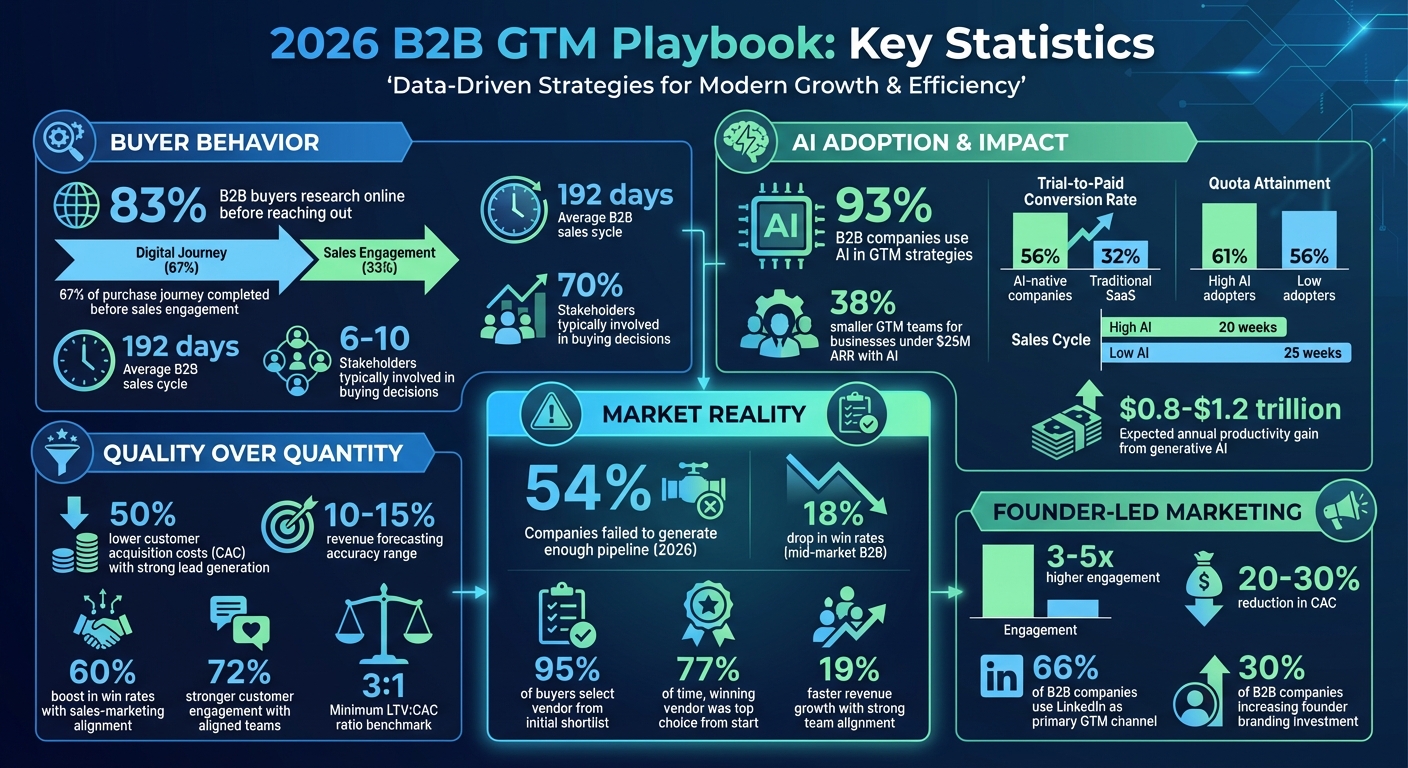
2026 B2B GTM Strategy: Key Statistics and Trends
Key Trends Shaping B2B GTM in 2026
How B2B Buyer Behavior is Changing
The way B2B buyers make decisions has undergone a dramatic shift. Research reveals that a whopping 67% of the purchase journey is already complete before a buyer ever engages with a sales rep. Buyers are doing their homework independently, and they’re not making decisions alone - six to ten stakeholders, often from various departments, are typically involved in the process. That means your GTM strategy needs to address concerns from finance, IT, operations, and executive leadership, each with their own set of priorities.
This evolution has stretched sales cycles significantly. On average, a B2B sales cycle now takes 192 days. For Fintech companies, it’s even longer, jumping from 21 weeks to 33 weeks - a 57% increase between 2023 and 2025. Buyers are also leaning heavily on private channels like Slack communities, LinkedIn DMs, and peer networks for advice and insights. These interactions leave behind digital breadcrumbs - visiting pricing pages, updating tech stacks, making strategic hires, or securing funding. These "intent signals" have become more critical than traditional firmographics, shifting the focus from just identifying an ideal customer profile (ICP) to pinpointing those who are actively in the market.
The Shift from Lead Volume to Pipeline Quality
With these changes in buyer behavior and extended sales cycles, the focus of GTM strategies is shifting. The old mantra of "more leads equals more pipeline" is being replaced with a sharper focus on pipeline quality. Jeremy Auch from Convertr sums it up perfectly:
"The traditional 'more leads, more pipeline' mindset is giving way to a more disciplined focus on data quality and consistency across every channel."
Here’s the math: 100 high-quality leads converting at 10% yield the same number of customers as 1,000 low-quality leads converting at 1% - but the quality-focused approach saves time, effort, and resources. Companies with well-honed lead generation processes enjoy 50% lower customer acquisition costs and can forecast revenue with a 10–15% accuracy range, making growth more predictable.
The benefits don’t stop there. Fragmented systems and "data chaos" cost 70% of employees over 20 hours a week. High-performing teams are ditching outdated metrics like MQL counts in favor of shared goals such as pipeline contribution, win rates, and CAC. When sales and marketing teams are aligned, companies see a 60% boost in win rates and 72% stronger customer engagement. The takeaway? It’s not about doing more - it’s about doing the right things with the right prospects.
How AI Fits into Modern GTM
AI has moved from being a "nice-to-have" experiment to becoming a core part of GTM strategies. AI-native companies are seeing impressive results, with a 56% trial-to-paid conversion rate compared to 32% for traditional SaaS companies.
What makes AI so effective? Precision. It combines three critical elements - Fit (firmographics), Intent (interest signals), and Timing (urgency indicators) - to dynamically prioritize accounts in real time. This allows sales teams to focus on prospects showing active buying signals.
The numbers back it up. Companies with high AI adoption see 61% quota attainment versus 56% for those lagging behind. Their sales cycles are also faster, averaging 20 weeks compared to 25 weeks for low adopters. For businesses under $25M ARR, AI adoption means leaner GTM teams - 38% smaller, to be exact - freeing up resources for other growth opportunities.
But here’s the catch: AI is only as good as the data it’s fed. Clean, unified data is essential. By 2026, Gartner predicts that 40% of enterprise applications will feature AI agents capable of autonomously handling tasks like lead qualification, enrichment, and routing.
This shift - from reactive reporting ("What happened last month?") to predictive insights ("What’s likely to happen next?") - requires businesses to treat AI as a foundational layer in their GTM stack, not just another tool to plug in. It's about integrating AI into the very DNA of your strategy, enabling smarter, faster, and more precise decision-making.
Building a Founder-Led GTM Strategy
What is Founder-Led Marketing?
Founder-led marketing turns the usual B2B marketing playbook upside down. Instead of leaning on polished corporate campaigns or overly generic messaging, this strategy puts the founder in the spotlight. It’s about using their voice, vision, and expertise to connect with audiences in a way that feels real and trustworthy. For small to medium-sized B2B companies, this approach is a game changer - it cuts through the noise with authenticity and conviction.
Brands that embrace founder-led marketing often see 3–5x higher engagement compared to traditional methods, while also slashing Customer Acquisition Costs (CAC) by 20–30%. Why? Because buyers aren’t just purchasing a product - they’re buying into the founder’s story and vision. As Kate Jensen, Head of Revenue at Anthropic, explains:
"There's no better salesperson at any company than the founder to talk about why they founded the company and their vision. This is true no matter how many millions or billions of dollars in revenue you have."
For early-stage companies (those under $1M ARR), the most effective go-to-market (GTM) channels consistently include LinkedIn, warm outbound efforts, and founder brand initiatives. And with 30% of B2B companies planning to increase investment in founder branding by 2026, it’s clear this isn’t just a passing trend - it’s a shift in how B2B growth works.
Positioning and Narrative Development
It all starts with a laser-focused Ideal Customer Profile (ICP). The narrower your target, the more your message will resonate. Once your ICP is defined, it’s time to develop what Koen Stam, Founder of GTM OS, calls "narrative-market fit" - essentially aligning your messaging with a specific problem or belief in your market.
"The founder's unique perspective creates narrative-market fit before product-market fit."
To refine this narrative, have 10–20 conversations a week with your ICP. Use these discussions to test and tweak your messaging based on what you hear in real time. And don’t just ask what prospects like about your product - ask them why it’s not better than their current solution. This question uncovers competitive advantages you might not have considered and sharpens your positioning.
Once your narrative is clear, build a content operating system around three core elements: story, insight, and proof. Your story should explain why you started the company, your insights should highlight your expertise, and your proof should showcase tangible results - whether that’s customer wins, revenue milestones, or product improvements. Test these ideas publicly on LinkedIn to see what resonates. Posts that gain traction? Those are the ones to double down on.
From there, expand your narrative into a broader GTM strategy that leverages the founder’s personal brand.
Using the Founder's Personal Brand
Your personal brand is your most powerful tool for distribution. LinkedIn is the obvious starting point - 66% of B2B companies already use it as a primary GTM channel - but the secret is consistency. Successful founders post daily, focusing on specific themes or topics that spark engagement.
Take Adam Robinson of RB2B, for example. Between 2023 and 2024, Robinson grew his LinkedIn following to 80,000 by being transparent about his revenue, wins, and setbacks. That openness helped him scale RB2B from $0 to over $20 million in ARR in just two years. Another example is Fivos Aresti of Workflows.io, who hit $1M ARR within three months of launching in December 2025. He ran a "LinkedIn connections of founders" campaign that leveraged 1.5 years of organic content and achieved a 25.4% reply rate.
But LinkedIn isn’t the only option. Newsletters are a great way to stay top of mind, while long-form content like webinars or podcasts helps establish deeper authority. The key is drawing inspiration from real-life experiences - customer calls, internal team discussions, and the day-to-day problems you’re solving. This keeps your content grounded and relevant, rather than sounding like empty marketing fluff.
Once you’ve built credibility, the next step is to make your personal brand scalable. Founder-led strategies aren’t about doing everything yourself forever - they’re about creating trust and authority that can be systematized for your team. Document your sales pitch, messaging, and customer success strategies into playbooks. This way, your team can close deals and drive growth even when you’re not in the room, breaking through the "founder-led ceiling".
Why Most B2B GTMs Fail in 2026 - Demand Gen, LinkedIn, AI, Narrative, Pipeline
The Core 2026 GTM Framework
To scale a founder-led go-to-market strategy, you need an integrated approach. The most effective playbooks in 2026 emphasize collaboration, moving away from siloed teams toward what Tony J Hughes, CEO of Sales IQ Global, describes as a "closed-circuit" system - a seamless setup where Sales, Marketing, and Customer Success operate with shared data and a unified rhythm. This framework is built around three key pillars: Strategy and Focus, Demand Creation, and Demand Capture and Conversion.
Strategy and Focus
At the heart of this approach is the founder’s insight, guiding decisions through a dynamic Ideal Customer Profile (ICP). This ICP shapes everything - from the content you produce to the deals your sales team prioritizes. Hughes underscores its importance:
"Your ICP is your true north. It's the boundary within which you build pipeline and win."
Start by defining your ICP, tailoring your offer to address specific pain points, and setting quarterly goals for pipeline growth and win rates across different channels and account tiers. A benchmark to aim for? A Lifetime Value to Customer Acquisition Cost (LTV:CAC) ratio of at least 3:1. This ensures you're scaling sustainably. Every quarter, dedicate four hours to an executive session to identify bottlenecks and recalibrate your top 3–4 priorities.
Once your strategic goals are locked in, it’s time to shift gears and focus on building demand.
Demand Creation
With your strategy established, the next step is generating demand - laying the groundwork for trust and credibility long before buyers are ready to make a move. The modern B2B approach follows the 70/30 rule: allocate 70% of resources to demand generation (ungated content, thought leadership) and 30% to capturing high-intent leads. Why? Because 70% of the buyer journey now happens before sales ever gets involved.
To make this work, create a content operating system anchored in three pillars: story, insight, and proof. Use LinkedIn as your primary platform (already favored by 66% of B2B companies) and repurpose your top-performing content across newsletters, webinars, and events. Before investing in paid promotion, test your ideas organically on LinkedIn for 48–72 hours. The goal? A steady stream of content that positions you as the go-to expert in your space. By the time buyers are ready, they’ll already know your name.
Once demand is flowing, the focus shifts to capturing and converting high-intent prospects.
Demand Capture and Conversion
Turning interest into action starts by optimizing your inbound paths. Make it simple for prospects to connect - whether that’s a direct scheduling link on LinkedIn or a clear call-to-action on your website. For outbound efforts, rely on signal-based triggers like profile views, content engagement, or recent funding news to prioritize outreach. These signals can make your outreach 2x–10x more effective than traditional cold methods.
Capitalize on the content you’ve already built by referencing specific posts or resources in your outreach. This creates a natural transition from demand creation to demand capture. And remember Hughes' crucial advice:
"If you're not in early shaping the problem… you become column C in their spreadsheet."
sbb-itb-9354cf2
AI-Enabled GTM Workflows for Founders
Shifting to an AI-first go-to-market (GTM) strategy isn’t about sidelining your instincts - it’s about supercharging them. Today, 93% of B2B organizations already incorporate AI into their GTM stacks. Generative AI alone is expected to add a staggering $0.8–$1.2 trillion in annual productivity for sales and marketing worldwide. For founders juggling strategy, content, and deal-making, AI can cut the time needed to gain insights from days to minutes, letting you focus on the big stuff that drives your business forward.
Mark Roberge, Co-Founder and Managing Partner at Stage 2 Capital, captures this shift perfectly:
"Reps that spend 75% of the week in front of customers are going to be three times more productive than reps spending the traditional 25%."
AI takes over the grunt work - research, CRM updates, repetitive tasks - so your team can spend more time actually engaging with customers. Let’s break down how to weave AI into your workflow while keeping that founder-driven authenticity that builds trust.
AI for Research and Insights
Before you sell, you need to know who’s worth targeting and when they’re ready to buy. AI transforms your Ideal Customer Profile from a static document into a constantly updated, living resource. It tracks retention trends, micro-segments, and real-time market signals. Instead of wasting time manually building prospect lists every quarter, AI tools can scan firmographics, intent data, and triggers like funding rounds or hiring spikes to dynamically reorder your priority accounts.
AI also speeds up understanding buyer behavior. By analyzing sales call transcripts, it highlights buying cues, objections, and sentiment in near real-time, eliminating the need for manual review [2]. This means you can tweak your pitch or follow-up strategy within hours instead of days. Tomer Harel, CEO of KeyScouts, sums it up:
"AI is no longer something leaders are 'experimenting' with on the side of their go-to-market strategy."
Ask yourself: how long does it currently take for a key market signal - like a new executive hire or product launch - to reach your sales team? AI can shrink that lag to almost zero.
Once you’ve got real-time insights flowing, the next step is using AI to craft personalized, attention-grabbing content.
AI for Content Creation and Personalization
Generic pitches don’t cut it anymore. The real challenge is scaling personalized outreach without exhausting your team. AI tools can help by drafting LinkedIn posts, newsletters, and sales emails that stay true to your brand’s voice while incorporating real-time insights like funding news, product usage, or engagement patterns. Think of AI as your co-seller, not a replacement.
Feed your top-performing content into AI tools to create tailored variations. For example, referencing a prospect’s recent funding round or a specific insight (like pipeline quality) in your outreach can boost engagement. 66% of B2B buyers are more likely to open emails that include their name or company name, and AI makes it possible to scale this personalization without losing authenticity.
Greg Baumann, Director of Enterprise Sales at Outreach, puts it plainly:
"Nobody likes a generic pitch. Craft each message with care, and show your prospects the reason you've called: you can bring them value! Lead with that, not with features."
Before committing to expensive AI platforms, test workflows with standard language models to ensure they align with your logic. This approach lets you scale outreach while keeping your founder-driven voice intact.
Once your content starts resonating, AI can help refine and prioritize leads based on how they engage.
AI for Lead Scoring and Prioritization
AI ensures you focus on leads that matter most. By integrating AI into lead management, your GTM system stays as agile as your strategy. The best systems combine three types of data: Fit (firmographics), Intent (behavioral signals), and Timing (purchase readiness). This predictive prioritization dynamically reorganizes your pipeline, making sure you’re reaching out to prospects who are actually in a buying window - not just anyone who filled out a form.
For product-led models, AI can sync product analytics with your CRM to automatically trigger sales tasks when users hit specific usage milestones. It can also flag deals in your pipeline that show signs of trouble - like behaviors that don’t align with past wins - so you can step in early. Paul Sullivan, Founder of ARISE GTM, explains this shift:
"GTM engineering means treating revenue growth as a technical discipline, building a system that consistently finds, wins, and keeps customers."
Instead of chasing vanity metrics like "emails sent", focus on meaningful ones like "seller time reclaimed" or "pipeline velocity". Considering the average B2B sales cycle takes 192 days, AI can help you shorten that timeline by ensuring reps spend their time on high-probability opportunities.
Operating Rhythm and GTM Metrics
In 2026, 54% of companies fell short of generating enough pipeline to meet revenue targets, and win rates dropped by 18% in mid-market B2B organizations. The gap between hitting your goals and missing them often comes down to tracking the right metrics consistently - and acting on them before challenges snowball.
Sangram Vajre and Bryan Brown from GTM Partners sum it up perfectly:
"Without the right metrics, your plan becomes a wish list instead of an operating system."
As businesses move from "growth at all costs" to a focus on efficiency, having a balanced scorecard is essential. This means tracking leading indicators - like audience growth, demo requests, and in-ICP engagement - to spot potential issues early. At the same time, lagging indicators - such as pipeline value, win rates, and sales cycle duration - help assess whether your strategy delivered results.
Consider this: 95% of B2B buyers select a vendor from their initial "Day 1" shortlist, and 77% of the time, the winning vendor was already the top choice at the start. If you're not on that shortlist early, your odds of winning plummet. This underscores the importance of tracking metrics that measure brand presence and influence before prospects even enter the funnel - not just late-stage performance.
The Minimum Viable GTM Scorecard
A strong scorecard should span your entire GTM system, integrating sales, marketing, and other functions. By 2026, success hinges on eight key pillars, each tied to a primary metric:
- Total Relevant Market (TRM): Focus on the accounts that align with your ICP (Ideal Customer Profile) - not the broad Total Addressable Market, but the realistic subset you can engage and win.
- Market Investment Map: Use projected revenue by product line to allocate resources where they’ll have the most impact.
- Brand & Demand: Monitor pipeline growth quarter-over-quarter to gauge the effectiveness of demand-generation efforts.
- Pipeline Velocity: Track revenue contribution by GTM motion (e.g., Inbound, Outbound, PLG, Partner, Event, Community) to identify the most efficient growth drivers.
- Customer Time-to-Value: Measure how quickly customers achieve their first meaningful milestone post-purchase.
- Customer Expansion: Use Net Revenue Retention (NRR) to check whether you're growing within your existing customer base.
- Revenue Operations: Evaluate your GTM Efficiency Ratio (revenue per dollar spent on GTM activities) to ensure sustainable growth.
- Leadership & Management: Assess team alignment with the C.A.T. Score (Clarity, Alignment, Trust).
Prioritize in-ICP win rates over vanity metrics like MQLs or email volume. This ensures your segmentation strategy is working. Also, track sales cycle length - the average B2B sales cycle is 192 days. Leveraging AI tools to detect signals can help shorten this timeline by focusing on high-probability opportunities. Integrating these metrics with AI keeps you agile and ready to adapt to market changes.
Companies with strong alignment across sales, marketing, product, and customer success teams see 19% faster revenue growth and 15% higher profitability. This alignment starts with a unified scorecard, where both the CMO and CRO share accountability for pipeline metrics. These shared routines give founders the ability to scale efficiently while staying in control.
Weekly and Quarterly Operating Rhythm
Metrics are only as good as the actions they inspire. To stay ahead, a consistent operating rhythm is critical. The best GTM teams operate on three cadences: weekly, monthly, and quarterly.
- Weekly: Host CRO/CMO "war rooms" to align marketing and sales efforts. Evaluate content performance, update messaging based on field feedback, and fine-tune outbound strategies. For example, Workflows.io targeted its "Dream 150" accounts with LinkedIn prospecting while automating outreach for lower-tier accounts. Their standout play - reaching out to the founder’s LinkedIn connections - delivered a 25.4% reply rate from 370 messages. Weekly reviews helped them double down on successful tactics and abandon ineffective ones.
- Monthly: Conduct a metrics audit to identify which KPIs drive results and eliminate those that don’t. Review channel performance to determine which efforts (e.g., LinkedIn, events, AI search) are generating pipeline versus just noise. A mid-sized SaaS company, for instance, cut its sales cycle from 200 to 120 days and exceeded quarterly targets by 33% by using AI-driven intent signals and conducting monthly reviews to refine outreach.
- Quarterly: Reassess your ICP and refine your segmentation based on data. Best-in-class teams revisit their ICP quarterly to stay aligned with market shifts. This is also the time to evaluate your Total Relevant Market, review motion-level scorecards, and adjust strategies based on win rates and CAC payback periods. Additionally, audit your tech stack to decide whether to double down on high-performing tools or test new ones.
Peter Emad, a GTM expert at SalesCaptain, puts it bluntly:
"If it takes a month to know what's broken, you're already bleeding. Weekly GTM reviews might feel extra, but they'll save you real dollars."
Comparison Tables for Decision-Making
Structured comparison tables can help you make faster, data-driven decisions. Here are three frameworks to guide your GTM strategy:
| Operating Rhythm Cadence | Focus Area | Participants |
|---|---|---|
| Weekly | Content reviews, messaging updates, sales-marketing alignment | CMO, CRO, Content Leads |
| Monthly | Channel performance, metrics audit, pipeline diagnostics | GTM Leadership, RevOps |
| Quarterly | ICP refinement, TRM reassessment, strategy updates | Executive Team (CEO, CMO, CRO, CPO) |
| Motion-Level KPIs | Primary Leading Indicator | Primary Lagging Indicator |
|---|---|---|
| Inbound-Led | In-ICP Website Visits | Closed-Won Value |
| Outbound-Led | Meetings Set within ICP | ACV / LTV |
| Product-Led (PLG) | Free Signups / Trials | Conversion to Paid |
| Partner-Led | Qualified Referrals | Partner-Sourced Revenue |
| Community-Led | Audience Size / Engagement | Community-Influenced Deals |
| GTM Element | Low Maturity (2024/25) | High Maturity (2026) |
|---|---|---|
| ICP Definition | Broad, unclear, or hypothetical | Narrow, data-validated, strictly governed |
| Positioning | Feature-focused messaging | Value and ROI-focused narrative |
| Alignment | Siloed functions with separate KPIs | Shared KPIs, SLAs, single source of truth |
| Pipeline | Volume-based (MQLs) | Quality-based (In-ICP Opportunity Value) |
| AI Usage | Tactical/Random acts of AI | Integrated into workflows and operating rhythms |
Key Takeaways for a Winning 2026 B2B GTM
Recap of the 2026 GTM Playbook
The difference between companies that meet their revenue goals and those that fall short boils down to three core elements: founder-led branding, integrated AI workflows, and disciplined execution. By 2026, a staggering 93% of B2B companies have incorporated AI into their go-to-market (GTM) strategies. But here's the catch - just using AI isn't enough to guarantee success. AI has become the backbone of effective GTM strategies, connecting the dots across marketing, sales, and customer success.
The game has shifted from focusing on lead volume to prioritizing pipeline quality. Instead of obsessing over MQL (Marketing Qualified Lead) counts, top-performing companies zero in on fit, intent, and timing. They rely on predictive signals to pinpoint accounts that are truly ready to buy. This level of precision begins with shared metrics, unified data, and a single leader driving AI transformation - often someone in Revenue Operations (RevOps) who can oversee the entire revenue process.
Founders still play a pivotal role in early-stage enterprise deals. Their personal brand and vision can open doors that cold outreach simply can't. However, scaling founder-led marketing requires a systematic approach. By treating revenue growth as a technical discipline - built on repeatable workflows rather than one-off campaigns - founders can scale their impact. The ARISE framework (Assess, Research, Ideate, Strategize, Execute) provides the necessary structure, while AI dramatically shortens the "time to insight" from weeks to mere hours.
This playbook blends the founder's vision with the precision of AI, creating a roadmap for sustainable revenue growth. These strategies lay the groundwork for decisive, impactful action.
Next Steps for Founders
To put these insights into action, founders need to refine and execute their GTM strategies without delay. Start by auditing your data to identify where signals are being lost during team handoffs. Assign a single leader to oversee AI integration, ensuring your tools work together seamlessly and eliminating fragmented experiments. Use AI to revisit and update your Ideal Customer Profile (ICP) every quarter, identifying new opportunities and segments.
Establish a disciplined operating rhythm to track performance and continuously refine your GTM strategy. Companies that master this kind of cadence can forecast revenue with 10–15% accuracy.
If you’re looking for support, consider partnering with a team that specializes in founder-led GTM strategies. For example, RevBoss offers services like custom content strategies, audience development, and lead activation campaigns starting at $1,500 per month - with no long-term contracts. Whether you need LinkedIn content, email newsletters, or full-service activation campaigns, the focus is always on building trust and driving pipeline, not just churning out content.
"Hope isn't scalable. Strategy is."
FAQs
How does AI enhance lead prioritization in B2B go-to-market strategies?
AI is reshaping how businesses prioritize leads by leveraging machine learning to dive into data sources like CRM records, website activity, email interactions, and intent signals. It generates real-time probability-to-close scores for each prospect, dynamically updating as new interactions roll in. This means your team can zero in on high-potential leads, while lower-intent accounts are automatically nurtured in the background.
By spotting patterns that might slip past human observation - such as a prospect’s behavior paired with their tech stack - AI enables marketers to focus on the most promising opportunities. The result? Shorter sales cycles, improved conversion rates, and smarter use of resources. Some AI-driven tools even suggest the most effective outreach channel, streamlining your sales process and making outcomes more predictable.
Why is founder-led marketing valuable for B2B companies?
Founder-led marketing offers B2B companies a distinct edge by tapping into the founder's personal voice to build trust and credibility. Founders have an intimate grasp of their product's vision and the challenges their customers face, which allows them to communicate in a way that feels genuine and relatable. This personal touch fosters trust, positioning the company as a partner rather than just another vendor, which can accelerate decision-making and deepen relationships.
On top of that, founders bring a level of agility that larger teams often can’t match. They can quickly adapt to new trends, experiment with AI-powered tools, and refine messaging on the fly. By leveraging their personal brand on platforms like LinkedIn, founders can draw in high-quality leads and build connections that competitors might struggle to duplicate. This strategy creates a unified narrative across sales, marketing, and product teams, paving the way for steady, long-term growth.
Why is prioritizing pipeline quality better than focusing on lead volume?
Putting pipeline quality at the forefront means channeling your energy toward leads with a real shot at becoming customers. This doesn’t just boost your ROI - it sets the stage for steady, long-term growth. By zeroing in on well-qualified prospects, your team can spend their time on meaningful conversations, rather than chasing a sea of unqualified leads.
Prioritizing quality also ensures your sales and marketing efforts align more closely with what buyers are actually looking for. This cuts down on wasted time and resources, steering clear of the diminishing returns that often come with broad, unfocused outreach. Plus, it helps you nurture stronger, lasting relationships with your customers. It’s a win-win.