The 2026 Trigger-Based Outreach Playbook

Trigger-based outreach is all about reaching prospects at the perfect moment - when they’re already thinking about the problem you solve. Instead of blasting generic emails, you focus on specific signals like pricing page visits, funding announcements, or new executive hires. Why? Because timing is everything: responding to high-intent signals within an hour makes you 7x more likely to qualify a lead.
This playbook breaks it down for founder-led teams with limited resources. You’ll learn:
- The 3 key trigger types: Intent signals (pricing page visits), behavioral triggers (webinar attendance), and account-level events (funding rounds, leadership changes).
- How to act fast: Use tools to monitor signals, automate alerts, and send personalized, timely messages.
- Why AI is your secret weapon: Let AI score leads, draft tailored messages, and prioritize follow-ups like a pro.
The goal? Stop wasting time on cold outreach. Instead, focus on the moments that matter to close deals faster and boost conversions by up to 400%. Let’s dive into the details.
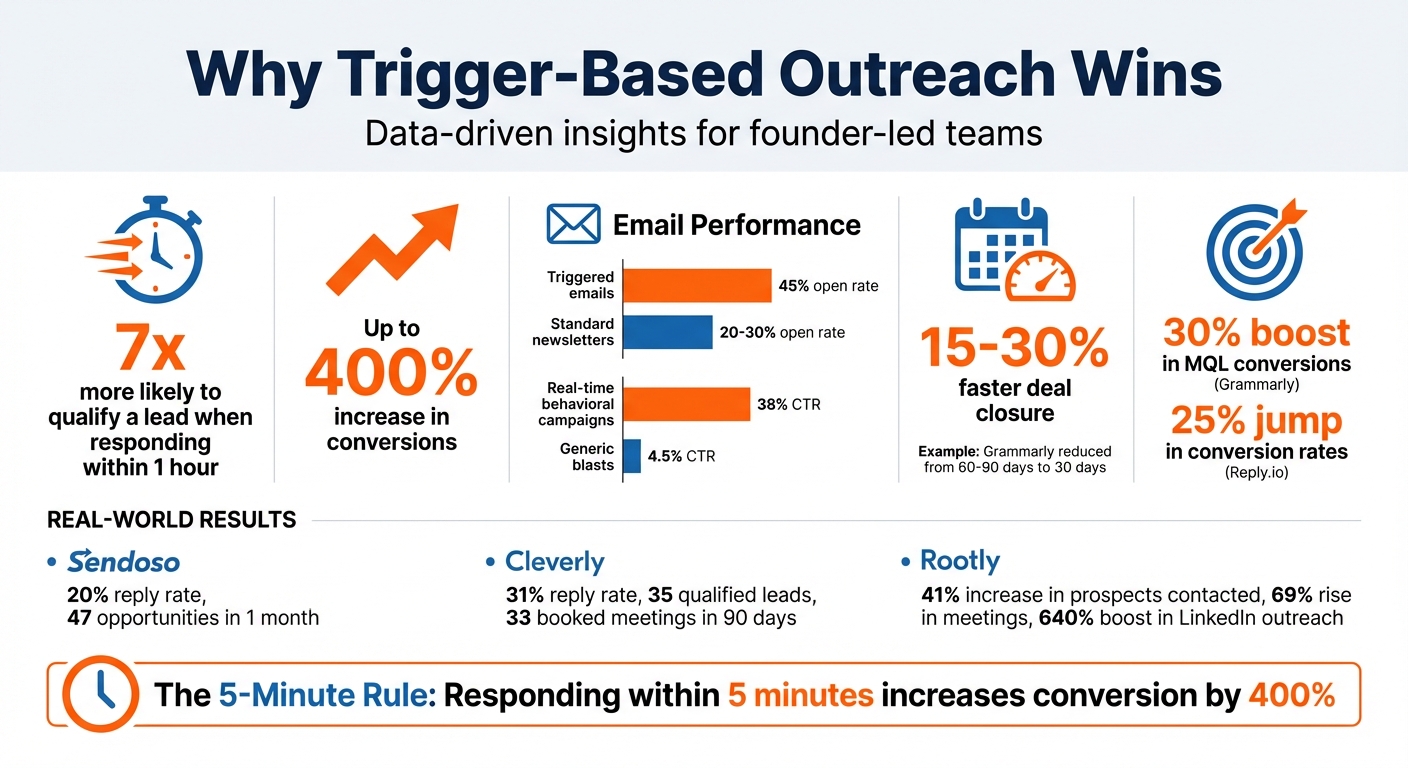
Trigger-Based Outreach Performance Statistics and Key Metrics
How To Implement Trigger Based Pipeline Generation Campaigns
Types of Triggers for B2B Outreach
Triggers come in different flavors: some point to immediate buying intent, while others signal early curiosity. Knowing how to spot and act on these can help you prioritize your time and tailor your outreach effectively.
Intent and Purchase-Readiness Triggers
These are the gold standard of signals. They show someone is actively evaluating solutions and possibly close to making a decision. For instance, if a prospect visits your pricing page three or more times within 48 hours, that’s a clear sign they’re in comparison mode.
Other strong signals include downloading comparison guides, browsing review sites like G2, or requesting product demos. These "first-party" signals - actions taken on your own platforms - are especially reliable. Timing is everything here; you’ll want to act within 72 hours to maximize your chances.
Take Grammarly as an example. They used Salesforce Einstein to track when multiple users from the same company were actively engaging with their product. This clustering behavior flagged high buying intent, allowing them to route these leads straight to sales. The result? A 30% boost in MQL conversions and a sales cycle that dropped from 60–90 days to just 30.
The trick lies in combining multiple signals to form a clear picture. A single visit to your pricing page might not mean much. But pair that with a recent job posting for a role your product supports, and you’ve got a strong reason to reach out. Acting on these insights can help founder-led teams strike while the iron is hot.
Behavioral and Engagement Triggers
Behavioral triggers focus on how prospects interact with your content over time. These include actions like clicking on emails, attending webinars, visiting your site repeatedly, or chatting with a bot. While these signals don’t scream "ready to buy", they do indicate research interest.
Here’s where personalization makes all the difference. If someone downloads a whitepaper about reducing customer churn, don’t send them a generic “let’s connect” email. Instead, reference the whitepaper and offer something relevant, like a case study showing how you’ve helped a similar company cut churn by 40%.
Triggered emails see an average 45% open rate, far outperforming the 20–30% typical for standard newsletters. Campaigns that use real-time behavioral data also achieve click-through rates of 38%, compared to just 4.5% for generic blasts. The secret? Relevance and timing.
For example, Reply.io leveraged AI-driven analytics to prioritize leads showing specific engagement patterns - like attending a webinar and visiting a case studies page. This approach led to a 25% jump in conversion rates.
But it’s not just individual actions that matter. Broader organizational movements and market shifts can also provide valuable timing cues.
Account, Event, and Market Triggers
These triggers revolve around organizational changes and external factors that open up buying opportunities. Examples include new funding rounds, executive hires (especially for roles like CMO or VP of Sales), mergers, hiring sprees, or office expansions. Event triggers might involve webinar attendance, trade show participation, or industry award wins. Market triggers are broader, such as new regulations, economic shifts, or competitor product launches.
New executive hires, for instance, are most receptive to outreach 10–21 days after starting. Research shows they typically spend 70% of their budget within their first 100 days in a role.
Sendoso capitalized on job-change triggers by reaching out to prospects who recently switched companies. Their message was simple yet effective: “Congrats on the new role at [Company]. At your last company, you used [Tool] - would it make sense to explore something similar here?” This approach achieved a 20% reply rate and generated 47 new opportunities in just one month.
Similarly, Cleverly targeted companies that had just raised Series B funding. Their outreach focused on scaling challenges, with messages like: “Congrats on the funding. Most companies at your stage struggle with [specific pain point] - here’s how we’ve helped similar teams.” Over 90 days, this campaign delivered 35 qualified leads and 33 booked meetings, with a 31% reply rate.
When using these triggers, always reference the event in your opening line. For example, “I saw you just hired a VP of Sales” or “Congrats on the Series B” immediately explains why you’re reaching out now. Just be cautious not to overstep - mentioning specifics like “I noticed you visited our pricing page five times” can feel intrusive.
| Signal Type | Prospect Mindset | Message Tone |
|---|---|---|
| Pricing Page Visit | Actively comparing options, urgent | Direct, value-focused, and benchmark-driven |
| New Executive Hire | Ambitious, seeking quick wins | Strategic, aligned with their 30-60-90 day goals |
| Content Download | Curious, researching pain points | Educational, empathetic, offering deeper insights |
Setting Up Your Trigger-Based System
Getting a trigger-based outreach system up and running doesn't have to be a massive undertaking. You don’t need a sprawling tech stack or a dedicated operations team. The secret lies in connecting the right data sources, automating meaningful alerts, and letting AI do the heavy lifting. For founder-led teams, simplicity is key - set up systems that run smoothly without requiring constant oversight.
Data Sources and Tracking Setup
Your trigger system hinges on three main types of data.
- First-party data: This comes from your own platforms, like your CRM (e.g., HubSpot or Salesforce), marketing automation tools (Marketo or Pardot), or web analytics like Google Analytics 4.
- Firmographic and contextual data: Tools like LinkedIn Sales Navigator, Crunchbase, and news alerts help you track organizational changes, such as funding rounds, new executive hires, or hiring surges.
- Intent and technographic data: Platforms like Bombora, 6sense, G2 Buyer Intent, and BuiltWith reveal what prospects are researching and the tools they’re adopting.
For smaller teams, consider using an all-in-one platform to simplify things. These tools centralize monitoring, data enrichment, and execution into a single workflow, saving you the hassle of juggling multiple dashboards to identify hot leads.
A smart move is to combine multiple signals before acting. For instance, a single visit to your pricing page might not mean much. But if that visit coincides with a recent VP of Sales hire at the same company, it’s a strong signal to reach out.
| Signal Category | Example Sources | Actionable Trigger |
|---|---|---|
| Internal | GA4, HubSpot, Segment | Pricing page visit, repeat feature views |
| Firmographic | LinkedIn, Crunchbase | New funding, executive hire, office relocation |
| Technographic | BuiltWith, Wappalyzer | New software adoption, dropping a competitor |
| Intent | Bombora, G2, 6sense | Surge in searches for specific keywords |
To prioritize responses, set up tiered thresholds. For example:
- Tier 1 triggers (high intent, like multiple pricing page visits within 48 hours) should get a response within 24 hours.
- Tier 2 triggers (medium intent, such as webinar attendance) can wait 3–10 days.
- Tier 3 triggers (low intent, like a single blog visit) should go into long-term nurturing.
Once your data is flowing into the system, the next step is automating your responses.
Automations and Notifications
Quick responses can significantly improve conversions. Set up instant alerts via Slack or email for Tier 1 triggers. For instance, if someone from a target account visits your pricing page three times in 48 hours, your system should immediately notify the right team member and create a task. Tools like Mailshake and Apollo are budget-friendly options for automating these workflows.
Tailor your outreach sequences to the specific trigger. A generic follow-up won’t cut it. For example, if a company just hired a new VP, send a personalized message like:
"Congrats on the new role! Many teams at your stage face [specific challenge] - here’s how we’ve helped others navigate this."
This approach has proven effective, maintaining a 31% reply rate and generating 35 qualified leads over six months.
Use dynamic tokens to insert real-time data into outreach templates, ensuring your messages feel timely and relevant. Coordinate your efforts across email, LinkedIn, and retargeting ads to keep your outreach consistent and avoid overwhelming prospects.
Another important element is signal suppression. Automatically remove prospects from sequences if they reply or have been contacted recently (e.g., within the last 7–14 days). This prevents over-communication and keeps your outreach respectful.
Using AI for Scoring and Content
AI takes your automated workflows to the next level by refining lead scoring and personalization. Instead of simply tallying clicks or downloads, AI evaluates factors like fit, behavioral patterns, and external intent signals to identify prospects who are closer to making a purchase. For example, Grammarly used Salesforce's Einstein AI to predict which accounts needed business plans based on user volume, generating 200 high-quality leads per month.
AI isn’t just for scoring - it’s also a game-changer for research. Tools like Artisan’s "Ava" gather data from various sources (e.g., funding announcements, job postings, and social media) to build lists that match your Ideal Customer Profile. These tools can also analyze a prospect’s website, recent job posts, and news to create personalized hooks, reducing manual prospecting time by 60–80%.
"Headcount won't win outbound anymore - precision and speed will."
AI also enables true 1:1 personalization at scale. Instead of relying on static templates, AI-powered systems craft unique opening lines and value propositions tailored to each prospect’s context. This approach can drive transaction rates up to six times higher compared to generic templates.
To keep your scoring accurate, apply recency decay. For instance, reduce behavioral scores by about 50% after 30 days to ensure outdated signals don’t inflate lead scores. Group leads into "Hot", "Warm", or "Cold" tiers based on these scores, and adjust your follow-up strategy accordingly.
sbb-itb-9354cf2
Playbooks for Common Trigger Scenarios
Here’s a practical guide for founder-led teams to respond effectively to high-intent signals without relying on a large sales team. These playbooks are designed to help you act quickly and meaningfully when potential customers engage with your brand.
Demo Requests and High-Intent Actions
When someone requests a demo or spends significant time on your pricing page, timing is everything. Studies show that sales reps who respond within an hour are nearly seven times more likely to qualify leads.
Here’s how to handle these high-intent actions:
-
Set Up Real-Time Alerts
Use tools to trigger Slack or email notifications for key actions, like multiple visits to your pricing page within 48 hours, demo requests, or interactions with high-value features. The goal? Respond fast - ideally within five minutes for real-time actions and no later than 24 hours. -
Make It Personal (With a Touch of Automation)
Send a personalized message referencing the specific action:
"I saw you were exploring our Enterprise pricing - happy to share how similar teams structure their plans."
Then, automate a follow-up sequence, but pause it as soon as they reply. Keep in mind, the value of high-intent signals fades quickly - usually within 48–72 hours. -
Use Real-World Success Stories
For example, in 2025, Sendoso leveraged job change triggers to connect with prospects, achieving a 20% reply rate and generating 47 opportunities in just one month. Similarly, a funding-trigger campaign led to 35 qualified leads with a 31% reply rate.
"In a market saturated with generic outreach, the only true competitive advantage left is timing."
– GTM Signal Studio
Event and Webinar Engagement
Events and webinars are excellent opportunities for warm outreach. But not all engagement is created equal - attendees often signal higher intent compared to registrants who didn’t show up.
Here’s how to maximize these opportunities:
-
Segment Your Audience
After the event, split your contacts into two groups:- Attendees: Send a personalized follow-up within 24 hours.
- No-shows: Share the event recording with a friendly note like, "Sorry we missed you! Here’s the session recording if you’d like to catch up."
-
Reference Specific Event Details
Personalize your follow-up by mentioning something relevant from the event:
"It was great seeing you at yesterday’s webinar on scaling outbound strategies - here’s the ROI calculator I mentioned during the Q&A."
This reinforces the connection and keeps your message relevant. -
Offer Extra Value
Include additional resources like a case study, a short video summary, or more insights. This approach nurtures the relationship without jumping straight into a sales pitch. -
Go Multi-Channel
Don’t just rely on email. Engage with their LinkedIn content for a few days before sending a connection request referencing the event. Multi-channel strategies can lower cost per lead by up to 31%. -
Automate Your Workflow
Use tools to track registrations and attendance, automatically enrolling contacts into a follow-up sequence immediately after the event. Timing is key to staying top-of-mind.
"Meeting prospects at trade shows provides a warm context for follow-up, especially when referencing topics discussed or sessions attended during the event."
– Yesware
Product Usage and Onboarding Triggers
Tracking product usage isn’t just about monitoring activity - it’s a way to identify when customers need help, are ready to expand, or might be at risk of leaving.
Here’s how to make the most of these signals:
-
Keep Tabs on Account Health
Use CRM fields like "Red", "Yellow", or "Green" to track account health. If an account shifts to "Red", have your Customer Success Manager step in immediately. -
Address Stalled Onboarding
Detect onboarding delays with webhooks and send a quick, helpful email:
"I noticed you signed up last week but haven’t completed your first workflow. Here’s a 2-minute video to get you started." -
Respond to Feature Engagement
If a user repeatedly checks out a specific feature, follow up with a tailored resource, like a case study or a short video, to show how they can maximize its value. -
Proactive Renewal Outreach
Set a trigger for 90 days before a contract expires. This gives your Customer Success Manager time to start conversations and reduce the risk of churn. -
Spot Expansion Opportunities
When you notice a spike in usage or interest in premium features, reach out with tips on integrations and highlight the benefits of upgrading. Grammarly, for instance, used AI-based lead scoring to boost account upgrades by 80%.
"Meaningful in-product activity can be treated as a sign to reach out."
– Emilia Korczynska, Userpilot
Measuring and Improving Your Outreach
Core Metrics for Outreach Success
Tracking the right metrics takes the guesswork out of outreach and turns it into a calculated strategy. Start with Time-to-First-Touch (TTFT) - this measures how quickly you respond after a signal, like a visit to your pricing page. For signals that indicate high intent, aim to respond within 24 hours to keep the opportunity alive.
Next, evaluate the reply rate for each type of signal. Not all triggers are created equal - some will naturally perform better than others. By tracking these separately, you can identify which signals are worth prioritizing. Your Signal-to-Opportunity Conversion Rate should exceed the benchmarks for cold outreach. If it doesn’t, it might be time to rethink how you’re defining your triggers.
Another key metric is Sales Cycle Velocity. Deals driven by signals often close 15–30% faster compared to cold outreach. Meanwhile, keep an eye on your Average Deal Value, as trigger-based leads often align with better-fit accounts, leading to potentially larger deals.
For email health, aim to keep your bounce rate below 2.5%, your opt-out rate close to 1.1%, and your complaint rate under 0.3%.
Some real-world success stories highlight the impact of optimizing these metrics. In 2025, Rootly fine-tuned their sales sequences using Outreach, resulting in a 41% increase in prospects contacted, a 69% rise in meetings scheduled, and a staggering 640% boost in LinkedIn outreach. Similarly, Snowflake saw a 15% increase in sales reps hitting their quotas, all while maintaining an average prospect reply rate of 20%.
These metrics aren’t just numbers - they’re a roadmap for refining your strategy and consistently improving your outreach efforts.
Refining Triggers Through Testing
Once you’ve set up automated alerts and AI scoring, the next step is to fine-tune your triggers through testing. Start by setting signal decay rules. For instance, high-intent signals like a visit to your pricing page lose their value within 48–72 hours, while medium-intent signals, such as new hires, stay relevant for 10–21 days. Build these timeframes into your system to avoid wasting time on stale leads.
You can also combine weaker signals to create stronger opportunities. For example, a pricing page visit might warrant a standard email, but pair it with a recent job posting, and the lead becomes far more promising. Experiment with different combinations to see what works best.
Run small tests with 50–100 accounts per segment before scaling up. Test different response times - does replying to a site visit within 15 minutes outperform a 2-hour or 24-hour delay? Similarly, adjust your sequence timing. For instance, compare the effectiveness of a 3-day gap between messages versus a 7-day gap.
"Grammarly implemented AI-based lead scoring in 2025 through Salesforce Einstein by identifying accounts where multiple users engaged with resources. Led by Senior Marketing Operations Manager Kelli Meador, this approach generated 200 high-quality leads per month, increased MQL-to-SQL conversion by 30%, and reduced deal closing time from a 60–90 day range to just 30 days."
Tailor your outreach channels based on your audience. For example, C-level executives often respond better on LinkedIn, with reply rates averaging 6.98%, while mid-level managers tend to prefer email. Use your engagement data to guide these decisions rather than relying on assumptions.
Governance and Compliance Best Practices
After optimizing your outreach, it’s essential to stay compliant and ethical. Adhere to regulations like GDPR and CCPA by being transparent about data collection, offering clear opt-out options, and ensuring you have documented consent.
Focus on first-party data - this includes information from your website visitors, event attendees, and product users. It’s a safer, more reliable approach in light of stricter privacy rules. If you’re using third-party data providers, audit their methods regularly to ensure they meet current standards.
Incorporate automated suppression logic into your processes. For example, remove prospects from sequences immediately after they reply, and enforce a 7–14 day "cooldown" period between campaigns to avoid overwhelming them.
While automation is a powerful tool, don’t overlook the importance of human oversight. AI can help score leads and recommend timings, but a human touch ensures your messages stay relevant and respectful. When reaching out based on a trigger, acknowledge the event - like congratulating someone on a promotion or funding announcement - to keep your outreach timely and personable.
"Trust is as valuable as personalisation."
Finally, balance automation with authenticity. While 72% of consumers say they only engage with personalized marketing, it’s crucial not to cross privacy boundaries. Use publicly available data, like LinkedIn updates or funding announcements, to establish relevance without being intrusive. This ensures your outreach is effective while staying respectful and ethical.
Conclusion: Building a Scalable Trigger-Based System
Trigger-based outreach is at the heart of modern B2B growth strategies. Responding to a prospect within an hour makes you nearly 7x more likely to qualify that lead compared to waiting longer. Teams that act on trigger events see conversion rates soar by 400%, and their deals progress through the sales cycle 15–30% faster. In today's landscape, timing isn't just important - it’s the ultimate competitive edge.
For founder-led teams, this approach offers a way to scale outreach without needing massive resources. By combining automated signal monitoring, AI-driven personalization, and multi-channel workflows, smaller teams can achieve the kind of reach typically associated with much larger organizations. The secret lies in clearly defining your Ideal Customer Profile (ICP), matching each trigger to a tailored outreach sequence, and maintaining a commitment to testing and refining your strategies. This isn’t just about efficiency - it’s about aligning your efforts with best practices that deliver measurable results.
RevBoss specializes in building marketing systems tailored for founder-led B2B businesses. Instead of relying on content alone to generate leads, RevBoss takes a proactive approach, turning trigger events into conversations and converting prospects into a pipeline. Their focus on authenticity and trust sets businesses apart in an AI-driven market, where buyers are more independent in their research than ever before.
To put these ideas into action, start by identifying where your target audience overlaps with key triggers - like funding announcements, leadership changes, or behavioral signals such as visits to your pricing page. Implement real-time monitoring systems, automate research and personalization tasks, and coordinate outreach across email, LinkedIn, and phone. The 5-minute rule proves its worth here: responding to leads within five minutes can increase your chances of conversion by 400%.
Teams that prioritize speed and precision can transform trigger-based outreach into a scalable, 24/7 growth engine.
FAQs
How does AI improve trigger-based outreach strategies?
AI takes trigger-based outreach to the next level by turning raw data into deeply personalized and scalable engagement strategies. It spots key buying signals - like someone visiting your website, downloading content, or a leadership shake-up - and aligns these with your ideal customer profile. The result? You can zero in on prospects who are more likely to convert, cutting down on wasted time and ensuring your outreach hits the mark at the right moment.
On top of that, AI automates the heavy lifting. It handles tasks like gathering and enriching prospect data, crafting customized messages, and juggling multi-channel campaigns across platforms like email and LinkedIn. By taking care of these tedious chores, AI can slash manual effort by as much as 60–80%. This means your team can scale their outreach efforts while keeping the quality intact.
What’s more, AI doesn’t stop there. It keeps an eye out for fresh triggers - such as funding updates or product rollouts - and adjusts outreach strategies on the fly. This ensures your messaging stays relevant to where your prospect is right now, fostering stronger engagement and paving the way for better customer relationships.
What are the best tools to track high-intent buyer signals?
Tracking buyer signals with high intent is a game-changer for founder-led B2B marketers who want to connect with prospects at just the right moment. By 2026, the most effective tools will blend real-time intent data, AI-driven insights, and smooth CRM integration to pinpoint and respond to critical triggers.
Here are a few standout tools making waves:
- Cognism Buyer Signals: Offers firm-level intent data, such as product launches or hiring trends, and integrates it seamlessly into sales workflows.
- LeadIQ: Tracks key events like funding announcements and leadership changes, while enhancing leads with intent scores to prioritize outreach.
- EverWorker AI Agents: These autonomous tools monitor behaviors like sudden spikes in product usage and handle personalized outreach automatically.
With these tools in your arsenal, you can respond faster and craft outreach that feels timely and relevant, making it easier to connect with high-value prospects.
How can I prioritize different triggers to improve outreach effectiveness?
To get the most out of triggers, focus on their impact, timing, and how well they align with your ideal customer profile (ICP). You can break them down into three categories:
- High-priority triggers: These are major events like funding rounds, leadership changes, or noticeable spikes in product usage. They often signal immediate challenges or needs, making them your best bet for faster conversions. Act on these first.
- Mid-priority triggers: Think of buyer intent signals such as trial sign-ups, increased website activity, or updates to their tech stack. These don’t always scream urgency but still hint at interest. Prioritize them based on how strong the signal is and how well they match your ICP.
- Low-priority triggers: Broader happenings like industry news or seasonal trends fall here. While they’re not urgent, they give you great material for personalization and can be useful for follow-ups or nurturing efforts.
To stay efficient, assign scores to triggers based on their strength, potential impact, and timing. Automate your outreach to tackle the highest-scoring triggers first. Regularly check your performance metrics and tweak your approach as needed. This way, you’ll focus your energy on the opportunities that are most likely to pay off.