A 60-Day Rollout Plan for Executive-Led Demand Generation

Want to supercharge your B2B marketing in just 60 days? Here's the playbook.
Executives leading demand generation can boost marketing results by up to 70%, thanks to their market insights and decision-making power. This 60-day plan shows you how to take executive expertise and turn it into a pipeline of qualified leads. Here's the breakdown:
- Days 1-15: Nail down your Ideal Customer Profile (ICP) and set up RevBoss to organize and act on your insights.
- Days 16-30: Use executive knowledge to craft LinkedIn content that resonates, build your audience, and engage with prospects.
- Days 31-45: Launch targeted campaigns and drive sales conversations with warm leads.
- Days 46-60: Review results, refine strategies, and scale using AI tools to improve personalization and workflows.
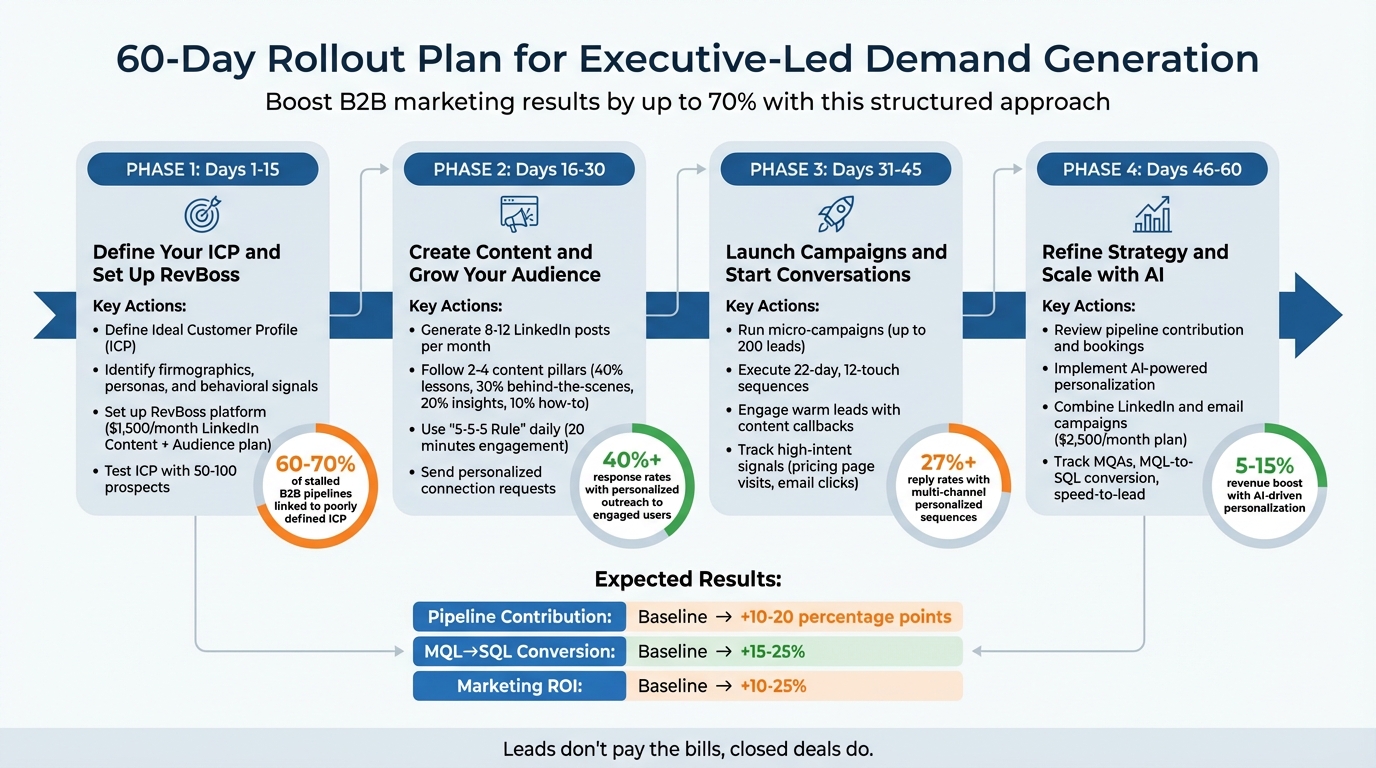
60-Day Executive-Led Demand Generation Rollout Plan
The Best LinkedIn Lead Generation Strategy for 2026
sbb-itb-9354cf2
Days 1-15: Define Your ICP and Set Up RevBoss
The first two weeks are all about laying the groundwork. This involves pinpointing exactly who your target customers are and setting up RevBoss to act on that clarity. Skipping this step isn’t just risky - it’s a pipeline killer. Research shows that 60-70% of stalled B2B pipelines are linked to a poorly defined ICP (Ideal Customer Profile).
How to Define Your Ideal Customer Profile
A strong ICP identifies the buying signals and behaviors of companies that urgently need your solution. As Predictable Revenue puts it:
"If your ICP isn't helping you prospect today, it's not an ICP. It's theater".
To get laser-focused, break it down into three targeting layers:
- Firmographics: Think industry, company size, and revenue range.
- Persona Context: Pinpoint decision-makers and their specific challenges.
- Behavioral Signals: Look for signs that indicate buying readiness, like recent funding rounds, executive hires, or changes in their tech stack.
Take this example: In 2025, Vymo, a financial CRM platform, struggled with a low 4.5% conversion rate from marketing qualified leads to sales qualified leads. Partnering with RevvGrowth, they redefined their ICP to focus on financial institutions facing daily sales tracking headaches and manual data entry issues (rated 9/10 in pain severity). They introduced a "Traffic Light" scoring system - Green for an 80%+ match, Yellow for 60-79%, and Red for below 60%. Within three months, their conversion rate shot up to 18%, generating $41.5 million in marketing-sourced pipeline. This proves how sharpening your ICP can transform your results.
Start with an "ICP v0" - a working hypothesis rather than a polished masterpiece. Test it by building a list of 50-100 prospects and sending small-batch messages over a week. Use reply rates and the quality of conversations to fine-tune your approach. At the same time, define an Anti-ICP to weed out prospects who lack budget authority or the right technical setup.
Once you’ve nailed down and tested your ICP, it’s time to plug these insights into RevBoss.
Getting Started with RevBoss
To kick things off, opt for the LinkedIn Content + Audience plan, which runs at $1,500 per month. During onboarding, you’ll have strategy calls to align RevBoss’s automation with your ICP. The platform takes care of content creation, audience engagement, and campaign management, while you provide the strategic vision and subject matter expertise.
Days 16-30: Create Content and Grow Your Audience
With your Ideal Customer Profile (ICP) finalized and RevBoss up and running, the next two weeks are all about building visibility and trust. This means creating consistent LinkedIn content that highlights your expertise while connecting with an audience of ideal prospects. The goal here isn’t to go viral - it’s to spark meaningful conversations with people who need your services.
Turning Executive Knowledge into LinkedIn Posts
Your expertise is your biggest asset. Use it to create LinkedIn posts that resonate. RevBoss simplifies this process by generating 8–12 posts per month, tapping into your knowledge through live or recorded sessions. These can be quick interviews or casual conversations where you share recent customer wins, lessons from board meetings, or challenges you’re working through. The team at RevBoss then transforms this into posts that sound like you - not like a corporate memo - by using your natural vocabulary and expressions.
Stick to 2–4 content pillars to keep your messaging consistent. A strong mix might include:
- 40% lessons learned: Share your experiences to build credibility.
- 30% behind-the-scenes moments: Show the human side of your business.
- 20% industry insights: Highlight trends and forward-thinking ideas.
- 10% tactical how-to posts: Offer practical advice that encourages saves and shares.
Every post should follow the "Hook-Substance-CTA" formula: start with an attention-grabbing question or statement, deliver concise insights, and close with a light call to action - something that invites engagement rather than a hard sell.
Take inspiration from examples like Alex Boyd of RevenueZen, who shared a "Data Post" outlining three specific strategies for growing organic traffic. Despite earning just 44 likes, the post’s clarity and actionable "DM to talk more" call-to-action led to four solid leads. On a different note, a client of Harris Fanaroff posted a personal photo in a Philadelphia Eagles jersey during the Super Bowl. This sparked a conversation with a fellow fan that turned into a deal worth over $500,000. As Rohan Pavuluri of TeamPost wisely puts it:
"The post should pass the 'would they say this at dinner?' test. If the CEO would never use the phrase 'leveraging synergies to drive value' in conversation, it should not appear in their LinkedIn post".
Once your content is live, the next step is to engage with your audience and turn that visibility into meaningful connections.
Growing and Engaging Your ICP Audience
Publishing great content is only half the equation. You also need to actively grow and engage your audience. Use Sales Navigator filters to find prospects who align with your ICP, then send personalized connection requests. Mention shared interests or reference recent company news to make your outreach stand out.
Adopt the "5-5-5 Rule" as a daily habit: spend 20 minutes leaving thoughtful comments on:
- 5 posts from your target audience.
- 5 posts from key connections like investors or partners.
- 5 posts from industry peers.
When someone interacts with your content - whether they like, comment, or share - respond quickly with a personalized message. Reference their comment to show genuine interest. For high-value prospects, take it a step further by sending a 10-second personalized video message. This tactic is underused (less than 1% of executives employ it), yet it boasts watch rates of 10–15% and response rates of 3–5%. Personalized outreach to engaged users can drive response rates of 40% or more.
Keep in mind that many top decision-makers - CEOs, CFOs, and VPs - might silently observe your posts without engaging. Watch for profile views and impressions to track these "silent engagers".
Managing Content with RevBoss Tools
Once you’ve got great content and an engaged audience, staying organized is essential. The RevBoss app streamlines this by centralizing content scheduling, audience management, and performance tracking. Posts move through a simple "Ideas, Scheduled, Sent" pipeline, so you can act on opportunities quickly.
The app’s RevScope Signal-to-Action Loop syncs with your LinkedIn feed to analyze post-level data - like topic, tone, and intent - offering evidence-based recommendations for future posts and media prompts. Need branded visuals? The creative editor automatically generates on-brand images using your logos and colors, saving you the hassle of switching between tools.
RevBoss also ensures your audience growth stays aligned with your ICP. Every new connection is vetted before any sales outreach begins, keeping your network both relevant and meaningful. Joel Bush, CRO of RepSpark, shared his experience:
"Our Account Manager understands our business, the RevBoss copywriters have embraced our voice. We get quality leads at a reasonable price".
These tools help you maintain consistency and impact, ensuring your content strategy continues to deliver results.
Days 31-45: Launch Campaigns and Start Conversations
At this stage, it's all about turning the engagement you've built into meaningful, sales-ready conversations. With your content live and your audience growing, the focus shifts to creating opportunities that drive results.
Running Event-Based and Engagement Campaigns
The key to effective campaigns is targeting with precision. Micro-campaigns aimed at small groups - think up to 200 leads - can be triggered by specific events like a new VP hire, Series A funding, or a change in tech stack. These campaigns succeed because they hit at the right time with content that resonates.
Tools like RevBoss can help you coordinate email, LinkedIn DMs, and phone calls into a multi-channel sequence, which has been shown to convert three times better. A 22-day sequence with 12 touches works well, divided into three phases:
- Days 1–4: Start with a personalized email, a LinkedIn connection request (without a pitch), and a voicemail. The goal here is to introduce yourself and establish a connection.
- Days 7–11: Build momentum by leveraging social proof, like case studies, and engaging with your prospect’s LinkedIn activity.
- Days 14–22: Create urgency with time-sensitive insights and wrap up with a "breakup email" that puts the decision in their hands.
Keep your emails concise - 75 to 125 words is ideal - to respect your prospect’s time [28,29]. Every touchpoint should provide immediate value, whether it’s an insight, a case study, or a benchmark, before asking for a meeting.
Reaching Out to Warm Leads
Before sending a private message, spend at least seven days engaging with your prospect’s public content. Leave thoughtful comments, like their posts, or share their insights [27,33]. This builds familiarity, so your name is recognized when you reach out directly.
When the time comes to message them, make it personal. Use a "Content Callback" to reference something specific they’ve shared or commented on. As Brandon Briggs, Fractional CRO and Founder of It's Just Revenue, explains:
"The sequence is the scaffolding. The rep is the building".
If a prospect mentions they already have a vendor, take it as a sign they have a budget and a need. Offer a comparison document to show how you stack up. Multi-channel sequences that combine personalized research with genuine value can achieve reply rates of over 27%. Even leaving a voicemail can make a big difference, doubling email reply rates from 2.73% to 5.87%.
RevBoss can also help you identify and prioritize prospects showing strong engagement signals, ensuring your efforts are focused where they matter most.
Identifying High-Intent Prospects
Not everyone who engages with your outreach is ready to buy, so it’s crucial to identify high-intent signals. Use the RevBoss dashboard to track behaviors like visits to your pricing page, multiple email clicks, or repeated profile views. Assign points to these actions - +5 for a website visit, +15 for a pricing page visit, and +10 for an email click - to create an awareness scoring system.
Don’t overlook "silent engagers" like CEOs or CFOs who may view your content without interacting. These quiet observers often signal serious buying interest. Keep in mind that B2B buyers are typically 57% to 69% through their decision-making process before they even contact a vendor, and 86% of enterprise buyers only consider vendors they’re already familiar with [34,30].
For high-intent actions like pricing page visits or demo requests, aim for a response time of under five minutes. Speed matters - buyers showing interest may be receiving over 36 vendor touches in just two weeks. Acting quickly and with relevance can make all the difference in securing a spot on their shortlist.
Days 46-60: Refine Your Strategy and Scale with AI
By this stage, you've built momentum - your audience is engaged, campaigns are running, and conversations are happening. Now, it's time to turn the data you've gathered into actionable insights and scale your most successful tactics with AI.
Reviewing Campaign Results
Focus on the metrics that matter most: pipeline contribution and bookings. The RevBoss dashboard is your go-to tool for tracking performance across the funnel, from awareness to engagement and conversions.
AI can project the future dollar value of your campaigns, helping you make smarter decisions about where to allocate your budget. This means you can double down on high-performing campaigns or cut underperforming ones - without waiting until the quarter ends. Keep an eye on key metrics like Marketing Qualified Accounts (MQAs), conversion rates from MQL to SQL, and sales cycle times to identify bottlenecks in your pipeline.
Armed with these insights, you can shift to AI-powered execution to fine-tune your strategy and automate where it matters most.
Using AI to Improve Personalization and Workflows
Today's AI tools don't just analyze data - they act on it. They can automate responses across systems based on real-time signals. For example, if a prospect visits your pricing page, AI can trigger an email sequence or update your website dynamically. This reduces decision-making cycles from weeks to just a couple of days. Faster responses mean you can stay agile and maintain your competitive edge.
AI-driven personalization has the potential to deliver a 5–15% revenue boost and improve marketing-spend efficiency by 10–30%. Here's how to make it work for you:
- Use AI to draft 2–3 variations of lifecycle emails, then have your team refine them for tone and accuracy before sending.
- Run ongoing champion/challenger tests to identify what resonates best with your audience.
- Set up weekly review cycles to analyze email and web performance, retiring content that doesn't deliver results.
"AI-powered personalization means using machine intelligence to turn first‑party data, behavioral signals, and content into timely, one‑to‑one experiences across channels."
Beyond personalization, AI can streamline workflows, ensuring your outreach is consistent and impactful.
Expanding to LinkedIn and Email Combined
To create a seamless experience for your prospects, combine LinkedIn and email campaigns. Upgrading to RevBoss's $2,500/month combined plan allows you to sync data and timing across platforms, ensuring your messaging feels cohesive rather than fragmented.
Use signal-based targeting to scale personalization effectively. For instance, pairing triggers like a recent funding announcement with a LinkedIn post can significantly boost reply rates - ranging from 25% to 40%. AI-personalized emails, in particular, can achieve reply rates that are five times higher. Timing is critical, so aim to engage prospects within 24–72 hours of key events like a job change or funding news.
With RevBoss, you can track projected pipeline value and adjust your budget in real time, ensuring you're investing in the channels that deliver the best results.
Measuring Results and Planning Ahead
Comparing Before and After Metrics
After 60 days, you should start seeing tangible improvements in your funnel. The focus here isn’t on vanity metrics like clicks or raw lead counts but on revenue-driven indicators. In fact, high-growth B2B companies often attribute around 50% of their new business pipeline to marketing efforts.
To gauge progress, compare key metrics from the start to where you are now. Metrics to prioritize include Marketing Qualified Accounts (MQAs), MQL-to-SQL conversion rates, and pipeline contribution - essentially the dollar value of opportunities influenced by marketing. Another critical measure is speed-to-lead, or how quickly your team responds to inbound interest. Ideally, 95–98% of opportunities should have a recorded source and UTM parameters to ensure precise attribution.
Here’s a snapshot of what your progress might look like:
| Metric | Day 1 Baseline | Day 60 Target | Day 90 Target |
|---|---|---|---|
| Pipeline Contribution | Baseline | +10 percentage points | +15–20 percentage points |
| MQL→SQL Conversion | Baseline | +15% | +25% |
| Speed-to-Lead (SLA Adherence) | 70% | 90% | 95% |
| Data Completeness | 80% | 95% | 98% |
| Marketing ROI | Baseline | +10% | +25% |
"Leads don't pay the bills, closed deals do."
With these metrics in hand, you’ll have the clarity needed to guide your next steps and keep building on the momentum.
Maintaining Progress After 60 Days
Once you’ve hit the 60-day mark, the challenge shifts to sustaining and amplifying your results. Keep the momentum alive by using the insights you’ve gathered to refine your campaigns and strategies.
Begin with weekly 30-minute pipeline reviews alongside your CRO to pinpoint bottlenecks and address them quickly. Adjust your budget quarterly by reallocating 20–30% toward the channels delivering the best results while cutting back on underperforming campaigns. It’s worth noting that only about 30% of paid campaigns tend to yield strong results.
As your strategy evolves, consider expanding your RevBoss programs. For example, if you started with LinkedIn-only content at $1,500/month, upgrading to the $4,000/month Content + Coaching + Activation plan could unlock additional features like direct outreach, event support campaigns, and sales offer development. These tools can help convert your growing audience into qualified opportunities. Alternatively, the $1,500/month Coaching plan offers weekly GTM brainstorming and campaign development support for executives seeking strategic input.
Consistency is key. Regularly measure, adjust, and refine your approach to ensure ongoing improvement. The groundwork laid in these initial 60 days positions you to scale effective strategies and build a predictable, repeatable pipeline for growth.
FAQs
What should I do if I can’t define a clear ICP in the first 15 days?
If you can't pinpoint a clear Ideal Customer Profile (ICP) in the first couple of weeks, shift your energy toward gathering insights. Use this time to collaborate with sales leaders, dig into marketing data, and spot gaps in the pipeline. The goal should be to define your ICP by the end of the first month. However, if that’s not feasible, focus on collecting data, running tests, and using feedback to fine-tune your target audience.
How much executive time does this 60-day plan require each week?
The 60-day demand generation plan generally takes 4 to 8 hours per week of an executive's time. This includes focusing on high-level strategy, attending review meetings, and making critical decisions to keep things on track. While the exact time commitment can differ based on the plan's scope and complexity, it's structured to fit seamlessly alongside other duties.
Which metrics best prove revenue impact after 60 days?
The best way to show revenue impact within 60 days is by focusing on pipeline creation and quality, campaign performance and ROI, and contribution to revenue goals. These metrics offer solid, measurable results from demand generation efforts, giving a clear picture of success in this short window.