Does AI Email Personalization Actually Work?

AI email personalization works - but only if done right. Here’s the quick answer: personalized, AI-driven emails can boost open rates to 90%, increase reply rates by 142%, and generate 760% more revenue than generic emails. But success depends on combining AI with human oversight to avoid robotic tones or bad data.
Key findings:
- AI saves time: What once took 30–45 minutes per email can now take seconds.
- Better engagement: AI-crafted emails see higher open, reply, and conversion rates.
- Data is king: AI shines when using accurate, professional data like company updates or LinkedIn activity. Poor data leads to mistakes.
- Human touch matters: AI should assist, not replace, your judgment. Review drafts to ensure accuracy and tone.
Bottom line: AI can scale personalization effectively, but it’s not a magic bullet. Pair it with thoughtful strategy and quality data for best results.
How to ACTUALLY AI personalize email outreach at scale (so that it works)
What Is AI Email Personalization in B2B Marketing?
AI email personalization takes machine learning and generative AI to the next level by crafting tailored messages - like subject lines, email body content, and calls-to-action - based on detailed recipient data, such as behavior, job role, and buying intent. It’s far more advanced than just dropping a recipient’s first name into a cookie-cutter email template. This technology dives into firmographics (like industry and company size), technographics (software and tools they use), and trigger events (e.g., funding rounds, hiring surges, or product launches) to create messages that feel relevant and timely.
In B2B marketing, this level of precision matters more than you might expect. AI operates on three levels: segment-level (defining your ideal customer profile), account-level (pinpointing "why now" signals like recent mergers), and individual-level (highlighting "why them" based on their specific responsibilities and priorities). This layered approach allows you to send customized, persona-specific emails to different members of a buying committee - like addressing a CFO differently than a RevOps lead - while maintaining a consistent narrative at the account level. This structure is crucial for understanding how AI-driven personalization works and why it’s a game-changer for strategic outreach.
How AI Email Personalization Works
AI operates in two key ways: it uses predictive analytics to figure out the best times to send emails and assess lead scores, while generative models create personalized content. This automates what used to be a painstaking manual process.
Take HubSpot as an example. In January 2025, their marketing team, led by Emmy Jonassen and Kipp Bodnar, revamped their nurture campaigns using GPT-4 and a vector database. The AI analyzed business URLs and content downloads to predict each lead’s specific "job-to-be-done." For instance, when a lead from an organic cold brew company showed interest in influencer marketing, the system predicted they were gearing up for seasonal promotions and sent them a tailored course suggestion. The results? An 82% jump in conversion rates, a 30% lift in open rates, and a 50% boost in click-through rates.
AI Personalization vs. Basic Email Tactics
Traditional email strategies rely on static segmentation, where leads are grouped by shared traits and marketers make educated guesses. AI, on the other hand, delivers true one-to-one personalization by identifying what a prospect is trying to achieve at that moment. Basic tactics often involve "token stuffing" (e.g., adding {{first_name}} and {{company}}), which can feel impersonal and robotic, eroding trust. AI avoids this by tapping into high-value data like account-level triggers and product usage patterns to craft relevant, customized messages.
| Feature | Basic Tactics | AI-Driven Personalization |
|---|---|---|
| Data Usage | Name, company, location | Behavioral, intent, triggers |
| Segmentation | Static, manual groups | Dynamic, adaptive segments |
| Content | One-size-fits-all templates | Individually tailored messaging |
| Research | Manual, time-intensive | Automated analysis |
The stats don’t lie. Personalized campaigns can drive up to 760% more revenue compared to generic "batch and blast" emails. On top of that, 73% of B2B buyers actively avoid vendors who send irrelevant outreach.
Why B2B Email Marketing Is Different
B2B sales are a whole different ballgame compared to B2C. The buying cycles are longer, and decisions often involve multiple stakeholders, meaning your emails need to do more than just grab attention - they need to build trust across an entire team. Unlike B2C, where a single person makes a quick decision, B2B requires "multi-threading" outreach. This means delivering different value propositions to various decision-makers while keeping the overall account narrative consistent.
Each stakeholder in a B2B deal requires tailored messaging. In fact, 91% of buyers are more likely to engage with vendors who personalize their communications. At the same time, 61% of B2B buyers now prefer a buying process without a sales rep, putting extra pressure on automated email campaigns to be helpful rather than intrusive. AI steps in here, sifting through mountains of data - like website activity, tech stacks, and hiring trends - to create emails that feel personal and relevant, all without sounding robotic.
"AI should do the research and first draft, but the message still needs to sound like a human who understands the buyer's world."
What the Data Shows: AI Email Personalization Performance
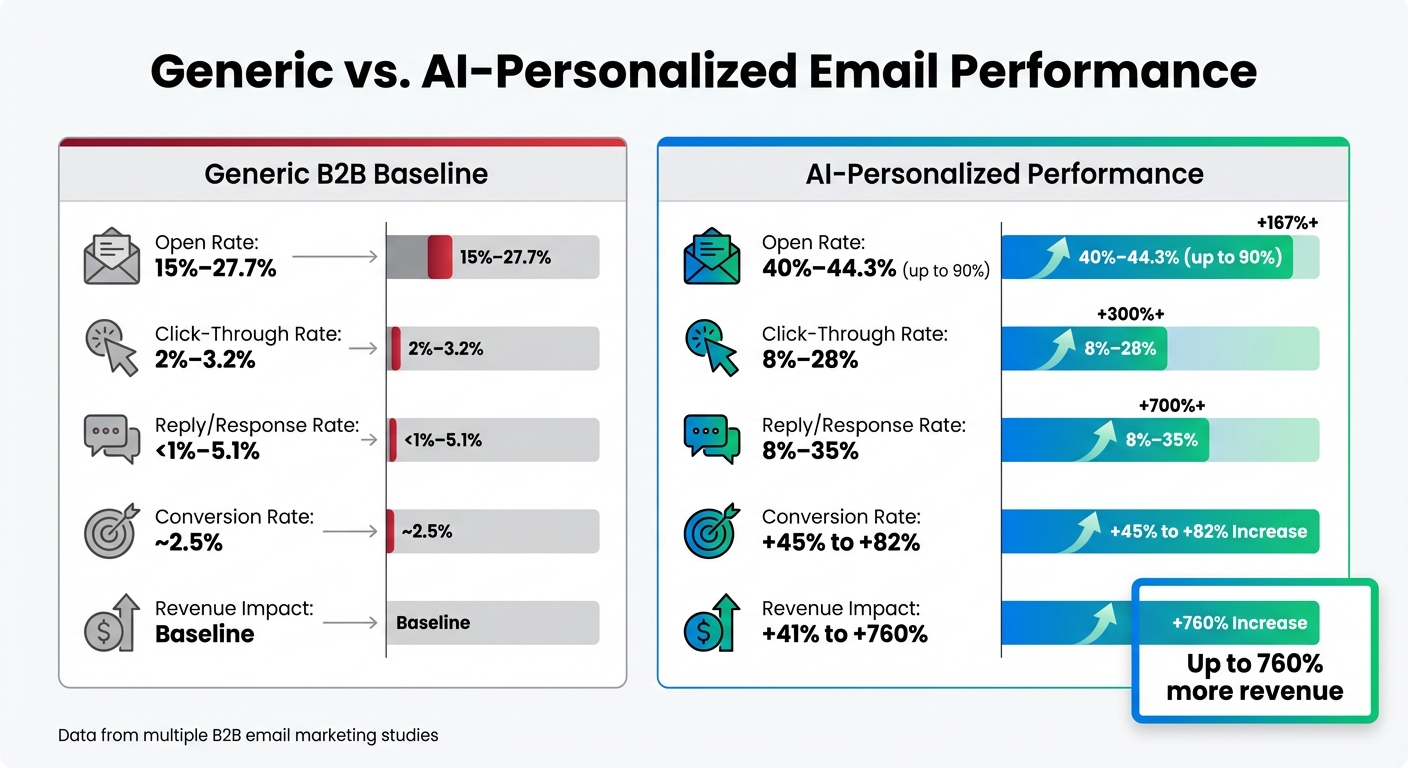
AI-Personalized vs Generic B2B Email Performance Comparison
Typical Results for Generic B2B Emails
When it comes to generic B2B email campaigns, the numbers aren’t exactly inspiring. On average, cold emails see an open rate of 27.7%, with response rates hovering between 1% and 5.1%. Click-through rates rarely climb past 3.2%, and the rate of meetings booked is a discouraging 1%. In particularly competitive industries, open rates can plunge to as low as 15%. These stats highlight the limitations of “batch-and-blast” email strategies. But there’s good news - AI-driven personalization has been shown to deliver far better outcomes.
Measured Results from AI Personalization
Emails powered by AI personalization are proving to be game-changers. Research shows they can achieve 6x higher transaction rates compared to generic emails. Reply rates can jump by an impressive 142%, with some campaigns achieving response rates as high as 35%. Companies leveraging AI for email personalization have reported a 41% year-over-year increase in email-attributed revenue. Even more striking, segmented and personalized campaigns have been shown to drive up to 760% more revenue than their non-segmented counterparts.
Take The Willow Tree Boutique, for example. In June 2023, they used predictive analytics to target customers based on AI-predicted next purchase dates. The results? Within just 90 days, 17.1% of their total email revenue came from AI-driven segments, contributing to a 44.6% year-over-year growth in email-attributed revenue. Similarly, Tata Harper Skincare tested 20 variations of sign-up forms in February 2024 using AI tools. This led to a 65% increase in form submissions and a 139% year-over-year boost in revenue from automated email flows in just 30 days.
HubSpot’s marketing team took things a step further in January 2025. Led by CMO Kipp Bodnar and VP of Marketing Emmy Jonassen, they implemented an AI system that analyzed business URLs and content downloads to predict user intent. The results? An 82% jump in conversion rates, a 30% rise in open rates, and a 50% boost in click-through rates.
"AI's real power in marketing isn't just automation - it's understanding individual customer needs at scale."
The table below lays out the stark contrast between generic and AI-personalized email performance.
Comparison Table: Generic vs. AI-Personalized Emails
| Metric | Generic B2B Baseline | AI-Personalized Performance |
|---|---|---|
| Open Rate | 15%–27.7% | 40%–44.3% (up to 90%) |
| Click-Through Rate | 2%–3.2% | 8%–28% |
| Reply/Response Rate | <1%–5.1% | 8%–35% |
| Conversion Rate | ~2.5% | +45% to +82% |
| Revenue Impact | Baseline | +41% to +760% |
Sources:
Why AI Email Personalization Works (And When It Doesn't)
How AI Improves Email Engagement
AI takes email personalization to another level, moving beyond the basic "Hi [First Name]" approach. It digs into behavioral and intent data to identify what a prospect is trying to achieve - whether that’s launching a new product or developing an influencer strategy. By analyzing real-time business triggers, AI ensures outreach happens at the perfect moment, using predictive send-time analysis to determine when a recipient is most likely to engage.
Instead of relying solely on generic segmentation by job title or industry, AI zeroes in on the specific task the recipient is working on. It identifies high-value triggers in real time, creating outreach opportunities that feel timely and relevant. For example, AI can analyze when someone typically opens or clicks on emails and schedule delivery for those precise windows.
AI also uses vector database matching to craft content tailored to a lead’s goals. It finds the closest match within your existing content library, ensuring relevance. On top of that, multivariate testing allows AI to trial different subject lines, openers, and calls-to-action at scale, quickly eliminating underperforming options.
"The real 'magic' isn't in the email itself but in how well the AI could predict what the user actually needed."
While AI has the potential to transform email engagement, it’s only as effective as the quality of the data it’s working with and the precision of its execution.
Common Failures of AI Personalization
Even with all its capabilities, AI isn’t foolproof. Mistakes often come down to poor data and an overdependence on automation. If your customer profiles are vague or built on outdated information, AI can misfire, leading to personalization that feels off or even alienates prospects. In fact, 53% of B2B buyers have reported that bad personalization negatively affected their purchase experience, making them 3.2 times more likely to regret their decision.
Shallow personalization - like dropping in a first name without any meaningful context - does more harm than good. Prospects can spot lazy automation a mile away. Worse, crossing personal boundaries by referencing overly private details, like vacations or family, can feel intrusive. Stick to professional, publicly accessible information, such as LinkedIn updates, company news, or press releases.
Another major pitfall is relying on AI to generate content without human oversight. A robotic tone or factually incorrect claims can damage your credibility. Research shows that 73% of B2B buyers actively avoid vendors who send irrelevant or inaccurate outreach.
"If your AI is just helping you send more bad emails, you're shrinking your addressable market."
Finally, ignoring email deliverability can sink even the most well-crafted campaigns. Scaling up with AI-generated content without warming up domains or validating email addresses leads to spam complaints, ultimately hurting your sender reputation.
Comparison Table: What Works vs. What Fails
| What Works | What Fails |
|---|---|
| Using professional business triggers (e.g., funding, hiring, product launches) | Referencing personal details (e.g., vacations, family, hobbies) |
| Contextual outreach based on verified priorities | Generic first-name tokens with no meaningful context |
| Human-reviewed drafts for tone and accuracy | Relying on fully automated emails with no quality checks |
| Reliable, segmented data from trusted sources | AI generating false claims from bad or outdated data |
| Structured templates with specific AI-customizable sections | AI rewriting entire emails, leading to inconsistent brand voice |
| Gradual scaling with proper domain warming | Rapid scaling without email validation or sender reputation management |
Sources:
sbb-itb-9354cf2
AI Personalization for Founder-Led B2B Marketing
Why Personal Voice Matters in B2B Outreach
When it comes to B2B marketing, founders bring a unique advantage: their deep expertise and personal stories. These elements create a level of credibility that generic outreach simply can't match. According to research, 74% of buyers are more inclined to engage with vendors who personalize their experience - but that personalization only works when it feels genuine and relatable. A founder sharing their own insights on industry challenges or recounting how they tackled a specific problem builds trust in a way that no template can replicate.
Here's the catch: crafting truly personalized outreach manually takes time - about 30–45 minutes per prospect. That means a founder can only manage around 10 tailored emails per hour. AI flips this equation, making it possible to scale personalization without losing the founder’s authentic voice.
How AI Supports Founder-Led Campaigns
Think of AI as your behind-the-scenes assistant. It takes care of the heavy lifting, like digging up details on a prospect’s hiring trends, leadership changes, or tech stack updates. This frees up founders to focus on what really matters: creating a compelling narrative that resonates. With AI, what used to take 40 minutes per prospect can now be done in seconds, allowing founders to scale from 10 to 100 personalized emails while maintaining quality.
"AI should be the research assistant, not the closer. The reps who win are the ones who use AI to save time on research and targeting, then reinvest that saved time into thoughtful outreach, storytelling, and relationship-building."
The secret is in training the AI to mirror the founder’s unique writing style. By feeding it content like blog posts, podcast transcripts, or call recordings, the system learns the tone and avoids sounding robotic. Founders can also set permanent guidelines for style - like using straightforward language or a bold, no-nonsense tone - to ensure consistency across campaigns. AI can even tweak messaging for different audiences, such as technical decision-makers versus financial stakeholders, while keeping the core brand voice intact.
This blend of AI’s speed and human creativity is the foundation of RevBoss’s approach to personalization.
How RevBoss Supports Founder-Led Personalization
RevBoss takes AI-powered personalization a step further by combining automation with human oversight to ensure campaigns stay sharp and authentic. The platform automates prospect research and drafts personalized messages, leaving room for a quick human review - typically under 60 seconds - to fine-tune tone and accuracy. This "human-in-the-loop" method ensures every message reflects the founder’s expertise and perspective.
RevBoss offers a Content + Coaching + Activation program (starting at $4,000/month) that covers direct outreach through email and LinkedIn DMs, audience targeting workflows, and crafting sales offers. The platform uses standardized templates with customizable sections for AI to fill in, like the opening line or problem framing, while keeping the overall message consistent. This prevents any drift from the founder’s voice and ensures the authenticity that makes their outreach so effective.
How to Measure ROI from AI Email Personalization
Key Metrics to Track
To truly understand the return on investment (ROI) from AI-powered email personalization, focus on metrics that directly impact revenue. Start with the basics: open rates and click-through rates. These are calculated by dividing unique events (opens or clicks) by the total number of delivered emails. They give you a sense of how much initial engagement your emails are generating.
Next, dig deeper with the reply rate, which is the percentage of unique human replies compared to delivered emails. This helps gauge how well your message resonates with recipients. For even more clarity, look at the positive reply rate - the proportion of replies that express genuine interest in your product or service. This metric gives you a clearer picture of the quality of responses you’re receiving.
Finally, calculate your cost per meeting. Add up all expenses tied to your email campaign - such as software subscriptions, AI credits, domain costs, and team labor - and divide that total by the number of meetings booked. This figure tells you whether the AI-driven personalization efforts are worth the investment. Research shows that AI personalization can yield up to a 16x revenue efficiency ratio, driving significantly more revenue with much less manual effort.
Once you’ve defined these metrics, you’re ready to test your campaigns and measure the actual ROI.
How to Run Before-and-After Tests
Testing the impact of AI personalization requires a methodical approach. Start by collecting 60 to 90 days of outbound email data to establish a baseline for your current performance. Review key metrics like open rates, reply rates, and meeting conversion rates to understand where you stand.
Next, focus on a specific audience segment within your Ideal Customer Profile (ICP) and split it into two groups. Send your standard email template to one group, while the other receives an AI-personalized version. To ensure your results are statistically valid, aim to deliver between 300 and 500 emails to each group. Analyze the performance of both groups over a consistent time frame - whether it’s 7, 14, or 30 days after sending - to ensure a fair comparison.
When reviewing results, filter out auto-replies, out-of-office messages, and system notifications to get an accurate reply rate. Go further by tagging replies as "Interested", "Not Now", "Wrong Person", or "Irrelevant." This will help you calculate the positive reply rate and refine your AI prompts based on real feedback.
Previous tests have shown that AI personalization can lead to noticeable improvements in engagement and conversion rates, making this process well worth the effort.
Measurement Table: Tracking Your Results
Use the table below to record and compare your metrics before and after implementing AI personalization. This will help you visualize the impact and identify areas for improvement.
| Metric | Formula | Before AI | After AI | % Change |
|---|---|---|---|---|
| Open Rate | (Unique Opens ÷ Delivered Emails) × 100 | |||
| Click-Through Rate | (Unique Clicks ÷ Delivered Emails) × 100 | |||
| Reply Rate | (Unique Human Replies ÷ Delivered Emails) × 100 | |||
| Positive Reply Rate | (Positive Replies ÷ Total Replies) × 100 | |||
| Meeting Rate | (Meetings Booked ÷ Delivered Emails) × 100 | |||
| Cost Per Meeting | Total Campaign Costs ÷ Meetings Booked |
Fill in the "Before AI" column with your baseline data and update the "After AI" column once your test has run for at least 30 days. The "% Change" column will reveal where AI personalization has made a difference - and where you might need to tweak your approach.
Conclusion: Does AI Email Personalization Work?
Yes, it does - but only when you combine AI-driven insights with a human touch. The numbers speak for themselves: AI-personalized emails can hit open rates as high as 90%, drive response rates up to 35%, and even rake in up to 760% more revenue compared to generic email blasts.
For founder-led B2B businesses, the benefits go beyond just saving time. It’s about scaling outreach without losing that personal, authentic touch. This approach ties back to what we’ve seen before: generic outreach falls flat, while founder-led efforts thrive on deeper connections. AI takes care of the heavy lifting - like data enrichment, prospect research, and drafting - so founders can focus on the bigger picture: crafting a compelling narrative and building relationships.
"AI's real power in marketing isn't just automation - it's understanding individual customer needs at scale."
The secret? Treat AI as your right-hand tool, not a substitute for human judgment. High-impact personalization that tackles specific challenges or leverages account-level insights beats surface-level tricks like just adding a recipient’s name. On the flip side, bad personalization can backfire: 53% of B2B buyers report that poor personalization negatively impacted their buying experience, making them 3.2 times more likely to regret their purchase.
To get the most out of AI-powered email personalization, take a hybrid approach. Let AI handle tasks like data enrichment and multivariate testing, but you stay in control of your brand voice, strategic storytelling, and final quality checks. Start with high-intent email sequences - like welcome series or cart abandonment emails - where customer behavior gives you the clearest signals. Focus on account-level triggers, such as recent funding rounds, executive hires, or gaps in their tech stack, rather than relying on generic demographic details. This balance ensures your emails hit the mark every time.
FAQs
How does AI-driven personalization enhance email engagement in B2B marketing?
AI-driven email personalization is transforming B2B marketing by crafting content that feels tailored to each recipient. By tapping into real-time behavioral data, firmographics, and other critical insights, it ensures that every email speaks directly to the recipient's needs and interests.
This kind of precision can lead to major wins - higher open rates, better response rates, and increased conversions. Some businesses using AI have seen open rates soar between 25% and 90%, with conversion rates climbing by as much as 82%. It’s a game-changer for boosting engagement and building stronger customer connections.
What mistakes should I avoid when using AI for email personalization?
The most common missteps in using AI for email personalization often stem from how the technology is applied, rather than any inherent flaws in the AI itself. Tossing in a first name or other simple placeholders just doesn’t cut it anymore - today’s audiences expect emails to feel relevant and tailored to their context. Generic messages not only fail to connect but can also drag down your response rates. Plus, AI is only as good as the data it’s fed. If you’re working with outdated or incomplete information, you risk sending messages that feel irrelevant - or worse, off-putting.
Another frequent issue is leaning too heavily on automation. Without human oversight, AI-driven emails can veer off course - missing the right tone, sharing details that feel too personal, or landing in inboxes at awkward times. These missteps can quickly derail engagement. To sidestep these problems, make sure you’re working with clean, accurate data, double-check AI-generated content for consistency with your brand, and focus on crafting messages that deliver actual value rather than just surface-level personalization. Striking the right balance between automation and human input is key to making your outreach resonate.
How can I calculate the ROI of AI-powered email personalization?
To figure out ROI, start by identifying the extra revenue generated from AI-powered email campaigns - think higher open rates, better engagement, or more conversions. Then, subtract the total costs of the AI tools and campaign execution from this revenue. Take that net profit, divide it by the total costs, and multiply by 100 to get your ROI as a percentage.
Here’s an example: Let’s say your AI-driven emails bring in $50,000 in additional revenue, and the total cost of tools and execution is $5,000. The ROI would be a whopping 900%. Here’s the math: $50,000 - $5,000 = $45,000; then $45,000 ÷ $5,000 × 100 = 900%. This straightforward formula shows how well AI is working to boost your business results.