AI Marketing Assistant vs. Traditional Agency: What Founders Actually Need

Founders face a critical decision: Should they choose AI marketing tools or agencies to grow their business? Here's the short answer: AI tools are cost-effective, fast, and scalable, while agencies offer human expertise, creativity, and a hands-on approach. Choosing the right option depends on your budget, goals, and how much time you can dedicate to managing marketing.
Key Takeaways:
- AI Marketing Assistants: Affordable (starting at ~$500/month), automate tasks like content creation and lead scoring, and provide rapid campaign adjustments. However, they lack strategic depth and human creativity.
- Marketing Agencies: Offer expert guidance, personal connections, and tailored strategies but come with higher costs (starting ~$5,000/month) and slower execution speeds.
- Hybrid Approach: Combining both can maximize efficiency and results, with AI handling repetitive tasks and agencies focusing on strategy and storytelling.
Quick Comparison:
| Factor | AI Marketing Assistants | Marketing Agencies |
|---|---|---|
| Cost | ~$500/month | ~$5,000+/month |
| Response Time | Hours | ~18 days |
| Scalability | High | Limited by team size |
| Personalization | Automated | Tailored |
| Creativity | Limited | Strong |
| Lead Gen Costs | Lower | Higher |
Bottom Line: If you're budget-conscious and need speed, AI tools are a practical choice. If you need deeper expertise and personal connections, agencies are better. For many, a mix of both delivers the best results.
AI Marketing Agencies: Scams or a Shortcut for Your Business in 2025?
AI Marketing Assistants: What They Do Well and Where They Fall Short
AI marketing assistants simplify and automate many marketing tasks, taking over responsibilities that once required entire teams. By streamlining these processes, they cater to founders who prioritize efficiency and cost savings. Here's a closer look at what these tools bring to the table and where they might fall short.
Main Features of AI Marketing Assistants
AI marketing assistants come packed with features designed to make marketing easier and more effective:
- Content Creation and Optimization: They can generate blog posts, social media updates, email campaigns, and ad copy by analyzing successful patterns and staying consistent with a brand's voice.
- Audience Segmentation and Targeting: These tools analyze customer data to find behavioral trends. They can automatically segment email lists based on factors like engagement, purchase habits, and demographics, ensuring tailored messaging for each group.
- Campaign Optimization and A/B Testing: AI tools make real-time adjustments to campaigns, pausing underperformers and scaling successful ones based on preset performance goals.
- Performance Analytics and Reporting: With dashboards that track key metrics, these tools highlight trends and provide actionable insights to fine-tune marketing strategies.
- Lead Scoring and Nurturing: By analyzing engagement signals - like website activity, email interactions, and social media behavior - AI assistants assign lead scores and trigger follow-up actions automatically.
Benefits for Founder-Led Businesses
For founder-led businesses, these tools offer several practical advantages:
- Cost Efficiency: AI tools are typically more affordable than hiring a marketing agency.
- 24/7 Operation: They keep campaigns running and leads engaged around the clock, which is especially useful for businesses operating in global markets.
- Quick Launch and Iteration: Founders can roll out campaigns and test new strategies rapidly, making real-time adjustments based on immediate feedback.
- Data-Driven Insights: AI processes customer data, market trends, and campaign performance to deliver actionable recommendations without requiring hours of manual research.
- Scalability Without High Costs: As businesses grow, these tools can handle increased marketing demands without the need for additional staff or proportional budget increases.
Drawbacks to Consider
Despite their strengths, AI marketing assistants do have some limitations:
- Dependence on Quality Data: These tools rely on high-quality data to perform well. Smaller businesses may struggle if they lack enough data to feed the system.
- Limited Creativity and Strategy: While AI is great at recognizing patterns, it often misses the mark when it comes to nuanced messaging or making strategic shifts that require human intuition.
- Setup and Learning Curve: Founders without a marketing background might find the initial setup and periodic adjustments challenging.
- Lack of Specialized Expertise: AI tools may not fully understand the complexities of niche B2B markets, including regulatory requirements or intricate decision-making processes.
- Weakness in Relationship Building: Personal relationships and trust remain critical in high-touch sales environments, something AI simply can't replicate.
- Over-Reliance on Historical Data: AI recommendations are based on past performance, which could lead to missed opportunities in markets that are evolving quickly or unpredictably.
Understanding these strengths and limitations is key to deciding whether AI marketing assistants are the right fit for your business or if traditional marketing agencies might offer a better solution.
Marketing Agencies: Benefits, Drawbacks, and Expertise
Traditional marketing agencies bring human expertise, creative strategies, and a level of strategic insight that AI tools just can't replicate. For founder-led B2B businesses, it's essential to understand what agencies bring to the table - and where they might fall short - before deciding if they’re the right fit.
What Marketing Agencies Provide
Marketing agencies offer a wide range of services designed to cover every aspect of marketing. It all starts with strategy development, where they dive into market research, competitor analysis, and detailed planning to align campaigns with specific business goals. This groundwork often includes positioning, messaging frameworks, and go-to-market strategies - areas where many founders might struggle without external support.
Another major offering is creative production. Agencies specialize in branding, website design, video creation, and graphic design, ensuring a polished and cohesive look across all materials.
When it comes to media buying and advertising management, agencies bring their connections to the table. They can negotiate better rates and placements, handle campaign management, and provide ongoing performance analysis across platforms like Google Ads, LinkedIn, and Facebook, as well as traditional media channels.
Account management is another hallmark of agency services. Dedicated account managers act as the main point of contact, coordinating various teams and ensuring projects stay on track. For B2B founders, this can be a game-changer, as agencies often extend their support to sales enablement - creating assets like case studies, whitepapers, and sales presentations, along with managing lead nurturing campaigns that require precise timing and messaging.
These services form the backbone of what agencies offer, setting the stage for their strengths in strategic marketing.
Strengths of Marketing Agencies
Agencies excel in areas where human insight and creativity are critical. Their deep industry knowledge allows them to navigate market complexities, understand buyer behavior, and address specific regulatory needs - things automated tools often miss.
They shine in creative ideation and storytelling, crafting narratives that resonate emotionally and helping businesses carve out distinctive brand positions in competitive markets.
In B2B settings, where trust is paramount, agencies take a relationship-driven approach. They understand how to build personal connections with prospects through strategic outreach and networking, emphasizing the importance of timing and human interaction in complex sales cycles.
Another standout strength is cross-channel integration. Agencies ensure that messaging across email, social media, websites, and sales materials works harmoniously, guiding prospects through a cohesive journey toward conversion.
Finally, agencies prioritize quality control and brand consistency. Their experienced teams meticulously review every piece of content, ensuring it meets professional standards and aligns with the brand’s identity.
Challenges for Founder-Led Businesses
Despite their strengths, agencies aren't always the best fit for founder-led businesses, especially startups operating on tight budgets or fast timelines.
One major hurdle is cost. Many agencies require hefty monthly retainers, setup fees, and long-term contracts, which can be tough for bootstrapped startups or businesses with limited marketing resources.
Slower turnaround times can also be a sticking point. While agencies follow thorough processes involving approvals and creative reviews, this can delay execution. For founders in dynamic markets, this lag can hinder quick testing and adaptation.
Rigid engagement models add another layer of complexity. Agencies often stick to predefined strategies, making mid-course adjustments time-consuming and costly. Long-term contracts further limit flexibility, leaving founders with little room to pivot as their business evolves.
Extensive communication requirements can strain time-strapped founders. Regular meetings, status updates, and approval cycles demand significant involvement from leadership teams juggling multiple responsibilities. In some cases, managing the agency relationship can feel as demanding as handling marketing internally.
Lastly, there’s the risk of misaligned priorities. Agencies might focus on metrics like brand awareness or engagement, while founders often need immediate results in lead generation and revenue growth. This disconnect can lead to frustration and wasted resources.
sbb-itb-9354cf2
Side-by-Side Comparison: AI Marketing Assistants vs Marketing Agencies
For founders juggling tight budgets and fast-changing markets, understanding the differences between AI marketing assistants and traditional agencies is key to making informed decisions.
Key Comparison Factors
- Cost-Efficiency: AI tools start at about $500 per month, cutting acquisition costs by 22% and reducing lead generation expenses by up to 50%. Agencies, on the other hand, often come with higher price tags due to retainer fees and additional costs.
- Speed-to-Market: While agencies typically take around 18 days to respond, AI systems can act within hours. This quick response allows businesses to reallocate budgets faster, leading to an 18% increase in ROI when done within 48 hours.
- Scalability and Efficiency: AI tools improve efficiency by as much as 80% and save content creators over five hours per week. Agencies, being reliant on human teams, face natural capacity limits.
- Customization and Personalization: Agencies excel at creating tailored strategies, while AI tools deliver scalable personalization. AI meets 80% of customer expectations while reducing costs by up to 30%.
- Founder Priorities: With 60% of marketers spending more time on manual tasks than strategic planning, AI helps free up time for founders to focus on big-picture goals.
Comparison Table
| Factor | AI Marketing Assistants | Traditional Marketing Agencies |
|---|---|---|
| Monthly Cost | Starting around $500 | Higher, with retainer fees |
| Response Time | Hours | About 18 days |
| Efficiency Boost | Up to 80% improvement | Limited by team size |
| Lead Gen Cost | Up to 50% reduction | Often higher costs |
| ROI Improvement | 20–30% higher ROI | Varies with execution |
| Time Savings | Saves over 5 hours/week | Requires more founder input |
| Scalability | Highly scalable via automation | Constrained by human resources |
| Personalization | Scalable personalization | Creative, tailored strategies |
This breakdown highlights the strengths and trade-offs of each option.
When to Use Both Approaches
A hybrid approach - combining AI's automation with an agency's strategic expertise - can deliver the best results for founder-led businesses looking for agility and depth.
During periods of rapid growth, AI can handle tasks like campaign execution, data analysis, and optimization. Meanwhile, agencies provide strategic guidance and creative input. Businesses using this combination have reported 20–30% higher ROI on campaigns.
For campaigns requiring specialized knowledge or intricate creative work, agencies offer unmatched human insight. At the same time, AI tools efficiently manage tasks like campaign monitoring, performance analysis, and lead nurturing. For market entry efforts, agencies can define positioning and messaging strategies, while AI ensures campaigns stay optimized over time.
With 82% of early AI adopters reporting financial gains, pairing AI's operational strengths with agency-led creativity is becoming a go-to strategy for forward-thinking founders. This blend of automation and human expertise can unlock growth and maximize returns.
RevBoss: Marketing Solutions Built for Founder-Led B2B Brands
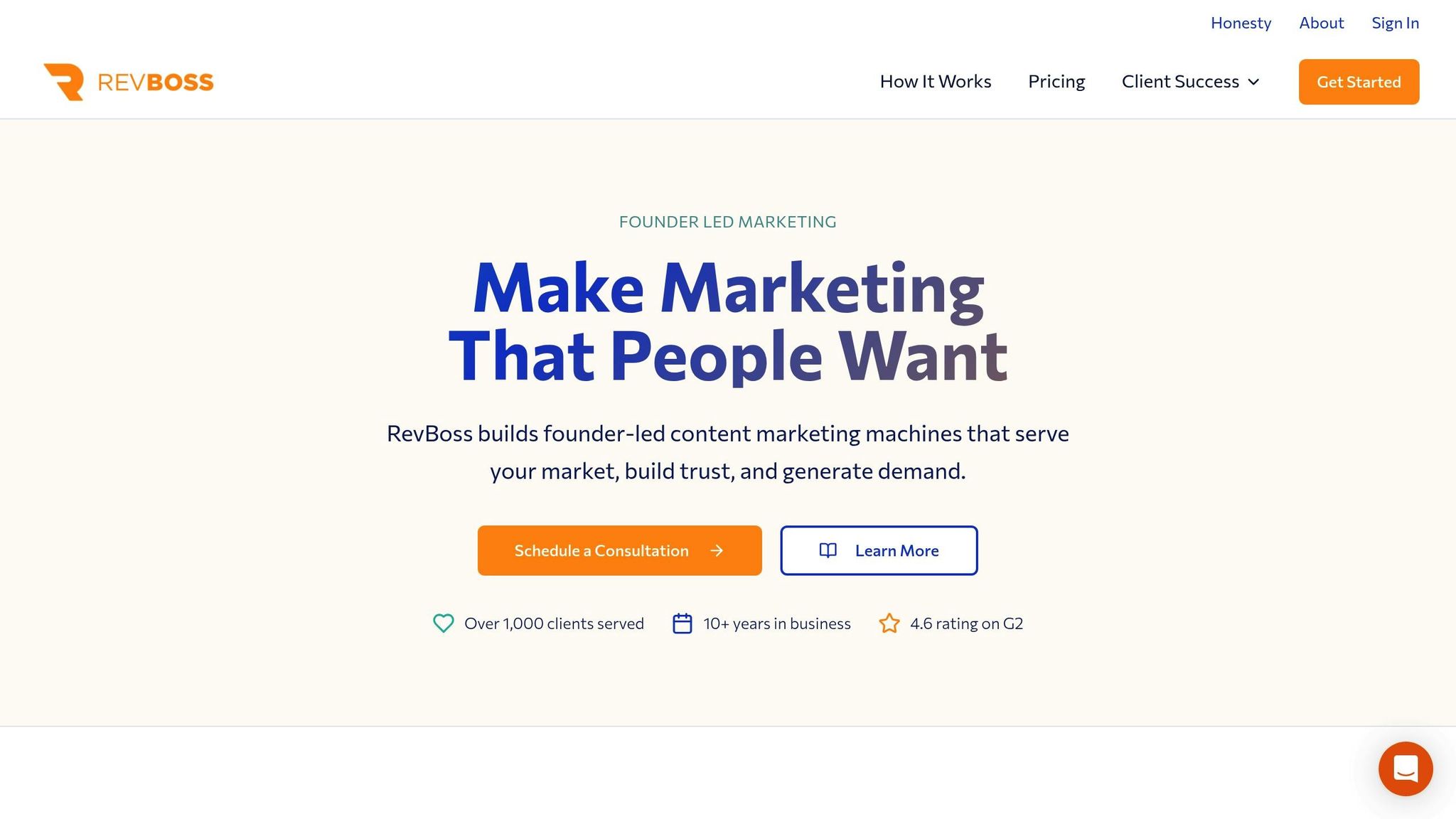
While AI tools and traditional agencies cater to a broad spectrum of needs, RevBoss focuses exclusively on founder-led B2B brands. With over a decade of experience and a track record of working with 1,000+ clients, RevBoss crafts personalized marketing strategies that build trust and drive measurable results. By combining strategy and execution, RevBoss addresses the unique challenges founders face in scaling their businesses.
"RevBoss builds founder-led content marketing machines that serve your market, build trust, and generate demand."
Founder-led businesses often require marketing that reflects the founder's vision and expertise while remaining scalable. RevBoss bridges this gap by blending strategic insights with actionable execution. Unlike generic solutions, their approach focuses on demand generation, leveraging the best of AI and traditional agency methods to tackle founder-specific hurdles.
Key Features of RevBoss
RevBoss offers a marketing system that revolves around the founder’s personal brand. It starts with a tailored content strategy aimed at engaging the ideal audience through educational and engaging material.
One standout feature is their LinkedIn audience growth campaigns, which tap into the founder’s personal network and industry connections. This approach recognizes that B2B buyers typically prefer to connect with people rather than faceless brands. For founder-led companies, the credibility and visibility of the founder can have a direct impact on business growth. This aligns with the need for personalized and scalable marketing solutions in such businesses.
Another critical element is their activation campaigns, which focus on converting conversations into qualified leads. RevBoss doesn’t just create content - they run campaigns that spark meaningful interactions. Their demand generation workflows ensure that content strategies are tightly integrated with lead nurturing, driving pipeline growth.
The platform also offers a streamlined onboarding process, which is a big win for busy founders. Instead of requiring extensive setup or management time, RevBoss handles content creation and audience engagement, allowing founders to maintain an active marketing presence while focusing on running their businesses.
"We partner with our clients to develop interesting, educating, and entertaining marketing content that serves their audience. And we don't just create and wait. We execute campaigns that generate conversations and convert into pipeline."
Pricing and Plans
RevBoss keeps its pricing straightforward and accessible for founder-led businesses. The Standard Plan starts at $2,500 per month, covering custom content strategy, production, audience growth, and lead activation campaigns. This includes LinkedIn campaigns, email outreach, SEO content, and activation workflows.
For those who want to try before committing, RevBoss offers a Pilot Program with custom pricing and a limited duration. This allows businesses to experience the platform’s core features without a long-term commitment.
For companies ready to commit, the Annual Plan offers discounted rates for a 12-month agreement. All plans include comprehensive features, with pricing adjustments based on specific content needs and media budgets. Compared to traditional agency retainers, which often start at $5,000+ per month, RevBoss provides a more accessible option without compromising on execution.
Why RevBoss Works for Founders
Founder-led businesses operate differently from larger enterprises. Founders juggle multiple roles, make quick decisions, and need marketing that reflects their personal vision and expertise. RevBoss embraces these realities with a founder-focused approach. By addressing the challenges of limited budgets and time constraints, the platform delivers results without unnecessary complexity.
"Authenticity, trust, and audience are the only durable marketing differentiators in an AI-first market."
With a 4.6 rating on G2, RevBoss has earned the trust of founder-led businesses. Their emphasis on genuine relationship-building over generic messaging resonates in B2B markets, where trust and credibility are key drivers of purchasing decisions.
RevBoss prioritizes authentic and trust-based marketing programs, ensuring campaigns serve the audience first, with sales as a natural outcome. This approach helps founders create sustainable growth rather than relying on short-term tactics that could harm long-term relationships.
Additionally, RevBoss understands the importance of measurable outcomes. Their campaigns are designed to generate meaningful conversations and convert them into pipeline opportunities, offering clear ROI tracking. This focus on tangible results allows founders to confidently invest in marketing and make informed decisions about scaling their efforts.
Conclusion: How to Choose the Right Marketing Solution
Finding the right marketing solution means identifying what works best for your unique business needs. AI-powered tools can handle tasks like content creation and automation with impressive efficiency, streamlining everyday processes. Meanwhile, traditional marketing agencies offer end-to-end strategies and execution, ideal for businesses seeking a more hands-off approach.
For many founder-led B2B companies, the real challenge lies in striking the right balance - leveraging your expertise while scaling your efforts. Think about your time, budget, and how crucial your personal brand is to your growth strategy.
This is where RevBoss steps in. RevBoss blends strategic expertise with founder-focused execution, offering tailored content strategies, in-house content creation, and LinkedIn campaigns that amplify your unique voice. Their approach is designed to support your brand, build trust, and generate demand - all while staying cost-effective.
The best marketing solution isn’t about choosing between AI-driven efficiency and full-service creativity. It’s about finding a method that aligns with your workflow and supports your business goals. With RevBoss, you get a mix of AI precision and human insight, helping you maintain authenticity, foster strong relationships, and scale as your business grows.
FAQs
How can founders decide between using an AI marketing assistant and a traditional marketing agency?
To choose between an AI marketing assistant and a traditional marketing agency, founders need to consider their specific business needs, budget, and long-term goals. AI marketing assistants excel at handling repetitive tasks, crunching data, and managing campaigns that are both cost-efficient and scalable. Meanwhile, traditional agencies bring strategic thinking, creative expertise, and a level of human intuition that AI tools simply can't match.
For many businesses, a mix of the two works best. AI can take care of routine tasks like email marketing or audience segmentation, while agencies focus on big-picture strategy and creative work. This combination allows you to maximize efficiency while keeping your marketing innovative and aligned with your brand’s growth plans.
How can founder-led businesses balance cost efficiency and creative expertise in their marketing efforts?
Founder-led businesses have some unique advantages, like in-depth industry expertise and the agility to make swift, strategic decisions. These traits can lead to more cost-effective marketing efforts that stay tightly aligned with the company’s overall goals.
That said, scaling up often requires a level of creative expertise that can be hard to cultivate internally. Bringing in an external agency might mean higher upfront expenses, but it also opens the door to professional-grade resources and fresh ideas that could be hard to replicate within the team.
The real challenge lies in striking the right balance: using the founder’s deep insights to shape the strategy while outsourcing specialized tasks to ensure campaigns are both impactful and efficient.
When should founder-led businesses combine AI marketing tools with traditional marketing agencies?
A hybrid approach is ideal for founder-led businesses looking to blend the efficiency of AI tools with the creativity and personal touch of traditional marketing. AI can take on tasks like optimizing digital ads, analyzing customer behavior, and generating tailored content. Meanwhile, traditional agencies can focus on areas like hosting in-person events, running print campaigns, or creating outdoor ads that foster trust and emotional connections.
This mix becomes especially effective when reaching diverse audiences or when a physical presence is key to strengthening brand recognition. By combining these strengths, founders can craft a strategy that delivers measurable outcomes while keeping their brand personal and impactful.