How to Build a Repeatable LinkedIn Content Engine for B2B SaaS and Services (Even with a Lean Team)

LinkedIn is a goldmine for B2B marketing - 80% of B2B leads come from the platform, and 4 out of 5 users are decision-makers. For lean teams, you don’t need daily posts or a big budget to stand out. A simple, repeatable content workflow can help you build authority, grow your audience, and turn engagement into sales.
Here’s the playbook:
- Know your audience: Define your Ideal Customer Profile (ICP) in detail - industry, company size, pain points, and goals.
- Leverage founder insights: Use the founder’s expertise to create posts that resonate. Record calls, repurpose ideas, and stick to 3–5 content pillars.
- Batch and schedule: Plan themes, write posts in batches, and schedule ahead to save time. Use tools like Notion and Canva for efficiency.
- Grow connections intentionally: Add 30–50 targeted connections weekly. Personalize requests and engage with their content first.
- Engage strategically: Comment thoughtfully, respond to post interactions, and follow up with value-driven DMs.
- Track results: Monitor metrics like qualified leads and pipeline value - not just likes. Use data to refine your approach.
Consistency is key. Post 1–2 high-quality updates weekly, track what works, and adjust. You’re not aiming for viral hits - just steady growth and trust-building. Start small, stay consistent, and let LinkedIn do the heavy lifting for your B2B pipeline.
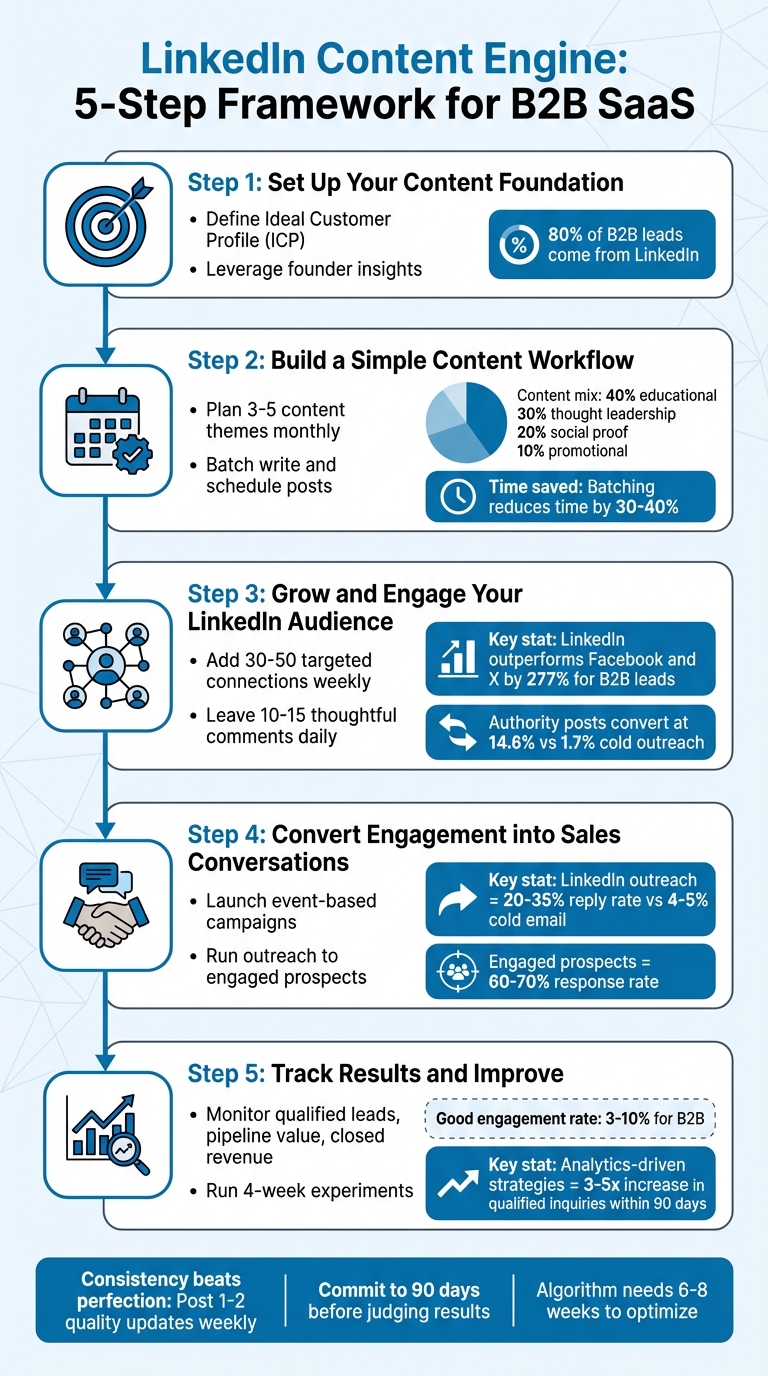
5-Step LinkedIn Content Engine Framework for B2B SaaS Teams
Steal this LinkedIn content strategy for B2B SaaS startups
sbb-itb-9354cf2
Step 1: Set Up Your Content Foundation
Before diving into posting, you need a clear sense of who you're talking to and what you're saying. Without a well-defined Ideal Customer Profile (ICP), your posts will miss their mark, failing to resonate with the right audience.
Define Your Ideal Customer Profile (ICP)
Think of your ICP as the blueprint for the companies you want to work with. It goes beyond generic labels like "SaaS companies" or "marketing leaders" and digs into specifics - details like industry, revenue, team size, and the pain points of decision-makers within those companies.
"A lazy ICP sounds like 'SaaS companies.' A powerful one is specific: 'Series B FinTech companies in North America with 100-500 employees who have recently hired a VP of Sales.'"
- Colin Gallagher, Growlancer
Start by analyzing your best current clients. What do they have in common - company size, industry, or the challenges they hired you to solve? Then, look for trigger events that suggest a company might need your solution right now, like recent funding, new executive hires, or regulatory changes.
Also, don’t skip defining your "anti-persona" - the companies or individuals who are a poor fit for your business. For example, solopreneurs, companies with tight budgets, or businesses outside your focus industries. Clarifying who you don’t serve helps avoid wasting time on low-quality leads.
| Attribute Category | Key Questions to Answer | Example (SaaS for Project Managers) |
|---|---|---|
| Firmographics | Company size, industry, revenue, location? | 50–250 employees, Tech, US-based, $10M–$50M ARR |
| Technographics | What software do they use? (CRM, etc.) | Uses Jira but manages projects in spreadsheets |
| Triggers/Pain Points | What signals a need? Recent funding, new hire? | Just hired a "Head of Product", missed deadlines |
| Goals/Motivations | What are they trying to achieve? | Improve collaboration, ship products faster |
Your ICP isn’t static - it’s a living document. Revisit it quarterly to keep up with market changes, product updates, or new trends in your pipeline. Once your ICP is solid, leverage your founder's unique perspective to create content with real impact.
Use Founder Knowledge to Create Content
Your founder’s experience is a goldmine for content. They’ve been in the trenches - solving customer problems, closing deals, and building the product. Sharing their insights can establish authority and spark meaningful engagement.
Take Lara Costa, co-founder of Cleo. In June 2025, she brought in $30,000 in Monthly Recurring Revenue (MRR) within four days of her product launch by sharing her journey and expertise on LinkedIn - before the product was even fully built. Similarly, Jay Singh, CEO of Casper Studios, reported that 90% of his company’s inbound leads came organically from founder-led LinkedIn content.
To capture authentic insights, repurpose existing conversations. Record sales calls, pitches, or meetings, and use transcription tools to turn this raw material into posts. One effective approach is the "Spicy Take" method: record calls using tools like Fathom, let AI pull out key opinions, and have the founder approve them for posting.
"If you're selling in your discovery calls, your content isn't strong enough."
- Taylor Cromwell, Freelance Writer
Stick to 3–5 core content pillars that blend your founder’s unique experiences with your technical expertise. Examples include industry predictions, lessons from mistakes, customer success stories, or actionable "edu-selling" posts that teach prospects how to solve a problem while subtly highlighting your product. This focused approach builds credibility and avoids a scattershot feed of unrelated ideas.
Set aside one hour each week for the founder to batch content creation. They can record voice notes, share insights, or review AI-drafted posts during this time. The goal isn’t to create perfect content - it’s to consistently share authentic, expert-driven insights without overwhelming your team.
Step 2: Build a Simple Content Workflow
Once you've laid the groundwork for your content strategy, the next step is to fine-tune your production process with a structured workflow. By leaning on your ICP and founder-driven content, this approach creates a system that keeps your LinkedIn presence active and consistent.
A well-thought-out workflow can be the difference between staying consistent and burning out. Breaking tasks into distinct phases - like brainstorming, writing, and scheduling - helps maintain momentum.
Plan Content Themes Each Month
Organize your content around 3–5 themes (or pillars) each month. For example, one pillar might address client challenges, another could highlight your methodology, and a third might focus on industry insights. To manage your workload, try the "Bonfire and Fireworks" model:
- "Bonfire" content includes steady, low-effort posts that keep you visible.
- "Fireworks" are larger, high-impact pieces like webinars or case studies that spark major engagement.
Plan for one "Fireworks" piece each month, then repurpose it into 5–15 smaller "Bonfire" posts. Strive for a content mix of 40% educational, 30% thought leadership, 20% social proof, and 10% promotional posts.
"Create once. Distribute forever. Most people will spend 20 hours to create a masterpiece and spend 20 minutes to promote it."
- Ross Simmonds, Founder, Foundation Marketing
Keep a running list of ideas from client conversations, FAQs, or trending topics. When it's time to plan, shortlist six ideas based on their potential reach, reusability, and how easy they are to measure [27, 28]. Schedule about 70% of your content in advance, leaving 30% open for timely responses to industry news or trending topics.
Once your monthly themes are mapped out, focus on batching your content creation.
Write and Schedule Posts in Batches
Batching your work can cut your content creation time by 30% to 40% compared to tackling posts one by one. The secret is to break the process into steps: write all your hooks first, then your captions, and finally create visuals.
Aim to draft each post in 15–20 minutes without overthinking or editing. Save the polishing for a separate session, where you can refine your hooks and simplify complex language. For example, Solène Rauturier maintained a 28-week streak from March to September 2025 by using a four-step system - Capture, Transform, Create, Prep - to publish 11 posts per week across LinkedIn and Instagram. This strategy helped her double her LinkedIn following and reach over 135,000 people in just six months.
If you're just starting out, aim for 8–12 posts per month - about 3–4 posts per week. Use templates for recurring formats like case studies or how-to guides to speed things up. During the final edit, add personal touches to keep your voice authentic. Reading your posts out loud before scheduling can help ensure they sound conversational and approachable.
After drafting, use tools to organize and schedule your posts efficiently.
Use Tools to Manage Your Workflow
The right tools can bring order to the chaos. Platforms like Notion or Trello work well for content calendars, while Supergrow.ai (starting at $19/month) helps with drafting. For visuals, Canva is a go-to option, and Shield App (starting at $15/month) provides analytics to track performance. Set aside 15 minutes every Friday to review and tweak the upcoming week's content.
If you're working on video content, Descript simplifies editing and generates captions automatically - an essential feature, given LinkedIn video views have increased by 36% year-over-year. For scheduling, tools like RevBoss let you bulk-schedule posts and collaborate with your team.
Here's a quick comparison of time investment based on your workflow approach:
| Approach | Time per Week | Time per Month |
|---|---|---|
| Manual Posting | 5–7 hours | 20–28 hours |
| ChatGPT + Copy-Paste | 3–4 hours | 12–16 hours |
| Content Automation (Batching) | 30–45 minutes | 2–3 hours |
Step 3: Grow and Engage Your LinkedIn Audience
Once your content strategy is in motion, it's time to shift your focus to bringing in the right people - those decision-makers who can fuel your sales pipeline. Crafting and sharing great content is only half the battle; the other half is ensuring it reaches the right audience. By growing your LinkedIn network with intention and keeping that audience engaged, you can build trust and visibility that naturally leads to meaningful conversations.
LinkedIn is a powerhouse for B2B lead generation, outperforming Facebook and X by 277%. However, connection acceptance rates have dropped significantly, from over 50% in 2020 to just 30–35% in 2026. To stand out, you'll need a targeted approach to both who you connect with and how you engage them.
Add Targeted Connections to Your Network
Start by identifying the buying committee within your target accounts. These are the economic buyers, decision-makers, and internal champions you need to reach. Tools like Sales Navigator are invaluable here, helping you filter prospects by seniority, time in their role, company growth, and even keywords in their profiles. The "posted in the last 30 days" filter is especially helpful for spotting active users who are more likely to engage.
Look for signs of activity, such as following competitors, commenting on niche-related posts, or attending relevant webinars. Before sending a connection request, take a moment to interact with their profile - view it, engage with their content, and build some familiarity over 24–48 hours. This small effort can make your outreach feel more natural and less random.
"Are you surrounded by the right people on LinkedIn – or by random contacts from the last 10 years?"
Set a manageable weekly goal of 30–50 well-researched connection requests to grow steadily without triggering account restrictions. When crafting your connection message, keep it short and conversational - just 1–2 sentences, like something you'd send on WhatsApp. Avoid pitching right away. Instead, mention a mutual connection, reference a post they shared, or highlight recent company news to make your message personal. Personalized requests can boost reply rates by 72% compared to generic ones.
Before you hit "Connect", make sure your LinkedIn profile reflects the value you bring to your ideal customer. Prospects will check your profile before accepting, so ensure your banner, photo, and headline clearly communicate who you are and what you offer.
Once you've connected with your target audience, the next step is keeping them engaged.
Interact Through Comments and Messages
The real work begins after someone accepts your connection request. Strategic commenting can significantly increase your visibility across LinkedIn. Aim to leave 10–15 thoughtful comments daily on posts that matter to your industry or target audience. A good comment includes genuine insight, a relevant stat or personal experience, and a follow-up question to keep the conversation going.
When it comes to your own posts, engagement is key. Respond to every comment within the first hour to maximize visibility in the algorithm. LinkedIn values "dwell time" - how long someone spends on your post - over simple likes. To keep readers engaged, use white space, bullet points, and easy-to-read formatting. Authority-building posts, which often attract inbound leads, convert at a 14.6% rate, compared to just 1.7% for cold outreach.
"LinkedIn outreach still works when you flip the approach. Instead of reaching out to cold prospects, position yourself so qualified leads reach out to YOU."
For direct messages, think of them as chats, not emails. Keep your messages short - just 1–2 sentences - and avoid diving into a sales pitch right away. Instead, offer something useful, like a checklist or template tied to a recent post they shared, with no strings attached. If someone engages with your content, follow up within 24–48 hours to keep the momentum going. And if they don't respond, switch up your approach in the next message by addressing a different challenge they might face, rather than just following up for the sake of it.
For your top-tier prospects, consider sending a quick 30-second voice message. These stand out because they’re rarely used and can increase reply rates by 15–20%. And if someone replies, respond within 2 minutes - a quick reply can be a game-changer for boosting conversions.
Step 4: Convert Engagement into Sales Conversations
Now that you’ve got a solid content strategy, a streamlined workflow, and an engaged audience, it’s time to shift gears and turn those interactions into meaningful sales conversations. This is where targeted campaigns come into play.
LinkedIn outreach delivers reply rates of 20–35%, significantly outperforming cold email’s 4–5% average. But here’s the catch: most campaigns lose steam after the first message, leaving 60–70% of potential opportunities untapped. Success often comes after two or three follow-ups, so a consistent and value-driven approach is key. Here’s how you can make it happen.
Launch Campaigns Around Events
Events like webinars, trade shows, product launches, or industry gatherings are perfect conversation starters. Instead of a cold message, you can follow up on something your prospect has already experienced, making your outreach feel natural and relevant.
Take this example: In January 2026, ESCP Business School ran a Sponsored Content campaign tied to its scholarship program. It achieved a 14% conversion rate - double their goal - and generated 290 leads from 2 million impressions. They used people-centered visuals and direct messaging connected to the event.
Timing matters here. Reach out within 24–48 hours after the event while it’s still fresh in their minds. Keep your message short - just one or two sentences - and reference something specific about the event. For instance: “I saw you attended the [Event Name] webinar on Tuesday. Are you currently tackling [specific challenge]?” Then, offer a no-pressure resource like a case study or framework to keep the conversation flowing.
"LinkedIn is a trust platform. Treat it like a conversation, not a campaign."
If they don’t reply, avoid sending a generic follow-up. Instead, share something new - an insight, a tip, or another resource - every 5–7 days to keep the dialogue engaging without becoming repetitive.
While event-based outreach is a great starting point, leveraging interactions with your existing content can help you keep the momentum going.
Run Outreach Campaigns to Find Interested Prospects
Beyond events, focus on connections who are already engaging with your content. Actions like likes, comments, and profile views are small but meaningful signals of intent. These “micro-commitments” can result in response rates as high as 60–70%, compared to just 1.7% for cold outbound messages.
To maximize results, design a multi-touch sequence that builds familiarity before making an ask. A winning sequence might include a profile visit, engaging with their content, sending a personalized connection request, and then following up with a value-first message. Campaigns that combine profile visits with messaging see an 11.87% reply rate - almost double that of message-only strategies.
When writing your outreach, try the "Context-Insight-Soft CTA" framework. Start with a clear reason for reaching out, share an insight relevant to their role, and close with a low-pressure question. For example: “I noticed you commented on [Topic]. We’ve helped similar companies tackle that challenge successfully. Worth exploring a quick idea?” Keeping your messages under 400 characters can increase response rates by 22%.
Instead of asking for a long call, offer something easy to say yes to, like a quick “3-step playbook” or a short case study. Hahow for Business, for instance, used LinkedIn Lead Gen Forms to shorten their sales cycle by 30%.
For high-value prospects, consider sending a 30-second voice message to add a personal touch. This can boost reply rates by 15–20%. And if they respond, aim to reply within 2 minutes to keep the momentum going.
To avoid LinkedIn’s radar, limit automated activity to 25–30 connection requests per day and vary the timing. Use a centralized inbox to keep track of all campaign messages and ensure your team responds quickly.
"The real question isn't how many people engage with your posts, but how many of those engagements turn into qualified leads, booked meetings, and, ultimately, closed sales."
Finally, focus on metrics that matter - qualified leads, pipeline value, and closed revenue - not just vanity numbers like impressions or likes. Add UTM parameters to every link you share in posts or DMs to track exactly which campaigns are driving leads in your CRM. This data will help you refine your strategy and double down on what’s working.
Step 5: Track Results and Improve Your System
Once your content engine is up and running, the next step is all about keeping tabs on its performance and making adjustments. The secret to a winning LinkedIn strategy lies in focusing on metrics that tie directly to revenue, not just surface-level stats.
Monitor Your LinkedIn Metrics
To get a clear picture, track metrics in three categories: Business Impact (like qualified leads, pipeline dollars, and closed revenue), Engagement (website clicks, profile views, and content shares), and Activity (impressions, reactions, and follower growth). While impressions and likes can show reach, only qualified leads truly impact the bottom line.
"Impressions, engagement rate, and follower count are inputs, not outcomes. What you actually need to measure: Qualified leads, pipeline dollars, closed revenue."
To calculate your engagement rate, add up reactions, comments, and shares, divide by total impressions, and multiply by 100. For B2B company pages, a solid engagement rate typically ranges between 3% and 10%. Keep an eye on your save rate - when people bookmark your content, it signals value and often leads to better long-term reach than likes.
Pay attention to custom button clicks (like "Visit Website" or "Contact Us") on your company page, as these are strong indicators of intent. Integrate UTM parameters into your CRM so you can track leads originating from LinkedIn and calculate cost per qualified engagement instead of just raw numbers.
Here’s what good performance looks like based on your follower count:
| Follower Count | Monthly Impressions (Good/Great) | Monthly Website Clicks (Good/Great) | Qualified Leads (Good/Great) |
|---|---|---|---|
| 100–500 | 1,500–3,000 | 8–30 | 1–5 |
| 500–2,000 | 3,500–7,000 | 15–70 | 3–12 |
| 2,000–10,000 | 10,000–30,000 | 40–200 | 8–30 |
Also, review your follower demographics regularly to ensure they align with your ideal customer profile (ICP). If website clicks are high but leads remain low, it might be time to tweak your website’s conversion path.
Armed with these metrics, you can start making data-driven changes to your strategy.
Use Data to Improve Your Approach
Set aside 15 minutes every Friday to review your top-performing posts. Look for patterns in hooks, topics, formats, and posting times. Comments are a goldmine - recurring questions or debates can inspire future content that resonates even more.
"Creating LinkedIn content without analyzing performance is like driving with your eyes closed."
To refine your strategy, run 4-week experiments where you test one variable at a time. For example:
- Week 1: Establish a baseline.
- Week 2: Experiment with different hook styles.
- Week 3: Test proof types (e.g., metrics vs. case studies).
- Week 4: Try out different formats (carousel posts vs. text posts).
This methodical approach helps you pinpoint what’s working and what’s not.
Analytics-driven strategies can lead to a 3–5x increase in qualified inbound inquiries within 90 days. Companies posting weekly see 2x more engagement than those that don’t, and video content generates 5x more engagement than other formats. Use these benchmarks to guide your content planning.
Lastly, match the people engaging with your posts against your CRM to ensure you’re reaching decision-makers. If you’re getting clicks but not conversions, focus on improving your landing pages or offers instead of scrapping successful content themes.
Conclusion
Building a dependable LinkedIn content system takes a solid plan, steady effort, and a willingness to learn from your results. By clearly identifying your ideal customer profile (ICP), setting up a structured content workflow, engaging with purpose, and keeping an eye on key metrics, you can turn LinkedIn into a steady source of qualified leads.
LinkedIn is a proven tool for B2B lead generation, but success demands patience. The platform's algorithm typically requires 6–8 weeks of consistent posting to effectively understand and distribute your content. This is why committing to a 90-day strategy is so critical before making any judgments about your performance.
"Marketing isn't about fishing for leads anymore. In 2026, it's about owning the map, being visible everywhere AI and humans make decisions."
This long-term approach not only establishes your credibility but also drives meaningful growth. For example, between March and September 2025, Solène Rauturier doubled her LinkedIn audience and reached over 135,000 people by sticking to a repeatable workflow and posting 11 times a week.
The key takeaway? Consistency wins over perfection. Regularly review your metrics, tweak one variable at a time, and let the data guide your next steps. You’re not aiming to go viral; the real goal is to build mental credibility with your audience. That way, when they face the problem you solve, your brand is the first one that comes to mind.
Start your 90-day LinkedIn experiment now. Adjust weekly, stay consistent, and see how your efforts translate into measurable outcomes.
FAQs
What should I post if I’m not a natural writer?
If writing feels like a struggle, lean on systems that make it easier. Dedicate focused sessions to batch-create LinkedIn posts, so you're not starting from scratch every time. Give old content a second life by turning blog posts into bite-sized social updates. Templates and frameworks can be lifesavers, offering a solid starting point when inspiration runs dry. You can even automate parts of your workflow to save time and energy. The key is building a repeatable process that helps you deliver consistent, engaging content - even if writing isn’t your strong suit.
How do I turn LinkedIn engagement into booked sales calls?
To turn LinkedIn engagement into booked sales calls, start by building authentic connections. Make sure your profile is polished and speaks directly to your ideal audience - it should highlight how you can help them. Engage thoughtfully with posts and comments that matter to your prospects, showing genuine interest.
When it’s time to reach out, skip the cold pitches. Instead, focus on understanding their challenges. Listen, respond to their needs, and offer something helpful - whether it’s advice, a resource, or a solution. The goal is to create trust and rapport before suggesting a call.
Consistency is everything. Regularly interact with your network and tailor your efforts to ensure your outreach feels personal and relevant. This approach transforms LinkedIn connections into real sales opportunities.
Which LinkedIn metrics actually predict revenue?
Metrics such as impressions, engagement, and interactions - including comments and reactions - play a key role in forecasting revenue. When analyzed methodically, these numbers often align with trends in pipeline growth and revenue performance, offering valuable insights into how LinkedIn contributes to overall business success.