How to Build a Scalable Cold Outreach System

Cold outreach can be a pain - too manual, and you burn out; too automated, and your emails get ignored. The solution? A system that scales while staying personal.
Here’s the cheat sheet:
- Automate 80%, personalize 20%: Let tech handle emails, follow-ups, and data while you focus on real connections.
- Nail the basics first: Define your Ideal Customer Profile (ICP), warm up your email domains, and get a CRM that supports multi-channel outreach.
- Follow a clear workflow: Target → Enrich data → Craft modular messages → Sequence touches → Handle replies → Book meetings.
- Personalization matters: Use tailored details like recent posts or company news to stand out.
- Track your metrics: Open rates (20–40%), reply rates (2.8%), and meeting bookings are your north stars. Adjust daily for quick wins.
The goal? A repeatable system that gets replies, books meetings, and grows your pipeline - without making you feel like a spam bot. Let’s break it down step by step.
The Best Cold Email Marketing Setup in 2025
Mapping Out the Cold Outreach Process
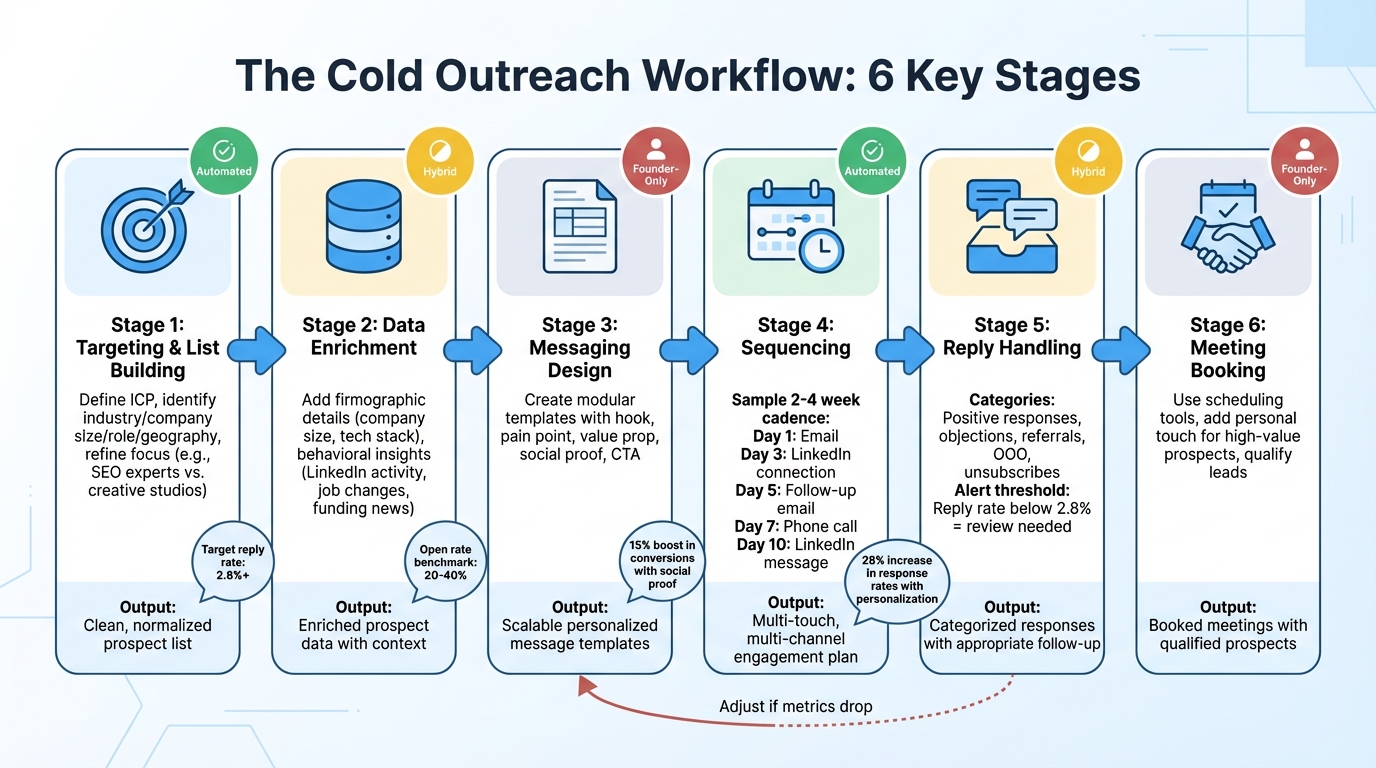
6-Stage Cold Outreach Workflow System
Building a scalable outreach system isn’t just about having the right tools - it’s about creating a seamless workflow where every step connects logically. This process balances automation with the personal touch that’s essential for founder-led outreach.
When you map out the workflow, you can pinpoint where automation fits best, where personalization is a must, and where a founder’s involvement adds the most value. Let’s break down the process to see how these elements come together.
Key Stages of the Outreach Workflow
An effective cold outreach system typically follows six key stages, each contributing to the overall success of the process:
1. Targeting and List Building
Start by defining your ideal customer profile (ICP). Think about factors like industry, company size, role, geography, and buying triggers such as recent funding or hiring trends. For example, if your ICP is "marketing agencies", refine it further - are you reaching out to SEO experts, creative studios, or performance marketers? Each group has unique challenges, so narrowing your focus ensures your messaging resonates. Clean, normalized data is essential at this stage to avoid wasted effort.
2. Data Enrichment
This step adds context to your targeting. Incorporate firmographic details (e.g., company size, tech stack) and behavioral insights (e.g., recent LinkedIn activity, job changes, funding news). Using APIs or enrichment platforms can automate this process, keeping your data accurate and current. This enriched data will fuel your personalized outreach later on.
3. Messaging Design
Develop modular templates that allow for easy personalization. Create a base structure with elements like a hook, pain point, value proposition, social proof, and a call-to-action (CTA). For instance, one template might open with, "Noticed you’re hiring for [role]", while another references, "Your recent post about [topic]." This approach helps you scale while keeping your messages engaging and relevant.
4. Sequencing
Plan a multi-touch cadence spanning 2–4 weeks, using various channels to engage prospects. A sample sequence might look like this:
- Email on Day 1
- LinkedIn connection request on Day 3
- Follow-up email on Day 5
- Phone call on Day 7
- LinkedIn message on Day 10
Focus on delivering value in the early touches - share insights, audits, or helpful content - before asking for a meeting.
5. Reply Handling
Establish clear rules for managing responses. Categorize replies into positive responses, objections, referrals, out-of-office messages, or unsubscribes. Pre-draft response templates for each scenario to save time. If reply rates dip below 2.8% for several days, it’s a signal to review your targeting or messaging strategy.
6. Meeting Booking
This is the end goal. Use scheduling tools like Calendly for efficiency, but don’t rely solely on automation. For high-value prospects, a personal touch like a quick call or custom video can make a world of difference. Define clear criteria for what makes a lead "meeting-ready" to avoid wasting time on unqualified prospects.
With the stages outlined, let’s explore how personalization enhances each step of the process.
Where Personalization Fits Into the Process
Automation is great for handling volume, but it’s the personal touches that build trust and drive results. The key is knowing where to add that human element without bogging down the workflow.
In targeting and enrichment, founder insights can help identify "champion accounts" - those prospects worth extra effort. Maybe it’s a shared connection, a mutual interest, or a company that aligns perfectly with your goals. These accounts deserve deeper research and a tailored approach.
During messaging and sequencing, sprinkle in founder-specific elements to stand out. For example, include a custom Loom video in your third touch or add a personalized note referencing something unique about the prospect. Campaigns that incorporate social proof - like testimonials or case studies - often see a 15% boost in conversions and a 28% increase in response rates.
Reply handling is another area where founder involvement can make a big impact. When a high-potential lead responds, a personal note or quick call from the founder can build rapport much faster than a canned response. For lower-priority replies, stick to pre-written templates that have been reviewed by a human.
At the meeting booking stage, personalization can seal the deal. A founder-led call or a tailored demo addressing the prospect’s specific pain points shows that you’re invested in solving their problems - not just playing a numbers game. This approach is particularly effective for high-value accounts.
Creating a Workflow Diagram
A visual workflow diagram can help you see how the entire process fits together. It maps out data flow, decision points, and task ownership, serving as both a guide and a training tool.
Use tools like Lucidchart or Miro to create a simple flowchart. Lay out your stages from left to right:
Targeting → Enrichment → Messaging → Sequencing → Replies → Booking.
Include decision nodes, like "Reply received? Yes → Nurture; No → Continue sequence", to show how prospects move through the system.
Color-code tasks to distinguish between automation and human involvement. For example:
- Green for fully automated steps (e.g., sending emails).
- Yellow for hybrid tasks (e.g., reviewing AI-generated responses).
- Red for founder-only actions (e.g., strategic calls).
This makes it easy to see where your time is spent and where bottlenecks might occur.
Don’t forget to include feedback loops in your diagram. For instance, if open rates drop below 20% or reply rates fall under 2.8%, trigger a review of your messaging or timing. These loops are critical for refining your process over time.
Finally, define clear entry and exit points. For example, entry might be "Prospect added to CRM from a data provider", while exit might be "Meeting booked and logged" or "Prospect marked as unqualified." This clarity ensures no prospect gets lost in the shuffle.
Once you’ve mapped everything out, you’ll have a clear view of your outreach system, making it easier to fine-tune each part for maximum efficiency.
Setting Up Your Outreach Infrastructure
After outlining your outreach workflow, the next step is creating a system that can handle your strategy as it grows. A well-built infrastructure not only supports scaling but also minimizes headaches from technical hiccups.
Your outreach setup revolves around three key elements: email deliverability, data management systems, and knowing when to bring in external support. Together, these ensure your emails reach inboxes, your prospect data stays organized, and your time is spent on what truly matters.
Email Infrastructure for Deliverability
Getting your emails into inboxes rather than spam folders starts with setting up the right technical tools. You’ll need to configure SPF, DKIM, and DMARC records for your sending domains. These DNS records verify your emails and tell recipients’ servers that you’re a legitimate sender, not a spammer.
It’s smart to use a dedicated subdomain for cold emails, separate from your main business domain. This keeps your primary domain’s reputation intact if any issues crop up with your email campaigns.
Before you ramp up your email volume, warm up your mailboxes over 4–6 weeks. Start small - about 10–20 emails per day per inbox - and gradually increase the count, keeping an eye on metrics like open rates and bounce rates. Ideally, you’re aiming for open rates above 40% and bounce rates below 2%.
To maintain your sender reputation, rotate domains and use email service providers (ESPs) that can handle the load. Shared IP pools from platforms like Google Workspace or Microsoft 365 are often a safer bet for B2B outreach compared to dedicated IPs, which can be tricky to manage and more susceptible to blacklisting.
Systems for Data and Prospect Management
Your CRM is the backbone of your outreach efforts. Tools like HubSpot or Salesforce can integrate with data providers to source prospects, clean up the data, and segment it for personalized campaigns. Structuring your data fields to include variables like {company_pain} or {recent_activity} makes personalization at scale possible.
Start with detailed segmentation. Instead of lumping all "marketing agencies" into one group, break them into smaller categories - like SEO specialists, creative studios, or performance marketers - so your messaging can directly address their specific needs. Keep your data clean and enriched, aiming for over 90% accuracy to ensure you’re targeting quality leads.
Sales engagement platforms can take a lot of the grunt work off your plate. Tools like Instantly.ai or Salesforge offer flat-fee pricing, AI-driven personalization, built-in lead databases, and unified inboxes to manage replies. These platforms automate multichannel outreach across email, LinkedIn, and phone calls, and they can even flag issues like sudden drops in reply rates. This allows you to scale your efforts without hiring more sales development reps (SDRs) or paying for extra seats.
Set up automated reporting to track key metrics daily, such as deliverability (aim for inbox placement above 95%), reply rates (target 5–10% to start), and data quality. If reply rates suddenly dip, your system should alert you to review the campaign. Even small tweaks - like improving by 2–3% per day - can make a big difference over a month.
Once you’ve built a solid internal system, it might be time to consider outside help to take things further.
When to Work With External Partners
At some point, managing all the technical details - like warm-ups, compliance, and monitoring - can become overwhelming. If you’re spending more time on backend setups than on connecting with prospects, it might be time to bring in external support.
Companies like RevBoss can handle everything from content creation to audience targeting and campaign execution. They integrate with your CRM and ESPs to manage workflows and multichannel outreach, freeing you up to focus on meaningful conversations. Their goal is to create campaigns that spark real dialogue and turn into pipeline opportunities.
External partners can also take over complex tasks like managing multi-IP APIs, monitoring performance, and running warm-up networks. This lets you automate about 80% of repetitive tasks so you can concentrate on the 20% that actually drives results.
The trick is finding partners who enhance your founder-led approach rather than replacing it. With the right setup and support, you can scale your outreach while keeping the personal touch that makes your communication effective.
sbb-itb-9354cf2
Crafting Scalable, Personalized Messaging
Once you’ve built a solid infrastructure, the next challenge is creating messages that scale while still feeling personal. The key? A modular approach that combines interchangeable elements like openers, value propositions, and CTAs. For instance, an opener for SEO agencies might address a pain point like, "Struggling with inconsistent leads?" Meanwhile, creative studios could see something like, "Finding it hard to showcase ROI to clients?" Both examples smoothly lead into a value proposition centered on increasing leads without the need to expand their team.
To make this work, take advantage of your sales engagement platform’s dynamic fields - things like {first_name}, {company_recent_funding}, or {recent_activity}. These fields let you automate message creation while keeping each one relevant, thanks to segmented, normalized data aligned with your target audience. This method enables scalable, personalized messaging across various channels.
Building a Modular Messaging Framework
A modular framework is built around flexible components like openers, value propositions, and CTAs. For example, you might start with a question that resonates with a specific audience: "Struggling with inconsistent leads?" for SEO agencies or "Finding it hard to showcase ROI to clients?" for creative studios. Each opener flows naturally into a value proposition, like helping them scale leads without adding headcount.
Dynamic fields in your sales tools - such as {first_name} or {recent_activity} - are essential for automating message assembly. These fields ensure each message feels relevant while being easy to scale, thanks to segmented data tailored to your audience.
Personalization Techniques at Scale
Scaling personalization doesn’t mean sacrificing depth - it’s about tiering your approach. Start with basic personalization (name, company), move to intermediate (mutual connections, role-specific challenges), and finish with advanced (custom details like recent posts or announcements).
While basic personalization using merge fields can improve open rates, advanced personalization takes it further. Including specific, tailored details about a prospect can result in up to 82% higher open rates and generate $20 in ROI for every $1 spent. To maximize impact, use trigger-based messaging. For example, if someone opens your email but doesn’t reply, follow up with a LinkedIn message on day three and a phone call on day five.
AI tools can help draft introductions and follow-ups, automating about 80% of repetitive tasks like sequencing and data mining. However, human review remains crucial for maintaining authenticity. This balance allows your team to spend more time building trust and genuine relationships.
Adapting Messages for Different Channels
With your modular framework and tiered personalization ready, it’s time to adapt your messages for each channel. Emails should be concise - three to five sentences that clearly present your value proposition and include a subtle CTA.
On LinkedIn, keep it conversational and brief. Reference shared connections or recent posts to make a connection. For cold calls, aim to deliver value within 30–60 seconds. Start with a direct question like, "Are you dealing with [specific challenge]?" and focus on listening rather than pitching.
Successful teams rely on multichannel cadences to keep the conversation moving forward. For instance, start with an email on day one to share a compelling insight. Follow up with a LinkedIn message on day three to build rapport around that insight, and round things off with a phone call on day five to close the loop. Each interaction should build on the last without repeating the same information, ensuring a seamless flow that keeps prospects engaged.
Measuring and Optimizing Outreach Performance
Scaling your outreach efforts is just the beginning. The real challenge lies in tracking what’s working and making adjustments to improve outcomes. Focus on metrics that directly connect your outreach activities - like meeting bookings and pipeline contribution - to revenue. Don’t get sidetracked by irrelevant stats. For cold emails, typical open rates hover between 20% and 40%, while reply rates average around 2.8%. With effective personalization, those numbers can climb significantly. Advanced personalization frameworks, for instance, can generate $20 in ROI for every $1 spent.
Instead of waiting for monthly performance reviews, the best teams adopt daily feedback loops, tweaking campaigns by small margins of 2–3%. These minor adjustments help refine strategies without risking major performance setbacks. Make use of your sales engagement platform’s dashboards to monitor key metrics in real time, and let AI tools recommend the best send times based on your prospect data.
Key Metrics to Track
To measure success, focus on four key performance indicators (KPIs): open rates, reply rates, meeting bookings, and pipeline contribution. These metrics are directly tied to revenue. Open rates tell you if your subject lines are grabbing attention, while reply rates indicate whether your message resonates. Meeting bookings reflect genuine interest, and pipeline contribution measures the creation of qualified opportunities and the revenue your outreach influences. Don’t overlook deliverability metrics like bounce rates - they’re crucial for maintaining a strong sender reputation.
Once you’ve established these core metrics, fine-tune your approach with systematic testing.
A/B Testing and Experimentation
Testing turns guesswork into actionable insights. Start with A/B testing your subject lines - personalized subject lines can increase response rates by 15–28% compared to generic ones. Experiment with different messaging strategies, such as starting with a problem-focused angle versus a value-driven one. You can also test audience segments, like targeting industry-specific pain points or role-specific challenges, and adjust send times to align with time zones and avoid weekends. Use your sales platform’s automation to split prospects into two groups for testing. Multichannel sequences that are carefully optimized have shown to drive 287% higher engagement rates. Keep your tests manageable by focusing on 2–3 variables at a time, analyze the results, and scale the winning strategies into your outreach playbook.
Creating a Living Playbook
Think of a living playbook as the brain of your outreach system. It’s a continuously updated resource that tracks workflows, effective messages, key metrics, and testing outcomes. This approach mirrors the daily feedback loops mentioned earlier, ensuring your team stays consistent while scaling. It also makes onboarding new team members faster and more efficient. Start by documenting your core workflows, including sequences, personalization guidelines, and initial KPIs. Then, capture A/B test results to identify which subject lines and cadences drive better engagement. Review your playbook quarterly using analytics from your platform, incorporate AI-suggested changes, and maintain version control for training purposes.
Conclusion
Key Takeaways for Founders
Building a scalable cold outreach system requires a combination of a clear process, the right tech tools, and a founder's personal touch, all backed by consistent tracking and measurement. Start by investing in the essentials - set up proper domains, follow warmup protocols, and integrate a solid CRM. These steps are crucial to avoid spam issues that can derail your outreach efforts before they even begin.
Finding the sweet spot between automation and personalization is where the magic happens. Automate 70–80% of your workflow - things like data collection, sequencing, follow-up schedules, and basic personalization fields. Then, dedicate 20–30% of your time to meaningful, human-driven interactions. This mix allows you to reach a large number of prospects while keeping your messages personal and engaging. Using modular messaging frameworks can help you maintain a consistent core message while tailoring specific elements for different audience segments. At the same time, multichannel cadences - combining email, LinkedIn, and phone outreach over a 3–4 week period - can significantly boost your chances of connecting with prospects.
Think of your outreach system as a long-term investment. Regularly review key metrics, fine-tune your messaging, and update your strategies to ensure your system grows with your business. And remember, every "no" or objection is a golden opportunity to refine your targeting, adjust your offer, or sharpen your narrative - it’s feedback, not failure.
These strategies lay the groundwork for scaling while maintaining a personal, founder-led approach.
How RevBoss Can Support Your Outreach Efforts
If your team is stretched thin, bringing in expert help can make all the difference. RevBoss specializes in building founder-led marketing systems that turn your expertise into consistent, trust-building content and active audience engagement. This approach helps you warm up your market, either ahead of or alongside your outbound campaigns.
RevBoss also runs lead activation campaigns designed to turn engaged audience members into real conversations and pipeline opportunities. Their system ensures that content creation, audience building, and outreach efforts work together seamlessly, rather than operating in silos. With programs starting at $1,500 per month and a track record of serving over 1,000 clients in the past decade, RevBoss offers a proven way to build a founder-led marketing engine that drives demand and builds trust - all without adding more to your to-do list.
FAQs
How do I effectively combine automation and personalization in cold outreach?
To strike the perfect balance between automation and personalization, let automation handle the repetitive grunt work - things like scheduling emails or keeping tabs on responses. Meanwhile, dedicate your energy to crafting messages that genuinely connect by addressing the recipient's specific interests, needs, or actions. This approach keeps your outreach feeling real and relevant.
The key is to create content that truly speaks to your ideal customer profile (ICP) and fosters trust. While automation allows you to scale your efforts, it's the personal touch that makes your communication memorable and sparks meaningful engagement.
What key metrics should I monitor to evaluate the success of my outreach strategy?
To measure how well your outreach efforts are landing, keep an eye on key engagement metrics like email open rates and click-through rates. Dive deeper by analyzing response rates, the quality of replies, and conversion rates, such as how many solid leads you’re pulling in.
Don’t forget to track your overall outreach volume - it’s a balancing act between scaling up and keeping things personal and effective. These numbers will help you spot what’s hitting the mark and where you might need to tweak your approach.
How do I know when to get external help for my cold outreach system?
When scaling your cold outreach system starts feeling overwhelming - without losing the personal touch or impact - it might be time to look for external support. This is especially relevant if running campaigns eats up too much of your time or if you’re missing the tools and know-how to get the best results.
Enlisting outside expertise can simplify your workflow, maintain consistent messaging, and strengthen trust with your audience. It’s a practical choice for those aiming to grow while keeping quality intact.