Why Cold Email Is Declining (and What to Do Instead): Audience-Led Pipeline for B2B

Cold email is dying. Reply rates are plummeting (down to 1–5%), spam filters are smarter, and buyers are exhausted from the 121+ emails they get daily. The old playbook - send a ton of generic emails and hope for the best - is officially broken.
Here’s the deal: buyers want relevance, not random. They’re doing their own research, ignoring cookie-cutter pitches, and tuning out anything that feels robotic. Even AI-crafted emails are getting side-eyed for being "too perfect." If you’re still relying on cold email alone, you’re wasting time and burning leads.
The fix? Shift to an audience-led approach. Focus on building trust before you hit send. Think founder-led content, smart LinkedIn engagement, and personalized multi-channel outreach. This isn’t about spamming inboxes - it’s about showing up where your buyers are, adding value, and earning their attention. The result? Higher reply rates (10–25%), faster sales cycles, and leads that actually convert.
Here’s the TL;DR:
- Cold email stats are grim: 95% ignored, 1.7% conversion, and most emails never even hit the inbox.
- Buyers are overwhelmed: They’re deleting emails in 3 seconds flat and ignoring anything irrelevant.
- What works now: Build an audience first. Use LinkedIn, personalized content, and multi-channel strategies to warm up leads. Then, reach out with something tailored and meaningful.
Cold email isn’t just outdated - it’s a waste of effort. Start building relationships, not spam folders.
The Creator-Led Strategy Boosting B2B Ad Efficiency 32% (Meta Study)
sbb-itb-9354cf2
Why Cold Email Is Failing
Cold email is losing its edge. Three key factors are driving this decline, and understanding them is crucial to finding a more effective way forward.
Too Many Emails and Exhausted Buyers
The average professional receives a staggering 121 emails every day - that’s over 27,500 emails a year vying for attention. Add Slack messages, Teams notifications, and calendar alerts, and the daily interruptions jump to 275. It’s no wonder people are tuning out.
This constant barrage has led to what’s being called "cold email blindness." People can now spot and delete unsolicited sales emails in mere seconds. They’ve become experts at recognizing the telltale signs: generic subject lines, formulaic openings, and the unmistakable tone of a sales pitch. On average, emails are deleted within 3 seconds, with subject lines scanned in just 2.7 seconds.
Here’s the kicker: professionals make about 35,000 micro-decisions every day, and by the time your email shows up, their mental energy is already drained. As OneAway.io puts it:
"Your prospect isn't rejecting you. They're cognitively depleted... deleting is easier than deciding"
Attention spans are shrinking, too. In 2004, people could focus on a screen for 2.5 minutes; today, it’s down to 47 seconds. Your email isn’t just competing with others - it’s up against an exhausted brain that’s ready to shut down. And if that’s not enough, technical obstacles are making cold email even harder to get right.
Spam Filters and Delivery Challenges
Even the most carefully written email might never reach its recipient. Modern email systems like Gmail and Microsoft rely on AI-powered "risk engines" to screen messages. These tools assess technical trustworthiness (SPF, DKIM, DMARC), sender behavior (like bounce rates and volume changes), and how recipients interact with your emails (opens, replies, or deletions).
The stats are grim: 16.9% of marketing emails never hit the inbox, and another 10.5% go straight to spam. That means nearly 40% of cold emails land in Promotions or Spam folders, where they’re rarely seen.
The margin for error is tiny. Email providers enforce a spam complaint rate of 0.3%, with anything over 0.1% being the safe zone. Unfortunately, the average B2B spam complaint rate is a whopping 2.01%, far exceeding acceptable limits. A poor sender reputation triggers a vicious cycle: low engagement signals to providers that your emails are unwanted, leading to even stricter filtering.
Interestingly, 69% of spam complaints aren’t about technical issues - they’re because the content is irrelevant. Spam filters are doing their job: protecting users from unwanted clutter.
Shifting Buyer Preferences
Beyond inbox overload and technical barriers, changing buyer behaviors are the final nail in the cold email coffin. Buyers now expect tailored, relevant communication, making generic cold emails feel outdated. While 68% of B2B decision-makers still prefer email for initial contact, they want messages that speak directly to their needs - not generic outreach.
Today’s buyers are more independent. They spend only 17% of their purchasing journey meeting with potential suppliers, opting to do their own research instead. Referrals are the starting point for 84% of B2B buyers, leaving cold emails as a last resort.
Generative AI has added a new twist. While AI can churn out polished, "personalized" emails at scale, buyers are catching on. This has led to what’s being called the "uncanny valley" effect - emails that are too perfect feel robotic and insincere. As Ry Walker puts it:
"The more perfect your cold email is... the more likely people assume AI wrote it. The only thing that works now is manufacturing warm at scale"
The numbers don’t lie: inbound leads convert at 14.6%, while cold outbound leads lag far behind at just 1.7%. Buyers are still buying - they’re just ignoring unsolicited interruptions from strangers.
The Alternative: Audience-Led Pipeline Building
Cold emails are losing their edge in a world where buyers are inundated with messages. An audience-led approach flips the script by focusing on trust and familiarity before making contact. With 80% of B2B sales interactions expected to happen in digital channels by 2025, connecting with buyers where they already spend their time is more important than ever.
Instead of blasting out thousands of generic emails for a meager 1.7% conversion rate, this method prioritizes a smaller, engaged audience that converts at 14.6% by earning attention first. As Daniel Wiener, an Oracle and USC alum, explains:
"Data-driven targeting is the forensic science of the marketing world - it's about using data to understand your audience, predict their behavior, and engage them in a way that feels personalized and relevant".
This strategy revolves around three pillars: founder-led content to establish credibility, audience data for precise personalization, and multi-channel engagement to build trust at scale. Let’s break it down.
Using Founder-Led Content
Founder-led content is the backbone of this approach. When a founder shares insights, lessons, or behind-the-scenes stories, it resonates more than a standard sales pitch. Why? A founder’s voice is seen as contributing value, while a sales rep’s can feel like solicitation. The key isn’t to post endlessly but to post intentionally. The most effective founder-led content falls into four categories:
- "What I learned": Personal lessons from experience.
- "Industry insights": Analysis of trends and market dynamics.
- "Problem/solution": Addressing customer pain points without a sales pitch.
- "Behind the scenes": A look at decision-making processes.
This type of content helps position you as a trusted voice in your industry, driving inbound leads that convert faster - often in 30–45 days, which is three to five times quicker than traditional cold outreach.
Take Allan Duza, CEO of Reachbox.ai, as an example. Over 18 months leading up to October 2025, he scaled his business to $6 million in ARR by sending hyper-personalized emails. Each email included a custom video outlining three specific ways the prospect could grow their customer base using his platform. The kicker? He wasn’t cold - his content had already established credibility.
Similarly, the founder of Instantly.ai grew the company to $2.4 million in ARR within nine months by pairing public content with a straightforward outreach message:
"Hey [Name], we built a tool that helped us get 100k MRR in a few months. Do you want to see if we can do the same for you?"
These examples highlight how founder-led positioning can generate 10–20 qualified inbound leads per month with just 4–6 hours of effort weekly - a stark contrast to the 10–12 hours spent on outbound efforts that don’t build long-term momentum.
Using Audience Data for Better Personalization
Personalization goes beyond adding someone’s name to an email - it’s about understanding their needs and speaking directly to them. This requires layering data from various sources, including:
- Firmographics: Company size and industry.
- Technographics: Tools and software they use.
- Behavioral data: Website visits and interactions.
- Intent data: Signals of active research.
- Engagement data: How they’ve interacted with campaigns.
- Social data: LinkedIn activity and posts.
With third-party cookies becoming less reliable, first-party data - like website interactions and CRM history - takes center stage. This shift allows for more personalized journeys across the customer lifecycle, moving from account-based marketing to a broader account-based experience.
The payoff for personalization is huge. It can boost revenue by 50% while cutting acquisition costs by 40%. Companies that prioritize tailored experiences see revenue increases of 6–10%, far outpacing those that don’t. Smaller, targeted campaigns (under 50 recipients) also earn triple the reply rates (5.8%) compared to bulk emails (2.1%). As James Milsom, Head of Marketing at Hunter.io, puts it:
"Relevance now beats reach. Smaller sends with segmented, verified data get higher engagement because each message feels personal and credible".
For instance, Canon Business Solutions used a data-driven strategy to target healthcare and finance sectors in 2023. They created tools like print cost calculators and industry-specific whitepapers to address pain points, gathering prospect data in the process. This approach boosted their authority and generated high-quality leads through targeted paid marketing and SEO.
AI can assist in analyzing large datasets and structuring messages, but human oversight ensures the tone remains engaging and not robotic.
Combining Multiple Channels
Personalized messaging is powerful, but integrating multiple channels is what truly builds trust and visibility.
This approach doesn’t rely on a single platform - it weaves together touchpoints to guide prospects through a trust-building journey. For example, LinkedIn outreach boasts reply rates of 20–35%, compared to cold email’s 4–5% average. Combining LinkedIn, email, and event marketing into a cohesive sequence amplifies results.
A proven sequence might look like this: visit a prospect’s LinkedIn profile → engage with their content → send a connection request → follow up with a value-first message → send a personalized email. By the time you directly message them, you’re no longer a stranger - you’re someone they recognize.
Here’s what the data shows:
- LinkedIn connection acceptance rates average 29.61%.
- Campaigns that pair profile visits with messages achieve an 11.87% reply rate.
- Personalized connection requests see 72% higher reply rates than generic ones.
- Voice messages on LinkedIn, though underused, generate 15–20% more replies than text.
As Vamshi Chandar, a Digital Content Specialist at FunnL, explains:
"LinkedIn isn't just another social platform - it's the only place where professional intent is built into every interaction".
Beyond LinkedIn, content marketing and SEO are top performers for 70% of marketers, while networking, referrals, and events remain effective at 60% or higher. For example, you might engage with a prospect’s LinkedIn post, invite them to a webinar, and follow up with an email referencing their participation. Each interaction reinforces the others, creating a compounding effect.
This shift from a linear funnel to a cyclical "Attract, Engage, Delight" model is gaining momentum. Existing customers become advocates, fueling new growth, while content drives the entire process. By combining multiple channels, you’re not just building a pipeline - you’re creating a growth engine that sustains itself.
How RevBoss Uses Audience-Led Marketing
RevBoss has found a way to adapt to the changing landscape of outreach by moving away from traditional cold emails. Their approach focuses on audience-led marketing, emphasizing a multi-channel strategy that prioritizes building relationships before making the ask. Instead of bombarding inboxes with generic messages, RevBoss helps B2B founders create meaningful touchpoints - like engaging with content, connecting through mutual acquaintances, or visiting profiles - before sending that first email. In this model, the email becomes the final step rather than the starting point.
The key to this strategy lies in two main activities: growing an engaged LinkedIn audience through consistent, valuable content and using personalized, multi-channel outreach to convert that audience into opportunities. The idea is to remain top-of-mind for potential buyers so that when they enter the small percentage of the market actively looking to purchase (around 5%), they think of your brand first. After all, the majority of B2B buyers - 95% - aren’t in the market at any given time.
LinkedIn Content and Growing Your Audience
To help founders grow their audience, RevBoss creates 8–12 highly targeted LinkedIn posts each month. These posts are built around an "anchor asset", such as a founder interview or an in-depth article, and then broken down into a steady stream of content. The content is designed to educate and engage rather than sell, with themes like expert analysis, frameworks, contrarian takes, and case studies.
RevBoss also uses pre-engagement workflows to warm up potential prospects. This includes actions like visiting profiles and interacting with their content. When someone sees your name pop up repeatedly in their notifications and then receives a message, you’re no longer just another stranger - you’ve become a familiar name. This method has proven to significantly boost cold email reply rates, moving them from the typical 1–3% to an impressive 10–20%.
The content strategy operates on a 1:Many / 1:Few / 1:1 model. It starts with broad visibility through LinkedIn posts, narrows to segmented engagement via webinars or roundtables, and culminates in personal conversations that close trust gaps. As Walker from RevBoss aptly explains:
"Outbound sales is pretty broken in 2025... no amount of ai-powered email automation will fix it... the only thing that works now is manufacturing warm at scale".
This carefully curated content pipeline lays the groundwork for more personalized and effective outreach.
Direct Outreach and Converting Leads
Once an audience is engaged, RevBoss shifts gears to conversion through LinkedIn DMs, email, and event marketing. But this isn’t about throwing messages at the wall to see what sticks. Instead, the outreach is targeted and multi-channel, designed to respect the prospect’s time and intelligence.
The Trigger-Insight-Bridge (TIB) Framework is at the heart of this personalization. Rather than relying on basic filters like company size, RevBoss digs deeper, analyzing unstructured data such as job descriptions, LinkedIn comments, and "About" sections to uncover genuine business needs. For example, noticing a company hiring a Head of Data Science (the trigger) might lead to the insight that they’re scaling their analytics efforts, which then bridges to a tailored solution. This nuanced approach has been shown to increase meeting-booked rates by 45% within three months.
RevBoss also employs the Permission Pass Framework to craft emails that feel transparent and value-driven. These emails, sent from real human inboxes and capped at 35 per day, don’t immediately pitch a product. Instead, they ask for permission with a soft call-to-action, such as, "Is this a priority for you right now?" This subtle approach has been shown to double reply rates.
The effectiveness of this multi-channel strategy is backed by data: 82% of buyers are open to meeting with sellers who reach out proactively with relevant, value-focused messages. And since B2B buyers typically consume 3–7 pieces of content before contacting a vendor, combining educational LinkedIn content with thoughtful direct outreach meets them exactly where they are in their decision-making process. The results speak for themselves - outbound-sourced deals tend to be 50% larger than inbound deals, and leveraging three or more channels can boost conversion rates by around 30%.
Results: Cold Email vs. Audience-Led Outreach
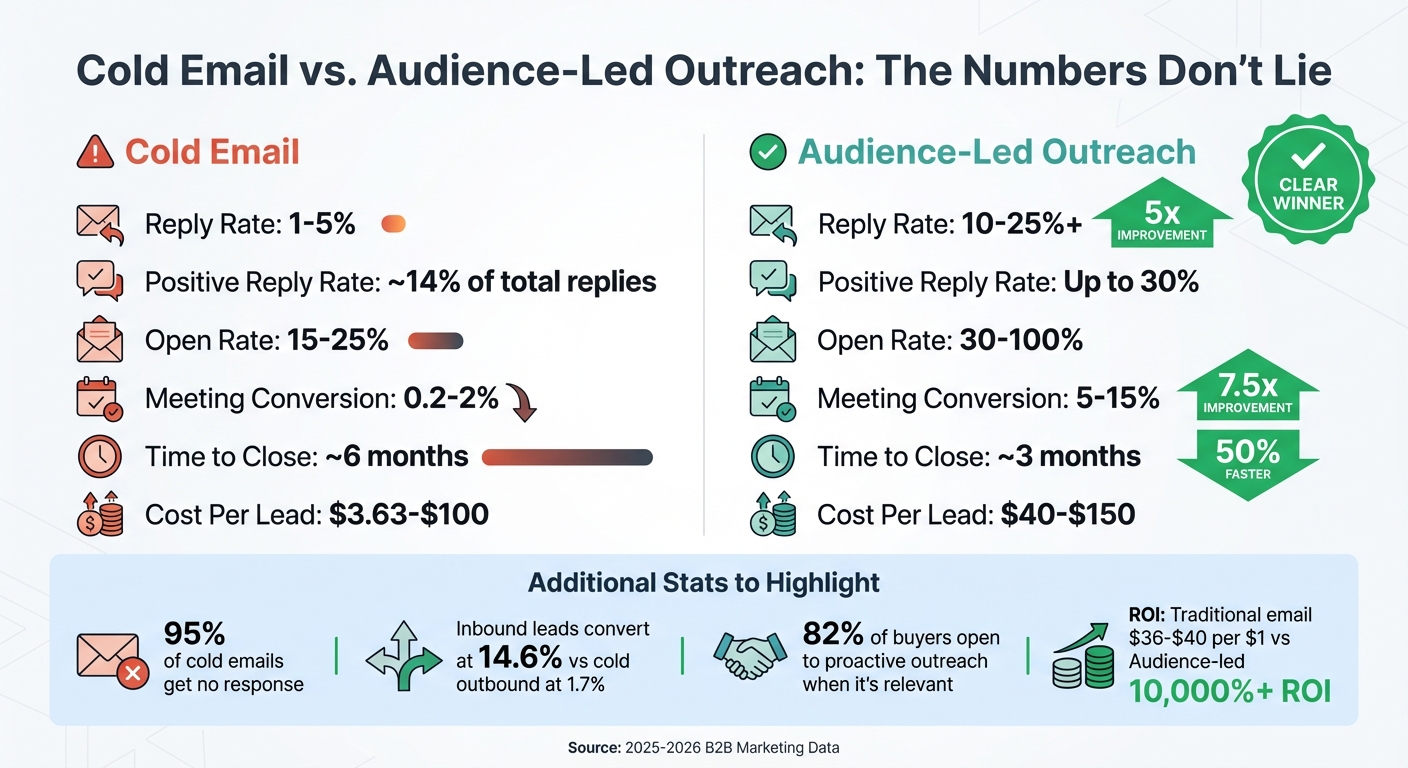
Cold Email vs Audience-Led Outreach: Performance Metrics Comparison
Metrics That Matter
The numbers paint a stark picture of the difference between cold emailing and audience-led outreach. Traditional cold email campaigns in 2026 have an average reply rate of just 3.43%. Out of those replies, only about 14.1% show genuine interest - nearly half are auto-replies - leaving an effective interested reply rate of a mere 0.64%, or roughly 1 in 157 contacts.
Audience-led outreach, however, takes a completely different approach. By warming up prospects through LinkedIn engagement and personalized research, reply rates soar to anywhere between 10% and 25%. These replies often lead to meaningful conversations, with conversion rates from first contact to a booked meeting climbing from 0.2–2% (cold email) to 5–15% for audience-led strategies. Companies adopting this method also see their sales cycles shrink - from six months to just three.
The return on investment (ROI) adds another layer of clarity. While traditional email marketing typically delivers $36–$40 for every $1 spent, audience-led campaigns can achieve ROI exceeding 10,000%. Additionally, inbound leads generated through these strategies cost about 62% less than outbound leads, and businesses are three times more likely to report higher ROI from audience-led efforts. The following table offers a side-by-side breakdown of these metrics.
Side-by-Side Comparison
| Metric | Cold Email | Audience-Led Outreach |
|---|---|---|
| Reply Rate | 1–5% | 10–25%+ |
| Positive Reply Rate | ~14% of total replies | Up to 30% |
| Open Rate | 15–25% | 30–100% |
| Meeting Conversion | 0.2–2% | 5–15% |
| Time to Close | ~6 months | ~3 months |
| Cost Per Lead | $3.63–$100 | $40–$150 |
These metrics make it clear: audience-led outreach doesn’t just boost engagement - it also speeds up the entire sales process.
Between 2025 and 2026, Ener2Crowd, an energy investment platform, collaborated with Artemis Leads to move away from generic outbound strategies and adopt a personalized, multi-channel approach. This campaign, spearheaded by Executive Chairman Paolo Baldinelli, zeroed in on high-value, hard-to-reach niches like Family Offices and Asset Management Companies. Over nine months, the shift turned zero outbound success into a steady stream of high-quality leads in these specialized markets. Artemis Leads summed it up best:
"Personalized outreach is 5–10 times more effective than generic emails".
Conclusion
Cold email, as we know it, is failing. A staggering 95% of traditional cold outreach efforts yield no responses, and most buyers now see these emails as nothing more than spam. With reply rates plummeting to just 5.1% and 68% of B2B buyers openly expressing their dislike for such tactics, the message is clear: the old way isn’t working.
There’s a better way forward: audience-led pipeline building. This approach trades mass emailing for relevance and focuses on relationships instead of quick transactions. By narrowing down to smaller, laser-focused lists (under 50 contacts), leveraging behavioral signals to identify prospects actively seeking solutions, and securing permission before pitching, response rates skyrocket to 32% - a 6.3x improvement over traditional methods. As James Milsom from Hunter.io aptly said:
"If you need a trick to get attention, you haven't earned attention".
This isn’t just a tweak to your strategy - it’s a complete overhaul. Instead of bombarding prospects with generic messages, audience-led tactics rely on founder-driven content, LinkedIn engagement, and permission-based outreach to warm up leads before making a pitch. The result? You earn trust, safeguard your sender reputation, and build a pipeline that strengthens over time.
The numbers back it up: B2B buyers are five times more likely to engage when outreach comes through a referral, and nearly 80% ignore messages that aren’t tailored to their specific needs. Audience-led marketing doesn’t just deliver better results; it reshapes how buyers view your brand. By meeting their expectations for personalized, value-driven interaction, you turn what was once an unwelcome interruption into a trusted and reliable resource.
FAQs
How do I start an audience-led pipeline if I have no audience yet?
Starting from scratch without an audience is entirely possible if you focus on building genuine connections and using smart strategies. Start by identifying your ideal customers and reaching out through personalized, relationship-driven approaches. The key is to prioritize trust and offer real value in your interactions. Take a closer look at your current network - there could be untapped opportunities waiting there. Pay attention to intent signals, like behaviors or actions that indicate interest, to engage with the right prospects. By emphasizing meaningful relationships and targeting the right people, you can lay a solid groundwork for growth, even without an existing audience.
What should my first 30 days of founder-led LinkedIn content look like?
In the first 30 days, aim to establish yourself as a go-to expert while connecting meaningfully with your audience. Share content that offers real value - think industry insights, lessons learned, and challenges you've faced. A mix of educational posts, personal anecdotes, and thought-provoking ideas will help you stand out.
Make sure your profile reflects your expertise clearly. Highlight your skills, experience, and what you bring to the table. Spend time engaging with posts in your niche - comment thoughtfully, share insights, and start conversations. Focus on building genuine connections and positioning yourself as a reliable resource that your audience can trust.
How do I personalize outreach without sounding like AI?
To make your communication feel more real and less robotic, focus on offering specific, thoughtful insights about the person you're reaching out to. Skip the cookie-cutter templates - dig into their recent LinkedIn updates, company announcements, or challenges they’ve shared. Use AI tools as a helping hand, not the entire process, to refine your message. The key is genuine effort: show you’ve taken the time to understand them, not just skimmed surface-level data. This approach builds trust and creates a connection that feels truly personal.