Content + Connections + Campaigns: The Only 3 Motions You Need for Predictable Demand

Want predictable sales? It boils down to three things: content, connections, and campaigns. Most B2B founders waste time on scattered tactics that don’t deliver. Instead, focus on these three motions to build a repeatable demand engine:
- Content: Educate and build trust before prospects even talk to you. Answer their questions, solve their problems, and position yourself as the go-to expert.
- Connections: Relationships drive sales. Engage on platforms like LinkedIn, comment thoughtfully, and build trust over time. People buy from people they know.
- Campaigns: Target the right audience at the right time. Use triggers like new hires or funding rounds to send personalized, timely messages that convert.
Here’s the reality: 95% of your audience isn’t ready to buy today, and 70% of their decision-making happens before they contact you. Content keeps you visible, connections make you memorable, and campaigns turn interest into revenue. Start with one motion, stay consistent for 90 days, and scale from there. Let’s break it down.
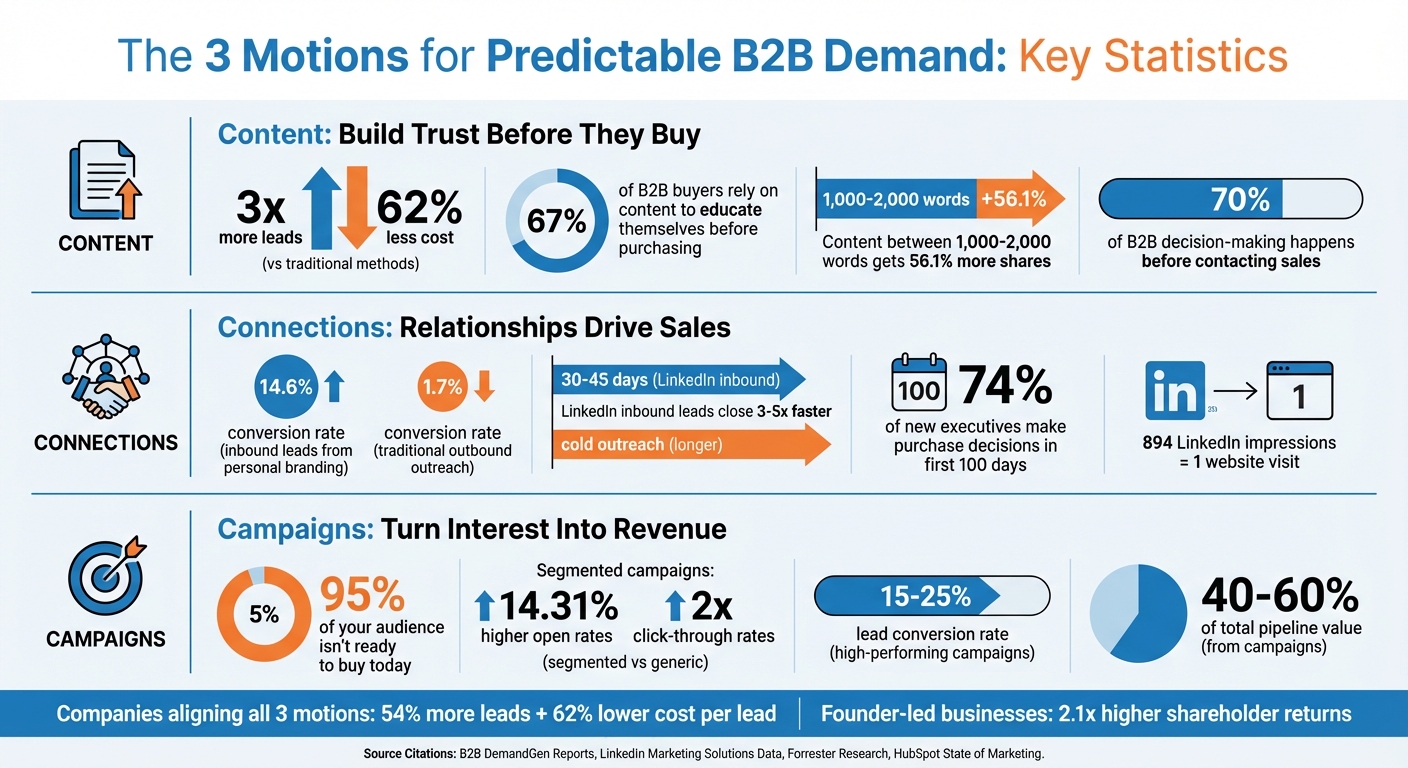
Content, Connections, and Campaigns: Key Statistics for B2B Demand Generation
Our Simple 3 Step B2B Demand Generation Strategy for 2025
sbb-itb-9354cf2
Creating Content That Drives Demand
Content is the engine behind demand generation. When done well, it informs potential customers before they even talk to you, builds trust, and positions your business as the go-to option. Content marketing generates three times more leads at 62% less cost compared to traditional methods. For small business founders, it’s an unbeatable way to maximize impact with limited resources. It’s also the foundation for building connections and launching campaigns that stick.
Skip the cookie-cutter stuff. 67% of B2B buyers rely on content to educate themselves before making a purchase decision. That means your content has to pull its weight before a sales rep ever enters the picture. Focus on creating educational pieces that address specific questions, challenge outdated industry norms, and showcase your expertise in ways that resonate with your audience.
Defining Your Ideal Customer Profile (ICP)
Successful content speaks directly to a specific person, not a vague group. Instead of aiming for “B2B marketers,” picture someone real - like a head of marketing at a 50-person SaaS company, struggling with inconsistent leads and a tight budget.
To refine your ICP, dig into these five areas: Pains (what keeps them up at night), Gains (what outcomes they’re striving for), Shifts (what changes make them open to new solutions), Blockers (what objections stop them from buying), and Motivators (what drives them to act). These insights fuel content ideas that genuinely matter to your audience and align with your goal of creating predictable demand.
A great place to mine content ideas is from real conversations. Listen to questions from sales calls, investor meetings, or support tickets. If multiple prospects ask the same thing during discovery calls, that’s a flashing neon sign to create a blog post, video, or guide answering it.
Selecting Content Formats That Work
Not every content format delivers the same punch, and not every style will feel natural to you as the creator. The trick is to find formats that suit both your audience and your strengths. Hate writing? Record voice memos or Loom videos, then transcribe them into posts. Comfortable on camera? Try LinkedIn videos or YouTube shorts.
Match your format to where your buyer is in their journey. Short LinkedIn posts or quick blogs work well for building awareness. Case studies and comparison guides are better for the consideration phase. When buyers are close to deciding, long-form guides, ROI calculators, or technical docs can seal the deal.
Here’s a stat to note: Content between 1,000 and 2,000 words gets 56.1% more shares than shorter pieces. But don’t feel like every post needs to be a deep dive. Use the "Bonfire vs. Fireworks" approach: keep a steady stream of low-effort content like social posts and short blogs to stay visible, and occasionally drop high-impact pieces like webinars or research reports. Test ideas with quick "Bonfire" posts first - if they resonate, expand them into "Fireworks" content. This strategy keeps your audience engaged while making the most of your time and resources.
Setting Up a Consistent Publishing Schedule
When it comes to content, consistency trumps perfection. Regular posting builds trust and keeps you visible to the 95% of your market that isn’t ready to buy yet. The key is to pick a cadence you can stick to.
Start with the "Crawl, Walk, Run" method. Begin small - maybe two blog posts a month and one bigger asset, like a whitepaper or webinar, every six weeks. Once you’ve nailed that for three months, level up to weekly blogs and two larger pieces per month. This prevents burnout and keeps you from abandoning the effort when life gets busy.
Use "Content Jams" to streamline your process. Dedicate 30 minutes to talk through a topic - either with a colleague or just recording yourself. Transcribe that discussion and repurpose it into multiple formats: a blog post, social media updates, email newsletter content, and more. This shifts the process from creating content from scratch to editing, which is much less daunting.
"If you only show up occasionally, you force every channel to work harder than it should. The result is usually uneven performance and a constant feeling that you need a new tactic."
Staying consistent ensures you’re top of mind when prospects are ready to make a move. A strong content library doesn’t appear overnight - it’s built piece by piece through steady effort. Once that rhythm is in place, you can focus on building deeper connections with your audience.
Building Connections That Matter
Content gets attention, but it's genuine connections that build trust. Here's a striking stat: inbound leads from personal branding convert at 14.6%, while traditional outbound outreach lags far behind at just 1.7%. That's not just a gap – it's the difference between spinning your wheels and creating a self-sustaining pipeline.
Trust isn't built through cold emails or generic LinkedIn messages. It comes from showing up consistently, sharing meaningful insights, and nurturing relationships long before any sales pitch enters the picture.
These authentic connections grow over time. Unlike quick, transactional outreach, relationship-focused marketing builds value with every interaction. For example, LinkedIn inbound leads often close deals within 30–45 days, which is 3–5 times faster than cold outreach prospects. As a founder, your credibility gives you an edge, turning brief exchanges into real trust.
"A sales rep commenting on a post is soliciting. A founder commenting is contributing. Same action, entirely different perception."
Take Lara Costa, co-founder of Cleo, as an example. In 2024, she used LinkedIn to build her personal brand and generated $30,000 in monthly recurring revenue just four days after launching her product. By building her audience and trust before her product was even finalized, she demonstrated the power of authentic connections. This kind of groundwork transforms platforms like LinkedIn into engines for lasting partnerships.
Using LinkedIn to Grow Your Audience
LinkedIn is more than just an online resume – it's the center of B2B relationships. Yet, many founders miss the mark by treating it as a static profile rather than a dynamic tool for engagement. The real opportunity lies in showing up where your ideal customers are and offering value before sending a connection request.
Start by identifying 3–5 industry leaders whose audiences align with your target customers. Dedicate just 15 minutes a day to leaving thoughtful, specific comments on their posts. A single well-placed comment in a high-traffic thread can expose you to thousands of potential prospects.
With 4–6 hours of focused engagement per week, you could generate 10–20 inbound leads monthly. To amplify results, use the 4-3-2-1 Framework: post four times a week across three content pillars (educational, storytelling, and sales-focused), target two key audience groups (ideal clients and followers), and offer one clear lead magnet.
Transform your LinkedIn profile into a landing page. Replace your CV-style bio with a headline that instantly communicates who you help and how. Use the "About" section to address your audience's challenges, not just list your accomplishments. Highlight your expertise in the "Featured" section with case studies, frameworks, or guides.
Before you send a connection request, engage with your prospects by commenting on at least 10 relevant posts from industry leaders or potential clients. Personalized connection requests can have acceptance rates 35–40% higher than generic ones.
Focusing on High-Value Relationships
Once you've built a solid digital presence, focus on relationships that genuinely matter. Not all connections are created equal. Some will become customers, others may refer business, and some might remain passive contacts. Prioritize high-value relationships – whether they're direct buyers, influencers, or peers – because a few meaningful connections will always outperform a sea of superficial ones.
Here's a key insight: 70% of B2B deals involve at least three touchpoints. Whether you're sharing an insightful article, celebrating someone's milestone, or introducing them to a helpful contact, these small, thoughtful actions build goodwill and trust. By focusing on value-first engagement, you create relationships that grow stronger over time.
Building Real Relationships vs. Transactional Outreach
Transactional outreach is all about numbers – sending out hundreds of cold emails and hoping for a handful of replies. Real relationships, on the other hand, require time and trust upfront. By offering insights, answering questions in public forums, or sharing practical advice, you create opportunities that naturally come to you.
Take InVision's approach in 2016. Instead of running a traditional ad campaign, they created a documentary, "Design Disruptors", and empowered local design leaders to host screenings in over 100 cities. This grassroots effort attracted 17,000 attendees and generated nearly 100,000 leads, all by focusing on value.
Between 2015 and 2019, InVision also launched the Design Leadership Forum (DLF), an invite-only community for design leaders from companies like Google and Netflix. By fostering mentorship and hosting intimate gatherings instead of pushing products, they built deep trust that turned into long-term customer loyalty.
"Human proximity will become the new moat."
In a world dominated by automated outreach, genuine human interaction is a powerful differentiator. On LinkedIn, it takes an average of 894 impressions to generate one website visit. That’s why pairing quality content with active engagement is critical for turning passive viewers into engaged prospects.
Adopt a "Comment First" approach by engaging with your network's content to spark warm, authentic conversations. Justin Rowe, founder of Impactable, is a great example. By consistently sharing high-value content and engaging thoughtfully on LinkedIn, he grew his following to over 85,000 and turned his personal brand into one of his company's top lead sources. He achieved this without relying on paid ads or cold emails – just consistent, value-driven relationship building.
Interestingly, new executives are 74% more likely to make purchase decisions within their first 100 days on the job. By establishing rapport early, you position yourself as the trusted resource they turn to when they're ready to buy.
Running Campaigns That Convert
Turn your audience's attention into actual revenue with campaigns that deliver results. The key difference between campaigns that succeed and those that flop lies in clear goals, tailored messaging, and smart tracking.
Most of your potential customers - around 95% - aren’t ready to buy right now. Your campaigns need to do double duty: build trust with the majority who might buy later while converting the small percentage ready to act today.
Planning Campaigns Around Clear Goals
Every campaign needs a well-defined, measurable goal that aligns with your business priorities. Vague objectives like "get more leads" won’t cut it. Instead, use S.M.A.R.T. goals: Specific, Measurable, Achievable, Relevant, and Time-bound. For instance, "Schedule 30 demos with mid-sized agencies in the next six weeks" gives you a clear target and timeline.
Before you launch, think about where your audience sits on the 5 Stages of Awareness:
- Unaware: They don’t even know they have a problem.
- Problem Aware: They recognize the issue but haven’t explored solutions.
- Solution Aware: They’re researching options.
- Product Aware: They’re evaluating your offering.
- Most Aware: They’re ready to buy.
Someone just becoming Problem Aware doesn’t need a pricing page - they need content that helps them understand their challenge.
Modern campaigns also thrive on signal-based triggers to create urgency. These are real-time buying signals like new executive hires, funding rounds, or an uptick in job postings. For example, new executives are 74% more likely to make purchase decisions within their first 100 days. If you can reach them during this window with a message that speaks to their immediate priorities, your chances of engagement skyrocket.
"The biggest issue is marketers not being ready. They start with tactics… and wonder why it fails."
Plan your campaigns in 90-day sprints instead of annual plans. This keeps your team agile, lets you pivot based on data, and ensures urgency. Within each sprint, map out a multi-channel strategy across email, LinkedIn, phone, and even direct mail over a 2–6 week period.
Once your goals are clear, focus on crafting messages that resonate with different audience segments.
Personalizing Messages for Different Segments
Generic campaigns are a recipe for mediocre results. Segmented B2B campaigns see 14.31% higher open rates and double the click-through rates compared to generic ones. But personalization isn’t just about slapping someone’s first name in an email - it’s about business relevance. Show prospects you understand their specific challenges, tools, and goals.
To get started, define 5 key CRM fields to fuel your personalization efforts:
- Trigger Event: New hire, funding round, etc.
- Tech Stack: Tools they use, like Salesforce.
- Persona Pain Point: Specific challenges, like wasting hours on manual reporting.
- Competitor Mentioned: Who they’re comparing you to.
- Company Goal: Their strategic priorities.
With this data, you can create messages that feel tailored, not templated. Use modular templates that adjust based on CRM data while keeping your core value proposition consistent. For example, if you’re targeting a new VP of Sales at a company using HubSpot, mention their role and the pipeline challenges they likely face.
Instead of blasting out mass emails, run smaller, targeted micro-campaigns. Send batches of around 200 leads based on specific triggers or segments, test your messaging, and refine before scaling. This lets you experiment without exhausting your entire list.
Map your messaging to the Before/After Framework:
- Before: What’s the prospect’s current struggle?
- After: What outcome are they aiming for?
For example: "Before: Your sales team loses 10 hours a week on manual data entry. After: They focus on closing deals while automation takes care of the busywork." This approach appeals to both emotional and practical needs.
"The more I respect the reader's anxieties, motivations, and context, the more likely they are to trust me. And trust? That's what drives conversion."
Take it a step further with dynamic content blocks in emails and landing pages. If you’re targeting enterprise companies, highlight security certifications and compliance. For startups, emphasize fast deployment and low upfront costs. This level of customization can lead to 6x more transactions than generic campaigns.
Once your messages hit the mark, tracking their performance becomes critical for scaling success.
Tracking Campaign Performance
To measure success, focus on the metrics that matter. Too many founders get distracted by vanity metrics like page views or social media impressions. Instead, track impact metrics that directly influence pipeline and revenue.
Use a three-tier reporting framework:
- Tier 3 (Signs of Life): Metrics like LinkedIn engagement rates, email open rates, and traffic from your Ideal Customer Profile (ICP). These show if your campaign is reaching the right audience.
- Tier 2 (Early Indicators): High Intent Revenue Opportunities (HIRO) - deals with a 25% or higher close rate - plus sales feedback and self-reported attribution (asking prospects how they heard about you).
- Tier 1 (Business Results): Metrics like website-sourced pipeline, Customer Acquisition Cost (CAC), and pipeline velocity (how quickly a lead moves from interest to closed deal).
Track traffic sources accurately with UTM parameters on all campaign URLs. But don’t rely solely on software attribution. Add an open-text field to demo request forms asking how prospects found you. This captures "dark social" touchpoints - like word-of-mouth or podcast mentions - that tools often miss.
Calculate your campaign ROI with this formula:
(Revenue from Campaign – Campaign Cost) / Campaign Cost.
Just make sure your data is clean - filter out existing customers, competitors, and irrelevant contacts to avoid inflating your numbers.
High-performing campaigns typically achieve lead conversion rates of 15–25% and contribute 40–60% of total pipeline value. If your numbers fall short, analyze where prospects drop off. Are your open rates low? Your subject lines might need work. Low click rates? Your offer might not be compelling. Low conversion rates? Your landing page might be unclear.
"Marketing is an experiment - measure ROI rigorously to see your results."
Set up regular feedback loops between sales and marketing. Hold weekly or bi-weekly check-ins to review whether engaged accounts are turning into real opportunities. If sales can’t close marketing-generated leads, adjust your targeting or messaging. And if sales is closing deals from accounts marketing didn’t touch, figure out what’s working outside your campaigns.
Finally, monitor pipeline velocity to ensure you’re driving quality leads, not just quantity. A healthy Customer Lifetime Value (CLV) to CAC ratio is 3:1 or 4:1. If your CAC is too high relative to CLV, you’re spending too much to acquire customers who don’t stick around long enough to justify the cost.
Connecting Content, Connections, and Campaigns
Content, connections, and campaigns are the backbone of a demand generation system that works seamlessly. When these three elements work together, they create a cycle where each one strengthens the others. Think of it like this: content provides something meaningful for your connections to share, connections amplify your content’s reach and credibility, and campaigns turn all that activity into measurable revenue opportunities. This interconnected approach ensures that every part of your marketing strategy works in harmony.
When one of these elements is missing, the system falters. Without content, campaigns lack depth. Without connections, content goes unnoticed. Without campaigns, there’s no way to turn engagement into results.
How the Three Motions Work Together
These three elements function as a 1:Many / 1:Few / 1:1 distribution model. Here’s how it breaks down:
- 1:Many: Content like LinkedIn posts, newsletters, and podcasts reaches a broad audience. This builds trust with the 95% of your market that isn’t ready to buy today. By staying visible, your brand becomes familiar and credible when those prospects eventually enter the buying phase.
- 1:Few: Webinars, roundtables, and niche content series target specific groups. This step focuses on high-potential accounts and personas within your Ideal Customer Profile (ICP).
- 1:1: Campaigns take it to a personal level. Sales reps use tailored outreach and relevant content to close trust gaps with individual prospects.
Here’s an example of how it all plays out: You write a blog post on pipeline management challenges (content). A VP of Sales at a target company sees it on LinkedIn because you’ve been engaging with their posts (connections). Two weeks later, they get a personalized email referencing the blog and offering a free pipeline audit (campaign). The content builds credibility, the connection creates familiarity, and the campaign delivers a timely offer.
"If you're selling in your discovery calls, your content isn't strong enough."
To keep the system running smoothly, use the "Bonfire and Fireworks" framework. Your “bonfire” content - short LinkedIn posts, quick videos, and social snippets - keeps your brand visible and helps you test what resonates. Once you identify what works, invest in more in-depth content and repurpose it into smaller assets for maximum reach.
Timing is key. A solid content foundation must come first, or campaigns will feel hollow. Connections without content to share won’t go far. But when all three align, they create a system where each piece amplifies the others.
Companies that align these motions report 54% more leads and a 62% reduction in cost per lead. These leads are also more likely to convert since they’ve already engaged with your content and recognize your brand.
Overcoming Common Implementation Challenges
One major hurdle is "segment sprawl" - trying to appeal to too many markets at once. When you spread your efforts too thin, none of them gain enough traction. The solution? Run an 80/20 analysis: figure out which 20% of customers drive 80% of your revenue, and focus your efforts on that group for at least 90 days.
Another common mistake is "tactics-first" thinking - jumping into ads or outreach campaigns before defining your ICP or creating content. This leads to generic messaging that doesn’t resonate and wastes resources on unqualified leads.
"The biggest issue is marketers not being ready. They start with tactics… and wonder why it fails."
To avoid this, follow the "Be Ready, Be Helpful, Be Seen" framework. Start by understanding your ICP’s pain points and buying triggers. Then, create content that addresses those challenges. Only after building this foundation should you focus on expanding your reach with campaigns and paid media.
Inconsistency is another challenge. Publishing a few blog posts or engaging on LinkedIn for a short burst, then going quiet, confuses your audience and kills momentum. Instead, follow a "Crawl, Walk, Run" cadence. Begin with a manageable output - like two blog posts a month and one larger content piece every 45 days. Once that feels sustainable, gradually increase your efforts. Consistency matters more than ambition.
"Consistency matters more than ambition. If you commit to one a week, doing the one a week is the job."
Lastly, many founders try to outsource too early - hiring external help before validating their pitch and positioning. It’s crucial to gain hands-on experience in both sales and content creation before delegating these tasks.
Allocating Time and Resources Effectively
The three motions demand a significant time investment, and founders often underestimate this. A good starting point is 10–15 hours per week, divided as follows:
| Motion | Weekly Time Allocation | Key Activities |
|---|---|---|
| Content | 4–6 hours | Writing blogs, recording videos, repurposing assets |
| Connections | 3–5 hours | Engaging on LinkedIn, attending events, 1:1 conversations |
| Campaigns | 3–4 hours | Planning sequences, personalizing outreach, tracking results |
Treat this time as non-negotiable, just like product development or client meetings.
Expect at least 90 days to see meaningful results. The first 30 days are about building your foundation - defining your ICP, creating initial content, and establishing your LinkedIn presence. Days 31–60 focus on consistency and testing - publishing regularly, engaging with your audience, and launching small campaigns. By days 61–90, you should start seeing early signs of success, like increased engagement, inbound demo requests, and warmer outreach responses.
"By treating content like an investment to be nurtured over time (rather than a one-and-done campaign), organizations can reap compounding returns."
Use 90-day sprints to stay focused. At the end of each sprint, evaluate what’s working and adjust. Double down on content topics that drive engagement, deepen connections with promising accounts, and refine campaigns based on performance data. This iterative approach keeps you agile and avoids wasting time on ineffective strategies.
To prevent burnout, build a "Mount Rushmore" bench - a small group of 3–5 internal experts who can contribute ideas and insights. Schedule weekly 30-minute brainstorming sessions with one of these experts, record the conversation, and turn it into multiple content pieces. This keeps your pipeline full without overloading your team.
Scaling Your Founder-Led Marketing
Once your content, connections, and campaigns are humming along, it’s time to think bigger. Scaling isn’t about stepping away from your marketing efforts - it’s about building systems that let you stay strategic while delegating the day-to-day. Many founders hit a wall around the 9–18 month mark, where juggling marketing, product development, and sales becomes overwhelming. The key is to keep your voice at the center while creating processes that others can execute.
Creating Systems You Can Repeat
Moving from spontaneous efforts to a structured process starts with documenting what already works. Think of it as building an operating system for your marketing - one that covers planning, creating, publishing, and measuring consistently.
Start by setting up a Content Hub using tools like Notion or Airtable. This hub should house your story pillars, brand voice guidelines, and your best-performing content. When team members or contractors need to create something, they’ll have a clear reference instead of guessing.
"Marketing should be a system, not a series of random acts."
Another useful practice is scheduling Content Jams - 30-minute biweekly sessions to create raw content that can later be repurposed.
To make your process scalable, create mini-SOPs (Standard Operating Procedures) for repeatable tasks. For example:
- How to structure a LinkedIn post (hook → main point → call-to-action)
- Steps to turn a blog into social media snippets
- Managing engagement routines effectively
These SOPs don’t have to be fancy - a checklist or a Loom video can work wonders. The goal is to make your process easy for others to follow while you stay focused on strategy.
To avoid losing focus, work in 90-day sprints. At the start of each quarter, choose one theme, one main offer, and one target audience segment. At the end of the sprint, review what worked and adjust for the next cycle.
Keeping Your Voice as You Grow
Your voice is what built trust with your audience, so don’t let it get diluted as you scale. Instead, embed your unique insights into processes that others can follow. Founder-led content tends to resonate more because it feels personal and human.
One way to maintain authenticity is by keeping editorial control. Outsource drafting, design, and production, but keep the final say on all content. If you’re working with a ghostwriter, record 30–60 minute sessions to share your insights. They can shape the raw material, but the core ideas and phrasing should come from you.
Use the Earned Insights framework to keep your content grounded. Share lessons from real experiences - mistakes, surprising client conversations, or strategies that didn’t pan out. These specific, hard-to-fake details make your content stand out.
Another way to scale while staying authentic is by building a "Mount Rushmore" bench of 3–5 internal experts. Rotate weekly brainstorming sessions with these experts, record the conversations, and repurpose the insights into multiple pieces of content.
"Founder-led is not a content strategy. It's a trust strategy."
As your brand grows, consider a Founder-Plus-Brand strategy. This means tying your personal trust to consistent brand elements - think specific colors, visual styles, or even a mascot. These assets make your brand recognizable even when your personal voice isn’t front and center.
Knowing When to Get Outside Help
Once your systems are in place, the next step is delegating execution. Timing is everything here. Bring in help too early, and you risk wasting resources before your message is solid. Wait too long, and you’ll burn out trying to do it all. The sweet spot is usually around the 9–18 month mark, once you’ve proven your content works and consistency becomes hard to maintain.
Signs you’re ready to delegate include running out of bandwidth, seeing stagnant growth, or feeling stuck in a plateau.
Start small by hiring a content VA or freelancer to handle tasks like repurposing, scheduling, and engagement. This frees you up to focus on strategy. Between months 12–30, you might expand your team with GTM operators like SDRs, AEs, or marketing generalists to manage campaigns and lead generation.
Make sure your workflows are documented so others can follow them. If you can’t explain your process clearly, you’re probably not ready to delegate yet.
When bringing in external partners, prioritize those who can preserve your voice. Ask questions like:
- Do they conduct interviews to capture your ideas?
- Will you have final editorial approval?
- Can they integrate your brand’s style into every piece of content?
The best partners don’t replace you - they amplify your efforts while keeping you at the center of the strategy.
For a more hands-off approach, consider services like RevBoss. Starting at $1,500 per month, they offer weekly strategy calls, content production, and lead-generation workflows tailored for founder-led B2B businesses.
"Your founder has their finger on the pulse better than everyone else, so they should be really tightly involved in the messaging."
The goal isn’t to remove yourself from marketing but to free yourself from execution. This way, you can focus on high-impact activities like writing quarterly essays, forging strategic partnerships, and refining your positioning. Founder-led companies outperform their peers by 2.1 times in shareholder returns - and in tech, that advantage jumps to 2.8 times. Your voice is a powerful asset; scaling doesn’t mean losing it.
Conclusion
Building predictable demand boils down to mastering three key areas: creating content that informs, fostering meaningful connections, and running campaigns that drive action.
Here’s a reality check: only about 5% of your market is ready to buy at any moment, and roughly 70% of the B2B buying process happens online before prospects ever engage with a sales team. That means your content must carry the weight of educating potential buyers and addressing their concerns. By understanding this, you can take intentional steps to develop a demand engine that works for you.
Start small and stay consistent. Focus on producing one valuable piece of content each week, nurture relationships with a handful of high-value prospects, and deploy campaigns that target clear buying signals. Nail one motion at a time until it becomes second nature, then expand from there.
Your personal voice is a powerful tool. Founder-led businesses tend to outperform, delivering 2.1 times higher shareholder returns and increasing the likelihood of customer purchases by 77% when the CEO is active on social media. Keep your unique perspective at the forefront of your efforts, even as you scale and bring in additional resources.
Hitting $1 million in revenue isn’t about reinventing the wheel - it’s about consistently applying these three motions: content, connections, and campaigns. Test what works, document your process, and scale thoughtfully. Start with the motion that feels most natural, commit to 90 days of focused effort, and watch as trust and visibility grow, paving the way for your business’s success.
FAQs
Which motion should I start with first?
Creating content that matters is the cornerstone of building trust and establishing your expertise. It’s how you position yourself as a go-to resource while drawing in the right audience. A well-structured content plan not only keeps your messaging consistent but also ensures you stay on track, even when life gets hectic. Once you’ve nailed your content strategy, you can shift your energy toward building meaningful connections and running campaigns that amplify your reach and impact.
How do I pick my ICP in one hour?
To pinpoint your Ideal Customer Profile (ICP) in just an hour, start by examining your top-performing customers. Look for patterns in areas like their industry, company size, revenue, and common challenges they face. Zero in on the high-value prospects who are most likely to gain from what you offer. Next, cut out less promising groups that don’t align with your goals. Prioritize the segments with the most potential and clearly define the criteria. This clarity helps ensure your sales and marketing teams are working in sync toward the same targets.
What should I track to prove ROI?
To show ROI, monitor campaign performance metrics, content engagement, and revenue attribution. These data points provide a clear picture of how effective your efforts are and their direct contribution to driving business growth.