How To Convince Your CEO To Build a Personal Brand

Your CEO’s personal brand isn’t optional anymore - it’s a business driver. Buyers, investors, and employees want to see the face behind the company. Here’s why you need to make the case:
- Trust equals revenue: 82% of people trust a company more when its CEO is active on social media.
- Visibility drives sales: 77% of consumers are more likely to buy from a company with a socially active CEO.
- Talent magnet: 82% of job seekers research a CEO’s online presence before applying.
- Market value matters: A CEO’s reputation directly influences 44% of a company’s market value.
Worried about time or risk? A streamlined system can limit your CEO’s involvement to just 40 minutes a month, while your team handles the heavy lifting. Start with a 90-day pilot program to test the waters, using services like RevBoss for a low-commitment, high-impact approach.
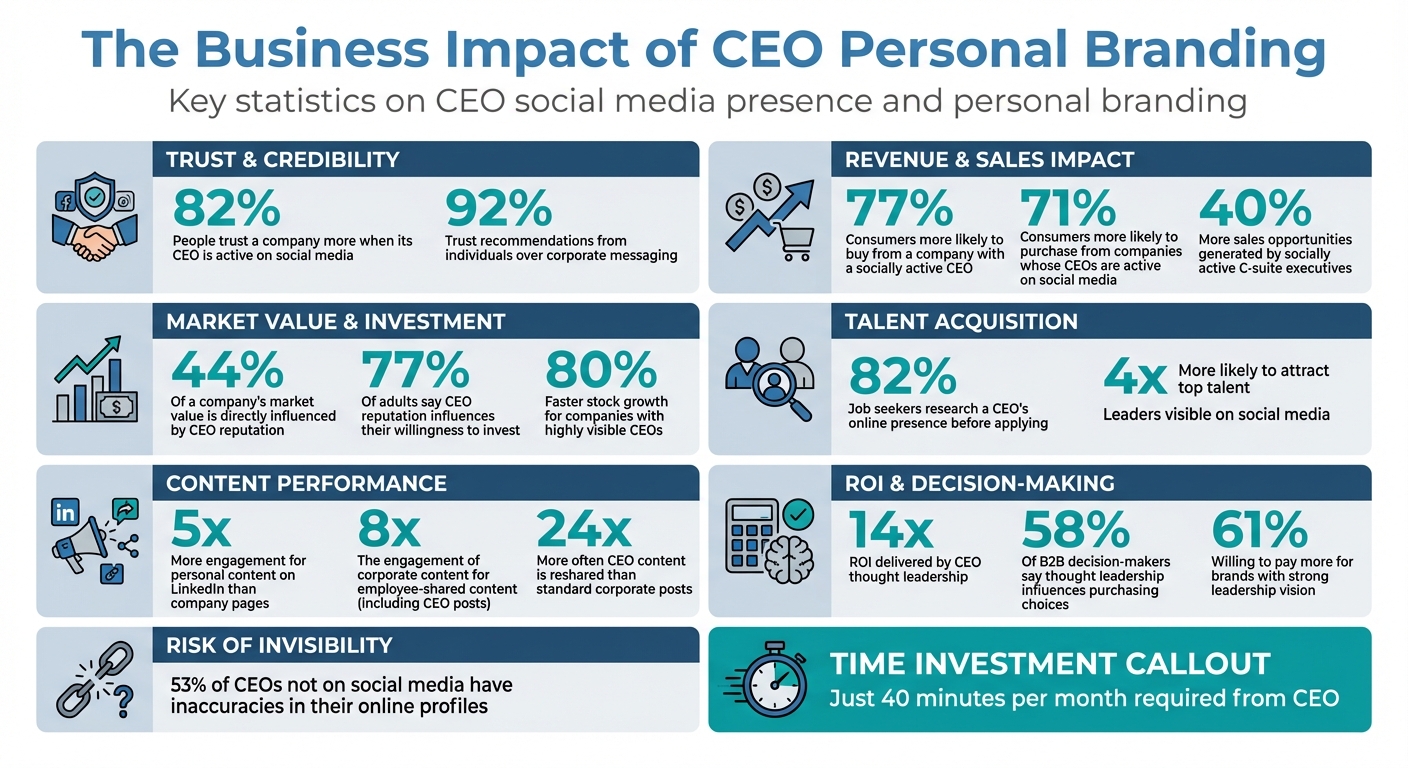
CEO Personal Brand Impact: Key Statistics on Trust, Revenue, and Market Value
Personal Branding for CEOs: Turning Leadership into Scalable Lead Generation
Understand Your CEO's Priorities and Concerns
When pitching the idea of personal branding to your CEO, it's crucial to tie it directly to their strategic priorities. Avoid framing it as a superficial or self-serving endeavor. Instead, position it as a solution to the pressing business challenges they’re already tackling. Whether their focus is on hitting revenue targets, boosting investor confidence, or attracting top talent, speaking their language ensures your proposal resonates.
Identify Their Business Goals and Pain Points
Start by connecting your CEO’s personal brand to their existing goals. For instance, if revenue growth is at the forefront, highlight that 71% of consumers are more likely to purchase from companies whose CEOs are active on social media. If investor relations are critical, remind them that 77% of adults say a CEO’s reputation influences their willingness to invest, and CEO reputation alone accounts for 44% of a company’s market value. Facing challenges with talent acquisition? Point out that leaders who are visible on social media are four times more likely to attract top talent compared to those who aren’t.
Take inspiration from General Motors’ executive visibility program led by CEO Mary Barra in 2023. By combining strategic messaging with authentic personal content - like selfies with interns - GM reached 20 million people in just six months. This approach not only strengthened GM’s employer brand but also bolstered its market positioning. Use examples like this to show how aligning personal branding with business objectives can lead to tangible results, whether that’s standing out in the market, weathering crises, or countering critics who might otherwise control the narrative.
Once you’ve demonstrated how personal branding aligns with their goals, be ready to address potential pushback.
Address Common Objections
Objections often revolve around two main concerns: time and risk.
Time is the most frequent hurdle. Many CEOs assume personal branding requires hours of effort, from crafting posts to responding to comments. Offer a streamlined solution: delegate the bulk of the work to your marketing team. With a well-organized system, the CEO’s involvement could be limited to just 40 minutes a month - less time than a typical executive meeting.
Fear of controversy is another major concern, especially among Gen X leaders who prefer to avoid unnecessary risks. To manage this, propose a "brand architecture" that ensures all communication aligns with the company’s core values. Reassure them that they don’t need to comment on every trending topic - in fact, they shouldn’t. Instead, encourage them to focus on areas where they have expertise and genuine interest. This builds credibility and niche authority without inviting unnecessary scrutiny. As Emily Neal from DSMN8 aptly puts it:
"Visibility isn't optional; it's competitive defense".
If your CEO doesn’t take control of their narrative, competitors or critics will.
To make the concept more appealing, reframe "personal branding" as "leadership branding" to underscore its strategic importance. Present it as a tool for driving recruitment, boosting employee engagement, and achieving key business outcomes. For CEOs who lack social media expertise (67% of senior leaders want guidance in this area), offer a structured 90-day plan. Include pre-approved templates and frameworks to simplify the process, making it feel manageable and far less daunting.
Build a Data-Driven Case for Personal Branding
When it comes to addressing concerns about time investment and potential risks, nothing speaks louder than hard data. To make a compelling argument for personal branding, focus on metrics that directly tie it to measurable business outcomes like revenue growth, market value, and competitive edge. Forget vague claims about "increased brand awareness" - instead, zero in on numbers that show real impact. For example, research reveals that CEO reputation accounts for 44% of a company’s market value. This aligns perfectly with the earlier discussion about linking personal branding to broader business objectives.
Use Industry Statistics
Kick things off with stats that highlight the tangible benefits of personal branding. For instance, socially active executives in the C-suite generate 40% more sales opportunities. Additionally, 77% of consumers are more likely to buy from a company if its CEO is active on social media. Visibility also builds trust - 82% of people trust a company more when its senior leaders have an online presence, and 92% trust recommendations from individuals over traditional corporate messaging.
The numbers don’t stop there. Employee-shared content, including posts from CEOs, achieves 8x the engagement of standard corporate content and is reshared 24x more often. Companies with highly visible CEOs have seen stock growth rates up to 80% faster. In the B2B space, 58% of decision-makers say thought leadership influences their purchasing choices, and 61% are willing to pay more for brands that demonstrate strong leadership vision.
While statistics provide a solid foundation, real-world examples bring these insights to life.
Show Success Stories from Other CEOs
Consider the early days of the COVID-19 pandemic. A study by FTI Consulting found that companies with vocal, visible leaders generated an estimated $260 billion in additional shareholder value. This underscores how strong public-facing leadership can instill investor confidence.
Take John Legere, the former CEO of T-Mobile, as another example. By crafting an engaging and unconventional personal brand on Twitter, he helped transform T-Mobile’s reputation and market share, turning it from a struggling carrier into a major competitor. Then there’s Elon Musk, whose personal brand on Twitter (now X) has amassed over 90 million followers, far surpassing Tesla’s 15.2 million as of June 2022. Musk’s visibility has undoubtedly played a role in Tesla’s success.
And let’s not forget Jeff Bezos, who summed it up perfectly:
"Personal branding is what people say about you when you're not in the room".
sbb-itb-9354cf2
Create a Presentation to Convince Your CEO
You’ve got the data and counterarguments ready - now it’s time to package everything into a sharp, compelling pitch that speaks directly to your CEO’s priorities. A well-structured presentation can be the difference between a quick "no" and getting the green light.
Use This 5-Slide Pitch Framework
Keep your presentation concise and laser-focused. This five-slide format is designed to hit the points your CEO cares about most: risk and time.
- Slide 1: Highlight the costs of being invisible online. When a CEO lacks an active digital presence, it creates opportunities for competitors and misinformation. For instance, 53% of CEOs not on social media have inaccuracies in their online search profiles.
- Slide 2: Introduce the solution. Personal content shared on LinkedIn profiles generates 5x more engagement than posts from company pages. This positions your CEO as a relatable, human face for the brand.
- Slide 3: Show the numbers. CEO thought leadership delivers a 14x ROI, and 77% of adults say they’re more likely to invest in a company led by a well-regarded CEO.
- Slide 4: Explain the low-effort system. Your CEO would only need to dedicate about 40 minutes per month while your team handles the heavy lifting.
- Slide 5: Lay out the plan. Propose a 90-day pilot program that starts with a digital presence audit and includes consistent, strategic posting. This sets the stage for seamless execution, as outlined in the next section.
Position RevBoss as a Low-Risk Starting Point
One of the biggest obstacles is the perceived risk of trying something new. That’s where RevBoss comes in. With proven ROI and engagement metrics already on the table, RevBoss offers a low-commitment option. Their LinkedIn Content + Audience service starts at $1,500/month on a month-to-month basis. This approach eliminates long-term contracts while delivering measurable results, including weekly strategy calls, 8–12 LinkedIn posts, and audience growth workflows.
To put things in perspective, companies like PayPal have invested heavily in CEO visibility - creating roles like "Head of CEO Content", with salaries topping $236,000 as of summer 2025. By starting with a managed service like RevBoss, your CEO can test the waters without the expense of a full-time hire. It’s a practical, low-risk way to prove the value of building their digital presence.
Follow Up and Secure Buy-In
After delivering a strong pitch backed by data and a clear plan, the next step is all about follow-through. The days immediately following your pitch are critical. CEOs need time to reflect, but staying top of mind with a prompt follow-up ensures the momentum isn’t lost.
Follow-Up Email Template
Send this email within 24 hours of your pitch. Keep it concise, professional, and focused on action:
Subject: Next Steps: 90-Day Personal Brand Pilot
Hi [CEO Name],
Thank you for taking the time to review the personal branding proposal yesterday. The data highlights the importance of CEO visibility - 53% of CEOs not on social media have inaccuracies in their online profiles.
Here’s the proposed 90-day pilot:
- Month 1: Conduct a digital presence audit and create a content framework
- Month 2: Launch with 8–12 LinkedIn posts (~40 minutes total per month)
- Month 3: Evaluate results and decide on next steps
We can start with RevBoss's LinkedIn Content + Audience service at $1,500/month on a month-to-month basis - no long-term commitment required. This includes weekly strategy calls, content creation, and audience growth workflows.
Would you be available for a quick 15-minute call this week to discuss the roadmap?
Best regards,
[Your Name]
Once the email is sent, be ready to address any follow-up questions or concerns the CEO might have.
How to Handle Additional Objections
When following up, it’s common for objections to surface. Here’s how to address them with clear, measurable outcomes:
If time is an issue:
Reassure them about the minimal time commitment - just 40 minutes monthly. That’s two 15-minute sessions and a quick 10-minute review. For example, General Motors CEO Mary Barra used a similar strategy in 2024–2025, combining product launches with relatable, culture-driven content like selfies with interns. The result? 20 million people reached in just six months.
If they’re worried about performance:
Focus on the metrics you’ll track: LinkedIn follower growth, post engagement, inbound partnership inquiries, and recruitment impact. A 90-day pilot offers tangible data to demonstrate ROI. As Lauren Cobello, CEO of Leverage with Media, explains:
"Personal branding is what people say about you when you're not in the room. The question is, are you letting that narrative be written by others, or are you taking control of the story?"
If privacy is a concern:
Set clear boundaries upfront. The content strategy can focus on leadership insights and industry expertise while avoiding personal or family-related topics. Following an 80/20 rule - 80% value-driven insights, 20% promotional - keeps the brand professional and relatable without oversharing.
Position visibility as a strategic necessity, not vanity. With 82% of people more likely to trust a company when its executives are active on social media, staying silent isn’t just a missed opportunity - it’s a potential liability.
Conclusion: The Business Impact of a CEO's Personal Brand
The numbers speak volumes: 82% of people are more inclined to trust a company when its senior executives are active on social media, and 44% of a company’s market value is tied directly to the CEO’s reputation. These aren’t just stats - they’re a wake-up call. A CEO’s personal brand isn’t about ego; it’s a powerful business tool that delivers real, measurable results. Ignoring this opportunity doesn’t just mean staying invisible - it could mean losing ground to competitors.
A well-crafted personal brand for a CEO goes beyond visibility. It builds trust, strengthens market value, and fuels growth. In times of crisis, it acts as a buffer, preserving the company’s reputation. It also draws in top-tier talent - people want to work for leaders who stand for something and share a clear vision.
The best part? Building this kind of presence doesn’t have to drain a CEO’s time. With the right team, the heavy lifting - like creating content and expanding the audience - can be managed, leaving the CEO free to focus on big-picture decisions and approvals.
For instance, RevBoss offers a LinkedIn Content + Audience service starting at $1,500 per month, with no long-term commitments. This includes weekly strategy sessions, tailored content creation, and proven audience growth workflows. It’s a low-risk, high-reward way to establish a leadership presence, especially for founder-led B2B companies.
Ultimately, the question isn’t whether your CEO should develop a personal brand - it’s whether your company can afford not to. In today’s competitive market, controlling the narrative isn’t optional. It’s how you build trust, credibility, and sustained growth.
FAQs
How does a CEO's personal brand build trust and drive business growth?
Building a strong personal brand as a CEO can do wonders for fostering trust in your company. Research highlights that 82% of people are more likely to trust a business when its executives are active on social media. Why? Because it makes leadership feel more relatable and transparent. And trust isn’t just a warm fuzzy feeling - it drives action. In fact, 77% of consumers say they’re more inclined to buy from a company whose CEO actively engages in public conversations.
But it’s not just about winning over customers. A CEO with a visible and engaging personal brand can also instill confidence in investors and attract top-tier talent. This combination can significantly impact the bottom line. By sharing insights and showing genuine leadership, a CEO can position their company as not just credible, but forward-thinking and dynamic.
How much time does a CEO need to dedicate to building and maintaining a personal brand?
The time a CEO needs to invest in building and maintaining a personal brand can differ based on their objectives, industry, and how hands-on they want to be. That said, it doesn’t have to dominate their calendar. Many CEOs achieve great results by setting aside just a few hours each week for tasks like writing content, engaging on social media, or attending public events.
To keep things manageable, responsibilities like creating posts or managing social media accounts can often be handed off to trusted team members or external professionals. This frees up the CEO to focus on the more impactful aspects, such as sharing their expertise or fostering direct connections with their audience.
How can a CEO’s personal brand help attract top talent and secure investors?
A CEO’s personal brand can be a magnet for top talent and eager investors. By openly sharing a compelling vision, genuine values, and thoughtful perspectives, CEOs not only highlight their company’s culture but also give a glimpse into their leadership approach. This resonates with job seekers, making the organization stand out in a crowded hiring landscape. The result? Faster hiring processes and better employee retention.
For investors, a CEO with a recognizable and trusted personal brand helps ease concerns and instills confidence in the company’s trajectory. It signals reliability and strong leadership, which often translates into increased trust and larger funding opportunities. Simply put, a CEO’s personal brand isn’t just about image - it’s a powerful tool for attracting the talent and capital needed to fuel business growth.