Demand Gen Governance: How to Scale Quality Across Teams

Your demand gen team is growing fast, but scaling without a plan? That’s a recipe for chaos - bad leads, frustrated sales, and wasted budget. The solution? Governance. It’s the framework that keeps your processes, people, and platforms aligned so you can scale smart, not just big. Here’s the playbook:
- Align Sales and Marketing: Define MQLs, SQLs, and set SLAs (e.g., respond to hot leads in 5 minutes or less).
- Engineer Quality: Use clear ICP filters, automate lead QA (like deduplication), and focus on metrics that matter - pipeline impact, not vanity stats.
- Standardize Workflows: Map every stage of your funnel with clear criteria, triggers, and ownership. Document these in tools like Notion or Confluence.
- Automate and Centralize: Use tools like CRMs and marketing automation platforms to enforce standards, route leads, and track metrics in real-time.
- Track Metrics That Matter: Prioritize conversion rates, LTV:CAC ratios, and pipeline velocity. Skip vanity numbers like email opens.
- Audit and Improve: Regularly review data quality, SLA compliance, and team performance. Adjust based on actual results, not assumptions.
Scaling isn’t just about doing more - it’s about doing better. Governance ensures your demand gen machine runs smoothly, delivers results, and keeps sales and marketing on the same page. Let’s dive into the details.
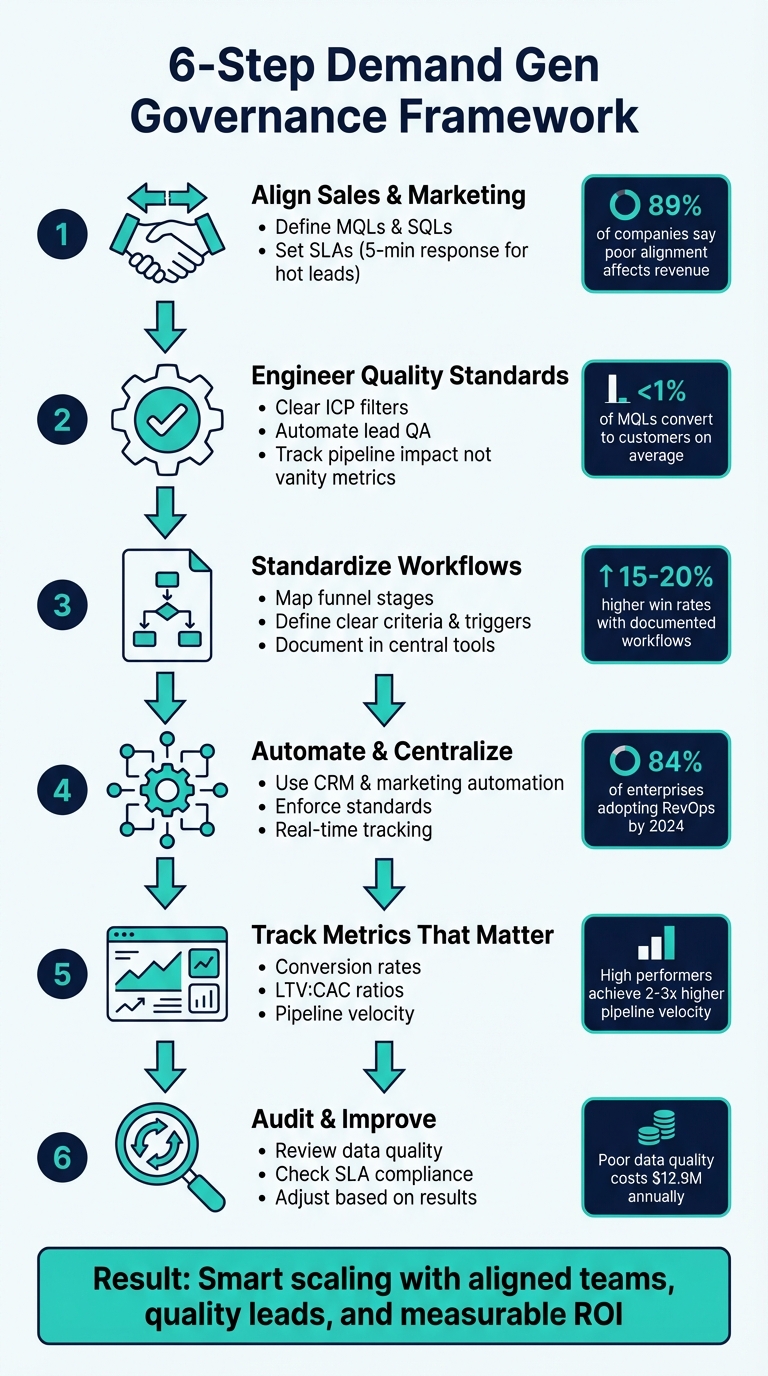
6-Step Demand Gen Governance Framework for Scaling Quality
Building a High-Impact Demand Gen Framework
sbb-itb-9354cf2
Setting Up Core Governance Principles
To bridge the governance gap and create a scalable demand generation framework, it's essential to establish clear principles. These principles focus on aligning teams around shared goals, defining what "quality" means in measurable terms, and concentrating efforts on your ideal customer profile. Think of them as the guardrails that keep your demand generation strategy on track as you scale.
Aligning Sales and Marketing Teams
Sales and marketing need to work toward the same goal: driving revenue. When marketing focuses solely on lead volume and sales zeroes in on closing deals, misalignment can wreak havoc. In fact, 89% of companies acknowledge that poor alignment between these teams directly affects their revenue.
To get everyone on the same page, start with universal lead definitions that establish common ground for Marketing Qualified Leads (MQLs) and Sales Qualified Leads (SQLs). Next, formalize a Service Level Agreement (SLA) to define clear expectations for response times and lead management. Why does this matter? Research shows that the likelihood of qualifying a lead drops 21 times when the response time increases from 5 minutes to 30 minutes.
Take Udemy as an example. In 2025, they introduced a unified Go-to-Market (GTM) platform combined with automated territory-based lead routing. This reduced rerouted leads by 46% in real time, showing how alignment and automation can deliver immediate results. The key is to create governance structures that make collaboration effortless.
With alignment in place, the next step is to focus on defining and measuring quality.
Setting Quality Standards and Metrics
"Lead quality is not something you 'optimize.' It is something you engineer."
Start by standardizing stage definitions with clear criteria for when leads enter and exit each stage. This creates a Shared Definitions Framework that everyone can follow.
When it comes to metrics, ditch vanity numbers and focus on a four-level hierarchy:
- Activity: The marketing team's actions - emails sent, ads displayed, webinars hosted.
- Engagement: How the market responds - click-through rates, form completions, MQLs.
- Pipeline: The sales impact - marketing-sourced pipeline, velocity, and Sales Qualified Opportunities (SQOs).
- Revenue: The ultimate benchmarks - Customer Acquisition Cost (CAC), lifetime value (LTV):CAC ratio, and payback period.
Automating quality assurance can save time and reduce errors. Use tools for email/domain validation, consent checks, and deduplication before leads even reach your sales team. Centralizing data governance on a single platform ensures that all teams work with the same numbers and definitions.
"If a metric does not help a rep, a manager, or finance make a better decision this week, drop it."
- Nathan Thompson, Fullcast
Once you've engineered quality, the focus shifts to targeting the right customers.
Focusing on Ideal Customer Profile (ICP) Targeting
Your Ideal Customer Profile (ICP) is where strategy meets execution. Companies with strong GTM alignment see 32% higher year-over-year growth, and prioritizing high-fit ICP segments can boost win rates by 20–30% in just two quarters.
To refine your ICP, use filters like industry, firmographics, and key buying roles. This helps weed out low-fit leads before they clutter up your system. Implement tiered scoring (e.g., A/B/C) to classify accounts, routing top-tier leads to your most experienced reps with stricter SLAs. The payoff? Targeting ICP-fit accounts makes logo acquisition eight times more efficient, and tailored messaging can improve MQL-to-SQL conversion rates by 35–50%.
"When a company has a clear understanding of its ideal customer, the business becomes simpler and more aligned, with sales, marketing, product development, and customer success operating in harmony."
- Alan Gonsenhauser, Founder and CEO, Demand Revenue, LLC
Treat your ICP as a dynamic guide, not a static document. Regularly clean your data (monthly), review your rules (every two months), and retrain predictive models (quarterly). Establish a feedback loop with sales to track lead disposition and identify channels delivering off-ICP leads. This disciplined approach prevents the costly mistake of acquiring high-churn, low-fit customers who drain resources without contributing to sustainable growth.
Creating Standard Processes and Workflows
Once your teams are aligned and quality standards are defined, having documented processes ensures quality is upheld at every step. As mentioned earlier, strong governance plays a key role here; documented workflows make sure those quality benchmarks are consistently applied across all team interactions. Organizations that rely on repeatable, documented workflows throughout the revenue cycle see 15–20% higher win rates compared to those that depend solely on institutional knowledge. This makes documenting processes a critical first step toward turning governance into consistent demand generation success.
Documenting Each Demand Gen Stage
Begin by mapping your funnel to reflect real-world B2B buying behaviors. Use stages like Awareness, Consideration, Intent, Evaluation, Conversion, and Expansion, and clearly define entry and exit criteria for each stage. For instance, a lead might enter the "Intent" stage after requesting a demo and exit once they qualify as an SQL or are sent back to a nurture sequence.
Processes should be tied to specific triggers. Avoid vague instructions like "review leads monthly." Instead, use actionable triggers such as, "If the lead-to-account match rate drops below 80%, re-audit routing rules". Assign each process to a single owner, leveraging a RACI model, and specify the required inputs (like CRM reports) and outputs.
"The process that lives in someone's head is the process that breaks first."
- Jordan Rogers, RevenueTools
Store these documents in platforms like Notion, Confluence, or your CRM, ensuring they’re easily accessible. Include version control with a "last-updated" date and change log, and schedule quarterly reviews during QBRs to keep processes current. Plan for fallback scenarios, such as when a lead doesn’t match any routing rules or when an SLA is breached.
Once these stages are clearly documented, the next step is enforcing standards through SLAs.
Setting Service Level Agreements (SLAs)
SLAs transform intentions into measurable commitments. The most critical SLAs cover four time-based stages: assignment (target: under 1 minute for automated routing), first contact (within 5 minutes for hot leads), qualification (24–72 hours), and handoff (24–48 hours to book a meeting).
Data strongly supports the importance of speed. Companies that contact leads within one hour are nearly 7x more likely to qualify them compared to those that wait longer. Reaching out within 5 minutes increases conversion likelihood by 21x compared to waiting over 30 minutes. Despite this, the average B2B company takes over 29 hours to respond to a new lead.
To enforce SLAs, use automated alerts, acceptance timers, and mandatory CRM fields to prevent leads from slipping through the cracks. Tie SLA compliance to performance reviews or commission structures, such as requiring 85% compliance to earn full bonuses. Companies with formal marketing-sales SLAs are 34% more likely to achieve year-over-year ROI growth.
| SLA Type | Definition | Target (Hot Leads) | Target (Warm Leads) |
|---|---|---|---|
| Speed-to-Lead | Time from MQL creation to first outreach | ≤ 5–15 minutes | ≤ 1–2 hours |
| Accept/Reject | Time for a rep to claim or disqualify a lead | ≤ 24 hours | ≤ 48 hours |
| Follow-up Sequence | Minimum touches across channels | 6 touches in 48 hrs | 4 touches in 5 days |
| Qualification | Time to move lead to SQL or nurture | ≤ 24 hours | ≤ 72 hours |
| Handoff | Time to book meeting after qualification | ≤ 24 hours | ≤ 48 hours |
Start with a simple, one-page SLA that focuses on key handoffs, and expand it as you refine your processes. Regularly review and audit these SLAs - monthly if possible - to account for changes like new hires, territory adjustments, or shifts in lead volume.
Once standardized processes and SLAs are in place, the next step is using centralized tools to streamline collaboration.
Using Centralized Tools for Team Collaboration
Centralized platforms are essential for scalable governance. Your CRM (like Salesforce or HubSpot) acts as the system of record, while specialized tools handle specific processes. For example, routing platforms automate lead assignment based on territory, account ownership, or ICP fit. Marketing automation tools manage the lead lifecycle and attribution, while sales engagement platforms ensure reps follow up according to SLAs. Revenue intelligence platforms provide insights into deal health and forecasting.
By 2024, 84% of enterprise companies are expected to have adopted some form of revenue operations, and 75% of the fastest-growing companies globally plan to implement a RevOps model by 2025. Companies with aligned revenue operations often see a 10–20% boost in sales productivity and a 30% cut in GTM costs.
"Revenue operations collapses those silos. One team, one data model, one set of definitions, one operating cadence."
- Jordan Rogers, RevenueTools
Enforce data standards at the point of entry using field validation rules and automated QA tools. This ensures critical data - like UTM parameters and company names - is captured before leads even enter your system. Document your routing logic in a centralized wiki to safeguard institutional knowledge, especially in case of staff turnover. Look for platforms with visual flow builders that enable operations teams to manage complex workflows without heavy coding requirements.
Tools like RevBoss consolidate these workflows within your governance framework, ensuring team alignment and visibility. By centralizing lead routing, enrichment, and scheduling, you eliminate gaps that allow leads to slip through the cracks and ensure every buyer signal gets the attention it deserves.
Setting Up Quality Assurance and Metrics
Processes and SLAs don’t mean much if you’re not measuring the right things. Quality assurance isn’t about churning out more reports - it’s about making sure you have visibility into metrics that distinguish whether your demand generation efforts are driving revenue or just creating noise. Here’s the reality check: in the average B2B company, less than 1% of MQLs convert to customers, yet many teams still focus on MQL volume instead of prioritizing pipeline quality.
By building on standardized processes and SLAs, quality assurance ensures your efforts translate into revenue rather than wasted resources.
Focus on the Right Metrics
The right metrics help you spot problems before they hit your revenue. Pay attention to three key areas:
- Quality: Keep an eye on MQL-to-SQL conversion rates and Sales Acceptance Rates.
- Efficiency: Track CAC payback periods and LTV-to-CAC ratios.
- Velocity: Measure how quickly opportunities move through your funnel.
High-performing B2B companies can achieve pipeline velocity that’s 2x to 3x higher than their peers. Additionally, monitor the ICP-Fit Logo Acquisition Rate to ensure you’re capturing high-value accounts rather than just generating a flood of leads. Accounts that fit your Ideal Customer Profile (ICP) are 8x more efficient to acquire.
Data Quality is Non-Negotiable
Everything hinges on clean, reliable data. Audit your data with these three pillars in mind:
- Accuracy: Is the information still correct?
- Completeness: Are all required fields filled out?
- Coverage: Do you have the right contacts in your system?
Poor data quality costs businesses an average of $12.9 million annually, and 37% of teams say they’ve lost revenue because of it.
Building Real-Time Dashboards
Dashboards are your command center, connecting four key levels of data: Activity (e.g., emails sent), Engagement (e.g., clicks, MQLs), Pipeline (e.g., marketing-influenced value), and Revenue (e.g., ROI, LTV-to-CAC). Here’s how you can structure a dashboard for maximum clarity:
| Dashboard Row | Focus Area | Key Metrics |
|---|---|---|
| Row 1 | Volume | Marketing-sourced pipeline, total MQLs, pipeline coverage ratio (aim for 3x to 4x your revenue targets) |
| Row 2 | Quality | MQL-to-SQL conversion rate (13–21% is typical), win rate by source, average deal size |
| Row 3 | Efficiency | CAC by channel, CAC payback period (median for SaaS: $2.00 spent per $1.00 of new ARR), LTV-to-CAC ratio |
| Row 4 | Funnel Health | Stage-to-stage velocity, recycled lead volume, stage-aging alerts |
Dashboards become actionable when they include threshold-based alerts. For example, set a Slack notification if your MQL-to-SQL conversion time exceeds five business days or if your pipeline coverage ratio slips below 3x. Every metric should tie back to a clear definition, a clean system of record, and role-specific playbooks that guide teams on how to respond when thresholds are breached.
Capturing the "Dark Funnel"
B2B buyers often complete 70% of their evaluation before they ever engage with your website. To capture these hidden insights, add a free-text "How did you hear about us?" field to high-intent forms. Self-reported attribution can uncover qualitative signals that tracking software might miss. Standardize definitions across teams by creating a one-page glossary for lead stages (MQL, SQL, SQO), with explicit entry and exit criteria. This eliminates internal confusion about what your data actually represents.
When dashboards provide real-time insights, regular audits keep your metrics sharp and actionable.
Running Regular Audits and Feedback Loops
Dashboards show trends, but audits dig deeper to identify root causes and validate improvements. Use a tiered approach:
- Weekly reviews: Focus on lead quality and pipeline health.
- Monthly audits: Check for routing accuracy and lifecycle drift.
- Quarterly recalibrations: Update scoring models and data standards.
Start with a Data Health Dashboard that tracks field completion rates, duplicate records, and formatting inconsistencies (e.g., "USA" vs. "United States"). Around 64% of organizations say data quality is their biggest data integrity challenge. To improve segmentation, replace free-text fields for industry or job titles with picklists or enrichment tools.
Audit disqualified leads regularly. These leads often highlight gaps in your framework or targeting more effectively than closed-won deals. If sales keeps rejecting leads from a specific source or campaign, it’s time to adjust your ICP targeting or scoring model - not just train your sales team.
"Lead quality is the output of your revenue system. If the system is fragmented, quality suffers regardless of how strong your marketing is."
Formalizing Feedback and Streamlining Workflows
Create a cross-functional governance committee that includes Marketing Ops, Sales Ops, and RevOps. Meet quarterly to address data integrity challenges, review SLA compliance, and recalibrate scoring models based on actual win/loss data. When auditing speed-to-lead metrics, use the median instead of the average. Outliers, like a lead that took three days to contact, can skew the average and hide your team’s actual performance.
To avoid workflow chaos, implement fallback queues in your routing logic. This ensures leads don’t vanish if primary rules fail. Regularly review workflows and tag them as "Keep", "Consolidate", or "Kill" based on their alignment with your ICP and lifecycle stages. This keeps your automation aligned with your governance framework, preventing inefficiencies from creeping in.
Scaling Quality with AI and Automation
Bringing AI and automation into your governance framework can transform how you manage demand generation as your business grows. Think of AI as a digital team member, capable of running end-to-end workflows across your entire demand generation stack. Companies that are built around AI often see free-trial-to-paid conversion rates jump to 56%, compared to 32% for those that aren’t AI-driven. This boost happens because AI ensures every lead experiences optimized, automated sequences, no matter which team or region handles them.
AI also connects the dots between your platforms - CRM, marketing automation tools, and enrichment software - so everyone operates from a unified, enriched data source. Instead of sticking to rigid schedules, AI enables outreach triggered by real-time signals like funding announcements, executive changes, or new tech adoption. Reaching out within 24 hours of such events can increase reply rates by 40%. Teams using AI agents typically see a 20–40% boost in first meetings within two months, thanks to faster, more relevant responses. Let’s dive into how AI takes campaign performance to the next level with smarter sequencing and enriched data.
Using AI to Improve Campaign Performance
AI isn’t just about execution - it’s about adaptability. Modern AI tools adjust outreach strategies based on how prospects respond. For instance, if an email sparks engagement, the system might switch to another channel to keep the conversation going. This kind of adaptive sequencing ensures a seamless buyer experience across multiple touchpoints without requiring constant manual adjustments.
To further enhance campaign performance, use waterfall enrichment to improve data accuracy. Instead of relying on one data source, set up workflows that pull from several providers in a prioritized order. This method can achieve match rates of 85–92% for B2B contacts. Reject records that don’t meet an 85% confidence level to protect deliverability and ensure your outreach is backed by reliable data. With contact information decaying at a rate of roughly 30% per year, automated re-enrichment is essential for maintaining quality.
When it comes to targeting, back-test your Ideal Customer Profile (ICP) models against the past year’s closed-won deals. Every converted account should rank in the top tier - if not, your scoring model likely needs adjustment. AI prospecting workflows can save over 80% of the time spent on manual list building by incorporating signals like hiring trends and tech stack changes to continuously identify and score accounts.
"The differentiator is turning insights into coordinated steps your systems can trust."
Automating Repetitive Tasks
Sales reps can reclaim over two hours a day by automating tasks like data entry and scheduling. But the real game-changer lies in automating high-impact tasks that directly affect pipeline quality. A great place to start is lead-to-account matching - automatically linking new leads to existing accounts to maintain context, avoid duplicate outreach, and ensure leads are correctly assigned.
Speed-to-lead is another area where automation shines. Set up alerts for untouched leads after 5 minutes, and reassign them to a backup team if they remain inactive for 15 minutes. AI can also craft hyper-personalized outreach triggered by specific events, like a prospect’s recent promotion or company news. This approach achieves reply rates 2–3x higher than generic templates. For efficiency, focus deep research on Tier 1 (Strategic) accounts, use trigger-based personalization for Tier 2 (ICP), and rely on segment-level automation for Tier 3 (Long tail). This tiered strategy balances personalization with scalability.
To maintain quality, consider a human-in-the-loop model for high-stakes outputs. For example, tasks like pricing recommendations or contract terms should go through formal validation processes before reaching customers. Classify tasks as low-risk (e.g., internal summaries) or high-risk (e.g., customer-facing pricing), and reserve human approval for the latter category.
"In 2026, if your revenue organization doesn't have AI governance, you don't have an AI strategy. You have a liability waiting to materialize."
- Jordan Rogers, RevOps Leader
Finally, set up a continuity queue to catch leads that slip through the cracks due to routing issues or missing data. This ensures no prospect is overlooked during team transitions or tool failures. Early adopters of AI-driven systems have reported campaign creation and execution speeds increasing by up to 15x, with overall growth climbing by 10% or more and annual productivity gains of 3–5%. By automating these key tasks, you create a reliable, high-quality demand generation process that aligns seamlessly with your governance goals.
Training Teams and Testing Improvements
Without proper training and continuous fine-tuning, even the most well-thought-out governance framework will fall flat. As Jordan Rogers, The GTM Advisor, aptly puts it, "Governance without adoption is just documentation". It's not enough for your team to know the rules - they need to grasp why those rules exist and how their daily efforts fit into the larger demand generation strategy.
Training Teams on Governance Frameworks
Training is the backbone of any governance framework, ensuring it becomes an active part of your demand generation system. A structured 60-day rollout can help align teams effectively:
- Days 1–14: Catalog all tools and processes to establish a baseline.
- Days 15–30: Classify tasks by risk level (e.g., customer-facing vs. internal).
- Days 31–45: Develop concise, one-page guidelines covering escalation protocols and data access policies.
- Days 46–60: Conduct targeted training sessions tailored to each team.
For new hires, onboarding should immediately cover lifecycle stages, SLA expectations, and campaign standards to ensure consistency from day one. Using a RACI matrix (Responsible, Accountable, Consulted, Informed) for each stage of the demand generation process eliminates confusion and clarifies roles.
Regular cross-functional meetings are another key piece of the puzzle. Weekly pipeline hygiene reviews, bi-weekly MQL quality checks, and monthly funnel analyses are opportunities to reinforce training and keep everyone aligned. These routines transform governance from a static document into a dynamic, actionable system that teams integrate into their daily workflows.
Once your team is fully trained, the next step is testing and refining these processes to ensure they deliver measurable outcomes.
Running Tests to Refine Processes
Testing is where you turn training and documented processes into scalable, revenue-focused systems. Rather than running small, isolated A/B tests on elements like button colors, focus on experiments that tie directly to key outcomes, such as shortening the sales cycle or increasing deal size. A simple three-step framework can guide this process:
- Ideate: Identify constraints or explore new market segments.
- Implement: Test time-limited tactics, like predictive lead scoring.
- Measure: Use a scorecard to decide whether to scale, tweak, or abandon the tactic.
Consider running 30-day quality sprints to test new channels or approaches. Reserve 20–30% of your budget as a control group to validate results before scaling globally. Track weekly channel performance using metrics like the Sales Accepted Lead (SAL) rate and pipeline per lead. If quality metrics drop, pause immediately to diagnose and address the issue.
It's also worth regularly auditing disqualified leads. These often highlight gaps in your framework that successful deals might not reveal.
Another critical area to monitor is rework rates - how often automated or AI-generated outputs require manual corrections. High rework rates can point to gaps in training or process design. Additionally, enforce data completeness thresholds of 80–95% for key CRM fields like ICP Tier and Lead Source before routing leads. These metrics help you evaluate whether your governance framework is actively driving results or just sitting idle in a shared folder.
Conclusion: Building a Scalable Demand Gen Framework
Scaling demand generation isn’t just about doing more - it’s about doing it smarter. The teams that succeed in scaling don’t just focus on volume; they focus on governance. This means creating a structure where every process, tool, and strategy aligns with clear standards. Everything we've discussed - from ICP guardrails to governance pillars - feeds into this approach.
Key Takeaways for Scaling Demand Gen Quality
Start with well-defined ICP guardrails. These filters - covering industry, firmographics, and buying roles - help block low-quality leads from clogging your system. Build on this with the four governance pillars:
- System Governance to optimize tool configurations.
- Process Governance to ensure SOPs and SLAs are rock-solid.
- Behavioral Governance to train teams and establish consistent rhythms.
- Data Governance to maintain clean, usable data models.
"Governance is the operating system that ensures every aspect of your revenue engine - processes, platforms, people, and campaigns - runs as intended."
- Rachit Puri, RevOps Global
Make automation your ally. Companies with high automation maturity generate double the pipeline contribution of their less-automated peers. Automate lead QA processes - like email verification, consent checks, and deduplication - before handing leads off to sales. Use routing systems that account for rep capacity and reassign leads automatically if SLAs aren’t met.
Focus on the right metrics. Vanity metrics like MQL volume won’t cut it. Instead, track meaningful metrics like SAL/SQL conversion rates and payback periods on a weekly basis. Create a rhythm of cross-functional reviews - weekly pipeline hygiene checks, bi-weekly MQL quality assessments, and monthly funnel analyses - to keep everyone on the same page. When combined with the governance framework, automation, and targeted measurement, these practices lay the foundation for consistent, scalable demand generation.
Next Steps for Your Governance Framework
To put these ideas into action, follow this 30-day plan:
- Days 1–5: Finalize ICP guardrails and set UTM standards.
- Days 6–10: Build QA workflows and templates.
- Days 11–15: Launch pilot processes.
- Days 16–30: Review dashboards and document playbooks.
FAQs
Who should own demand gen governance?
Demand generation governance works best when it's handled by a cross-functional leadership team. This team should include key players from marketing, sales, and revenue operations (RevOps). Why? Because having everyone on the same page ensures that processes, metrics, and standards stay aligned as efforts grow. RevOps, in particular, takes the lead on managing operational systems, keeping data accurate, and ensuring consistency. By sharing ownership, teams can avoid silos, uphold standards, and create scalable demand generation processes that maintain quality across the board.
What’s the fastest way to fix lead quality?
The fastest way to enhance lead quality is by leveraging AI-driven lead scoring models. These tools analyze past conversion data to predict which leads are most likely to close, allowing you to route them effectively. By cutting down on unproductive efforts, your team can zero in on high-potential opportunities, making the demand generation process smoother and increasing the number of leads that sales teams actually accept.
How do I pick metrics that drive revenue?
When selecting metrics that truly impact revenue in demand generation, focus on ones that tie marketing efforts directly to pipeline growth and sales results. Metrics like pipeline influence, lead-to-opportunity conversion rates, and revenue attribution should take center stage. These provide a clearer picture of how marketing drives business outcomes, unlike traditional metrics such as lead volume, which often lack context. To ensure your metrics are both dependable and actionable, implement strong data governance practices. This approach allows you to measure the effectiveness of your demand generation strategies while keeping your efforts aligned with revenue objectives.