Your Exec Team is Your Best Sales Prospecting Resource

Your executive team isn’t just for big-picture strategy - they’re your sales team’s ace in the hole. Why? Because executives have access to trusted networks, credibility, and industry insights that sales reps can’t replicate. Here’s the deal:
- Executives bypass barriers: CEOs and VPs can connect directly with decision-makers, skipping gatekeepers.
- Warm intros work: Prospects are 5x more likely to respond to a warm introduction than cold outreach.
- It drives results: Companies with formal executive sponsor programs see 26% of their top leaders driving revenue growth, compared to just 4% without.
Want to maximize this? Teach your execs to map their networks, craft personalized LinkedIn messages, and run multi-channel campaigns. Add tools like LinkedIn Sales Navigator and RevBoss to streamline the process. The result? More meetings, faster sales cycles, and stronger pipelines.
Let’s break down how to turn your leadership team into a sales-driving machine.
Lessons Learned from Insight Led Selling - Dr Stephen Timme & Melody Astley - INSIDE Inside Sales
Use Executive Networks for Warm Introductions
Your executives likely already have connections to the people your sales team is trying to reach. The challenge lies in transforming those connections into actual conversations. A warm introduction can make all the difference - buyers are 5x more likely to engage when approached this way instead of through cold outreach. That difference could be the tipping point between being ignored and securing a meeting.
To leverage these connections, start by mapping your executives' networks to align their relationships with your target accounts. For example, in June 2025, LinkedIn Senior Account Executive Anthony Natoli and his manager used Sales Navigator's "connections of" filter to map three target accounts. They identified a former colleague at one of the targets and crafted a short, tailored introduction. The result? A booked meeting within just two hours.
How to Map Executive Networks
Begin by pinpointing your high-value target accounts, then identify the 6–10 key decision-makers involved in B2B purchasing decisions. LinkedIn Sales Navigator’s TeamLink feature is a powerful tool for this, as it reveals shared connections across your sales team. If some colleagues don’t use Sales Navigator, you can expand your reach with TeamLink Extend. Additionally, the "connections of" filter allows you to search for prospects tied to specific executives, such as your CEO or VP of Sales.
Don’t limit yourself to formal connections - informal relationships like former colleagues, board members, or alumni can also open doors. For instance, in April 2024, an Account Executive at Canada Post used TeamLink to secure a warm introduction into a tough account, ultimately landing a deal worth more than double the initial investment.
"The team struggled to break into an account until an AE used TeamLink to get a warm intro - leading to a deal worth over 2x the initial investment."
– Judy Wang, Sales Effectiveness Sr. Manager, Canada Post
Stay proactive by setting up alerts for when your executives' connections move into new target accounts. Newly appointed executives often bring fresh perspectives and are more likely to consider new solutions. When prioritizing introduction pathways, focus on relationship strength - a former colleague’s recommendation carries more weight than a casual LinkedIn connection.
Once you’ve mapped these connections, the next step is turning them into actionable, warm referrals.
Getting Warm Referrals from Executives
After identifying the right connection, make it as easy as possible for your executive to facilitate the introduction. Research the mutual connection, understand the prospect’s challenges, and draft a clear and concise introduction message for the executive to use.
Remember, asking for an introduction is asking for a favor, and it risks the executive’s reputation. This means your messaging needs to be precise and compelling. Warm introductions can boost conversion rates by 15–18%, but they only work when the referrer believes you’ll deliver real value. Provide your executive with a strong "reason to connect", such as a specific insight or shared interest they can include in their outreach.
"Asking for an intro is asking for a favor. Look at it from the referrer's perspective, knowing that they have a reputation to upkeep. Give them confidence that you can truly make a positive impact for the contact in question."
– Amanda B., Content Strategy and Operations Leader, LinkedIn
Train Executives on LinkedIn Outreach
Leverage the credibility your executives already have by helping them enhance their LinkedIn engagement. These leaders often possess extensive networks, but many didn’t grow up using social media as a sales tool. That’s where targeted training comes in - teaching them the techniques that work specifically on LinkedIn. By building this foundation, you can guide them toward crafting better messages and making the most of LinkedIn’s features.
LinkedIn messages are different from emails - they’re compact and appear in a small window. Keep messages concise so they fit on the screen and hold the recipient’s attention. Interestingly, top-performing sellers who exceed their revenue targets by 25% or more are 41% more likely to be highly active on LinkedIn.
Before your executives send a single message, ensure their profiles are polished. Think of the profile as a digital business card - it should include a professional photo, a strong headline, and a complete work history. A well-crafted profile establishes credibility instantly. Without this, even the most thoughtful outreach risks being ignored, as prospects often check profiles before responding.
Write Personalized LinkedIn Messages
Teach your executives to keep messages short and sweet - five to seven sentences max. This ensures the entire message is visible without scrolling.
An effective message follows a simple three-part structure: start with a Hook (a compelling opening line or question), offer a Value Proposition (how you address a specific problem), and close with a clear Call to Action. The goal isn’t to close a deal in the first message but to spark a conversation.
Encourage them to find common ground by using icebreakers like shared LinkedIn groups, mutual connections, or recent industry-related comments. For example: “I noticed your comment on supply chain forecasting - it aligns with the challenges we’re helping solve.”
Review their messages to ensure they focus on the prospect, using “you” and “your business” more than “I” or “my company.” This approach shifts the tone to be more prospect-centric. Additionally, messages with 400 characters or fewer tend to get a 22% higher response rate compared to longer ones.
"LinkedIn isn't the place to spray and pray. No place is. Don't do that."
– Steli Efti, CEO, Close
When possible, avoid using LinkedIn InMail - it often feels impersonal or overly sales-driven. Instead, encourage executives to send personalized messages as part of connection requests, which are limited to 300 characters. This method feels more organic and professional.
Use LinkedIn Features for Prospecting
Once personalized messaging is mastered, executives can tap into LinkedIn’s powerful tools to find and engage prospects. Sales Navigator, for instance, offers over 40 filters that help pinpoint decision-makers based on criteria like seniority, job function, company size, and years of experience.
One standout feature is TeamLink, which shows which colleagues are connected to a prospect. This makes it easier to map out warm introductions, complementing earlier networking efforts.
Teach executives to use Boolean operators (AND, OR, NOT) for precise searches. For instance, searching “Marketing Manager AND San Francisco” narrows results to meet both criteria. The “connections of” filter is another useful tool, allowing searches within a specific contact’s network or a target account.
LinkedIn’s Account IQ, powered by generative AI, provides quick summaries of account research. This helps executives understand a prospect’s business challenges before reaching out. Similarly, the Relationship Explorer tool identifies “hidden allies” within an account, which is invaluable for multi-threading - building connections with multiple stakeholders at once.
Encourage them to save searches and leads, enabling alerts on prospect activity. For example, when a prospect shares a post or changes jobs, it creates a timely opportunity to reach out.
Finally, train executives to use Smart Links. This feature allows them to share content and track how prospects interact with it. These insights can guide follow-up conversations. Keep in mind, video content performs exceptionally well on LinkedIn, driving five times more engagement than other types, while live video generates 24 times more engagement. Consider tools like Vidyard to help executives include personalized videos in their outreach.
Consistent activity is key. Executives who post three to four times a week and engage with prospects’ posts build familiarity before sending direct messages. This approach, often called “social leadership,” transforms them from cold outreachers into trusted voices within their industry.
Run Multi-Channel Exec-Led Outreach Campaigns
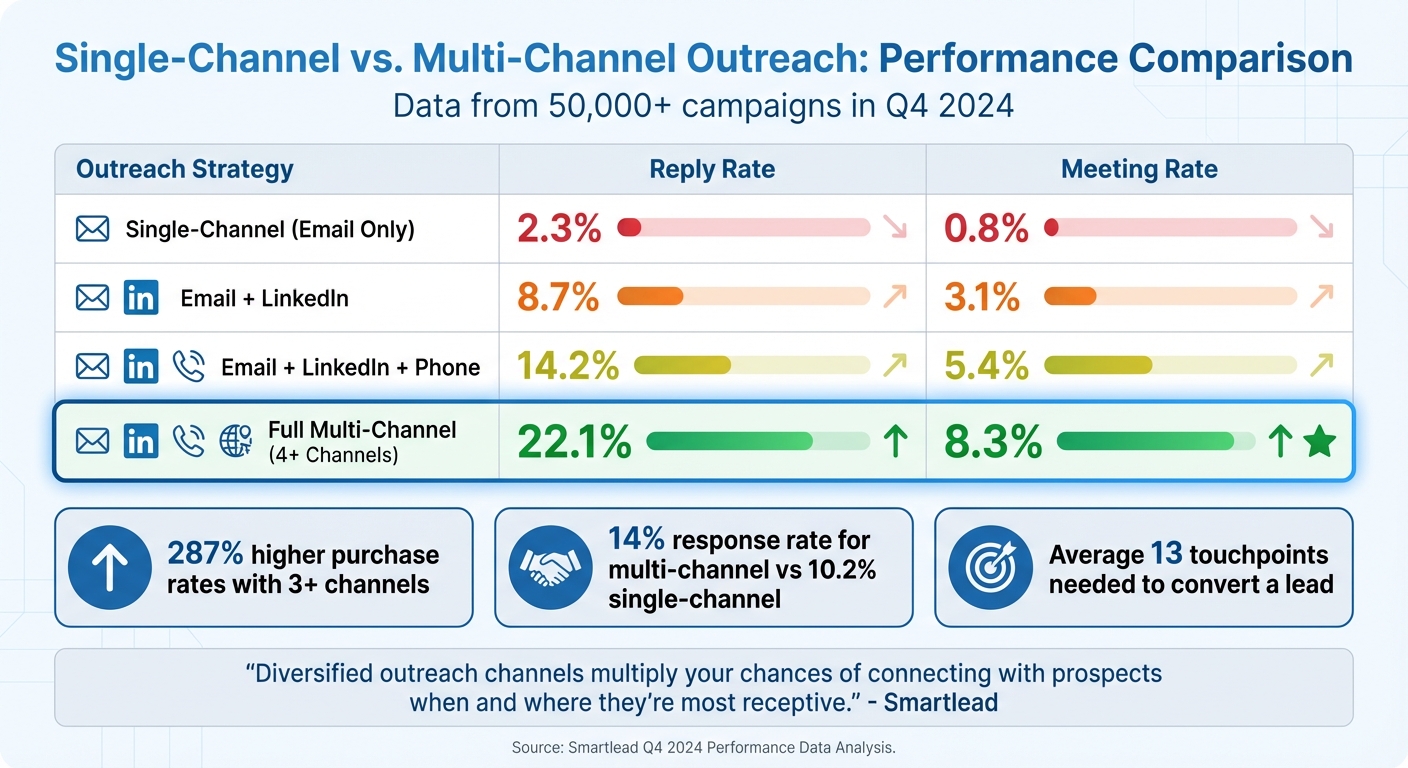
Single-Channel vs Multi-Channel Outreach Performance Comparison
When prospects see an executive's name pop up across different platforms, it’s a game-changer for credibility. Relying solely on LinkedIn won’t cut it - successful outreach needs to combine email, LinkedIn, and phone calls. Each channel plays a specific role: email delivers the key message, LinkedIn builds social proof, and phone calls handle objections in real-time.
Here’s why this matters: companies using three or more channels see 287% higher purchase rates compared to those sticking to just one. Multi-channel campaigns also boast a 14% response rate, far outpacing the 10.2% average for single-channel approaches. Want even better results? Full multi-channel sequences (four or more channels) achieve a 22.1% reply rate and an 8.3% meeting rate - a massive leap from the 2.3% reply rate and 0.8% meeting rate of email-only outreach.
The trick is to structure your outreach in layers of intimacy. Start with low-touch channels like email, move to LinkedIn interactions, and finish with a phone or video call. This gradual escalation builds "cognitive ease" - a psychological effect where repeated exposure to a name makes it feel familiar and trustworthy. With B2B buyers now using up to 10 different channels to evaluate suppliers - double the number from 2016 - it’s clear that adding just one extra touchpoint can boost meeting bookings by 14%. Add more, and that number jumps to 24%, though it often takes an average of 13 touchpoints to convert a lead.
Single-Channel vs. Multi-Channel Outreach: A Comparison
Data from over 50,000 campaigns in Q4 2024 paints a clear picture:
| Strategy | Reply Rate | Meeting Rate |
|---|---|---|
| Single-Channel (Email) | 2.3% | 0.8% |
| Email + LinkedIn | 8.7% | 3.1% |
| Email + LinkedIn + Phone | 14.2% | 5.4% |
| Full Multi-Channel (4+ Channels) | 22.1% | 8.3% |
"Diversified outreach channels multiply your chances of connecting with prospects when and where they're most receptive."
With stats like these, it’s no wonder tools like RevBoss make multi-channel strategies seamless to execute.
Set Up RevBoss Workflows for Exec Outreach
RevBoss simplifies the complexity of multi-channel campaigns, letting you combine email, LinkedIn, and direct outreach into one cohesive sequence. This ensures consistent follow-ups without overwhelming your team - or your prospects.
Here’s an example of a 14-to-21-day sequence:
- Day 1: Send a problem-focused email that highlights a key industry challenge.
- Day 3: View the prospect’s LinkedIn profile and engage with one of their recent posts.
- Day 5: Send a personalized connection request on LinkedIn.
- Day 8: Make a phone call and leave a value-packed voicemail if there’s no answer.
- Day 10: Follow up with an email referencing the voicemail and include a helpful resource.
RevBoss workflows also include suppression logic, which pauses all outreach for 48 hours after a response to avoid annoying prospects with redundant messages. On top of that, intent-based triggers make your sequences smarter. For instance, if a prospect opens an email three times but doesn’t reply, the system can prompt a LinkedIn message or phone call within hours to strike while the iron’s hot. Plus, RevBoss integrates with your CRM, ensuring all interactions feed into a single, unified record, so you can switch channels based on real-time behavior.
Timing is everything. Schedule emails for Tuesday–Thursday between 8:00–10:00 AM, and target LinkedIn engagement Wednesday–Friday from 9:00–11:00 AM to catch prospects when they’re most active.
This approach isn’t just theory. In 2025, Rootly, an incident management platform, used a multi-channel strategy powered by automation. By focusing on LinkedIn and email, they contacted 41% more prospects, scheduled 69% more meetings, and achieved a 640% increase in LinkedIn outreach. Their success came from ditching scattered efforts in favor of systematic coordination. When your executives align their outreach, they don’t just connect - they convert.
sbb-itb-9354cf2
Give Executives Value-Driven Messaging and Research Tools
To make executive-led prospecting more effective, arm your leaders with messaging that speaks to real business challenges and research tools that uncover what matters most to prospects. A casual, unplanned approach won’t cut it. In fact, 82% of top-performing sales reps always research their prospects before reaching out. Buyers today expect salespeople to act as trusted advisors, especially when you're targeting high-value prospects. Executives need structured messaging frameworks and precise research to engage meaningfully.
When outreach strategies are organized and well-targeted, executives can turn curiosity into action. Without this structure, they risk falling into what some call "seagull behavior" - showing up unprepared, causing chaos, and leaving without follow-up. To avoid this, equip your team with tools and frameworks that emphasize value over product features and research methods that save time and effort.
Create Messaging Frameworks Focused on Value
Generic pitches are a waste of time. A staggering 90% of C-level executives ignore cold calls and emails. It’s not that they’re unreachable - it’s that most outreach fails to address the issues they actually care about. Executives are focused on outcomes, not product specs.
That’s where the AIM Framework comes in:
- Anxiety: Call out a pressing business challenge to grab attention.
- Influence: Back it up with industry insights or data to build credibility.
- Motivation: Show how you can deliver measurable, meaningful results.
For example, instead of saying, "Our platform improves efficiency", try something like this: "Companies in your industry lose $2M annually to manual RevOps processes. Here’s how three competitors cut that cost by 40% in just six months." By tying your message to metrics like cost savings, revenue growth, or productivity, you make it impossible to ignore.
Structured messaging frameworks deliver real results. Just look at F5, a leader in application security. In 2024, they adopted Highspot to streamline how reps access and personalize messaging. Within 16 weeks, they saw a 4x jump in customer engagement, a 4x increase in meetings booked, and a 6x boost in opportunities created. When executives focus on addressing pain points rather than pushing product features, they can transform hesitation into action.
| Sales Cycle Stage | Messaging Focus for Executives |
|---|---|
| Awareness | Help prospects identify their pain points and highlight challenges faced by similar teams. |
| Interest | Link your product or service to specific goals the prospect cares about. |
| Evaluation | Emphasize business impact, share customer success stories, and align your solution with their priorities. |
| Decision | Address risks and provide clear ROI through case studies and data. |
| Adoption | Reinforce value and suggest quick wins to keep stakeholders engaged. |
"Instead of just pushing for a sale, focus on educating potential clients, addressing their pain points, and positioning your solution as essential to their success."
– Magda Paslaru, Managing Director, RainbowIdea
Use Research to Personalize Outreach
Personalization isn’t a luxury - it’s the bare minimum. The 3x3 Research Method offers a quick way to gather insights: spend three minutes identifying three key data points about your prospect. This could include spotting a recent funding announcement, a new product launch, or even a LinkedIn post where they mention scaling challenges.
For public companies, digging into 10-K reports can be incredibly revealing. For instance, if a prospect’s 10-K mentions "operational inefficiencies in customer onboarding", you could lead with, "I noticed your recent filing highlighted onboarding bottlenecks. Here’s how we helped a similar company cut their onboarding time by 50%." This shifts your pitch from "nice-to-have" to "must-have."
Keep an eye on trigger events. Prospects are 65% more likely to respond to an InMail if they’ve changed jobs in the last 90 days. Mentioning a mutual connection in your first message can also boost your chances of landing a meeting by 70%. Tools like BuiltWith or HG Insights can help uncover a prospect’s tech stack, making it easier to identify gaps or inefficiencies. For example, if they’re using outdated CRM software, you might say, "I noticed you’re still on [legacy system]. Most teams in your industry upgraded last year to avoid compliance risks."
Using platforms like RevBoss can make research even easier. Instead of manually hunting for intel, RevBoss pulls key data points - like job changes, LinkedIn activity, or company news - so your team can personalize their outreach without wasting time. When paired with multi-channel outreach, this kind of research positions your executives as trusted advisors. And that’s critical - 88% of buyers say trust is essential to doing business.
Track and Measure Executive Prospecting ROI
To make executive outreach truly effective, you need to measure its impact clearly and consistently. Without tracking, it’s impossible to know what’s working and what’s not.
Start by setting measurable goals and reviewing results weekly and quarterly. This ensures accountability and keeps the initiative front and center. Top-performing sales teams rely on outbound efforts as a key growth driver, with 80% highlighting it as an essential part of their revenue strategy. Your executive team should approach prospecting with the same level of commitment.
Metrics That Matter
When evaluating executive-led prospecting, focus on metrics that provide actionable insights.
- Meeting Conversion Rate: This tracks the percentage of prospects who actually schedule a meeting after being contacted. A strong conversion rate means your targeting and messaging are hitting the mark.
- Reply Sentiment Analysis: Don’t just measure response rates - analyze the tone of replies. Categorize them as "Positive" (eager to meet or requesting more information) or "Objections" (issues like budget or timing). This helps gauge how well your outreach resonates with decision-makers.
- Sales Cycle Time: Executive involvement should accelerate the buyer's journey, not slow it down. Shorter cycles mean your approach is effective.
"Understanding at the rep and team level what percent of replies are positive and what objections they are facing gives you the ability to coach to better inputs which drive better outcomes."
– Joeylynn Koenig, Customer Success Manager, Outreach
Key Metrics for Executive Prospecting
The right metrics help you assess whether your executives are connecting with the right people and driving pipeline growth.
- Prospect Seniority Mix: This ensures leaders are targeting high-priority decision-makers - think VPs, Directors, and C-suite executives who hold the purse strings. If your team is engaging lower-level contacts, it’s time to refocus.
- Cost per Opportunity: Calculate how much it costs to generate a single lead. This metric highlights the efficiency of your outbound efforts.
- Calls to Close Ratio: This shows how many outreach attempts are needed to convert a prospect into a customer.
- Referral Campaign Performance: Referrals are gold. They convert 71% better and close 69% faster than cold outreach.
Companies led by "Growth Champion" executives - those who balance relationship-building with revenue goals - achieve sales and profit growth rates twice as high as those led by "Social Visitors" or "Dealmakers". To keep the pipeline moving, set daily persona goals, such as adding 10 high-priority contacts to your outreach sequences each day.
| Metric | What It Measures | Why It Matters |
|---|---|---|
| Meeting Conversion Rate | % of prospects contacted who book a meeting | Reveals whether targeting and outreach are effective |
| Positive Reply Rate | % of replies with positive sentiment | Shows if messaging resonates with leadership |
| Sales Cycle Time | Average days from lead to close | Measures how much executives speed up deal velocity |
| Cost per Opportunity | Total spend divided by leads generated | Evaluates ROI of prospecting resources |
| Prospect Seniority Mix | % of high-level personas contacted | Ensures executives engage the right decision-makers |
These metrics give you a clear picture of how executive involvement transforms outreach into productive meetings.
Using RevBoss Metrics to Refine Campaigns
Leverage these metrics to continually improve your campaigns with tools like RevBoss. By centralizing data and automating workflows, RevBoss helps you track performance in real time and make quick adjustments. For example, you can A/B test your sequences by experimenting with subject lines, opening hooks, and calls-to-action across 200–300 touches. This approach helps identify the most effective strategies.
Take Rootly, an incident management platform, as an example. In 2025, the company used Outreach to audit sales sequences and automate manual tasks. The results were impressive: a 41% increase in prospects contacted, a 69% boost in meetings scheduled, and a 640% jump in LinkedIn outreach. These kinds of gains are achievable when you combine the right tools with disciplined tracking.
Consistency is key. Monitor overdue tasks to ensure follow-ups don’t fall through the cracks. Aim to close each day with fewer than 50 pending tasks and each week with none. And remember, it often takes 8–12 touches to get a response from a prospect. Using multiple channels - email, phone, LinkedIn - keeps your outreach persistent but not overbearing.
Finally, report results to the executive team on a weekly and quarterly basis. This keeps everyone aligned and allows for real-time adjustments. When executives see the tangible outcomes of their prospecting - like shorter sales cycles, higher win rates, or a stronger pipeline - they’ll remain invested in the process.
Common Mistakes in Executive-Led Prospecting and How to Fix Them
When executives dive into prospecting without a plan or coordination, they can unintentionally derail the entire effort. One glaring example of this is what account managers call "seagull management" - executives who swoop into customer meetings unprepared, stir up confusion, and leave others scrambling to clean up the mess. Take the case of a global chemical firm in 2021. A newly appointed executive, Robert, met with a key customer without first consulting the account manager. Lacking a clear understanding of the company’s capabilities, he promised unlimited production capacity during demand surges - a promise the firm simply couldn’t keep. The fallout strained the relationship for months.
Another common misstep is oversimplified outreach. Treating decision-makers like faceless inboxes instead of real people is a major turn-off. Jumping straight into a sales pitch without first establishing relevance or offering meaningful insights is equally ineffective. Research shows that 92% of B2B buyers start the sales process already considering a specific vendor. This means your executive team must stand out by showcasing strategic value - not just rattling off product features.
Over-socializing is yet another trap. About 19% of executives focus solely on building personal rapport, spending time schmoozing without addressing substantive business issues. While trust is important, customers looking for strategic partnerships often grow impatient when conversations lack depth. On the flip side, executives who act purely as dealmakers can create their own problems, like encouraging customers to bypass account managers for direct price negotiations.
So, how do you avoid these pitfalls? Start with mandatory briefing and debriefing protocols. Executives should never meet with customers alone. Require them to engage with account managers before and after every meeting to ensure everyone is on the same page and to capture valuable insights. Implement executive sponsor programs, assigning leaders to strategic accounts for two- to three-year terms. This ensures consistency and allows for deeper relationships to develop. Companies with formal sponsor programs report that 26% of their executives act as "growth champions", compared to just 4% at firms without such programs. Additionally, centralize a system for tracking customer visits to monitor outcomes and refine strategies.
These measures not only bring structure to executive involvement but also ensure their efforts align with broader prospecting goals.
"Account managers have a name for executives who meet with customers without any briefing or debriefing: seagulls. They fly in, make a lot of noise, leave a mess, and fly off."
– Noel Capon and Christoph Senn, Authors
Conclusion
Your executive team is a powerhouse of connections, trust, and influence that can revolutionize your prospecting efforts. Companies with structured executive sponsor programs see a stark difference: 26% of their top managers become high-impact leaders, compared to only 4% at firms without such programs.
Start by mapping out your executives' networks and tapping into their ability to build trusted relationships. Integrate their involvement into multi-channel campaigns that align with your broader sales strategy. Brief them thoroughly beforehand and debrief afterward to avoid the dreaded "seagull" effect - where they swoop in, create a flurry of activity, and disappear without follow-up. This cohesive approach not only accelerates your pipeline but also deepens customer trust.
Make executive prospecting a cornerstone of your strategy, not an afterthought. Set clear objectives, track metrics like pipeline growth and meeting conversion rates, and use tools that simplify coordination. Platforms like RevBoss can help you streamline executive-led outreach campaigns across email and LinkedIn, ensuring that their efforts drive measurable results.
Here’s a striking fact: 92% of B2B buyers enter the purchasing process already considering a specific vendor. Your executives have the authority and credibility to position your company as that vendor. As discussed earlier, personal engagement from your leadership team can significantly influence market dynamics.
Start small. Focus on one or two key accounts and assign executive sponsors for two- to three-year terms. Develop tailored messaging frameworks and monitor results closely. This methodical approach ensures you’re maximizing the impact of your executives' involvement. It’s time to activate your leadership team and let their influence work for your business.
FAQs
How can executives use their networks to boost sales prospecting?
Executives can turn their professional and personal networks into a powerful sales prospecting tool by building a network map. Start by jotting down your LinkedIn connections, alumni associations, board memberships, and industry group affiliations. Then, organize these contacts based on their industries, decision-making roles, and how they might influence key business challenges. LinkedIn’s search tools can be especially useful for spotting second-degree connections, identifying emerging roles like Chief Revenue Officer, and finding opportunities for warm introductions.
Once you’ve outlined your network, shift your focus to mapping relationships within your target organizations. This can help you pinpoint decision-makers and key influencers. Give priority to high-value connections and think about outreach strategies that make an impact. For instance, you might request a warm introduction, host exclusive executive events, or share tailored thought-leadership content that resonates with your audience. Keep track of responses and refine your approach as you go - this way, your network can become a steady pipeline of qualified leads.
What makes a LinkedIn outreach message effective for connecting with prospects?
Crafting a LinkedIn outreach message that resonates involves keeping it short, personal, and focused on what’s in it for the recipient. Start with a personalized greeting - mention something specific about them, like a recent post they shared or a mutual connection, to demonstrate genuine interest. This small touch shows you’ve done your homework and aren’t just sending a generic message.
Next, establish credibility by briefly explaining who you are and how your experience or your team’s expertise connects to their industry or challenges. Keep it relevant and concise - this is your chance to show you understand their world.
Then, lay out a clear value proposition. What’s the benefit for them? Address their needs or pain points directly, using simple, no-frills language. Make it obvious why your message is worth their time.
Wrap things up with a strong call-to-action. Whether it’s suggesting a quick meeting, asking a thoughtful question, or sharing a helpful resource, make it easy for them to engage. Finally, include a brief signature with your name, title, and a link to your LinkedIn profile or company page. This reinforces professionalism and gives them an easy way to learn more about you.
Why is reaching out through multiple channels more effective than using just one?
Using a variety of channels to connect with potential buyers works better because it boosts both visibility and engagement. By meeting people where they already spend their time, you’re naturally increasing your chances of making a connection. In fact, businesses that use three or more channels often experience purchase rates that are almost three times higher than those sticking to just one channel. Response rates? They improve dramatically too.
Today’s buyers are active on platforms like email, phone, and social media. On average, it takes about 13 touchpoints to turn a lead into a customer. A multi-channel strategy ensures your message stays consistent and reinforces your value across these interactions. This approach doesn’t just catch their attention - it builds trust and helps move them through the buying process more smoothly.