Executive Thought Leadership on LinkedIn: A Step-by-Step System (Not “Personal Branding”)

Want to make LinkedIn work for you as a founder or executive? Here's the deal: buyers trust people, not brands. Thought leadership on LinkedIn isn’t about vanity metrics or "personal branding." It’s about sharing hard-earned insights to build trust, shorten sales cycles, and establish authority.
Here’s the quick playbook:
- Optimize your LinkedIn profile: Clear headline, engaging summary, measurable achievements, and Creator Mode activated.
- Define content pillars: Focus on 3–5 topics that align with your expertise and your audience’s challenges.
- Post high-impact content: Share actionable insights, use visuals, and engage with comments to spark conversations.
- Grow your network: Connect strategically with decision-makers and influencers in your space.
- Post consistently: Aim for 2–5 posts per week, track performance, and refine your strategy.
Why it matters: 73% of decision-makers trust thought leadership more than traditional marketing, and executives active on LinkedIn are trusted 58% more. Follow this system to turn your LinkedIn presence into a demand-generating machine.
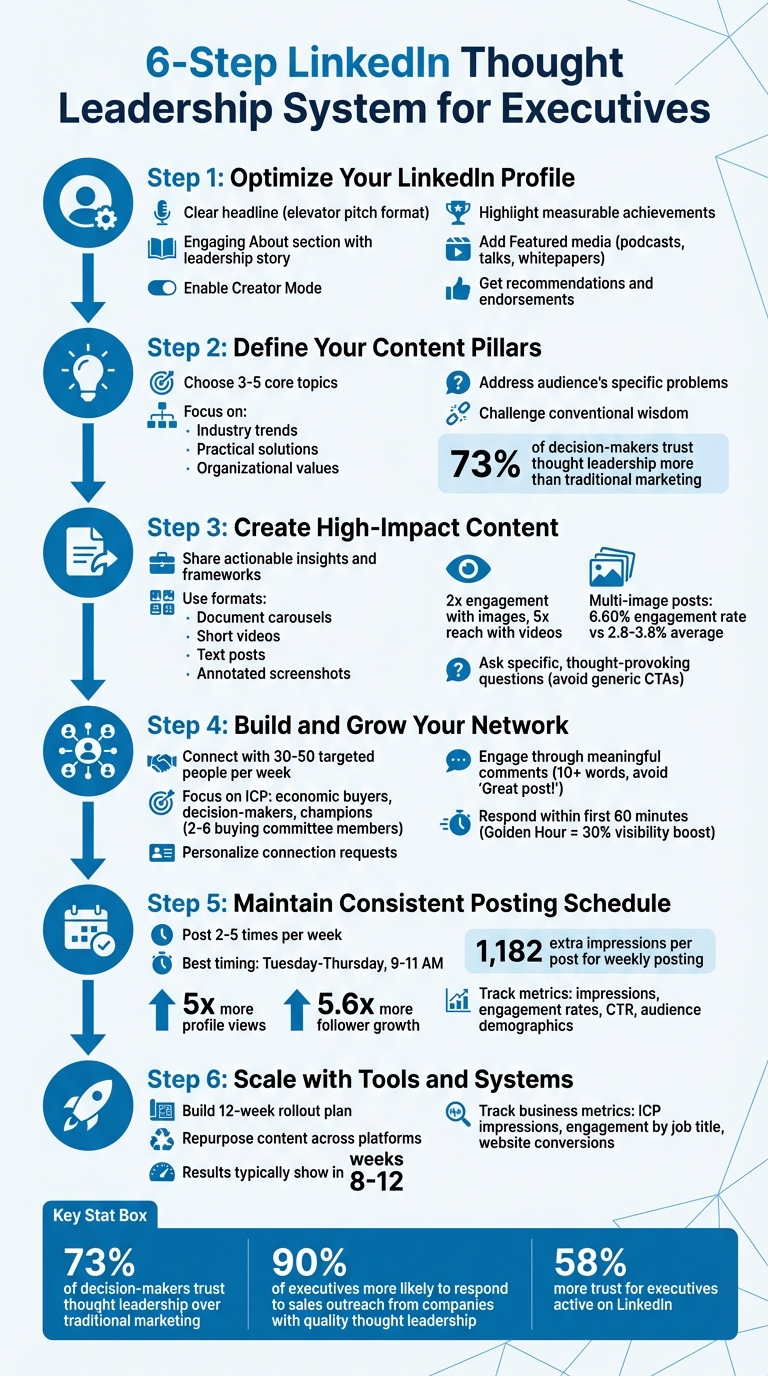
6-Step LinkedIn Thought Leadership System for Executives
From Expert to Impact: How to Build Real Thought Leadership on LinkedIn (Without the Fluff)
sbb-itb-9354cf2
Step 1: Optimize Your LinkedIn Profile
Your LinkedIn profile is often the first thing decision-makers will see about you. It’s your chance to stand out and establish trust, not just blend in with another run-of-the-mill executive bio.
Write a Clear Headline and Summary
Think of your headline as your one-line elevator pitch. It should instantly tell people who you help and how you do it. Skip generic titles like "CEO at XYZ Corp" and aim for something like "Helping Manufacturing Companies Build High-Performing Teams". Keep it straightforward - clarity wins over cleverness when it comes to LinkedIn discovery.
For your About section, ditch the resume vibe. Instead, craft a leadership story. Start with your core beliefs, share the tough lessons you’ve picked up along the way, and finish with your current mission. This personal, relatable approach makes people want to follow you, not just skim past your profile.
Also, make sure to enable Creator Mode. This feature unlocks tools like LinkedIn Newsletters, gives you access to post-level analytics, and switches the default "Connect" button to "Follow", helping you grow your audience.
Highlight Experience, Skills, and Media
In your Experience section, focus on results, not responsibilities. Replace task lists with bullet points that showcase measurable achievements, like "Increased revenue by 30% in 18 months". This data-driven approach proves your impact and builds authority.
Use the Featured section as your professional portfolio. Add media that shows your expertise - podcast interviews, conference talks, whitepapers, or case studies. These examples back up your claims and make your profile more engaging.
When adding skills, choose those that reflect your leadership strengths, such as "Strategic Planning" or "Change Management." Avoid listing basic technical skills unless they’re critical to your role. These details matter - 73% of decision-makers trust thought leadership content more than traditional marketing materials.
Once your profile is polished, the next step is building credibility through recommendations.
Get Recommendations and Endorsements
Recommendations from colleagues, board members, or clients carry a lot of weight. Don’t hesitate to ask for them. Endorsements for your top skills also boost your credibility, especially when they come from respected professionals in your network.
Keep your profile up to date. Refresh your achievements every quarter, use a high-quality headshot, and choose a banner image that reinforces your personal brand. This could be a quote, a photo of you speaking at an event, or something that visually represents your expertise.
A well-crafted profile is the foundation for establishing yourself as a thought leader on LinkedIn.
Step 2: Define Your Content Pillars
Once your profile is optimized, the next step is to define 3–5 core content pillars. These are the primary topics that reflect your expertise and consistently reinforce your message.
To find the right pillars, focus on areas where your expertise intersects with your audience's challenges and the gaps in current industry conversations. Ryan Law, Director of Content Marketing at Ahrefs, describes thought leadership as being built on "earned secrets" - insights drawn from your personal and professional experiences. Let’s break down how to identify the topics that will form the foundation of your thought leadership.
Pick Topics That Match Your Expertise
Your content pillars should align with three key areas: Industry trends, Practical product solutions, and Organizational values. Take a page from Will Fuentes, founder of Maestro Group, who crafted a five-pillar system from 2023 to 2025. His pillars included themes like “What I Heard” (client insights), “What I Found Funny,” and “Guiding Principles.” By sharing lessons from client meetings and personal anecdotes instead of pushing sales pitches, he managed to generate 2–3 qualified enterprise leads every week.
Another effective tactic is to challenge conventional wisdom in your industry. Start by analyzing what 5–10 of your peers are posting, then identify areas they might be overlooking or where you can offer a contrarian perspective. For instance, Tom Hunt uses his podcast, Confessions of a B2B Entrepreneur, to challenge industry norms. By focusing on the overlap between his expertise and his audience’s pain points, he converts content into leads, with 20% of his company’s sales-qualified leads coming directly from this approach. The next step is tailoring these topics to directly address your audience's biggest challenges.
Address Your Audience's Problems
Your content pillars should speak directly to the issues your audience faces. Start by identifying three specific target groups - such as CXOs in B2B tech, founders, or operations managers - and craft topics that resonate with their needs. Stay informed by monitoring LinkedIn comments, participating in relevant Slack groups, and paying attention to recurring questions in your niche.
Consider this: over 50% of decision-makers spend at least an hour each week consuming thought leadership content, and 73% trust it more than traditional marketing materials. That trust is your opportunity.
"I don't think you can gain a competitive advantage without thought leadership. The reason why thought leadership is a prerequisite is because trust is a prerequisite, and thought leadership is a way to build trust".
Step 3: Create High-Impact LinkedIn Content
Once you've outlined your content pillars, it's time to craft posts that establish trust and highlight your expertise. The aim here isn't to chase likes or views but to deliver content that educates, challenges norms, or sparks thoughtful dialogue.
Focus on Value-Driven Posts
Every post you create should reflect your professional insights - those hard-earned lessons and unique perspectives. This could mean sharing frameworks you've developed, lessons from past mistakes, or offering a fresh take on industry conventions instead of rehashing overused advice.
Choosing the right format is crucial. For example:
- Document carousels (PDFs) are excellent for step-by-step guides or frameworks because they encourage users to spend more time on your post.
- Short, captioned videos let your personality and authority shine through.
- Concise text posts are perfect for cutting through the noise.
- Annotated screenshots showcasing real decisions or results can underscore your expertise.
Start your post with a bold statement to grab attention, back it up with data, offer a practical takeaway, and end with a question to spark interaction. For instance, Leigh McKenzie, Head of SEO at Backlinko, used this approach after the company’s acquisition. She shared personal insights and experiences, which resulted in over three times the reactions and five times the comments compared to posts on the company page. This highlights how authentic, personal content from executives can foster deeper connections and credibility.
This foundation sets the stage for leveraging visuals and driving engagement.
Use Visuals and Data
Posts with images on LinkedIn see twice the engagement, while videos achieve five times the reach. However, visuals shouldn't just be filler - they need to reinforce your message. Multi-image posts, for instance, show an average engagement rate of 6.60%, far exceeding the usual 2.8% to 3.8% range.
You don't need a professional design team to make an impact. Harshala Chavan, founder of Merrative, used a simple screenshot of a Slack message to share her experience of landing a writing gig during the rise of Generative AI. This unpolished but relevant visual added authenticity to her story and led to three inbound service inquiries via direct messages. This example proves that meaningful visuals can enhance thought leadership and drive measurable business results.
But visuals alone aren’t enough. Engagement is the real driver.
Add Calls to Action
Generic prompts like "Agree? Comment below" are now penalized by the LinkedIn algorithm, reducing visibility by 45%. Instead, ask specific, thought-provoking questions like, "What’s one constraint I might be overlooking in enterprise rollouts?" or "If you tried this, where would it break in your stack?". These types of questions encourage deeper discussions, increasing dwell time and meaningful interactions - key factors for boosting your post's reach.
Engage actively by responding thoughtfully to early comments. This signals to LinkedIn's algorithm that your post is worth amplifying, triggering a second wave of distribution. It's worth noting that 9 out of 10 decision-makers and executives are more likely to respond to sales outreach from businesses that consistently produce high-quality thought leadership. Your call to action should aim to foster conversations that build trust and credibility.
Step 4: Build and Grow Your Network
Once you’ve got strong content in place, the next step is building a network that can amplify your message. Even the best content won’t go far without the right people to share it with. Focus on targeted relevance - connecting with professionals who align with your business goals - instead of chasing vanity metrics like follower count.
Connect with the Right People
Start by identifying your Ideal Customer Profile (ICP) and pinpointing the 3–6 roles that influence buying decisions. This group typically includes economic buyers (like CEOs), decision-makers (such as Heads of Sales), and champions or end-users. Don’t just aim for the top-level executives - also connect with key members of the buying committee (usually 2–6 people) to expand your reach.
Leverage LinkedIn’s advanced search filters to create reusable lists based on criteria like job title, company size, industry, and seniority. Skip the "People you may know" section - it rarely aligns with your strategic goals. Alex Hisaka, a LinkedIn and Salesforce veteran, explains it best:
"Connections irrelevant to your business goals are unprofitable. And they can damage your reputation. Remember, connections are implied endorsements."
Aim to send 30–50 carefully chosen connection requests per week, spread across 3–5 days. Before reaching out, spend 10–15 minutes daily engaging with posts from your target prospects or influencers (those with 5,000–50,000 followers). This builds familiarity and trust. When you’re ready to send a connection request, personalize it - reference a mutual connection, mention a specific post they wrote, or highlight a shared challenge in your industry. This “warm-up” strategy not only increases acceptance rates but also lays the groundwork for meaningful conversations.
Once you’ve built a solid base of targeted connections, shift your focus to engaging with them actively to strengthen those relationships.
Engage Through Comments and Collaborations
On LinkedIn, comments are now one of the most effective ways to boost visibility. The platform’s algorithm prioritizes “dwell time” - how long users engage with your posts and comments - over simple likes. To make your comments stand out, follow this structure: reference a specific point from the post, share a unique insight or story, and end with an open-ended question.
Avoid generic comments like "Great post!" or "Agreed", as these are often flagged as low-effort. Instead, aim for thoughtful responses of at least 10 words. On your own posts, respond to comments within the first 60 minutes - this "Golden Hour" strategy can boost your post’s visibility by around 30%. It signals to LinkedIn’s algorithm that your content is valuable and worth promoting.
Active engagement does more than just boost visibility; it helps establish your reputation as a trusted voice in your industry. When public conversations gain depth, you can transition to Direct Messages - but only after building a genuine connection. Avoid cold pitching at all costs. Remember, personal LinkedIn profiles generate five times more engagement than company pages, so use your executive account for all interactions.
Step 5: Maintain a Consistent Posting Schedule
On LinkedIn, consistency beats perfection every time. The platform’s algorithm favors regular, predictable activity while penalizing those who post in random bursts. Members who post at least twice a week enjoy up to 5x more profile views, and those who post weekly see 5.6x more follower growth compared to irregular posters. A steady posting rhythm not only keeps engagement alive but also strengthens the trust you’ve worked hard to build.
Set Up a Posting Schedule
For the best results, aim to post 2–5 times per week. Jumping from one post to 2–5 posts weekly can lead to 1,182 extra impressions per post and a 0.23 percentage point boost in engagement rates. But don’t assume more is always better. A study of 247 B2B company pages revealed that posting 8–12 times per month generated an average of 4.7 qualified leads, while posting daily (20+ times) only produced 2.1 leads.
Timing also matters. Posts published between Tuesday and Thursday, from 9:00 AM to 11:00 AM in your audience’s time zone, tend to perform best. To avoid splitting engagement or being flagged as spam, leave a 12–18 hour gap between posts. Tools like LinkedIn’s native scheduler let you plan up to three months ahead, or you can batch-create content in a quick 90-minute session on Sunday afternoons or Monday mornings.
Julian Winternheimer, a Data Scientist at Buffer, sums it up perfectly:
"Post as often as you can - as long as the quality stays high. Low-quality content posted frequently won't yield great results."
Track and Improve Performance
LinkedIn’s analytics provide insights into impressions, engagement rates, click-through rates, and the demographics of your audience. Review these metrics weekly to identify which posts perform best and adjust your strategy accordingly. The first 60–90 minutes after posting are critical - the algorithm uses this "Golden Hour" to decide if your post deserves wider reach.
Once you’re tracking performance, start experimenting. Test out different approaches to see what resonates most. For example, try opening posts with bold statements versus questions, compare video posts to carousels, and tweak your posting times. Data shows that carousels can drive nearly 600% more engagement than text-only posts, while video posts see about 84% higher engagement. If your analytics reveal you’re missing your target audience in terms of seniority or industry, refine your content themes to better address their specific challenges.
Step 6: Scale Your Efforts with Tools and Services
Once you've got a rhythm going, the next hurdle is scaling up without losing the essence of your voice. Relying solely on manual content creation isn’t practical in the long run. The key isn’t cutting back on posts - it’s about using systems and tools to amplify your reach while staying true to your message.
With your posting schedule locked in, now’s the time to simplify your workflow and maximize your impact.
Build a 12-Week Rollout Plan
A structured 12-week plan can turn your sporadic posting into a well-oiled content machine. Week 1 should focus on strategy - nail down your niche and craft a core contrarian thesis that sets you apart. In Week 2, map out a 90-day content calendar. This should include one standout piece, like a 4,000+ word research report, supported by 8–12 smaller articles. This ensures a steady stream of content that keeps your audience engaged.
For the following weeks, focus on a rotation of content creation, audience engagement, and performance analysis. Don’t forget to repurpose your work: a single 30-minute interview can be transformed into a YouTube video, several LinkedIn clips, a blog post, and even a newsletter. This strategy not only saves time but also reinforces your position as a trusted voice in your industry.
Leverage RevBoss to Scale Your Growth
RevBoss offers a structured approach to scaling your content efforts, helping you turn them into measurable business results. Their services are designed to build founder-led marketing systems that drive demand without overwhelming your workload.
- The LinkedIn Content + Audience package ($1,500/month) includes weekly strategy sessions, 8–12 LinkedIn posts, and workflows to grow your audience.
- The Content + Coaching + Activation package ($4,000/month) adds direct outreach, event support, and sales offer development to the mix [revboss.com].
Instead of chasing vanity metrics, focus on meaningful business metrics. Track unique impressions among your ideal customer profile (ICP), engagement by specific job titles and industries, and website conversions using UTM-tagged links. RevBoss also integrates tools like DemandSense, which identifies companies visiting your website from LinkedIn, helping you pinpoint warm leads who haven’t converted yet.
Conclusion
LinkedIn thought leadership isn’t about racking up followers or perfecting a polished facade. It’s about building trust by consistently sharing meaningful, value-packed content that establishes you as a go-to expert in your field. The six-step system outlined here - from fine-tuning your profile to expanding your reach - offers a straightforward way to turn LinkedIn into a powerful tool for generating demand, rather than just another platform for networking.
The numbers back this up. A whopping 73% of decision-makers see thought leadership content as more trustworthy than traditional marketing, and 90% of decision-makers and executives are more open to sales outreach from companies that regularly share high-quality insights. By sharing lessons from your own journey, you strengthen trust and engage your audience on a deeper level.
"I don't think you can gain a competitive advantage without thought leadership. The reason why thought leadership is a prerequisite is because trust is a prerequisite, and thought leadership is a way to build trust."
- Joe Chernov, Vice President of Marketing, Pendo
Here’s a practical starting point: create a simple system to capture your thoughts - maybe a Slack channel for quick voice notes or a weekly 30-minute session to reflect. Commit to a 90-day experiment where you post three times a week. Results often start showing between weeks 8 and 12. Focus on addressing your audience’s challenges, engage with comments and messages in the first two hours after posting, and track the metrics that matter most: qualified leads, pipeline impact, and interactions from your ideal customer profile.
FAQs
How do I choose the right content pillars to establish thought leadership on LinkedIn?
To nail down the right content pillars for LinkedIn thought leadership, focus on areas where you can consistently deliver genuine value while highlighting your expertise. Start by pinpointing topics that play to your strengths, align with industry trends, and cater to the needs of your audience. Your pillars should strike a balance - broad enough to allow for diverse content but focused enough to establish you as a go-to expert.
Think about what your audience cares about most. Dive into their challenges, interests, and feedback. Content around industry insights, new trends, or actionable solutions to everyday problems often hits the mark. At the same time, make sure your pillars tie back to your business goals, reinforcing both your personal brand and professional ambitions.
The secret sauce? Choose themes that let you produce steady, meaningful content that builds trust and reinforces your credibility as a leader in your space.
How can I boost engagement on my LinkedIn posts?
To make a splash on LinkedIn, focus on being real - share personal stories, genuine experiences, and practical takeaways that your audience can connect with. People are drawn to content that feels relatable and trustworthy, so let your personality shine through.
Another big win? Consistency. Even short, meaningful updates posted regularly can keep you on your audience’s radar and strengthen your presence over time.
Mix things up with your content. Use different formats like text posts, photos, or videos to grab attention and spark conversations. But don’t stop there - be part of the action. Comment on others' posts, respond to comments on your own, and dive into discussions. These interactions not only boost your visibility but also encourage deeper connections, which LinkedIn’s algorithm loves.
By blending authenticity, regular posting, creative content, and active engagement, you can build a strong LinkedIn presence and establish yourself as someone worth following.
How can I find and connect with the right audience on LinkedIn?
To connect with the right audience on LinkedIn, start by fine-tuning your profile to highlight your expertise and the value you bring to the table. Think of it as your professional storefront - it should immediately grab attention and resonate with your target audience. Use a clear, impactful headline, write a concise yet engaging summary, and include relevant keywords that align with your industry and career goals.
Make it a habit to engage regularly. Spend just 10 minutes a day interacting with posts from industry leaders or commenting thoughtfully on discussions that align with your expertise. These small efforts can make a big difference in boosting your visibility. Beyond engagement, share content that reflects your personal insights or experiences. Authentic posts that showcase your perspective help build trust and show your audience what you stand for.
When reaching out to connect, skip the generic messages. Instead, personalize your connection requests or follow-ups by referencing shared interests, mutual connections, or common goals. This tailored approach increases the chances of forming meaningful relationships. By blending a polished profile, consistent engagement, and thoughtful outreach, you’ll be well on your way to building a LinkedIn network that supports your professional ambitions.