FAQ: What Actually Works On LinkedIn Now?

LinkedIn is the top platform for B2B deals, with 1.2 billion members, including 65 million decision-makers. Here’s what’s working in 2025:
- Personal Profiles Outperform Pages: Founder profiles get 10x more engagement than company pages. Use your personal voice to build trust.
- Content That Converts: Carousels, PDFs, and videos dominate. Short, unscripted videos and in-depth carousels drive engagement and credibility.
- Consistency Wins: Posting 3–5 times weekly strikes the balance between visibility and audience interest.
- Optimize Your Profile: A strong headline, clear About section, and featured content make your profile a magnet for leads.
- Engagement Over Virality: Focus on sparking meaningful conversations. Comments and saves signal buying intent to both audiences and LinkedIn’s algorithm.
- Blend Organic + Paid: Test content organically, then amplify successful posts with targeted ads for decision-makers.
Key Tip: Build trust, not just reach. Thought leadership and genuine conversations convert more than flashy posts. Ready to transform your LinkedIn game? Let’s dive in.
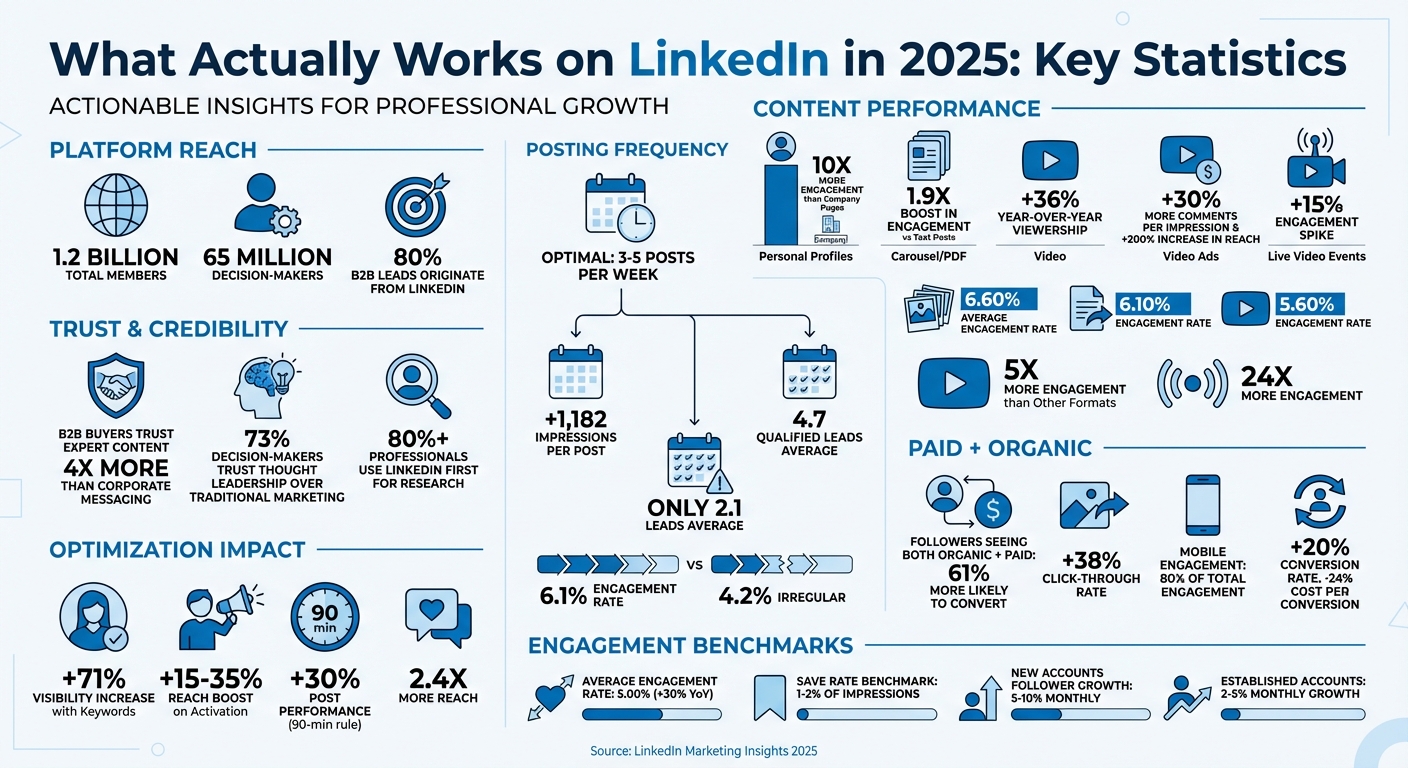
LinkedIn Marketing Statistics 2025: Key Performance Metrics for B2B Success
Zero-Cost B2B LinkedIn Strategy That Works
Creating Content That Gets Results
If you want your LinkedIn content to stand out, focus on formats that truly engage. Carousels and PDFs, for example, perform nearly twice as well as standard text posts, showing a 1.9x boost in engagement. Video content is also gaining serious traction, with viewership up by 36% year-over-year. Why? LinkedIn’s algorithm prioritizes "dwell time" - the longer people interact with your content, the more likely it is to appear in other feeds. Formats like slideshows, videos, and posts with enticing "see more" buttons are perfect for keeping users engaged and boosting visibility.
Native video is particularly effective for building trust. Short, unscripted clips help humanize you as a founder. Forget glossy, overproduced videos - B2B audiences crave authenticity. In fact, video ads generate 30% more comments per impression and have seen a massive 200% reach increase in recent years. Keep it real and focus on sharing genuine insights instead of corporate jargon.
Another powerful strategy is the "Anchor Asset" approach. Here’s how it works: create one in-depth piece of content - like a 10-slide carousel - each month, then break it down into smaller posts, videos, and updates. This not only amplifies your message but also reinforces your voice as a leader. High-value posts with lots of saves often resurface weeks later thanks to LinkedIn’s algorithm. And here’s the kicker: B2B buyers trust content from subject matter experts and executives 4x more than they trust corporate messaging. Your personal voice carries real weight.
Using High-Performing Content Formats
Carousels are LinkedIn’s engagement goldmine. They’re designed to keep users swiping, which signals to the platform that your content is worth their time. To make the most of this format, start with a strong hook in the first two lines to grab attention.
Video content, on the other hand, should feel natural and conversational. AJ Wilcox, Founder of B2Linked, sums it up perfectly:
"That affinity with the brand is more heavily/quickly influenced by video than any other medium".
Keep your videos under 90 seconds, shoot them on your phone, and focus on sharing relatable experiences rather than polished presentations. Live video is another winner - Live Video Events saw a 15% engagement spike in just one quarter. Real-time, unfiltered content resonates deeply with audiences.
Text-based posts can still pack a punch if you structure them well. Use short paragraphs, sprinkle in emojis or line breaks, and deliver your main point early. If you’re linking to external content, avoid adding the link in your post - place it in the first comment instead. This keeps users on LinkedIn longer, which the algorithm loves. Also, pay attention to how often people save your posts. A high "save" rate often correlates with buying intent, especially for B2B audiences.
Finding the Right Balance Between Consistency and Quality
Consistency is key, but more posts don’t always mean better results. For instance, moving from one post per week to 2-5 posts can increase impressions by 1,182 per post. However, overdoing it can hurt engagement. A study of 247 B2B company pages found that posting 8-12 times per month generated an average of 4.7 qualified leads, while posting daily (20+ times) only brought in 2.1 leads.
For founders, the sweet spot is 3-5 posts per week. This keeps your content visible without overwhelming your audience or sacrificing quality. Posting more than 12-15 times a month risks audience fatigue.
To stay consistent without the stress, try batching your content. Spend 60-90 minutes once a month creating and scheduling posts so you’re not scrambling daily. Use a content mix like the 40/30/20/10 rule: 40% educational insights, 30% customer stories, 20% product education, and 10% company news. This approach keeps your content varied and engaging.
Timing also matters. Engage actively in the first 90 minutes after posting - replying to comments during this window signals high engagement to the algorithm, which can boost your reach. Consistency in timing helps too. Pages that post at regular intervals see an average engagement rate of 6.1%, compared to 4.2% for irregular posting. For B2B audiences, aim to post between 9:00 AM and 11:00 AM, Tuesday through Thursday, in your target market’s time zone. This disciplined approach ensures your content gets the attention it deserves.
Improving Your LinkedIn Profile for Better Visibility
Think of your LinkedIn profile as your personal marketing tool - a way to boost your visibility, build trust, and open doors to new opportunities. Did you know that over 80% of recruiters and professionals turn to LinkedIn first when researching candidates or potential partners? By fine-tuning your profile with the right keywords and ensuring all sections are complete, you can increase your visibility by up to 71%. Let’s dive into how to make your profile stand out.
Key Elements of an Effective Profile
First impressions matter, and your profile photo is where it all begins. Use a high-quality headshot where your face takes up 60–70% of the frame. A friendly smile (showing teeth!) and a slight squint can make you appear approachable without looking overly surprised. Don’t overlook your banner image either - it’s like a billboard for your personal brand. Use it to clearly communicate your value proposition, keeping mobile readability in mind.
Your headline is prime real estate. It pops up everywhere - search results, comments, messages, and connection requests - so make it work hard for you. Career strategist Robert Little, MBA, puts it perfectly:
"Your headline travels everywhere with you: search results, comments, DMs, and invites. Use it strategically".
Max out the 220-character limit to highlight your role, a credibility metric, and how you help others. For example: "Founder @ Company | $50M+ Exit | Helping SaaS Founders Scale." Simple separators like "|" or "•" keep it clean and readable.
The About section should tell a story, not read like a dry resume. Write in the first person and start with a hook that grabs attention. Share your industry beliefs, back them up with measurable results, and finish with a clear call to action. Jane Deehan, a B2B marketer and former LinkedIn team member, notes:
"The LinkedIn profile page is the foundation for your personal branding... many leave it blank".
Neal O'Grady, Co-founder of Demand Curve, uses his summary to share his journey, provide proof of his ability to grow startups, and outline his services with a strong CTA at the end.
The Featured section is where you can show off. Add case studies, media clips, or lead magnets. Jessica D. Winder, Senior VP at Co-Lab Software, links to YouTube videos, press features, and other platforms to showcase her expertise. This section is a great way to guide visitors to your website or portfolio.
When it comes to your Experience section, think beyond job titles. Use the "Problem-Action-Result" framework to show what you’ve achieved. Instead of saying, "Managed marketing campaigns", try something like, "Launched a targeted ABM campaign that generated $2.3M in pipeline within 90 days." Numbers make a difference. Also, list 20–30 skills to align with LinkedIn’s Skills Graph and aim for at least three recent recommendations from colleagues or clients to add credibility.
By optimizing these key areas, you’ll set the stage for leveraging LinkedIn's Creator Mode to take your personal brand even further.
Using Creator Mode to Build Your Personal Brand
Once your profile is polished, it’s time to activate Creator Mode for even greater visibility. This feature shifts the focus from your past roles to your current influence. Jeff Bullas, CEO of jeffbullas.com, explains:
"This immediately signals to visitors that you are focused on building an audience for your content, rather than just collecting direct connections".
With Creator Mode turned on, your profile’s main button changes from "Connect" to "Follow", making it easier for people to engage with your content. You can also choose up to five "Talks about" hashtags that appear under your headline, giving instant insight into your expertise. Creator Mode also unlocks tools like LinkedIn Live for live streaming, LinkedIn Newsletters for long-form content, and Audio Events - all at no cost. Plus, advanced analytics help you identify which topics resonate most with your audience. Activating Creator Mode can boost your reach by 15–35%. Sophie Miller, Founder of Pretty Little Marketing, sums it up:
"Brands are finally realizing that people connect with people, not logos".
However, Creator Mode isn’t for everyone. It requires consistent content creation - if your "Activity" section is empty, the prominent placement could backfire. But, if you’re posting 3–5 times a week, this feature can significantly amplify your visibility and position you as a thought leader in your field.
Building Authority and Engaging Your Target Audience
Once your LinkedIn profile is in top shape, the next step is building trust and sparking meaningful conversations. LinkedIn’s algorithm has shifted gears - it’s no longer about chasing viral hits. Instead, it prioritizes authentic discussions and expert-driven content. Decision-makers aren’t interested in flashy corporate talk. They’re looking for real insights from people who genuinely understand their challenges.
Establishing Yourself as a Thought Leader
To stand out as a thought leader, narrow your focus to the intersection of industry trends, customer pain points, and your business priorities. This isn’t about casting a wide net - it’s about diving deep into areas where your expertise shines.
Here’s a stat that speaks volumes: 73% of decision-makers trust thought leadership content more than traditional marketing materials when assessing a company’s capabilities. Buyers want to hear from subject matter experts who can provide depth and clarity - not just broad statements from executives. In fact, B2B buyers trust expert-driven content four times more than branded corporate messaging.
Being transparent about your journey also helps. Share real-time updates on your company’s growth, product iterations, and even the hurdles you’re facing. People connect with authenticity, not just polished success stories. Alexandra Rynne, LinkedIn Ads’ Content Strategy Lead, sums it up perfectly:
"Thought leadership helps the people you're selling to trust the people they're buying from".
Keep your profile fresh by adding case studies, whitepapers, or eBooks that showcase your expertise. These resources act as tangible proof of your know-how, reinforcing your credibility.
Once you’ve established yourself as a trusted voice, it’s time to turn that authority into active, community-driven engagement.
Creating Community-Driven Interactions
Positioning yourself as an expert is just the start - real impact comes from engaging directly with your audience. LinkedIn’s algorithm uses something called the "Cohort Test": it shows your post to a small group first, gauging their reactions. If they linger (hello, dwell time) and join the conversation, your content gets boosted to a wider, similar audience. This means your goal isn’t just to rack up likes - it’s to spark thoughtful, meaningful discussions.
Ditch simple yes/no questions and go for prompts that require detailed answers. For instance, instead of asking, "Do you agree?", try something like, "What’s the biggest challenge you’ve faced when implementing this strategy?" These kinds of questions not only encourage deeper responses but also signal your expertise to the algorithm.
Timing is another key factor. Stick to the 90-Minute Rule: be super active in the first 90 minutes after posting. Respond to comments, ask follow-up questions, and keep the momentum going. This early engagement can boost your post’s performance by 30%. Plus, posts with thoughtful replies can achieve 2.4x more reach compared to those without. Always end your replies with a question to keep the conversation alive.
Here’s a great example: In 2024, financial software company LucaNet ASEAN used conversational automation to drive webinar sign-ups. They ran a poll before the event and followed up with personalized DMs based on the responses, offering tailored registration links. The result? A 53% conversion rate from poll participants to registrants. This shows how engaging content - like polls, Q&A sessions, and direct interactions - can turn passive viewers into active participants.
Another powerful tool? LinkedIn Live Events, which saw a 15% boost in engagement in Q4 2024. Lauren Maillian, Founder & CEO of LMB Group, puts it this way:
"Events are the best opportunity to have a live focus group for what people really want to hear and know from an individual, a leader, a business or a brand".
Use these live sessions not just to share your message but to actively listen. Understanding what your audience values most will strengthen your relevance and, ultimately, your credibility. When you prioritize connection over virality, you build trust - and trust is what drives decision-makers to choose you.
sbb-itb-9354cf2
Combining Organic and Paid Strategies for Better Results
Blend organic engagement with paid strategies to supercharge your LinkedIn efforts. Here's why it works: LinkedIn Page followers who see both organic and paid content are 61% more likely to convert compared to those who only see ads. Kylee Lessard, from LinkedIn's Product Marketing team, puts it perfectly:
"Organic is a flywheel for paid. Alone, they are powerful. But together, they are unstoppable."
Think of organic content as your testing ground. It helps you figure out what clicks with your audience naturally, giving you a roadmap for paid campaigns that are more likely to succeed.
Testing Organic Content Before Using Paid Ads
Start by using organic posts to see what resonates with your audience. If a post performs well organically, it's a strong candidate for a paid campaign. As Steve Kearns, an AI & Marketing Leader, advises:
"Your content's organic performance is a good indicator of what will resonate with your audience. When choosing content to sponsor, start with what's already popular."
Dive into your analytics to identify high-performing posts. Use tools like Page Demographics and Visitor Analytics to ensure the people engaging with your content align with your target decision-makers. Once you've identified the winners, take it a step further with Direct Sponsored Content. This allows you to A/B test creative elements - like headlines, visuals, and calls-to-action - directly in the feed without cluttering your Company Page.
Here are some tips for A/B testing and optimizing your content:
- Test at least four different visual variations. Rich media images can increase click-through rates by up to 38%.
- Keep your text concise - under 150 characters - and make sure key video information is highlighted in the first 10 seconds.
- Design content with mobile in mind, as 80% of engagement happens on mobile devices.
When you're ready to scale, use LinkedIn's Boost feature to amplify high-performing organic posts, extending their reach beyond your current followers. With proven organic content in hand, you can focus on precise paid targeting to expand your audience.
Using Targeting Tools to Reach Decision-Makers
After identifying what works organically, refine your paid campaigns with LinkedIn's advanced targeting tools. What makes LinkedIn unique? Its users are highly motivated to keep their profiles accurate for career and networking purposes, which means you get access to high-quality, first-party data. Nick Panayi, Head of Global Brand & Digital Technology at DXC Technology, sums it up well:
"LinkedIn for me has always been one of those weapons in your arsenal that you have to have... There is something here that is extremely difficult for other platforms to replicate."
Here’s how to make the most of LinkedIn's targeting:
- Focus on seniority, not age. Age-based targeting can shrink your audience by as much as 90%.
- Don’t just target directors and executives. Decision-makers often rely on input from managers and individual contributors. Targeting by "Years of Experience" can be more effective.
- For most Sponsored Content and Text Ad campaigns, aim for an audience size between 60,000 and 400,000 members. For Message Ads, ensure a minimum of 15,000 members.
- Use Matched Audiences for account-based marketing. Upload lists of specific companies or known prospects to zero in on your ideal audience.
Marit van der Louw, an International Content Marketer at TOPdesk, shares her success story:
"Since using the new remarketing capabilities for Lead Gen Forms and videos our conversion rate has gone up by 20%, while our cost per conversion went down by 24%."
Experiment with your targeting by running duplicate campaigns with slight tweaks - compare "Skills vs. Job Titles" or "Industry vs. Job Function". But don’t overdo it. Start with two or three targeting facets to give the algorithm enough data to work with. Check the Demographics tab in Campaign Manager regularly to see which job titles or industries are engaging with your content. During the testing phase, consider enabling Audience Expansion to let LinkedIn's algorithm find similar users to your ideal targets.
Measuring Success and Adjusting Your Approach
To make the most of your LinkedIn efforts, your measurement strategy must tie directly to business outcomes. This ensures your actions lead to meaningful results rather than just surface-level numbers. For instance, 80% of B2B leads from social media originate on LinkedIn, but relying solely on vanity metrics won’t give you a clear picture of your impact. Emma Faggoter, Social Media Coordinator at Slice, sums it up perfectly:
"Context transforms raw numbers into actionable insights."
The focus should always be on metrics that connect to your goals. Sure, impressions and likes might look impressive, but they don’t reveal if you’re influencing decision-makers or building credibility in your industry.
Tracking Engagement Beyond Vanity Metrics
When it comes to LinkedIn, not all engagement is created equal. Comments hold more value than likes, as they signify deeper interest and are favored by LinkedIn’s algorithm. Plus, interacting with comments can significantly expand your post’s reach. Video content is another game-changer, driving 5x more engagement than other formats, while Live Videos outperform even further with 24x more engagement.
Key metrics to monitor include:
- Profile views: These highlight interest from potential clients or partners.
- Search appearances: This shows whether your profile’s keywords align with terms your target audience is using.
- Social Engagement Percentage and Click-Through Rate (CTR): These metrics reveal whether your content is inspiring action or just being passively consumed.
The average engagement rate on LinkedIn is about 5.00%, which has grown by 30% year-over-year. Additionally, LinkedIn’s "Visitor Demographics" tool can provide insights into your audience’s seniority and job roles. For B2B founders, it’s far better to reach decision-makers like VPs and executives than to amass a large but irrelevant audience. Established accounts should aim for a 2-5% monthly follower growth rate, while newer accounts can target 5-10%.
To connect LinkedIn activity directly to tangible results, use UTM parameters on external links. This allows you to track how many LinkedIn users convert into website leads, tying your efforts directly to your sales pipeline.
Adjusting Based on Audience Insights
Once you’ve gathered data, use it to fine-tune your strategy. Identify which content formats drive the most engagement and double down on those. For example, multi-image posts lead with an average engagement rate of 6.60%, followed by native documents at 6.10% and videos at 5.60%. If PDF carousels are performing well, create more of them.
Evaluate the keywords bringing visitors to your profile. If they don’t align with your target B2B audience, tweak your headline and summary to better match their search intent. As Alice Xiong, Director of Product Management at LinkedIn, advises:
"Think about what kind of knowledge you have to offer to help people. That is the kind of thing that will likely get you to reach the right audience."
Experiment regularly to refine your approach. Test different hooks - like bold claims versus practical tips - or experiment with link placement (in the post body versus the comments). Compare shorter versus longer document carousels. These tests will reveal what resonates most with your audience.
Lastly, prioritize metrics like "Saves" and "DM Sends", as these are stronger indicators of B2B buying intent than likes. A "Save" rate of 1-2% of impressions is a solid benchmark for content that builds authority and long-term trust. By focusing on these insights, you’ll ensure your LinkedIn strategy keeps evolving and delivering results.
Conclusion
Succeeding on LinkedIn in 2025 hinges on a few key principles. Authority outweighs activity - your profile should position you as a trusted expert, not just another voice in the crowd. With the platform favoring original ideas and genuine expertise over generic, AI-driven content, the focus has shifted toward building real, meaningful connections.
Personal profiles are where the magic happens, consistently outperforming company pages in reach and trust. It’s no surprise that 80% of B2B leads originate from LinkedIn. But reach alone won’t cut it. The real game-changer lies in creating content that sparks engagement - think longer dwell times, thoughtful comments, and Saves. These metrics show both the algorithm and your audience that your content delivers true value.
To amplify your efforts, blend organic strategies with targeted ads. Start by establishing authority through consistent, high-quality content. Once you’ve got a winning formula, use targeted ads to give your best-performing posts an extra push. Experiment with different formats, track meaningful metrics, and refine your approach based on how your audience responds. As highlighted earlier, a "Save Rate" of 1–2% of impressions is a strong indicator that your content is building long-term trust.
FAQs
How can I make my LinkedIn profile more effective for generating leads?
Optimizing your LinkedIn profile for lead generation starts with making a strong first impression. Begin with a high-quality headshot and a custom banner that aligns with your personal brand or business. Your headline is prime real estate - don’t just settle for your job title. Instead, highlight the value you bring. Use keywords your target audience might search for, such as "B2B SaaS strategist" or "sales growth expert", to boost your profile’s visibility.
In the "About" section, focus on what sets you apart and back it up with measurable results. For example, you might include something like, "Helped businesses increase annual revenue by 40%." Wrap it up with a clear call-to-action, such as, "Let’s connect to discuss scaling your business." Don’t forget to personalize your LinkedIn URL, list relevant skills, and gather recommendations that reinforce your expertise.
Take advantage of the "Featured" section by showcasing case studies, videos, or lead magnets like free guides or audits. To keep the momentum going, engage consistently - comment on posts, share your insights, and create original content that highlights your expertise. Genuine interactions and meaningful engagement are what transform profile visits into valuable leads.
What types of content perform best for LinkedIn engagement?
The top content formats making waves on LinkedIn in 2025 are short, concise text posts, carousel documents (perfect for step-by-step guides or frameworks), authentic image posts showcasing real people, and native short-form videos. These styles resonate well with LinkedIn’s algorithm, which leans toward content that’s personal, easy to consume, and packed with value.
For founders diving into B2B marketing, blending these formats can take engagement to the next level. Here’s how you can mix and match:
- Use a punchy text post to introduce a carousel.
- Create a carousel that tells a compelling story or delivers actionable advice.
- Share a short video clip to add a relatable, human touch.
By leaning into these formats and keeping it real, you’ll not only extend your reach but also spark conversations and build closer ties with your audience.
How can I combine organic and paid strategies on LinkedIn for better results?
To truly make LinkedIn work for you, it’s smart to blend organic content with paid strategies into one cohesive game plan. Research shows that when people see both your organic posts and your ads, they’re far more likely to engage and take action. Organic content lays the foundation by building trust and credibility, while paid ads help you reach fresh audiences and amplify your message.
A good starting point? Look at your organic posts that are already performing well - those with plenty of comments, shares, or likes. Turn these into Sponsored Content to give them a much bigger audience. Keep your visuals and messaging consistent across both organic and paid efforts so your brand feels seamless and professional. You can also retarget people who’ve interacted with your organic content by showing them tailored ads, such as invites to events or lead-generation forms.
When you align these two strategies, they feed into each other beautifully. Organic engagement can make your ads more effective, while ads bring in new followers who’ll interact with your organic content. This cycle not only boosts conversions but also strengthens your authority on the platform, ensuring you get the most out of your LinkedIn efforts.