Founder Brand -- Hire Help or DIY?

Building your founder brand is not optional - it’s a business tool that drives trust, sales, and visibility. But here’s the kicker: Should you DIY it or bring in the pros?
TL;DR:
- DIY: Great for control and saving money but demands time and skills. Works best for early-stage founders or tight budgets.
- Hire Help: Saves time, ensures polish, and delivers consistent results, but it’s pricey and risks losing your voice. Ideal for scaling businesses or complex branding needs.
- Hybrid: Combine both - share your ideas, let experts refine them. Keeps your voice intact while saving time.
Quick Takeaways:
- DIY works when budgets are tight and you can commit time weekly.
- Hire help when growth stalls, branding gets inconsistent, or you’re stretched thin.
- Hybrid approach blends your authenticity with professional polish for the best of both worlds.
Whether you’re bootstrapping or scaling, the right choice depends on your time, budget, and goals. Let’s break it down.
Why Your Founder Brand Matters
What Is a Founder Brand?
A founder brand is essentially you - the recognized, relatable face of your company. It’s not about inflating your ego; it’s about creating genuine connections. Platforms like LinkedIn, podcasts, and email provide spaces for you to share your expertise, personal insights, and unique story. Instead of relying solely on corporate messaging, you step forward as the human connection that customers and prospects can engage with. This approach transforms impersonal business communication into a meaningful dialogue.
"Personal branding is an intentional, strategic practice in which you define and express your own value proposition... it's the amalgamation of the associations, beliefs, feelings, attitudes, and expectations that people collectively hold about you."
By building this personal connection, you not only define your identity but also unlock measurable benefits for your business.
Benefits for B2B Businesses
The numbers don’t lie - 82% of people trust companies whose leaders are active on social media. LinkedIn posts from executives generate twice as much engagement as those from company accounts. Even more compelling, 60% of decision-makers say thought leadership directly influenced their decision to work with a company.
A strong founder brand can speed up sales cycles by establishing trust early in the process. Many B2B buyers delay contacting sales teams until they’ve already pinpointed their needs. A visible founder brand allows you to connect with these buyers during their research phase, positioning your company as a trusted partner before they even reach out. Leads nurtured through founder-led storytelling often convert more effectively, resulting in higher-value deals. Instead of waiting for leads to trickle in, founder-driven outreach sparks direct conversations that move swiftly into your sales funnel.
The financial upside is hard to ignore. Studies show that 44% to 50% of a company’s market value is tied to its CEO’s reputation. Additionally, strong personal brands can boost B2B referrals by 50%. In today’s marketing world - where AI-generated content is everywhere - your authenticity and personal audience are what set you apart.
Common Challenges for U.S. Founders
Despite the clear advantages, many founders face familiar hurdles. Time is often the biggest obstacle - between product development, fundraising, and managing sales, there’s little room for anything else.
Then there’s the discomfort factor. Founders, especially those with technical expertise, often feel out of their element when it comes to being on camera or promoting themselves. The fear of coming across as overly self-promotional can lead to two extremes: complete silence or scripted, corporate-sounding content that fails to connect.
"Your success will depend on getting others to recognize your value. So you need to get comfortable marketing yourself."
Another challenge is the risk that comes with tying your personal identity to your company. A misstep - whether it’s a controversial opinion or a personal mistake - can quickly harm your business’s reputation and market value. On top of that, trying to maintain an active presence on too many platforms can lead to burnout. Many founders exhaust themselves by aiming for high-volume output rather than focusing on consistent, manageable efforts. The fast-paced nature of the U.S. market only adds to the pressure.
Understanding these obstacles is the first step in making smarter choices about your approach - whether that’s doing it yourself, bringing in outside help, or finding a mix of both.
How to Build a LinkedIn Founder Brand that Drives Revenue
DIY vs. Hiring Help: Pros, Cons, and How to Decide
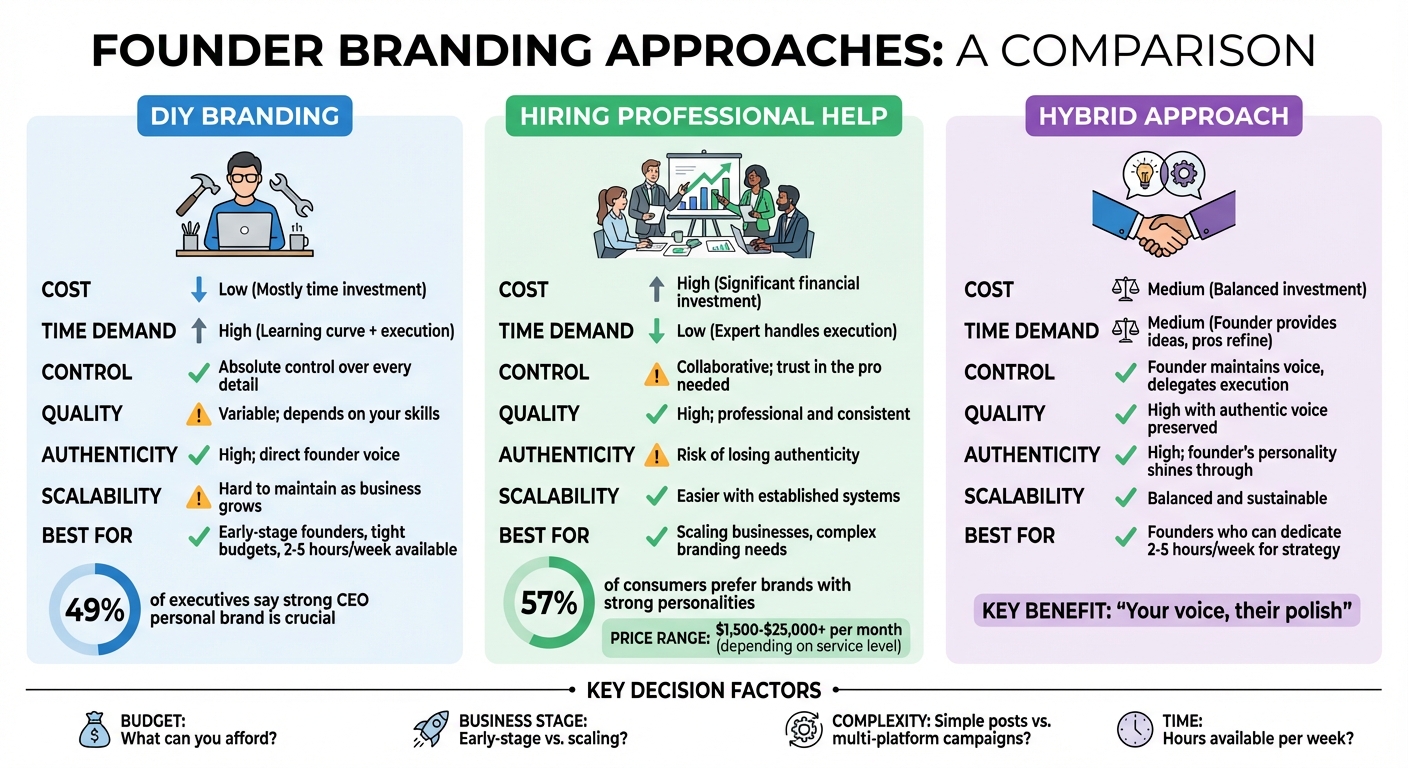
DIY vs Professional vs Hybrid Founder Branding: Cost, Time, and Benefits Comparison
Pros and Cons of DIY Branding
DIY branding gives you full control and saves money by swapping dollars for your time. It’s a great way to experiment with brand identities while keeping your voice front and center. After all, your voice is one-of-a-kind, and outsourcing could dilute that distinct perspective.
But let’s be real - DIY can be a serious time sink, especially if design or marketing isn’t your thing. The learning curve is steep, and without the right skills, your branding might not hit the mark. Keep in mind that 94% of first impressions hinge on design and emotional impact. And if your plate is already full, the time commitment can quickly feel overwhelming.
Pros and Cons of Hiring Help
Bringing in the pros means you’re tapping into expertise in areas like color psychology, typography, SEO, and brand strategy. It’s a time-saver from the get-go, letting you focus on running your business while the experts handle the heavy lifting. Plus, professional help delivers consistent, high-quality branding across all platforms, which builds trust faster. In fact, 57% of consumers are more likely to buy from brands with strong, recognizable personalities. Over time, professional support can also help you avoid costly rebranding efforts.
However, hiring help isn’t cheap. On average, small businesses allocate 11.72% of their budgets to marketing, including branding. There’s also the risk that an agency might miss the mark on your voice, creating content that feels generic or disconnected. For instance, journalists respond to only 3% of pitches on average and often prefer hearing directly from founders rather than PR reps.
"Your brand must be relentless, authentic and powerful, which is something you can't outsource to an agency."
| Feature | DIY Branding | Hiring Professional Help |
|---|---|---|
| Cost | Low (mostly time investment) | High (significant financial investment) |
| Time Demand | High (learning curve + execution) | Low (expert handles execution) |
| Control | Absolute control over every detail | Collaborative; trust in the pro needed |
| Quality | Variable; depends on your skills | High; professional and consistent |
| Authenticity | High; direct founder voice | Risk of losing authenticity |
| Scalability | Hard to maintain as business grows | Easier with established systems |
These trade-offs help frame the decision between DIY and hiring professional support.
How to Decide: DIY or Hire Help
The choice boils down to a few key factors. Start with budget - if you’re strapped for cash, DIY might be your only viable option. But if you can afford it, professional help often pays off in the long run.
Your business stage also matters. Early-stage founders can benefit from DIY as a way to experiment and find their voice. On the other hand, scaling businesses usually need professional help to maintain consistency and free up time.
Think about the complexity of your branding needs. If you’re just creating simple visuals or posting on LinkedIn, DIY might work fine. But for complex strategies, multi-platform campaigns, or major rebrands, it’s worth considering expert help. Lastly, weigh your time constraints - if you’re already stretched thin, DIY could end up costing you more in missed opportunities than it saves in dollars.
There’s also a middle ground. You can provide the raw ideas and unique perspective while hiring professionals - like editors or copywriters - to refine and polish the final product. This hybrid approach keeps your branding authentic while ensuring it looks polished and professional.
When DIY Founder Branding Works Best
Best Scenarios for DIY Branding
DIY branding shines during the early days of building your business, especially when experimenting without the help of a PR firm is not just practical but necessary. If you can carve out a few hours each week and have a knack for writing, you can make real progress on your own. Start small - focus on one platform, like LinkedIn, to build engagement before expanding your efforts.
This approach is ideal when budgets are tight and you want to maintain a personal touch that’s hard to replicate. Journalists, for instance, often prefer to hear directly from the founder rather than through a PR intermediary.
Here’s a compelling stat: 49% of executives say a strong CEO personal brand is crucial to a company’s reputation. Companies with standout CEO brands even see an 11% boost in shareholder returns compared to their peers. That’s the power of authenticity - your voice, your story, and your perspective are what make you stand out in ways no agency ever could.
Now, let’s dive into the tools and processes that can help you bring your DIY branding strategy to life.
DIY Tools and Processes You Need
To make the most of DIY branding, you’ll need a clear framework and reliable tools to keep things efficient. A great starting point is the "P-B-P-B and J" framework:
- Pinpoint your unique strengths and opinions.
- Build a consistent voice and visual identity.
- Project content to your audience.
- Boost visibility through networking.
- Judge results by tracking engagement.
This system keeps you focused and prevents the chaos of random posting.
To stay consistent, try a simple 10-minute daily routine:
- Monday: Update your list of influencers and colleagues you want to connect with.
- Tuesday: Reach out to one person from that list.
- Wednesday: Share an industry article or comment on a peer’s post.
- Thursday: Tweak a small detail of your online presence, like refreshing your LinkedIn bio.
- Friday: Complete that improvement.
"To be interesting, be interested."
Your toolkit is just as important. Canva is perfect for creating polished visuals like logos and banners, while Buffer or LinkedIn’s native scheduling tools help you plan posts for the week. Use Notion or Google Sheets as a simple editorial calendar to stay organized. Don’t forget the basics of your "digital real estate": a professional headshot, a sharp elevator pitch for your bio, an optimized LinkedIn profile, and a simple portfolio website.
When it comes to content, define 2–4 pillars - key themes you want to be known for. Dedicate one or two to your industry expertise and use the others to share personal passions or struggles that humanize your brand.
"A personal brand is about WHO you are and not WHAT you do."
This focus keeps your messaging sharp and avoids the scattershot approach that can dilute your impact.
Even short, consistent efforts - like those 10-minute daily sessions - can yield big results over time. Repurpose your core ideas into different formats and batch-create content on weekends to save time. Remember, people form their first impression of you online in just 50 milliseconds, so those few hours you invest each week can make all the difference.
sbb-itb-9354cf2
When to Hire Help for Your Founder Brand
Signs You Need Professional Support
In the early stages, handling your personal brand on your own might make sense. But there comes a point when doing it all yourself just doesn’t cut it anymore. If your growth has hit a wall, your leads have dried up, or you’re losing ground to competitors, it’s probably time to bring in the pros.
Another clear sign? When your plate is so full that you’re juggling business operations and branding efforts, and neither is getting the attention it deserves. At that point, the cost of inconsistent branding far outweighs the expense of hiring experts.
Here’s the thing: it’s tough to spot your own blind spots. As Brand of a Leader wisely explains:
"You do not want to work on your personal brand on your own... we do not have the impartiality of observation when it's our own life."
Major turning points - like prepping for a business sale, launching a new product, or stepping into a fresh market - are also moments when expert guidance can make all the difference. SimplyBe Agency offers a great analogy for this:
"Think of your personal brand like your personal credit score - you don't need it until you do."
If any of this sounds familiar, it’s worth exploring the kinds of professional services that can help you tackle these challenges head-on.
Types of Professional Branding Services
Professional branding services are designed to meet different needs at a variety of price points. Here’s a quick breakdown:
- Strategy sprints ($3,000–$7,000): These short-term projects map out your branding strategy and messaging framework.
- Consultants ($5,000–$15,000): Perfect if you already have a team, they help refine your positioning and coach your content efforts.
- Mid-market support ($8,000–$20,000): This includes strategy plus three to six months of ghostwriting, profile optimization, and coaching.
- Full-service agencies (starting at $25,000): They handle everything - design, media outreach, account management, and more.
- Personal branding coaches ($500–$5,000): Ideal for accountability and feedback on your drafts.
Each option comes with unique benefits. Consultants focus on sharpening your messaging, while agencies can take over tasks like ghostwriting LinkedIn posts or newsletters and optimizing your online presence. Some services also include PR efforts, like landing speaking gigs, podcast interviews, or media features. Others prioritize audience growth by strategically promoting your content to potential clients, investors, or hires.
When evaluating these services, keep your eye on the metrics that matter. Forget vanity stats like follower counts; instead, track revenue-driving results like inbound leads, deal sizes, and shorter sales cycles. As business advisor Kurt Schmidt puts it:
"A personal branding consultant transforms your professional reputation into revenue by solving three critical problems: unclear positioning, slow lead flow, and credibility gaps."
Here’s why this matters: only 15% of B2B thought leadership is rated as "very good" or "excellent". Yet, strong thought leadership can be a game-changer - 75% of buyers research solutions after engaging with it, and 86% are more likely to invite a thought leader into sales discussions or RFPs.
How RevBoss Can Help
This is where RevBoss steps in. They specialize in turning founder-led B2B marketing into a lead-generating powerhouse. Their services start at $1,500 per month and scale up to $4,000 per month, offering tailored solutions that take your personal reputation and transform it into measurable business results.
Here’s a snapshot of their plans:
- LinkedIn Content + Audience Plan ($1,500/month): Includes weekly strategy calls, 8–12 LinkedIn posts, and workflows to grow your audience.
- Email Newsletter + Audience Plan ($1,500/month): Delivers bi-weekly newsletters supported by engagement workflows.
- Combined Content Plan ($2,500/month): Merges LinkedIn and email strategies into a cohesive approach.
The most popular option? The Content + Coaching + Activation Plan ($4,000/month). This all-in-one package includes direct outreach (via email and LinkedIn DMs), event support for trade shows and webcasts, personalized audience targeting, sales offer development, and marketing asset creation. It’s designed to turn your audience into real sales opportunities.
For those who prefer a DIY approach but want expert input, RevBoss also offers a Coaching Plan ($1,500/month). This plan provides weekly consultations with specialists in AI, marketing, lead generation, and go-to-market strategies. It’s a great way to get expert advice on campaign development, content strategy, and deal reviews.
All RevBoss plans operate on a month-to-month basis, with discounts for longer commitments. Their streamlined onboarding process and ongoing management ensure you stay focused on building trust, standing out in your market, and generating demand - without getting bogged down in content creation.
The Hybrid Approach: Combining DIY and Professional Help
What Is the Hybrid Model?
The hybrid model strikes a balance between maintaining your personal touch and offloading tedious tasks to professionals. You focus on your core message and unique vision, while experts handle the nitty-gritty - think editing, scheduling, and campaign management. Start by jotting down raw ideas, then let the pros refine and distribute them. Anastasia Chernikova, CEO of Blueberry Storytelling, sums it up perfectly:
"Your writing doesn't have to be perfect; you can hire an editor or collaborate with a copywriter to get the final form down just right. The important thing is to ensure your personality shines through."
This approach keeps you in charge of direct engagement - whether it’s replying to comments, pitching ideas to journalists, or jumping into industry discussions - while your team takes care of the technical heavy lifting. From profile optimization to content calendars and analytics tracking, they’ve got you covered. Considering that 57% of consumers prefer brands with strong personalities, maintaining a consistent and authentic voice is crucial. By delegating time-intensive tasks, you can stay visible and engaged without burning out.
If this model sounds appealing, here’s how to evaluate whether it’s right for you and how to implement it effectively.
Self-Assessment Checklist and Implementation Plan
Ask yourself these critical questions to see if the hybrid model fits your needs:
- Do I have 2–5 hours a week to brainstorm ideas and engage with my audience?
- Can I confidently express a unique or bold perspective about my industry?
- Do I find technical tasks like SEO, email platforms, or website setup overwhelming?
If you’re nodding along, the hybrid model could be your ideal solution. Here’s a 60-day roadmap to help you blend your authentic voice with professional support:
Days 1–15: Start by defining your niche and setting visibility goals - whether you aim to be a "Resident Expert" or a "Local Hero." Identify bold, standout topics you want to address and decide which tasks, such as editing or scheduling, you’ll delegate to experts.
Days 16–30: Build your foundation with professional help. Create a media kit with polished headshots, concise bios, and speaking samples. Optimize your LinkedIn profile and set up email marketing platforms like Mailchimp or HubSpot. For expert guidance, consider RevBoss’s Coaching Plan ($1,500/month), which provides weekly consultations with specialists in AI, marketing, and lead generation while you remain in control of the execution.
Days 31–45: Launch your content strategy. Draft 3–5 cornerstone pieces that highlight your expertise. Don’t stress about perfection - collaborate with professionals for editing, SEO, and visuals. As Hinge Marketing puts it:
"Your reputation as an industry leader will be built to a great extent on your ability to translate complicated material into easy-to-understand language."
Days 46–60: Roll out your newsletter and actively participate in LinkedIn groups and industry discussions. Delegate scheduling and content distribution to your team, freeing you to focus on personal touches like responding to comments, sharing behind-the-scenes moments, and forming real connections. If you’re ready to scale even further, RevBoss’s Content + Coaching + Activation Plan ($4,000/month) offers support with outreach campaigns, event planning, and sales strategies to turn your audience into a thriving sales pipeline.
The key is knowing what only you can do - your voice and perspective are irreplaceable. Let professionals handle the time-consuming tasks, while you focus on being the authentic core of your brand and expanding your reach.
Conclusion: Choosing the Right Path for Your Founder Brand
Your founder brand is more than just a personal touch - it's a powerful tool for building trust, standing out in your industry, and ultimately driving revenue. With the clear benefits of a strong personal brand, the real challenge lies in figuring out how to develop it in a way that works for your unique situation.
The path you take - whether you go it alone, bring in professional help, or opt for a mix of both - boils down to three key factors: your time, your budget, and your current visibility. If your recognition is limited to your team or close network, starting with DIY efforts and straightforward tools might make sense. But if you're aiming to make waves on a larger scale, like gaining national attention, professional guidance becomes almost essential. The higher the stakes, the more critical it is to ensure consistency and manage the complexity of your brand across platforms.
One thing you can't compromise on? Staying true to yourself. As Anastasia Chernikova of Blueberry Storytelling aptly says:
"Nobody else in the world can replicate your voice, so you will always be presenting a watered-down version of yourself if you allow someone else to take the reins".
The most impactful founder brands strike a balance: they keep the founder’s unique perspective front and center while outsourcing tasks like editing, scheduling, and platform optimization to free up time and maintain quality.
That’s where RevBoss steps in. Whether you’re looking for weekly coaching to sharpen your DIY approach ($1,500/month), integrated content creation for LinkedIn and email ($2,500/month), or full-service audience activation with lead generation campaigns ($4,000/month), the focus is always on amplifying your authentic voice - not replacing it. The goal is to build a content marketing engine that connects with your audience and drives demand, all without piling more work on your plate. With expert support handling the heavy lifting, your personal voice remains the driving force behind your brand.
FAQs
Should I build my founder brand myself or hire a professional?
Deciding whether to take the DIY route or bring in professional help for your founder brand boils down to three main considerations: how much time you have, your level of expertise, and your budget. If money’s tight, you’ve got a solid vision, and you can carve out a few hours each week, DIY might be the way to go. It gives you the chance to keep things personal, make quick adjustments, and fully control your brand’s voice - especially if you already know your audience and can focus on just one or two platforms consistently.
On the flip side, hiring professionals makes sense if your schedule is packed, you need expert input, or you’re aiming for a polished, high-impact presence. Pros can simplify the process, keep things consistent, and deliver top-notch results - perfect for moments like fundraising or media campaigns. You can even go for a mix of both: outsource tasks like strategy and design while staying hands-on with storytelling and engagement. The right choice depends on your goals, how much time you can commit, and the resources you have.
Can hiring professional branding services make my personal brand feel less authentic?
Hiring professional branding services can definitely give your business a polished look, but there’s a flip side to consider - it might dilute your authentic voice. When an external team takes the reins on shaping your story, their approach might lean on their own style or pre-made templates, rather than capturing the essence of your personality, values, and unique journey. The result? Your brand could end up feeling a bit too cookie-cutter or overly polished, which might not click with your audience.
People connect with authenticity - it’s the foundation of trust. If your brand comes across as overly rehearsed or emotionally distant, it can chip away at your credibility. On top of that, leaning too heavily on outside experts can make it tricky to stay consistent when you’re representing your brand yourself. Whether it’s during interviews or while engaging on social media, a mismatch in tone or messaging could leave your audience feeling confused or disconnected.
What are the advantages of combining DIY and professional help when building a founder brand?
A hybrid approach lets founders stay true to their voice and maintain a personal connection with their audience while bringing in experts for tasks that demand specific skills or take up too much time. By personally managing key elements, founders can ensure their brand reflects their personality and values, making it feel honest and relatable.
At the same time, bringing in professionals for things like visual design, content creation, or technical work can elevate the brand’s presentation, save hours of effort, and give it a polished edge. This approach frees founders to focus on big-picture strategy and building relationships, while the more intricate or time-consuming tasks are handled by specialists. The result? A brand that feels personal yet professional, striking the right balance to achieve business goals.