Founder-Led Growth in B2B Communities

In B2B, founders are reshaping how businesses connect with their audience. Why? Buyers trust the person behind the brand more than polished corporate messaging. Founder-led strategies outperform traditional methods by building personal connections, delivering industry expertise, and driving higher engagement. Here's a quick breakdown of why this approach works:
- Trust and Expertise: Founders bring deep industry knowledge and authenticity that marketing teams can't replicate.
- Higher Engagement: Founder-led content sees more shares, comments, and interaction, especially on platforms like LinkedIn.
- Improved Conversions: Trust built through direct founder involvement leads to better-quality leads, shorter sales cycles, and stronger customer loyalty.
- Scalability Challenges: While founder-led efforts excel in engagement, scaling requires systems and team support without losing the personal touch.
This article explores how founders grow B2B communities, why their involvement matters, and how businesses can scale these efforts effectively.
How This B2B Founder Built a 50,000+ Community With LinkedIn
How Founders Build Communities: Core Methods
Founders intentionally create communities by leaning on their expertise and networks. The focus is on offering genuine value and building authentic relationships rather than pushing sales agendas.
Using Personal Networks and Industry Knowledge
Successful founders often kickstart their communities by tapping into their existing professional networks. These trusted connections - former colleagues, industry peers, clients, and mentors - serve as the foundation for early growth. Since these individuals already trust the founder's expertise, their participation signals credibility and value to others.
Years of experience within their industry allow founders to bring unique insights to the table. They understand the challenges, trends, and pain points that resonate deeply with their audience - insights that can't be easily replicated by outside teams. This authenticity helps foster meaningful conversations that attract and retain members.
Founders also engage with established industry spaces, such as LinkedIn groups, forums, and professional associations. By contributing thoughtful insights and participating in discussions, they gain a clearer understanding of their audience's priorities while positioning themselves as thought leaders. These early interactions often lead to the formation of loyal community members who become the first adopters.
This foundation of trust and shared understanding creates opportunities for deeper, more impactful engagement.
Direct Participation with Community Members
The most successful founder-led communities thrive because founders actively participate, rather than simply broadcasting messages. Consistent engagement - such as answering questions, joining discussions, and hosting interactive sessions - makes community members feel valued and connected.
Founders often host virtual coffee chats or Q&A sessions, offering members a chance to share their challenges and ask questions directly. These personal interactions foster a sense of belonging that traditional marketing struggles to achieve.
Sharing behind-the-scenes moments also helps founders build trust. Whether it’s lessons learned from running their business, their take on industry trends, or honest accounts of challenges they’ve faced, this transparency strengthens the bond between the founder and their community.
Many founders use their communities as testing grounds for new ideas. By sharing early concepts, gathering feedback, and involving members in product development discussions, they not only gain valuable input but also make members feel like an integral part of the company’s journey.
Consistency is key. Founders who engage daily or several times a week maintain higher activity levels within their communities compared to those whose involvement is irregular. A steady presence shows members that the community is a priority, not an afterthought.
This consistent interaction naturally supports content strategies that amplify a founder’s personal brand.
Custom Content Plans for Personal Branding
Building on trust and regular engagement, founders expand their influence with tailored content that highlights their expertise and personality. Founder-led communities thrive on content that feels authentic and directly addresses members’ needs.
The best founders develop recurring content themes that align with their knowledge and community interests. This could include weekly industry updates, in-depth explorations of specific challenges, or candid reflections on company milestones. By drawing from personal experience, the content feels genuine and relatable.
Storytelling is an especially powerful tool. Instead of generic advice, founders share real-life stories about lessons learned, mistakes made, and successes achieved. These narratives not only deliver practical insights but also create emotional connections with the audience.
Visual content adds another layer of engagement. Photos from industry events, behind-the-scenes snapshots, or simple graphics that explain key ideas help bring the founder’s personality to life. This makes the community feel more connected to the person behind the brand.
Interactive content plays a big role too. Founders might ask questions to spark discussions, run polls on industry trends, or invite members to share their own experiences. These elements encourage active participation and deepen the sense of community.
To maximize reach, many founders repurpose their community content across platforms. A thoughtful post in their community might become a LinkedIn article, a podcast episode, or even the basis for a detailed blog post. This approach ensures their insights reach a broader audience while maintaining their personal voice across channels.
Results of Founder-Led Growth on Engagement and Sales
When founders take an active role in their communities, the results speak volumes. Data confirms that founder-led communities not only boost member engagement but also deliver measurable business benefits. The way members interact and the impact on sales highlight the value of direct founder involvement.
Key Engagement Metrics in B2B Communities
Member Participation:
Communities led by founders tend to see higher weekly engagement. This creates a lively atmosphere where members feel more connected and invested.
Content Interaction Depth:
Members in these communities often spend more time engaging with content. This deeper interaction fosters meaningful discussions and strengthens the bonds between members.
Event Attendance:
When founders personally invite members to events or host them, attendance rates are noticeably higher. These events are often more interactive and leave a lasting impression on participants.
Response Time Expectations:
Founder-led communities are known for quicker, more personalized responses. This kind of prompt communication builds trust and reinforces members' sense of being valued.
Content Sharing:
Content shared directly by founders tends to spread more organically within the community. This natural sharing amplifies the community’s message without relying heavily on traditional advertising.
These metrics clearly demonstrate how founder involvement drives engagement, which in turn lays the groundwork for better conversion rates.
How Founder Involvement Affects Conversion Rates
Founder-led communities don’t just engage members - they also build trust, which is a key driver of conversions. Here’s how:
- Lead Quality: Members gain firsthand exposure to the founder's expertise, which often results in higher-quality leads entering the sales funnel.
- Sales Cycle Efficiency: The trust built within these communities can shorten the sales cycle, making decisions happen faster.
- Customer Lifetime Value: Customers acquired through founder-led efforts often form deeper, longer-lasting relationships with the brand, increasing their overall value.
- Referral Generation: A personal connection with the founder often inspires members to refer others, fueling organic growth.
- Upselling Opportunities: Consistent engagement keeps customers interested, making them more likely to explore additional products or services.
These conversion benefits highlight the impact of founder-led strategies, even as scaling such efforts presents its own set of challenges.
Founder-Led vs. Non-Founder-Led Models Comparison
Comparing founder-led and corporate-managed communities reveals the unique strengths of each approach:
| Aspect | Founder-Led Model | Corporate Model |
|---|---|---|
| Member Engagement | Higher and more active | Lower and less frequent |
| Response Time | Faster and more personalized | Slower, often standardized |
| Lead Quality | Perceived as higher due to trust | Aligns with industry norms |
| Sales Cycle | Shorter, driven by relationships | Longer, following standard processes |
| Customer Retention | Stronger loyalty and engagement | Meets baseline expectations |
| Event Attendance | Higher participation | Lower turnout |
| Content Sharing | More organic and widespread | Limited organic reach |
| Referral Generation | Higher due to personal connections | Modest activity |
Authenticity and Communication:
Founder-led communities thrive on genuine, unscripted communication that showcases the founder's personality and expertise. On the other hand, corporate-led communities often rely on polished, scripted messaging, which can feel less relatable and hinder trust.
Scalability Considerations:
One of the biggest hurdles for founder-led communities is scaling. As the community grows, it becomes harder for founders to maintain the same level of personal interaction. While corporate models handle growth more easily, they often sacrifice the personal touch that makes founder-led communities so engaging.
Content Creation and Crisis Management:
Founders can quickly share insights and address issues in a direct, unfiltered way. However, as their responsibilities grow, they may need more structured content strategies. Corporate-managed communities, by contrast, rely on formal protocols, which can handle larger-scale challenges but may lack the immediacy and personal connection of founder-led responses.
In short, while founder-led communities excel in engagement and conversions, maintaining this approach as the community grows requires careful planning to balance personal involvement with scalability.
How to Scale Founder-Led Communities
Expanding a founder-led community while keeping its original charm and personal connection intact is no small feat. The secret lies in creating systems that amplify your unique voice and presence, rather than replacing it. Research consistently shows that founder authenticity drives engagement, so scaling effectively means building infrastructure that enhances your impact without watering it down.
Building Systems for Content Creation and Sharing
Content Libraries and Templates
As your community grows, having a well-organized content library becomes essential. Start by collecting your most engaging posts - the ones that sparked meaningful conversations or resonated deeply with your audience. This library will act as your go-to resource for future content creation.
Develop templates for recurring content types, like weekly updates, member highlights, or solution-oriented posts. These templates should reflect your personal communication style - whether it’s the tone you use, the examples you share, or the way you structure your ideas. Think of them as blueprints that make creating consistent, on-brand content easier.
Automated Workflows with a Personal Touch
Automation can save time, but it’s important to balance efficiency with authenticity. Use tools to schedule posts across platforms, but leave room for real-time engagement. For example, you might automate a post sharing industry news but jump in with live commentary or reactions as events develop.
Tailor your content to fit each platform’s audience. A LinkedIn post might lean more professional, while a community forum response can be casual and conversational. The key is maintaining your voice while adapting to the style of each platform.
Repurposing Content
Make your content work harder by repurposing it. A thoughtful response to a community question can evolve into a blog post, a series of social media updates, or even a webinar topic. This approach ensures you’re consistently delivering high-quality content without starting from scratch every time.
Track how different types of content perform on various platforms. This data helps you focus on what resonates most with your community, while enabling you to streamline the creation process for less impactful formats.
How to Delegate Tasks Without Losing Your Voice
Documenting Your Voice
Before handing off tasks, clearly document your unique communication style. Go beyond just tone - capture the phrases you frequently use, your approach to problem-solving, and the examples you often reference. This will serve as a guide for your team to emulate your voice accurately.
Create decision trees for common scenarios. For instance, if a member asks about pricing or industry trends, your team should know how you’d typically respond. These tools ensure consistency even when you’re not directly involved.
Gradual Delegation
Start small when delegating. Have your team gather information, draft responses, or create talking points, but review and personalize their work before it’s shared publicly. This way, your voice remains present while your team handles the groundwork.
As your team gains confidence, gradually increase their responsibilities. Begin with simpler tasks like welcoming new members or sharing updates, and then move on to more complex roles like moderating discussions or addressing detailed questions.
Quality Checks
Set up a review system to catch inconsistencies before they reach your audience. Establish clear guidelines for when your team should escalate issues to you - such as sensitive topics or high-stakes interactions.
Regular feedback sessions can help your team better understand your style. Review their work together, explaining what worked and what didn’t, so they can refine their approach over time.
Moving from Founder-Only to Team-Based Management
Once your systems and delegation processes are running smoothly, it’s time to transition from a founder-led model to a team-supported one.
Defining Strategic Roles
Decide which tasks require your direct involvement and which can be handled by your team. Keep your focus on high-impact activities like major announcements, strategic discussions, and building relationships with key members. Delegate routine tasks like content scheduling, basic moderation, and admin work to your team.
You can still lead important conversations while your team manages follow-ups and keeps discussions active. This approach allows you to guide the community without being overwhelmed by day-to-day operations.
Building Trust with Your Team
Introduce your team to the community gradually. Share their backgrounds and explain how they’ll contribute to the group’s growth. This transparency builds trust and reassures members that the team is an extension of your vision.
Encourage your team to build their own relationships within the community. When members trust your team as much as they trust you, it reduces the pressure on you to be everywhere at once while ensuring the community remains vibrant and engaged.
Staying Visible as a Founder
Even with a capable team in place, your presence is still vital. Schedule regular appearances, like weekly Q&A sessions or monthly deep dives into industry trends. These moments give members direct access to you while your team handles the daily interactions.
Use data to guide where you spend your time. Focus on the topics, members, or discussions that deliver the most value to your community and business. This targeted involvement ensures your time is well spent, while your team maintains the overall health of the community.
sbb-itb-9354cf2
Case Study: How RevBoss Supports Founder-Led B2B Growth
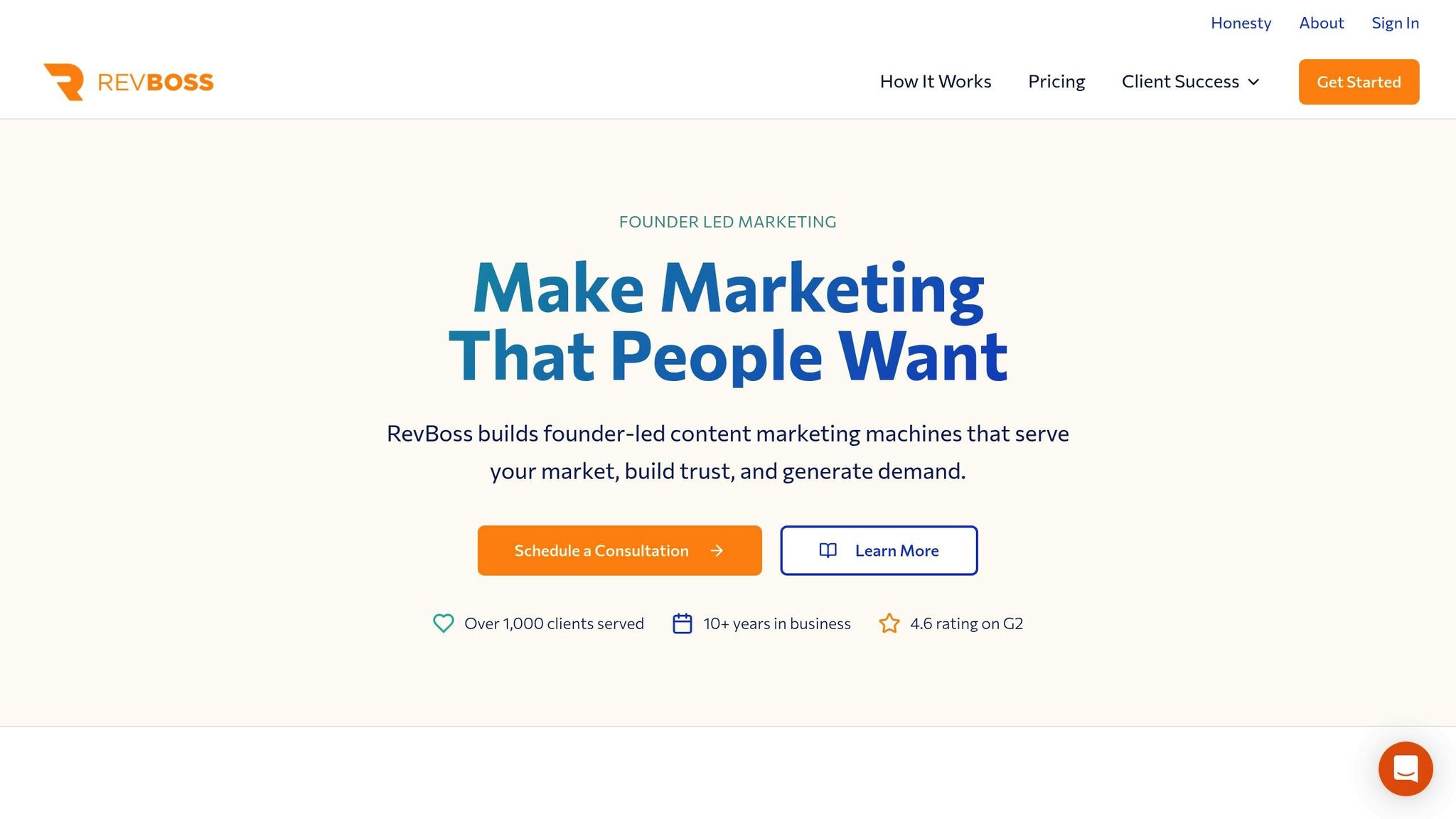
Scaling a business as a founder often means finding ways to amplify your personal brand without losing the authenticity that made your business successful in the first place. RevBoss steps in to tackle this challenge, offering marketing services tailored specifically for founder-led B2B companies. Their approach focuses on building trust and leveraging the founder's personality to drive growth, steering clear of impersonal, transactional methods. This case study dives into how RevBoss applies these principles to help businesses grow in a way that feels genuine and scalable.
RevBoss Marketing Services for Founder-Led Growth
At the heart of RevBoss’s strategy is creating content that captures the founder's unique voice and expertise. It all starts with a personalized content plan that mirrors the founder’s communication style, industry knowledge, and business goals.
Their team produces LinkedIn posts, email campaigns, and SEO content that genuinely sound like they came directly from the founder. This ensures that as content production scales, the founder’s authenticity remains intact.
A cornerstone of their service is LinkedIn audience growth campaigns. Rather than chasing vanity metrics, these campaigns focus on building an engaged community around the founder’s expertise. By targeting decision-makers in relevant industries, they attract qualified prospects who are drawn to the founder’s insights and thought leadership.
RevBoss also runs activation campaigns that nurture leads by leaning into personal branding. Instead of relying on generic email templates, these campaigns use the founder’s story and expertise to establish meaningful connections with potential clients. This approach aligns with the preferences of many B2B buyers, who value trust in leadership when choosing to work with a company.
Features and Benefits of RevBoss' Methods
RevBoss integrates multiple touchpoints into their demand generation workflows, ensuring the founder’s personal brand shines through every interaction. These workflows combine LinkedIn engagement, email outreach, and content marketing, creating a coordinated strategy that feels personal rather than automated.
Their onboarding process is designed to fully document the founder’s communication style, preferred topics, and industry insights. This documentation serves as a guide for all content creation, ensuring consistency across platforms and team members.
With ongoing content and audience management, founders can focus on high-value activities like strategic discussions and building relationships, while RevBoss handles content scheduling, community engagement, and lead qualification. This setup makes it easier for founders to transition from doing everything themselves to leading a team-based operation.
RevBoss offers this tailored service through a flexible pricing structure. Their Standard plan starts at $2,500 per month and includes a custom content strategy, audience development, and lead activation.
RevBoss vs. Standard Marketing Channels Comparison
When you compare RevBoss's founder-focused approach to traditional marketing methods, the differences are clear:
| Aspect | RevBoss Approach | Standard Marketing Channels |
|---|---|---|
| Content Strategy | Reflects the founder's voice and expertise | Generic, template-based messaging |
| Audience Building | Focused on relationships via LinkedIn | Broad SEO targeting and mass email lists |
| Lead Activation | Builds trust through the founder’s story | Impersonal, automated email sequences |
| Engagement Method | Highlights founder’s insights and thought leadership | Generic content and automated responses |
| Relationship Building | Prioritizes long-term trust | Focused on quick conversions |
| Scalability | Maintains authenticity while growing | Loses personal touch as volume increases |
Traditional email marketing and SEO often fall short when it comes to the authenticity B2B buyers expect from founder-led businesses. Generic outreach and broad-targeting strategies fail to create the personal connections that drive purchasing decisions in this space.
RevBoss flips this script by preserving the personal connection that’s crucial for founder-led businesses. Their system is designed to scale without sacrificing the trust and authenticity that make these businesses stand out. In the world of B2B, relationships and trust are everything - and RevBoss’s approach turns founder authenticity into a competitive edge rather than a growth obstacle. This case study underscores the importance of authentic, founder-led engagement in building sustainable B2B communities.
Conclusion: The Impact of Founder-Led Growth in B2B Communities
Research confirms that founders play a crucial role in the early stages of building B2B communities. Their involvement drives growth by establishing trust through genuine expertise, tapping into their deep product knowledge, and enabling fast, customer-driven improvements.
A well-established founder brand adds significant value to a business by fostering connections through personal, people-focused interactions. This approach leads to more meaningful sales conversations, heightened attention to content, and stronger alignment within the company around its mission and values.
For B2B startups facing long sales cycles, founder-led growth proves especially effective. It helps create category leadership and builds lasting trust by addressing customer challenges head-on and refining the sales narrative quickly.
Services like RevBoss (https://revboss.com) offer tools to scale founder-led growth while maintaining the authenticity that drives audience engagement.
The takeaway is clear: founder-led growth isn’t just a stepping stone - it’s a strategic advantage. When scaled thoughtfully, it creates a strong foundation for long-term success, fostering authentic leadership and meaningful connections within B2B communities.
FAQs
How can founders keep a personal connection with their B2B community as their business grows?
Staying Connected with Your B2B Community
Founders can maintain a meaningful connection with their B2B audience by sharing genuine stories, offering insights that showcase their expertise, and keeping communication channels open. These efforts help build trust and create a sense of relatability that resonates deeply with their community.
When it’s time to scale, it’s possible to grow without losing that personal touch. By embracing community-led growth, founders can empower key advocates to champion their brand, encourage peer-to-peer interactions, and focus on fostering real engagement. This approach allows the community to expand naturally while still reflecting the founder’s unique vision and personality.
How can founders effectively engage with their B2B community and build trust?
Founders can build trust and keep their B2B communities engaged by embracing openness and being real. Joining conversations, sharing relatable personal stories, and providing helpful insights can go a long way in forming genuine connections.
Adopting a community-first mindset - where collaboration and nurturing long-term relationships matter more than quick, transactional exchanges - lays the foundation for loyalty. When founders show consistent, heartfelt care for their audience, they not only earn trust but also deepen the community's engagement over time.
How do founder-led B2B communities differ from corporate-managed ones in engagement and conversion rates?
Why Founder-Led B2B Communities Perform Better
Founder-led B2B communities consistently outperform those managed by corporations when it comes to engagement and conversion rates. In fact, research reveals these communities can see 315% more engagement and 270% higher conversion rates. Why? It all comes down to the personal touch founders bring to the table.
Founders naturally exude a level of authenticity and trust that resonates with their audience. By sharing their personal stories and leveraging their unique brand, they create a deeper connection with community members. These genuine interactions often lead to more meaningful relationships, which, in turn, build credibility for the business.
The result? Shorter sales cycles and steady, measurable growth. When founders take the lead, their communities become more than just a platform - they become a trusted space where relationships flourish and success follows.