Founder-Led Marketing: What It Is, Why It Works, and When It Fails

Want to stand out in B2B? Put the founder in the spotlight. Founder-led marketing uses a founder’s personal voice and expertise to build trust, drive engagement, and create demand. Buyers trust people, not brands - and it works: CEOs active on social media see 46% higher engagement rates, and founder-led companies outperform others by 2.1x in shareholder returns.
But here’s the catch: it’s not scalable without the right systems. Over-relying on the founder can lead to burnout, bottlenecks, and inconsistent messaging. The solution? Build a process that amplifies the founder’s voice while letting the team handle execution.
Key Takeaways:
- Why it works: Buyers trust real stories and human leadership over corporate jargon.
- When it fails: Poor messaging, founder burnout, or bottlenecks stall growth.
- How to scale: Use tools, delegate tasks, and stick to a clear content strategy (e.g., 90% value, 10% promotion).
This approach isn’t for every stage - start post-product-market fit, when you can amplify momentum. Done right, founder-led marketing builds trust and drives growth without overloading the founder.
Founder-Led Marketing Strategy: How to Scale Trust Without Becoming the Bottleneck
What Is Founder-Led Marketing?
Founder-led marketing puts the founder or CEO in the spotlight, using their personal voice and expertise to drive the company’s growth. Instead of relying solely on polished corporate messaging, this approach highlights the human side of the business.
Unlike the carefully curated image often associated with traditional marketing, founder-led marketing emphasizes authenticity. It’s not about making the founder a celebrity - it’s about leveraging their platform to strengthen the company’s brand. By engaging directly with their audience, founders gain insights into their community’s challenges and goals. This approach sets the stage for understanding its key components and the strategies that make it work.
"Founder-led marketing is when you, as the founder or CEO, become a visible, active part of your brand... It's about showing people the real person behind the product."
The results speak for themselves. For instance, a CEO’s reputation accounts for 44% of a company’s market value, and founder-generated content gets eight times more engagement compared to official brand channels.
Core Elements of Founder-Led Marketing
Founder-led marketing thrives on four essential elements.
The first is vision storytelling - sharing the personal journey behind the brand. This goes beyond a dry corporate timeline and dives into the founder’s experiences, including the moments that shaped their vision and the hurdles they overcame.
Next is thought leadership, which positions the founder as a trusted expert in their field. This level of insight and credibility is something a typical marketing team can’t replicate. A great example is Canva’s CEO, who openly discussed over 100 investor rejections, showcasing resilience and expertise that helped grow Canva into a $26 billion company.
The third component, building in public, involves transparency. Founders share the ups and downs of their journey, including missteps and product evolution. For instance, Sahil Lavingia, the founder of Gumroad, has shared nearly every aspect of his entrepreneurial path since he started at 19, which has helped attract and retain users.
Finally, direct engagement is crucial. Founders who actively interact with their audience - commenting, participating in discussions, and fostering genuine relationships - build trust and loyalty. The key is to focus on providing 90% educational and industry value while limiting promotional content to just 10% to maintain audience interest.
Once these elements are in place, the next step is selecting the right platforms to amplify the message.
Common Channels for Founder-Led Marketing
To make founder-led marketing effective, it’s important to use the right digital channels.
For B2B marketing, LinkedIn is the go-to platform. Its algorithm favors personal accounts, giving founders a wider reach to share frameworks, insights, and success stories.
Newsletters are another powerful tool, offering a consistent way to connect with audiences without worrying about algorithm changes. Founders often use newsletters to share longer, more detailed content, from personal anecdotes to actionable advice.
Industry events and podcasts provide opportunities for meaningful conversations and storytelling, while X (formerly Twitter) is great for real-time commentary and networking, with an impressive 103.9 million U.S. users projected by 2025.
For consumer-focused founders, TikTok offers unparalleled reach. By 2025, TikTok’s engagement rates are expected to average 2.50%, far outpacing Instagram (0.50%) and Facebook (0.15%). However, most B2B founders prioritize LinkedIn and often pair it with a newsletter or podcast before branching out to other platforms.
Why Founder-Led Marketing Works
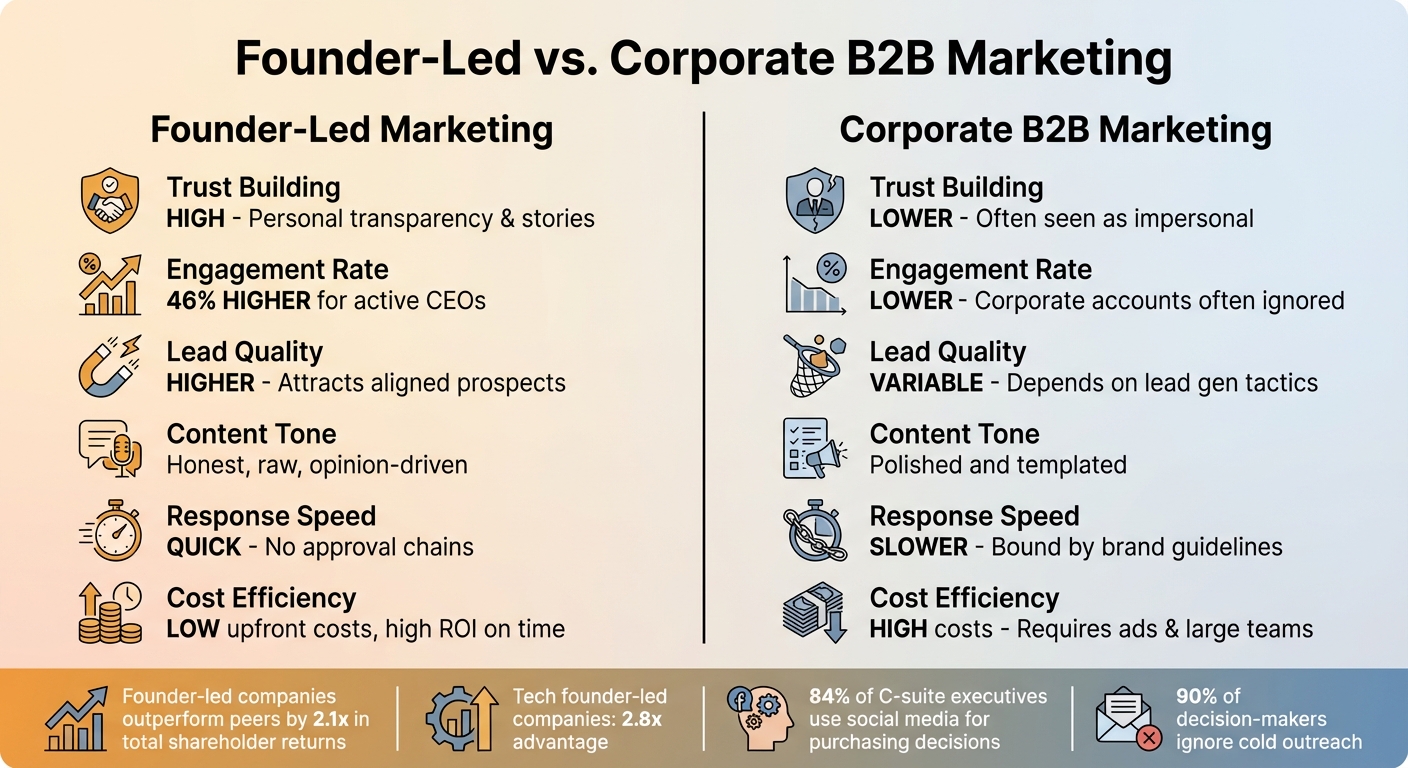
Founder-Led vs Corporate B2B Marketing: Key Performance Metrics Comparison
When founders share their personal stories, it cuts through the usual corporate noise and creates real connections - something most traditional B2B marketing struggles to achieve. Here's a striking fact: 82% of customers are more likely to trust a company whose leadership team is active on social media, and CEOs who engage on these platforms see 46% higher engagement rates. This kind of transparency builds trust and fosters deeper connections, as we'll explore further.
Building Trust and Credibility
Trust is the foundation of founder-led marketing. Unlike polished corporate messaging, this approach thrives on real stories, direct communication, and even moments of vulnerability. When founders share their experiences - both wins and failures - they create emotional bonds that logos and taglines can't match.
"You trust people more than logos. So does everyone else. Spend five minutes on LinkedIn and you'll see it: posts from founders get way more engagement than anything from a company page."
Take Jamie Siminoff, founder of Ring. After his 2013 Shark Tank appearance, he became the face of the brand, personally showcasing the product in demos and interviews. This hands-on approach helped build trust in a new product category and played a key role in Ring's $1 billion acquisition by Amazon in 2018.
Another example is Whitney Wolfe Herd, who founded Bumble while openly sharing her journey of overcoming workplace harassment. Her personal mission shaped Bumble’s features and helped the app stand out in a crowded market. This authenticity also propelled her to become the youngest self-made female billionaire at the time of Bumble’s IPO. In fact, 73% of B2B buyers say thought leadership is more persuasive than traditional marketing materials. As AI content becomes more common, genuine human perspectives from founders are increasingly valued.
Driving Engagement and Demand
Founder-led marketing doesn’t just build trust - it delivers real business results. By directly engaging with their audience, founders create connections that lead to better-quality leads and higher demand.
In January 2026, Chris Walker, founder and CEO of Passetto, used his LinkedIn content and podcast to generate $10 million in annual revenue. Instead of relying on traditional ad spend, Walker leaned on his expertise and personal voice to create an efficient demand engine.
Peter Caputa, CEO of Databox, takes a similar approach. By "building in public" on LinkedIn, he generates hundreds of sign-ups each month. Nearly half of his posts showcase how he personally uses Databox, demonstrating its value firsthand. As Caputa puts it:
"People love stories. I'm telling our story as it happens. People follow along. No different than why reality shows are popular and why people follow celebrities."
Another success story involves an enterprise SaaS founder who implemented a thought leadership strategy. Within 90 days, they saw a 340% increase in inbound demo requests, with these leads having 2.3x higher average contract values. This works because founder-led marketing naturally attracts prospects who align with the founder's vision, making them more invested from the start. These results highlight how this approach consistently outperforms traditional B2B marketing.
Founder-Led vs. Corporate B2B Marketing: A Comparison
Here’s how founder-led marketing stacks up against corporate strategies:
| Feature | Founder-Led Marketing | Corporate B2B Marketing |
|---|---|---|
| Trust Building | High; driven by personal transparency and stories [20, 1] | Lower; often seen as impersonal [2, 7] |
| Engagement Rate | 46% higher for leaders | Lower; corporate accounts often ignored [1, 7] |
| Lead Quality | Higher; attracts aligned prospects | Variable; depends on lead gen tactics |
| Content Tone | Honest, raw, and opinion-driven | Polished and templated |
| Response Speed | Quick; no approval chains | Slower; bound by brand guidelines |
| Cost Efficiency | Low upfront costs; high ROI on time | High costs; requires ads and large teams |
Research shows founder-led companies outperform their peers by 2.1x in total shareholder returns, with tech companies seeing an even greater 2.8x advantage. Additionally, 84% of C-suite executives use social media to make purchasing decisions, while 90% of decision-makers ignore cold outreach. In today’s market, a founder’s authentic voice is a powerful edge that corporate marketing simply can’t replicate.
sbb-itb-9354cf2
When Founder-Led Marketing Fails
Founder-led marketing can be a game-changer, but it’s not without its pitfalls. What starts as a strength can become a stumbling block as a business grows. Scaling the founder’s voice and influence isn’t as simple as just doing more of the same - it requires a shift in tactics to avoid turning advantages into obstacles.
Challenges of Scalability
When everything hinges on the founder - every post, every decision, every piece of content - growth inevitably slows. Teams are left waiting for approvals, product launches drag on, and the company’s agility takes a hit.
Take Mailchimp’s co-founder Ben Chestnut as an example. By 2018, with the company employing 100 people, Chestnut realized he was holding things up. As he put it:
"I was the bottleneck... There were too many decisions that had to go through me".
Chestnut’s solution? He stepped back and gave his leadership team the autonomy to execute his vision. This move helped Mailchimp scale effectively and eventually led to its acquisition by Intuit for about $12 billion in September 2021.
There’s also the issue of reach. Organic content can only go so far - platform algorithms and audience saturation create a natural ceiling. If the founder’s energy is the primary driver of the marketing engine, the entire system risks stalling. And when the audience associates trust and expertise with the founder alone - rather than the company - this trust doesn’t translate into brand equity.
Beyond operational bottlenecks, founder-led marketing also lives or dies by the clarity of its messaging.
Audience Misalignment and Inconsistency
When messaging misses the mark, founder-led marketing starts to falter. If a founder jumps between too many unrelated topics - covering 10 different themes in 10 posts - the audience struggles to connect the dots. The message becomes scattered, and the company’s value proposition gets lost.
Worse still, if the audience feels like content is being shared just to drive sign-ups rather than to provide genuine insights, trust erodes fast. Ignoring the 90/10 rule - where 90% of content should deliver value and only 10% should promote - leads to an overly salesy tone that turns people off.
Inconsistent execution only compounds these issues. Without a clear strategy or repeatable workflows, messaging becomes erratic, and the founder risks burnout. A scattershot approach - posting sporadically without a system for repurposing or distribution - limits reach and impact. And if the founder loses touch with the audience’s real challenges, even frequent posting won’t resonate.
These challenges become especially clear when comparing successful and unsuccessful approaches to founder-led marketing.
Success vs. Failure Scenarios: A Comparison
| Factor | Success Scenario | Failure Scenario |
|---|---|---|
| Business Stage | Post-product-market fit; amplifies existing momentum | Pre-product-market fit; used to cover up weak demand |
| Audience Fit | Founder deeply understands the audience’s struggles | Founder is out of touch with audience pain points |
| Execution Strategy | Systematic approach with a team managing distribution | Manual process with the founder as the bottleneck |
| Content Focus | Balanced content adhering to the 90/10 rule | Overly promotional content that feels like constant pitching |
| Brand Integration | Founder’s voice complements strong brand elements | Audience remembers the founder but not the company |
| Decision Making | Frameworks allow teams to act independently | Founder micromanages every decision, slowing progress |
The dividing line often comes down to intent. Is founder-led marketing being used to build trust and drive growth, or is it just an ego-driven vanity project? If high activity - like frequent posting - fails to generate meaningful revenue, it’s a clear sign that the strategy needs rethinking. Recognizing these warning signs is the first step to creating a balanced, effective approach that supports sustainable growth.
How to Optimize Founder-Led Marketing
Taking founder-led marketing from a personal effort to a scalable system requires smart strategies and replicable workflows. The goal isn't to sideline the founder but to amplify their voice across a broader audience. This involves building efficient processes, leveraging the right tools, and embedding the founder's trust into the brand identity.
Using Tools and Services to Scale
Scaling founder-led marketing isn't about doing more; it's about working smarter. By combining the founder's unique perspective with external support, you can manage routine tasks while keeping the founder's voice front and center.
For example, RevBoss offers solutions tailored for founders looking to grow their marketing efforts. Their LinkedIn Content + Audience program, priced at $1,500 per month, includes weekly strategy calls, 8–12 LinkedIn posts, and workflows to grow your audience. For $4,000 per month, their Content + Coaching + Activation program takes it further by adding outreach campaigns, event support, and sales offer development, helping turn content into qualified leads.
AI tools can also save time by automating repetitive tasks. Mario Martinez Jr., founder of Vengreso, used Fly Posts AI to significantly boost his content output, growing organic blog traffic from 3,000 to 32,000 clicks per month in just eight months. His time spent on social engagement dropped from over 30 minutes per post to under 9 minutes.
Paid ads can help break through audience limitations. Adam Holmgren, CEO of Fibbler, used LinkedIn Thought Leader Ads to expand his reach from Europe to the U.S. in January 2026. By designing ads that felt like organic posts, he maintained authenticity while growing his audience.
The takeaway? Use tools and services to handle the heavy lifting - distribution, editing, and logistics - so the founder can focus on crafting their message and sharing expertise.
Streamlining Content and Workflow
While tools help scale efforts, a streamlined content process ensures everything stays consistent and impactful. It's not about posting more; it's about posting smarter. Instead of daily scrambling, founders can batch content creation into focused blocks. A single 90-minute session can produce enough material for a month.
Founders can also turn everyday activities into content gold. Marketing teams can conduct 30-minute "Story Sessions" - casual Q&A chats that generate raw ideas for posts. They can audit emails, sales decks, and recorded calls to extract high-value insights. One founder even recorded weekly Loom videos, which a marketer transformed into polished LinkedIn posts.
Maximizing reach without extra effort is key. A single 10-minute video can be repurposed into a LinkedIn post, a newsletter snippet, and short-form clips, spreading the message across multiple platforms.
Content should follow a clear structure. A good mix includes 65% authority content (educational), 25% personal stories, and 10% sales-focused material. Stick to a few core themes - like industry insights, behind-the-scenes updates, and customer success stories - to keep messaging focused. The 90-10 value rule is critical: 90% of content should educate or inspire, while only 10% should promote.
These methods ensure a steady flow of high-quality content while keeping the founder's voice intact.
Balancing Founder Efforts with Team Support
Once workflows are running smoothly, team support becomes crucial for scaling sustainably. The ideal model isn't "founder-only" - it's "founder-plus." The founder provides the vision and trust factor, while the team handles execution and distribution.
Hiring the right first marketing team member is pivotal. Rather than opting for a junior generalist, founders should seek a "strategic doer" who understands positioning and demand generation. This person should be able to turn the founder's insights into a measurable pipeline, laying the groundwork for effective marketing operations.
With a capable team in place, the founder's role shifts to sharing expertise and high-level ideas. The team takes over research, scripting, editing, and multi-channel distribution. Refine Labs sums it up well:
"Founder-led doesn't mean founder-alone. Your team can handle research, scripting, editing, and logistics. All your founder needs to do is show up with their expertise and perspective".
To avoid bottlenecks, document successful tactics in a sales playbook. Include language from high-performing emails or calls so new hires can replicate the founder's approach. Storytelling can make these tactics up to seven times more memorable for the team.
Finally, embed brand memory into the founder's content. Use distinctive elements - like a specific color, mascot, or recurring theme - to ensure the brand remains recognizable even when the founder isn't directly involved. For instance, Adam Holmgren used a "pink lion" mascot and consistent brand colors in his LinkedIn posts, ensuring the company's identity stayed strong.
The ultimate goal? Build a system where the founder's voice drives trust, while tools and a skilled team handle the scaling.
Key Takeaways
People connect more deeply with real, human leadership than with impersonal corporate brands. When founders openly share their knowledge and insights, they build a level of trust that traditional corporate messaging just can’t match. The numbers back this up: tech companies led by founders have grown about 30% over the past five years, compared to just 6.7% for those managed by others.
But this approach isn’t all smooth sailing. Challenges like founder burnout and inconsistent messaging can creep in. Time is often a limiting factor, and without solid systems, growth can stall. Founders risk spreading themselves too thin, which can lead to messaging that feels scattered. The key to overcoming this? Careful planning. By focusing on 3–4 core content themes, batching content creation, and relying on a strong team for execution, founders can stay focused on their vision without getting bogged down in the details.
To make this work, a shift in strategy is critical: founders need to lead the charge while delegating execution to a skilled team. Tasks like research, scripting, editing, and logistics can be handed off, freeing up the founder to focus on what only they can do - sharing their unique perspective. As Refine Labs aptly states:
"In B2B, relationships are the moat."
Scaling a founder’s leadership requires systems that amplify their personal brand. Tools like those offered by RevBoss streamline founder-led marketing by combining strategy sessions, content creation, and audience-building workflows. Take Amoeba AI, for example: CEO Tooba Durraze saw such a surge in leads through this approach that she had to pause her beta launch because her onboarding team couldn’t keep up.
Founder-led marketing isn’t just a growth tactic - it’s about building trust. When delegation is done right, it transforms potential bottlenecks into a scalable engine for growth. With the right systems, tools, and team support, founders can channel their expertise into lasting success - without burning out.
FAQs
What are the main challenges of scaling founder-led marketing?
Scaling founder-led marketing comes with its fair share of hurdles. As a business grows, the hands-on, personal touch of the founder often needs to give way to a more structured and scalable marketing approach. This transition can bring operational headaches, especially when the founder's direct involvement slows things down or limits the team's ability to take initiative.
Another sticking point is the founder's time - or lack thereof. Juggling marketing with other critical responsibilities can stretch them thin, making it tough to maintain momentum. And let’s be honest, handing over the reins isn’t always easy. When the founder’s personal vision and voice are tightly woven into the brand, delegating tasks can feel like a gamble.
To navigate these challenges, businesses need to build clear, repeatable processes, give the team the tools and autonomy they need to thrive, and redefine the founder’s role to support long-term growth.
How can founders maintain their personal brand without risking burnout?
To keep your personal brand strong without running yourself into the ground, it’s crucial to set boundaries and delegate tasks. Trying to do it all will only lead to burnout. Balance your marketing hustle with some solid self-care to stay grounded and consistent. Instead of spreading yourself thin across every platform, focus on telling genuine stories and aim for quality content over sheer quantity.
A structured routine can work wonders - sprinkle in regular breaks and lean on a dependable support system to share the load. Set goals that are realistic, and don’t hesitate to step back when needed. This way, you can keep building your brand while taking care of your well-being for the long haul.
How can founders maintain consistent messaging in their marketing efforts?
Maintaining consistent messaging in founder-led marketing hinges on clarity and staying true to the founder's voice. Start by identifying what makes the founder's perspective stand out. Focus on topics they genuinely care about and have expertise in - this not only keeps the messaging real but also strengthens the bond with the audience.
Next, develop a content plan that zeroes in on a few platforms where the founder feels at ease. Whether it’s LinkedIn, podcasts, or other social media channels, sticking to familiar spaces can make the process smoother. To keep the flow steady, consider batch-creating content and reusing it across different platforms. This approach helps maintain consistency without piling on extra work.
Lastly, lean on tools like automation and establish regular habits for content creation. These small systems can keep things running, even during hectic times. Together, these strategies create a reliable and relatable brand image that resonates over time.