The Hard Truth -- This is Why it is So Much Harder to Generate Leads

Lead generation is harder than ever. Buyers do their research alone, trust is at an all-time low, and the market is overcrowded with generic pitches. Here’s the reality:
- 80% of the buyer’s journey happens online - before they even talk to you.
- 87% of buyers ignore outreach that isn’t tailored to their needs.
- Your CRM? It’s decaying at 30% per year, making your data unreliable.
For founders, the stakes are higher. You’re juggling everything - product, strategy, sales - and now you’re expected to lead marketing too. The old playbook of cold emails, cookie-cutter content, and scattered tools doesn’t work anymore.
What’s the fix?
- Show up early in the buyer’s research phase with helpful, ungated content.
- Cut through the noise with your voice - buyers trust people, not faceless brands.
- Simplify your tech stack and focus on tools that actually work together.
- Stay involved in lead generation without micromanaging - your insights matter.
Lead generation isn’t about doing more - it’s about doing it smarter. Let’s break it down.
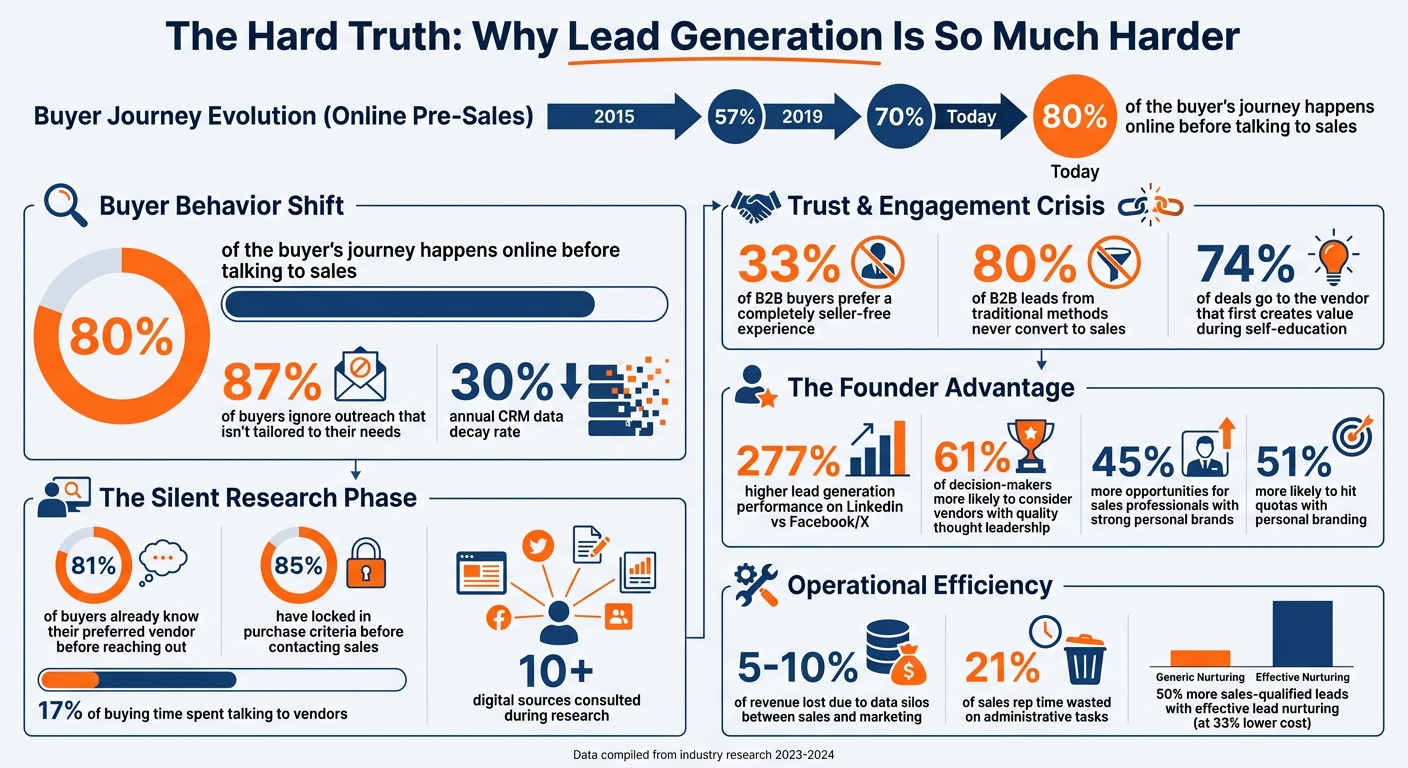
B2B Lead Generation Statistics: Why It's Harder Than Ever
Problem 1: Buyers Engage Later in the Sales Process
Buyers educate themselves before reaching out
These days, B2B buyers are doing most of their homework before they even think about contacting a vendor. In fact, a staggering 80% of their buying journey happens without any interaction with a sales team. They’re digging into at least 10 different digital sources - things like product reviews, case studies, and pricing comparisons - before they make any moves. And here’s the kicker: 87% of buyers say they’d rather do their own research than talk to a sales rep.
What’s even more eye-opening? Buyers only spend about 17% of their total buying time actually talking to vendors. By the time they do reach out, 81% already know which vendor they prefer, and 85% have locked in their purchase criteria. This trend has been building for years. Back in 2015, 57% of the buyer's journey was happening without sales involvement. By 2019, it jumped to 70%, and today, it’s hit that 80% mark. The takeaway? The research phase isn’t just research anymore - it’s where decisions are being made. If your brand isn’t part of that silent phase, you’re out of the game before it even starts.
How to build trust before buyers contact you
If buyers are doing their homework solo, your job is to show up in their research and build trust before they ever think about reaching out. Stats back this up: 74% of deals go to the vendor that first creates value during the buyer’s self-education phase.
Start with ungated, educational content. Buyers aren’t going to jump through hoops to get basic info - they’ll just move on to someone else. Focus on creating resources that help them during the "Problem Recognition" stage. Think blog posts, trend reports, or infographics that make their challenges clearer - even before they realize they need a solution. Keep in mind, 71% of B2B research starts with a generic Google search, not a branded one. Be there when they search.
Another key move? Founder-led thought leadership on LinkedIn. LinkedIn outperforms platforms like Facebook or X for B2B lead generation by a whopping 277%. Plus, 61% of decision-makers are more likely to consider vendors who share insightful, high-quality thought leadership. As a founder, this is your chance to shine. Share your expertise, industry insights, and real-world experiences. Skip the hard sell - buyers want value, not a pitch.
Interactive tools can also help you stand out. Things like ROI calculators, self-assessment quizzes, or business case templates can offer immediate value and help buyers rally internal support among their roughly 11.4 stakeholders. For instance, Zendesk nailed this in 2023 by teaming up with 6sense. They targeted high-intent leads in the Decision and Purchase stages, tailoring their messaging to specific keywords. The result? An 8% to 10% boost in opportunity creation from Marketing Qualified Leads worldwide.
For founders juggling a million things, this shift in buyer behavior makes lead generation even tougher. But here’s the bottom line: if you’re not building trust during that 80% of the journey when buyers are researching quietly, you’ll never make it to the conversation when they’re ready to buy.
Problem 2: Market Saturation Makes Buyers Ignore You
Why buyers ignore generic marketing messages
Your emails are going unopened. Your pitches? Ignored. Why? Decision-makers are drowning in a sea of templated outreach. This tidal wave of sameness has led to what we call inbox fatigue - buyers have become hyper-selective, instantly filtering out anything that feels generic or irrelevant.
The stats paint a bleak picture. 87% of B2B buyers dismiss outreach that doesn’t directly address their unique needs. Even worse, 80% of B2B leads generated through traditional methods never turn into sales. When your message looks and feels like the hundreds of others flooding their inbox, it’s no wonder it gets lost in the shuffle.
"Cold outreach methods can often come across as impersonal and insincere, making it difficult to establish trust with potential leads".
What’s more, 33% of B2B decision-makers now prefer a completely seller-free buying experience. They’d rather do their own research than sit through a pitch delivered by a sales rep reading off a script. And with 37% of all sales leads coming through email, the competition for attention in their inboxes is fierce. To survive in this saturated market, you need to shift gears - ditch the boilerplate and embrace genuine, human connection.
How personality-driven marketing cuts through the noise
The solution is refreshingly simple: be human. While others hide behind corporate jargon, your authentic founder’s voice can cut through the noise. Buyers aren’t looking for another faceless brand - they want to connect with real people who understand their needs and challenges.
Founder-led content thrives because it feels real. It’s about sharing honest opinions, candid moments, and even unpolished videos that showcase your product’s value. There’s a world of difference between slapping someone’s first name on a template and actually engaging them as a person. This personal touch doesn’t just stand out - it sticks.
Take Stanley as a prime example. In November 2023, a TikTok user shared a video showing her burned-out car, with a Stanley tumbler still intact inside. Instead of issuing a standard press release, Stanley’s President, Terence Reilly, recorded a casual, unscripted video. He offered to replace not just the tumblers but also her car. That heartfelt response went viral, racking up 7.7 million likes and over 200,000 shares. No cookie-cutter campaign could’ve achieved that level of engagement.
The takeaway? Focus on relevance over volume. Instead of blasting out generic pitches to hundreds of strangers, zero in on a handful of well-matched prospects. Tailor your messaging to address their specific challenges. Use platforms like LinkedIn to share insights and spark genuine conversations.
"The future belongs to companies that earn attention, not interrupt it".
Comparison: Generic vs. Founder-Led Lead Generation
Here’s how the two approaches stack up:
| Feature | Generic Lead Generation | Founder-Led Lead Generation |
|---|---|---|
| Core Strategy | High-volume outreach | Precision, relevance, and relationship-building |
| Messaging Style | Templated emails and AI-generated scripts | Personal stories, founder’s voice, and tailored insights |
| Buyer Perception | Impersonal and dismissive | Trustworthy and relatable |
| Engagement Goal | Quick, transactional interactions | Long-term value and meaningful connections |
| Response Rates | Declining due to saturation | Higher thanks to genuine engagement |
Problem 3: Too Many Tools Without a Clear Plan
The Cost of Using Disconnected Tools
Founder-led businesses often juggle separate CRMs, email platforms, landing page builders, lead scoring tools, and prospecting databases. This patchwork of tools leads to tool fatigue - instead of focusing on generating leads, you're stuck spending hours trying to keep these systems in sync.
And the cost? It's more than just lost time. 5–10% of your revenue can slip through the cracks due to data silos between your sales and marketing teams. Sales reps lose around 21% of their time on administrative tasks instead of closing deals. When systems don’t talk to each other, manual data entry becomes a necessity, leading to fragmented contact records, errors, and missed opportunities.
Without a unified view of customer interactions, decision-making becomes guesswork. For instance, if a lead checks out your pricing page, opens several emails, and then goes quiet, that activity is scattered across different tools. This disconnect is a big deal when 61% of marketers cite generating traffic and leads as their biggest challenge.
"Without leads, a business is just a costly hobby. No leads = no pipeline = no revenue."
How to Build a Simple Lead Generation System
Here’s the fix: keep it simple. Most founder-led businesses only need three core tools: a CRM (your go-to source for all customer data), an email tool that integrates with it, and a way to capture leads directly from your website. That’s it. Don’t overcomplicate it - master these basics first.
Start with your CRM. Platforms like HubSpot offer free plans, while Pipedrive starts at $14/month. Choose a system with built-in integrations to avoid manual exports or custom development. Seamless, automatic syncing is a must.
Next, prioritize lead scoring and routing. Set up straightforward rules: if someone downloads your guide and visits your pricing page twice, they get a higher lead score, and you receive a notification. This eliminates the need for manual handoffs, ensuring you focus on your hottest leads. Businesses that nurture leads effectively see 50% more sales-qualified leads at 33% lower costs.
The goal is a lean, automated system that gives you real-time insights into your leads without constant tinkering. Once this foundation is set, you’ll be better equipped to tackle more complex lead generation challenges.
Comparison: Complex Tool Stack vs. Simple System
| Feature | Complex Tool Stack | Simple System |
|---|---|---|
| Data Management | Fragmented silos; manual syncing required | Centralized CRM; automatic two-way sync |
| Team Focus | High admin burden managing configurations | Automated workflows; focus on selling |
| Lead Visibility | Blind spots across the buyer journey | Full visibility into every touchpoint |
| Efficiency | 21% of time wasted on research | Instant lead scoring and routing |
| Cost | High cumulative subscriptions; unclear ROI | Predictable expenses with measurable results |
Problem 4: Trust is the Real Barrier to Conversion
Why B2B Buyers are More Skeptical Now
Trust has become the biggest hurdle for conversions in today’s B2B landscape. Even with plenty of traffic, it won’t matter if buyers don’t trust you. A striking 33% of B2B buyers now prefer a seller-free experience. They’d rather dig into their own research than deal with a salesperson, likely because they’ve been let down by empty promises or generic sales pitches that feel impersonal.
This isn’t just about being visible; it’s about closing the credibility gap. Research reveals that 87% of B2B buyers dismiss outreach that doesn’t align with their needs. Think about it: cold emails and cookie-cutter LinkedIn messages have conditioned buyers to tune out anything that doesn’t feel tailored. One sales leader even shared that cutting outreach volume by half while focusing on quality and trust led to a 300% boost in connection rates.
"The mother of credibility is trust. You can't be credible if people don't trust you, simple as that."
This becomes even more critical when you consider that B2B deals often involve multiple stakeholders, each with their own concerns - whether it’s security, ROI, or ease of implementation. Without trust, even the most qualified leads will stall in endless research and never move forward.
How to Build Trust Through Founder-Led Content
To overcome this skepticism, a personal touch is essential, and founder-led content is a powerful way to deliver it. Buyers want to see the human side of your business. In fact, 73% of them consume between three and seven pieces of content before they’re ready to engage with a sales team. Sharing genuine insights and lessons on platforms like LinkedIn allows founders to establish trust long before any sales pitch. Short-form video content is especially effective, generating three times more engagement than text-only posts.
Newsletters are another great way to connect directly with your audience. For example, in 2022, a healthcare provider shifted away from cold outreach and embraced personalized email campaigns. The result? A 55% spike in email open rates and $4.5 million added to their pipeline in just two months.
Speaking engagements - whether through podcasts, webinars, or industry events - also help solidify credibility. Take the case of a manufacturing SaaS company that implemented a "Webinar Flywheel" strategy. They hosted three live webinars, repurposed the content for on-demand viewing, and saw tremendous results: 1,200 registrants, 900 MQLs, and $1.4 million in closed-won revenue. This approach highlights the importance of prioritizing helpful, value-driven content over a hard sales push.
"Trust is everything... The best sales development focuses on creating conversations that matter - conversations that go beyond immediate needs to build lasting business relationships."
sbb-itb-9354cf2
Problem 5: Founders Cannot Fully Delegate Lead Generation
Why Founder Involvement Matters
Lead generation isn’t something you can just outsource and hope for the best. Many founders fall into the trap of thinking that hiring someone to "handle marketing" is enough. But this often leads to generic messaging and a poorly defined ideal customer profile (ICP). In a world full of marketing noise and endless tools, your involvement as a founder is crucial to creating a lead generation strategy that stands out.
Here’s why: as the founder, you have an unmatched understanding of your market. You know the shifts happening in your industry, the real pain points your customers face, and the subtle cues that indicate buying intent. Without your input, marketing efforts can quickly become bland, disconnected, and self-serving.
Let’s put this into perspective. A whopping 51% of sales professionals say that finding leads is one of their biggest challenges, even though it’s their second most time-consuming task. On top of that, 37% of these professionals don’t use any automation tools to help with prospecting. Interestingly, companies that do use lead generation software are 14% more likely to hit their sales targets. While tools and technology clearly help, it’s your strategic insights as a founder that turn these tools into real results.
The question is: how do you balance your involvement without getting bogged down in every detail? Let’s dive into that next.
How to Balance Founder Involvement With Execution
You don’t need to micromanage every task to stay involved in lead generation. Here’s how to keep your strategic influence while letting your team handle the heavy lifting.
- Be the strategist, not the executor. Focus on shaping the messaging and direction, but leave the day-to-day execution to your team. For example, you can delegate content creation while ensuring it reflects your voice and vision.
- Set up regular reviews. Weekly revenue reviews with your sales and marketing teams can help you track lead quality, understand why some leads are disqualified, and adjust your strategy as needed.
- Create a "User’s Manual." Document your strategic vision and messaging guidelines so your team knows exactly how to execute in your voice without needing constant input. This ensures consistency without you having to oversee every detail.
- Repurpose content with your touch. Take what your team creates and add your personal spin. This keeps the authenticity buyers expect from founder-led messaging while letting you focus on higher-level strategy.
- Stay connected without micromanaging. Daily check-ins with key team members can help you address roadblocks and provide guidance without hovering over every task.
By staying engaged in a strategic way, you can preserve the authenticity and precision that make founder-led lead generation so effective.
Comparison: Founder Absent vs. Founder Involved
| Feature | Founder Absent (Generic Lead Gen) | Founder Involved (Founder-Led) |
|---|---|---|
| Content Quality | Bland and uninspired | Engaging, educational, and memorable |
| Trust Factor | Low; comes off as generic marketing | High; builds credibility through personal authority |
| ICP Accuracy | Vague and overly broad | Sharply defined based on real-world buyer behavior |
| Sales Alignment | Leads often dismissed as "low quality" | Leads align with sales goals and show clear intent |
| Market Presence | Relies on sheer volume | Leverages personal branding and authentic connections |
The contrast is clear. When founders step away entirely, lead generation becomes a numbers game - one that frustrates both marketing and sales teams. Staying strategically involved ensures your team can create leads that don’t just look good on paper but actually convert into paying customers.
How this $1M+ SaaS Founder made LinkedIn her Biggest Lead Channel
Conclusion
Generating leads has become a tougher game, with competition heating up and trust emerging as the biggest hurdle to conversions. In fact, a striking 33% of buyers now prefer a completely "seller-free" experience. With markets so saturated, standing out isn't just important - it's essential.
But here's the thing: you don’t need a laundry list of tactics. What you need are the right tactics, ones that focus on building trust through your personal brand. The numbers back this up - sales professionals with strong personal brands generate 45% more opportunities and are 51% more likely to hit their quotas. By sharing educational content that helps buyers make informed decisions before they even reach out, you can cut through the noise and connect on a human level.
Keep your lead generation strategy simple. Zero in on two or three core methods - be it LinkedIn, niche SEO, or webinars - and stick with them for at least six months. Resist the urge to jump ship when results aren’t instant. Success doesn’t come from having the fanciest tech stack; it comes from clarity - a clear message, a well-defined ideal customer profile (ICP), and founders who stay actively involved. This kind of focus allows you to use your unique voice to its fullest potential.
And yes, your voice matters.
"Customer relationships dragged us through recessions and downturns. Because if they really trust you, they will never look around the fence for another one."
Building that trust starts with you - your insights, your authenticity, and your commitment to showing up consistently.
The landscape for lead generation will only grow more challenging. But for founders who embrace trust, simplicity, and their own unique voice, there will always be a way to rise above the noise.
FAQs
How can founders stay involved in lead generation without micromanaging their team?
Founders can strike a better balance in lead generation by prioritizing strategy over getting bogged down in daily tasks. Start by defining a clear Ideal Customer Profile (ICP) and creating messaging that aligns with the founder's vision. This provides the team with a strong starting point and reduces the need for constant tweaks.
Hand off the execution to a skilled team. Let them handle outreach, keep data accurate, and qualify leads. To stay in the loop without micromanaging, set clear performance metrics - like conversion rates or pipeline growth - and use those to measure progress. Regular check-ins, whether weekly or bi-weekly, can help spot trends or solve issues while still giving the team room to operate independently.
Leverage technology to handle repetitive work. Tools like AI-powered lead scoring can identify the most promising opportunities, freeing founders to focus on strategic moves and important conversations. By stepping back from the nitty-gritty and trusting their team, founders can drive results without slowing things down through over-involvement.
How can B2B businesses build trust with buyers during their research phase?
Building trust with B2B buyers during their research phase takes a thoughtful mix of credibility, openness, and a personal touch. Start by crafting relevant, high-value content - think blogs, case studies, or videos - that directly tackles the questions and pain points your audience is dealing with. Keep your messaging consistent across all platforms to project a steady, expert voice they can rely on.
Leverage social proof to strengthen your credibility. Highlight client testimonials, showcase measurable results, and share case studies that demonstrate success in real-world scenarios. Buyers also appreciate transparency, especially when it comes to how their data is handled - clearly communicating your privacy practices can go a long way in easing concerns. On top of that, personalize your interactions by referencing specific content they’ve engaged with, whether it’s offering extra insights or suggesting a quick follow-up chat.
When your approach aligns with the buyer’s journey and feels genuine, you create a space where trust can grow, making it easier for prospects to move forward with confidence.
Why is it important to simplify your tech stack for better lead generation?
Simplifying your tech stack isn’t just a nice-to-have - it’s a game-changer. Every extra tool or manual process adds friction, slowing down the path from prospect to qualified lead. Outdated or overly complicated systems can bog your team down, leading to inefficiencies, missed opportunities, and unnecessary expenses. A cleaner, more streamlined setup ensures lead data stays accurate and actionable, letting your team zero in on what really matters: turning leads into customers.
When you consolidate your tools into a lean, efficient platform, everything starts to click. You can roll out new AI features with less hassle, scale personalized outreach efforts, and say goodbye to data silos. Plus, your budget gets spent on driving results, not on keeping redundant software afloat. For founder-led businesses, this simplicity isn’t just about saving time - it’s about enabling faster campaign tweaks and delivering stronger performance across the board.