How Founder Brands Build Trust Through Content

Building trust in B2B marketing isn’t about polished ads or SEO-heavy blogs - it’s about real stories from real people. Buyers trust humans more than brands, and founder-led content is the cheat code to bridge this gap.
- 73% of decision-makers trust companies more when leadership shares insights.
- CEO posts get 4x more engagement than company pages.
- Personal LinkedIn posts drive 10–15x more engagement than corporate ones.
Why does this work? Founders share personal experiences, failures, wins, and lessons that resonate far more than generic marketing. Think of Adam Robinson, who generated 1,600 leads from a single LinkedIn post, or Sam Altman, whose transparent updates drew 7M views.
Here’s the playbook:
- Share personal stories - the tough calls, the wins, and lessons learned.
- Follow the 90-10 rule: 90% value (educate, entertain) and 10% promotion.
- Engage consistently - respond to comments, start conversations, and build relationships.
Tools like RevBoss help founders scale this without burning out, turning raw insights into a steady flow of posts, videos, and articles. When done right, founder-led content doesn’t just build trust - it shortens sales cycles, attracts pre-qualified leads, and drives growth.
Bottom line: Buyers don’t trust faceless brands. They trust people. Your voice is your biggest asset - use it.
Why Founder-Led Content Builds Trust
The Human Touch: Moving Beyond Corporate Messaging
When founders step up to share their stories, they put their personal reputation on the line - something buyers value far more than a faceless corporate logo. Unlike employees sticking to a marketing script, founders bring genuine stakes to the table. Their credibility is tied directly to the success or failure of their business, making their words carry more weight.
This creates what’s often called "proof of proximity." Founders have walked in the same shoes as their customers. When they share raw, real experiences - like admitting, "We spent $15K on this and failed", or detailing a tough boardroom decision - it hits differently than a polished, impersonal case study. It’s like the contrast between flipping through a travel brochure and hearing firsthand stories from someone who’s just returned from the trip.
Take Sam Altman, CEO of OpenAI, as an example. In February 2025, he shared his company’s developer roadmap for GPT-4.5 and GPT-5 directly on X. He didn’t just announce plans; he explained how they aimed to simplify their product offerings. That single post racked up 7 million views, reinforcing his technical authority and showing the power of unfiltered engagement. This kind of transparency blends storytelling with strategic messaging, creating a connection that feels real and relatable.
In a world where over 54% of long-form LinkedIn posts are churned out by AI, feeds are flooded with generic, soulless content. Founders who share personal stories and bold truths cut through the noise. Their insights, drawn from lived experience, can’t be mimicked by algorithms. It’s a rare edge in a sea of sameness and a way to build a content strategy focused on delivering value, not just self-promotion.
The 90-10 Rule for Value-Driven Content
Authentic storytelling lays the groundwork for trust, but relentless product promotion can quickly erode it. That’s where the 90-10 rule comes in: dedicate 90% of your content to educating, entertaining, or offering behind-the-scenes insights, and save just 10% for direct promotion.
Why does this work? Because only 5% of B2B buyers are actively ready to make a purchase at any given time. The other 95% are in research mode - watching, learning, and deciding who they’ll trust when they’re ready to buy. Consider Lenny Rachitsky, who grew his newsletter to over 1 million subscribers by consistently delivering deep, founder-led insights on product growth. He didn’t waste his audience’s time with constant pitches; instead, he focused on sharing knowledge.
"Founder-led content isn't vanity or chasing likes. It's about leverage - the kind that gets you in the room before your SDR even picks up the phone."
- Kent Height, Founder, Techtonic
This strategy also addresses a key challenge in the B2B world: 75% of buyers at SaaS companies with $50M+ in revenue turn to their peers - not Google - when building vendor shortlists. They’re asking, “Who do I trust?” If a founder has been consistently sharing valuable insights, they’re already on that shortlist before the RFP even hits the table.
Content Types That Build Trust
LinkedIn Thought Leadership Posts
On LinkedIn, success isn’t just about racking up likes and comments; it’s about how effectively your content reaches and connects with others. The platform’s algorithm prioritizes posts from personal profiles over company pages, giving individual creators a massive advantage in visibility. This matters because 75% of buyers rely on peer recommendations when narrowing down vendor options.
Take Adam Robinson, CEO of RB2B, for example. In 2024 and 2025, he scaled his company to $1M ARR in just 16 weeks, largely thanks to his LinkedIn content strategy. His secret? Mastering the first 1-3 lines of every post - what he calls the "See More" hook. These opening lines are designed to spark curiosity, ensuring readers stick around for the rest of the post.
If you’re just starting, aim for a 90-day content schedule with this mix: 50% top-of-funnel (broad, relatable lessons), 30% middle-of-funnel (actionable frameworks and expertise), and 20% bottom-of-funnel (case studies and wins). And don’t just post and forget - spend 20 minutes daily responding to comments and transitioning public conversations into private DMs. That’s where the real opportunities often emerge.
Beyond metrics and strategies, sharing personal narratives can make your leadership more relatable and trustworthy.
Personal Stories and Behind-the-Scenes Content
Nothing builds trust quite like raw, honest storytelling. When founders share their struggles and triumphs, they show they’ve faced the same challenges as their audience. For instance, in 2013, Steli Efti, CEO of Close, nearly lost his company. Instead of hiding it, he shared a candid video explaining how staying silent during negotiations saved $500K. That vulnerability resonated deeply with entrepreneurs, creating a bond that no ad campaign could replicate.
Marie Martens, co-founder of Tally, uses a similar approach. She openly shares revenue updates and milestones on the company blog, treating it like a public diary. This transparency paid off - when Tally announced a funding round, it filled up within a day because the audience already felt invested in the team’s journey.
To craft stories with impact, try the CTDRP Framework: Context, Tension, Decision, Result, and Principle. This structure ensures your story isn’t just emotional - it also delivers a takeaway. And don’t overthink it. Sometimes, the best content comes from documenting what’s happening in real-time. For example, after a meaningful customer conversation, record a quick 60-second recap to share insights while they’re still fresh.
Customer Success Stories in the Founder's Voice
Founder-led success stories are a powerful way to showcase real results while keeping things personal. Unlike polished corporate case studies, these stories feel more genuine because they come directly from the founder, adding a layer of accountability. When a founder shares a customer win, it’s not just about the company - it’s their personal reputation on the line.
"When people trust that I’m invested in their success, they know I’m not about to risk my reputation by selling them a shitty CRM!"
John Hu, CEO of Stan, is a great example. In 2024, he grew his ARR by 8.6x by being radically transparent on TikTok and LinkedIn. He didn’t just share wins; he also talked about failures and lessons learned along the way. This openness made his audience feel like they were part of his journey, which made securing funding much easier. By admitting mistakes alongside successes, founder-led stories build trust faster than overly polished narratives.
The key to these stories? Focus on the "why" behind your decisions and the lessons your audience can apply to their own businesses. Keep the tone confident and helpful - like a friend who’s been there before - rather than falling back on impersonal corporate language.
Scaling Founder-Led Content with Systems
The RevBoss Audience System: Done-for-You Content
Founders often see the results of their content but hit a wall when it comes to creating it consistently. The answer isn’t grinding harder - it’s building a system that turns your expertise into a steady flow of content without draining your energy.
RevBoss steps in to streamline the entire process. Starting at $1,500 per month, they take your raw insights - captured during weekly strategy calls - and transform them into 8–12 LinkedIn posts per month, paired with audience growth campaigns. Your job? Share your stories, frameworks, and lessons. RevBoss handles the rest, from editing to distribution. This approach not only scales your content but also keeps your voice front and center, an essential element of founder-led marketing. By automating the heavy lifting while staying true to your perspective, the system strengthens the trust your audience has in your expertise. As Lukasz Fedor puts it: "The real problem isn't the founder or the hire. It's treating marketing as tasks instead of systems."
Chris Walker, founder of Passetto (formerly Refine Labs), used this kind of system to build an 8-figure B2B company in just three years. His strategy revolved around consistent LinkedIn posts and podcasts, with a team managing the production side. Similarly, Peter Caputa, CEO of Databox, drives around 100 free trial sign-ups per month by sharing metrics and operational lessons on LinkedIn through his "building in public" approach. Both examples show how a systemized content strategy can create a repeatable engine for growth.
Creating a Repeatable Content Engine
Once your content process is running smoothly, you can take it to the next level by building a repeatable engine. Founder-led content works best when it’s efficient, and the "Hero Asset" model is a perfect fit: record one high-value conversation each month, then repurpose it into vertical videos, LinkedIn posts, and articles. This method ensures you get maximum output with minimal time investment.
Here’s how a repeatable engine works in four steps: Capture ideas right after customer calls using tools like voice notes or Loom videos; Shape those raw ideas into key themes; Delegate the drafting to a content team or a service like RevBoss; and finally, Distribute the polished content across your platforms. Stick to the 3-Pillar Architecture for balanced content: 65% authority content (technical insights and how-tos), 25% personal content (your journey and lessons), and 10% sales content (product updates and wins). This structure helps you build trust and credibility long before making any sales pitch.
sbb-itb-9354cf2
Founder-Led Marketing Without Becoming an Influencer
Measuring Success: Trust and Pipeline Impact
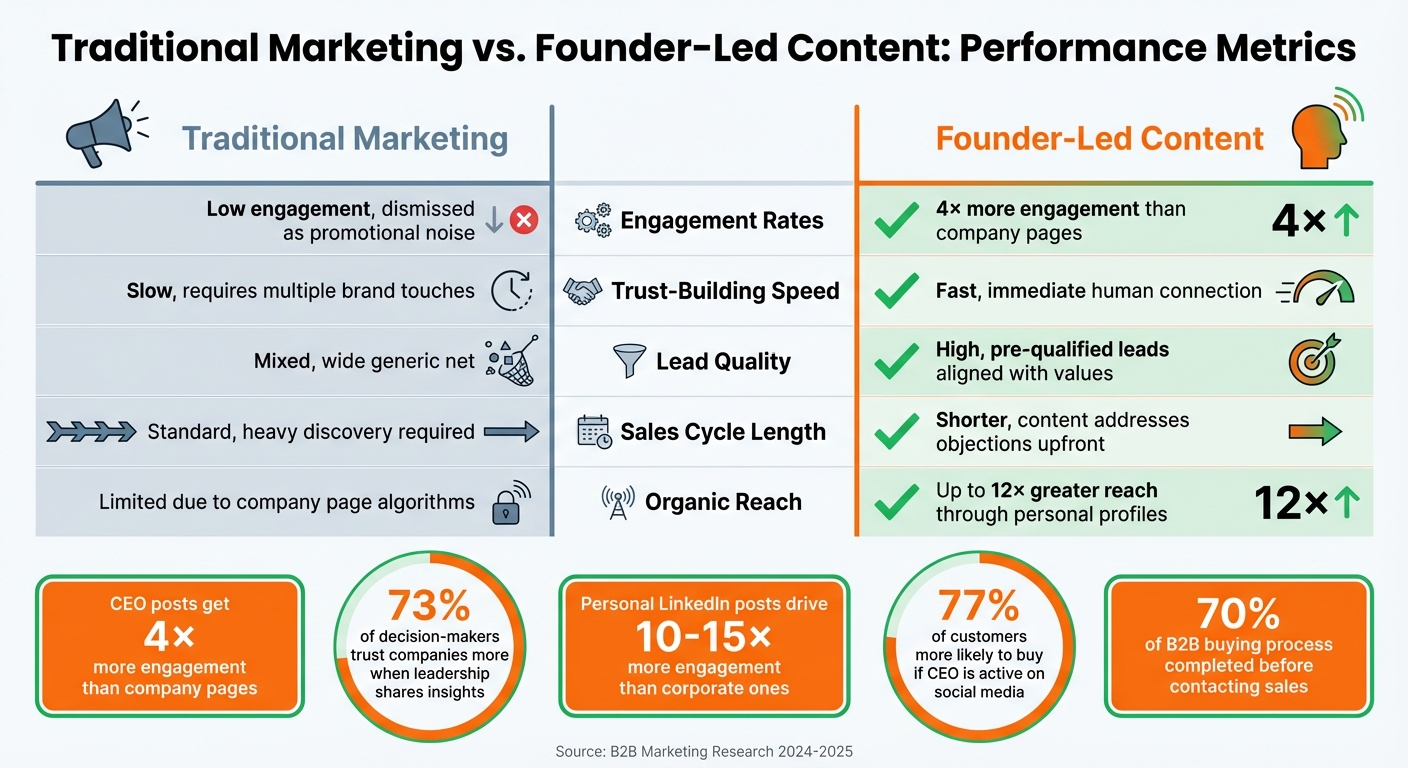
Founder-Led Content vs Traditional Marketing Performance Metrics
Key Metrics to Track
When it comes to founder-led content, the metrics you need to watch differ from traditional marketing. Start by keeping an eye on branded search volume - how often people search for your name paired with your company or industry niche (e.g., "[Your Name] + RevOps"). This is a clear indicator of growing authority and demand for your expertise [9, 23]. Additionally, as AI-driven search becomes more prominent, track AI citation signals. Content tied to recognizable experts is increasingly referenced in AI-generated outputs, signaling credibility in this evolving space.
Qualitative engagement is another crucial area. You’ll know you’re hitting the mark when prospects specifically mention your posts during discovery calls or when your insights get shared among peers [1, 14]. Instead of chasing vanity metrics like likes, focus on meaningful interactions - shares from your ideal customer profile (ICP) or comments that spark in-depth technical or strategic conversations [14, 23].
To measure pipeline impact, look at the percentage of inbound Sales Qualified Leads (SQLs) that stem from founder-led content. Compare the conversion rates between inbound leads - who already trust your brand - and outbound leads. Adding a "How did you hear about us?" field on lead forms can help capture attribution that traditional tools might miss. Also, note the sales cycle length - leads from founder-led content often close faster because trust is built early in the process. Within 18 months, founder-led inbound content can account for 20-40% of your sales pipeline.
"Founder-led content isn't vanity or chasing likes. It's about leverage – the kind that gets you in the room before your SDR even picks up the phone."
- Kent Height, Founder, Techtonic
Traditional vs. Founder-Led Approaches
Once you establish these metrics, it’s worth comparing the outcomes of founder-led content with traditional marketing strategies. The results are striking. For instance, 73% of decision-makers say they trust a company more when its leadership actively shares insights, and content shared by CEOs generates four times more engagement than standard company pages. On top of that, 77% of customers are more inclined to buy from a company if the CEO is active on social media, and 70% of the B2B buying process is completed before a prospect even contacts sales.
| Metric | Traditional Marketing | Founder-Led Content |
|---|---|---|
| Engagement Rates | Low; often dismissed as promotional noise | High; typically 4× more engagement than company pages |
| Trust-Building Speed | Slow; requires multiple brand touches | Fast; creates an immediate human connection [7, 14] |
| Lead Quality | Mixed; casts a wide, generic net | High; attracts pre-qualified leads aligned with shared values |
| Sales Cycle Length | Standard; involves heavy discovery | Shorter; content addresses objections upfront [11, 23] |
| Organic Reach | Limited due to company page algorithms | Up to 12× greater reach through personal profiles |
These comparisons highlight the power of personal storytelling over generic, corporate-style messaging. For example, Jay Singh, CEO of Casper Studios, shared that founder-led content on LinkedIn was responsible for driving 90% of his company’s inbound leads organically. This demonstrates how showcasing genuine expertise and a personal touch can dramatically enhance trust and drive pipeline growth.
Conclusion
The trust gap in B2B marketing is widening. With over 54% of long-form LinkedIn content now generated by AI, corporate messaging has become a sea of sameness. Buyers aren’t connecting with faceless brands anymore - they’re looking for voices with real stories, lessons, and scars from experience.
Founder-led content stands out because it delivers something traditional marketing can’t: authentic, hard-earned insights. Sharing the challenges from a recent sales call or the near-miss that almost derailed your business sends a clear message of competence and accountability that no polished corporate messaging can match. As Adam Holmgren, CEO of Fibbler, puts it:
"Founder-led is not a content strategy. It's a trust strategy"
And the numbers back this up. 73% of decision-makers trust a company more when its leadership shares insights, and 77% of customers are more likely to buy from a company if the CEO is active on social media. With 70% of the B2B buying process happening before a prospect even speaks to a sales rep, your content is doing the heavy lifting long before your team gets involved.
But here’s the catch: many founders start strong and then hit a wall. They run out of steam or exhaust their immediate network. That’s where a system like RevBoss steps in. Instead of treating founder-led content as an occasional effort, RevBoss transforms it into a consistent demand-generation machine. Through weekly calls, they capture your expertise, turn it into regular LinkedIn posts and newsletters, and activate your audience with campaigns that convert warm connections into meaningful conversations. By streamlining your content process while keeping your authentic voice intact, it ensures your trust-building efforts don’t stall.
If you’re serious about scaling trust and growth without becoming a full-time content creator, it’s time to stop treating founder-led marketing as optional. Make it the engine that drives your business forward.
FAQs
How do I start founder-led content if I don’t know what to post?
If you're stuck on what to post, start with topics you genuinely care about and have experience with - your knowledge, personal journey, or your company’s story. Share straightforward, story-focused content like LinkedIn updates, short videos, or podcasts. Highlight personal takeaways, lessons from your journey, and the hurdles you’ve faced. This approach builds trust and connection. By regularly putting out honest and relatable content, you’ll create a stream of ideas that truly connects with your audience over time.
How do I stay authentic without oversharing sensitive company details?
To maintain a genuine connection without revealing too much, share personal experiences, values, and perspectives that align with your brand. Stick to topics you care deeply about and use storytelling to engage your audience. Talk about your mission, the hurdles you've faced, and the lessons you've picked up along the way to foster trust. However, avoid disclosing sensitive operational or strategic details to safeguard your credibility and protect your business.
How do I prove founder-led content is creating pipeline, not just engagement?
To prove that founder-led content contributes to driving pipeline, focus on its influence on high-intent actions like demo requests or sales inquiries. Tools such as UTM parameters or CRM attribution can help link your content to actual conversions. Keep an eye on increases in inbound inquiries and shifts in pipeline metrics after sharing content - whether it's a LinkedIn post or a video. By consistently reviewing these trends, you can clearly show that founder-led content does more than generate engagement; it directly impacts the pipeline.