How Founders Shape Brand Voice in B2B Marketing

Your brand voice is the personality your business uses to communicate - and it’s crucial in B2B marketing. Why? Because trust and credibility drive decisions, especially for millennial and Gen Z buyers, 77% of whom say brand matters in their choices. A consistent, authentic voice helps you stand out, build trust, and even attract top talent.
For founder-led businesses, the founder’s personal values and style often shape the company’s voice. This creates a genuine connection with customers and makes the brand memorable. Here’s how founders influence brand voice:
- Authenticity builds trust: 85% of consumers prioritize authenticity when choosing brands.
- Personal storytelling sets you apart: Unique perspectives and relatable stories resonate with audiences.
- Balance matters: Blend personal style with professional credibility to meet industry expectations.
- Consistency is key: Clear guidelines ensure your voice stays aligned as you grow.
A strong founder-led voice not only drives sales but also builds lasting relationships in competitive markets. Ready to make your brand unforgettable? Let’s dive in.
Building a Unique Brand Voice
How Founders Shape Brand Voice
When founders take on a visible leadership role, their personal style often becomes the foundation for how their company communicates. It’s not just about having a charismatic CEO - it’s about embedding the founder’s values and personality into every aspect of the brand’s messaging.
The founder’s influence plays a major role in shaping the brand’s identity. Eighty-five percent of consumers say that authenticity is a key factor when deciding which brands to support. For founder-led companies, this authenticity stems from the founder's ability to infuse personal values into the brand's voice, creating a genuine connection with the audience.
Founders as Brand Representatives
Founders naturally become the face of their brand, and when they weave their personal values into the company’s communication, they foster trust. This trust is built on transparency and shared beliefs. Whether it’s a commitment to quality, customer satisfaction, or innovation, these values resonate with customers as something real - far removed from generic corporate messaging.
Take Syantra, a precision biotechnology startup, as an example. The company’s tone consistently reflects its dedication to the people it serves. From promoting fundraising events to sharing empowering customer stories, the founder’s focus on human impact is evident in every piece of content.
The importance of trust can’t be overstated. Eighty-seven percent of B2B buyers say trust is critical in their decision-making process. When founders integrate their personal values into the brand’s voice, they create lasting connections that go beyond transactions.
Standing Out in Competitive Markets
In crowded B2B markets, where products and services often seem indistinguishable, a founder’s unique perspective can set a brand apart. Fifty-nine percent of buyers discover new brands through creator content. This highlights the power of a personal, relatable narrative in a competitive landscape.
Brex, a financial technology company, is a great example. By adopting a casual, approachable tone in their marketing and social media, they connected with startup founders and entrepreneurs. Their use of humor and empathy toward the challenges faced by their audience made their brand relatable, resulting in a 40% increase in booked demos.
Similarly, Ramp crafted a brand voice that reflected its mission to empower businesses and ease financial stress. By positioning themselves as a supportive partner, using a confident and informative tone, they saw a 70% increase in positive replies from potential clients.
What sets founder-led brands apart is their ability to share genuine stories, insights, and challenges. These narratives resonate because they come from someone who has lived through the same struggles as their customers, creating a connection that competitors can’t easily replicate.
Finding the Right Professional Tone
While personal storytelling is key, founders also need to strike a balance between authenticity and professional credibility. This doesn’t mean adopting a dry, corporate tone - it’s about blending personal style with the expectations of the industry.
Goodlawyer, a tech startup, strikes this balance by focusing on transparency and quality while keeping their communication light and engaging. Coconut Software takes a similar approach, maintaining a professional tone that’s clear and approachable, appealing to financial institutions aiming to improve customer support.
The most effective founder-led brand voices share four essential traits: they’re authentic, clear, consistent, and engaging. Gorgias, for instance, emphasizes its personality through friendly, supportive communication and strong customer relationships, which led to a 55% increase in qualified deals.
"Bring a human voice and emotional connection… that's when you can embed yourself in someone's memory."
The numbers back this up: Nearly 80% of buyers engage with B2B creator content monthly, and 47% say they visited a vendor’s website after interacting with such content. When founders get their brand voice right, they’re not just creating marketing materials - they’re building a bridge between their expertise and their customers’ needs.
Steps to Build a Consistent Brand Voice
Creating a consistent brand voice is all about turning your mission and values into clear, actionable communication guidelines. It’s worth the effort - consistent brand presentation across all platforms can boost revenue by up to 23%. This is especially important for founder-led businesses looking to scale effectively.
Identify Your Core Mission and Values
Your brand voice should reflect your mission and values. Start by identifying 3-5 key values that define what your business stands for. For example, if honesty and creativity are central to your brand, your voice should be transparent and inventive. Your mission statement acts as your north star, guiding how you communicate across all platforms.
Take Patagonia as a case in point. Their "Don't Buy This Jacket" campaign encouraged customers to rethink consumption, aligning perfectly with their mission to combat climate change while being upfront about their goals. Similarly, Dove’s "Real Beauty" campaign highlights self-acceptance and authenticity, reinforcing their commitment to promoting body positivity.
"When your team speaks with one voice, your brand is impossible to ignore."
Once your mission and values are clear, the next step is to deeply understand the audience you’re speaking to.
Know Your Target Audience
Knowing your audience is essential for crafting a brand voice that resonates while staying true to your values. Eighty-one percent of consumers say they need to trust a brand before they’ll consider making a purchase. That trust starts with speaking their language in an authentic way.
Conduct surveys or gather insights to understand your audience’s preferences and expectations. This research isn’t about changing your core message - it’s about delivering it in a way that feels relatable and meaningful to your audience.
Your tone may shift slightly depending on the platform or audience, but your core personality should remain intact. For instance, a founder addressing enterprise clients might use a more formal tone compared to speaking with startup founders, but the underlying values and voice stay the same.
Authenticity is a dealbreaker for 86% of consumers when making purchasing decisions. This highlights why understanding your audience is so important. When you align your communication with their needs and preferences, you build trust and connection.
Once you’ve nailed down your audience insights, the next step is to formalize these ideas into a set of voice guidelines.
Create Voice Guidelines
After defining your values and understanding your audience, it’s time to create a detailed brand voice guide. This document should cover everything from tone and language style to key messaging points that reflect your brand’s personality.
Your brand voice guide should include:
- Core voice attributes and examples that embody your brand's personality
- Voice scales to adjust tone for different contexts
- Channel-specific guidelines to suit each platform’s unique culture
- A terminology guide to ensure consistent language
- Real-world examples of your voice in action
"BE AUTHENTIC when defining your brand voice. It is so much easier to stay consistent and also connect with your customers when your voice is designed around your core values and purpose."
Tailor your guidelines to each platform while staying true to your core voice. For example, LinkedIn posts might lean professional, while Twitter content can be more casual. Both, however, should unmistakably sound like your brand.
You can also create response templates that reflect your voice, ensuring every customer interaction - whether it’s a social media reply or a customer service email - reinforces your brand’s personality and values.
Finally, test your voice in action. Launch campaigns, review customer engagement, and refine your approach as needed. This iterative process ensures your brand voice evolves alongside your business while staying consistent and effective.
Common Challenges in Founder-Led Brand Voice
As businesses grow, founders often face unique hurdles in keeping their brand voice consistent. Even with well-defined guidelines, scaling up can stretch the limits of maintaining that distinct voice. Let’s dive into how growth can put your brand’s identity to the test.
Maintaining Voice While Scaling
Scaling up can blur the essence of your brand’s voice, especially as new team members come on board and communication channels multiply. Without strict adherence to branding protocols, teams may drift from the original tone and messaging. For instance, Kristin Marquet faced this issue during her company’s rapid growth. By creating a detailed brand guideline document, she was able to align her team on both visual and verbal branding.
"Maintaining that personal touch amidst growth is crucial. It helps customers feel connected to your brand and ensures that your message remains consistent, regardless of size."
– Ana Maria Bubolea, Founder, Brand Strategist, Buzzworthy Brands
As your team expands, it’s critical to fine-tune your communication processes to safeguard the authenticity of your brand’s voice.
Preventing Mixed Messages
Inconsistent messaging can erode trust. As companies grow larger, maintaining consistency across departments becomes increasingly difficult. Sales, marketing, and customer service teams often create their own messaging strategies, which can lead to conflicting narratives that weaken the overall brand.
One way to address this is by appointing a dedicated messaging leader. This individual ensures that all departments follow a unified set of strategic messages. Another key step is fostering a workplace culture that prioritizes clarity. Jenn Goddu from Sogolytics Blog highlights the importance of this approach:
"Create a culture of clarity. In other words, encourage all employees to ask clarifying questions and speak up if they're unsure how to approach a task; but crucially, instill this same culture in managers at all levels."
– Jenn Goddu, Sogolytics Blog
Documenting critical messaging points can also help prevent misunderstandings and keep everyone aligned.
Working Within Industry Limits
Beyond internal challenges, external industry expectations can influence how you communicate. In regulated fields like finance, balancing a founder’s casual tone with formal industry standards can be tricky.
Take Revolut, for example. The company uses a casual and direct tone to connect with younger, tech-savvy users. On the other hand, McKinsey & Company opts for a formal, polished style that reflects its expertise in global consulting. Similarly, GOV.UK takes a plain-language approach, using simple sentences and avoiding jargon to ensure accessibility for all.
The key is to adapt to industry norms without losing your brand’s essence. While professional standards might require some adjustments, your core values and personality should remain front and center, keeping the founder-led authenticity that makes your brand distinctive.
sbb-itb-9354cf2
Case Study: Founder-Led Brand Voice in Action
Notion has built its identity by channeling its founder's vision and personality into a brand voice that connects deeply with professional audiences. This example highlights how a founder's personal values can shape and define a brand's voice.
Building Trust Through Personal Values
Notion's rise is rooted in its founder's dedication to creativity, collaboration, and designing tools with people in mind. Instead of sticking to the usual corporate tone often found in enterprise software, Notion introduced a brand voice full of warmth and personality, driven by the idea that work should feel inspiring rather than mechanical.
One way Notion brings this to life is through hand-drawn profile images on LinkedIn, a nod to the founder's emphasis on creativity and individuality. They even launched an interactive platform for users to create their own doodle-style avatars, turning a design choice into a shareable, engaging campaign.
These hand-drawn visuals evoke the spontaneity of brainstorming sessions and workflows, perfectly reflecting Notion's mission to create tools that adapt to human creativity. This sketch-like aesthetic aligns beautifully with Notion's core purpose: offering a flexible workspace for writing, planning, and collaboration.
Their messaging also reinforces this personal touch. Visitors to Notion's homepage are met with straightforward, engaging language: "The happier workspace. Write. Plan. Collaborate. With a little help from AI." This line doesn’t just explain what Notion does - it reflects the founder's focus on creating tools that genuinely enhance the user experience.
Notion also taps into user-generated content to build a sense of community. For instance, in a Berlin-based campaign, employees described Notion in a single sentence, resulting in content that feels genuine and unscripted. These thoughtful choices contribute to stronger engagement and a clearer brand identity.
Results from a Strong Brand Voice
This approach has delivered measurable results. By staying true to its founder's values, Notion has fostered high audience engagement and boosted its visibility. The brand's commitment to authenticity helps potential users quickly understand its benefits while building the trust that’s so critical for B2B software adoption. It’s a reminder that enterprise solutions don’t have to trade personality for credibility - in fact, a brand's unique character can be a powerful advantage.
As one industry expert puts it:
"People follow people, not products. The brands thriving today are the ones where the founder's passion, purpose, and presence lead the way."
Notion demonstrates how a founder's personal values can be a driving force behind effective B2B marketing.
How RevBoss Supports Founder-Led Brand Voice
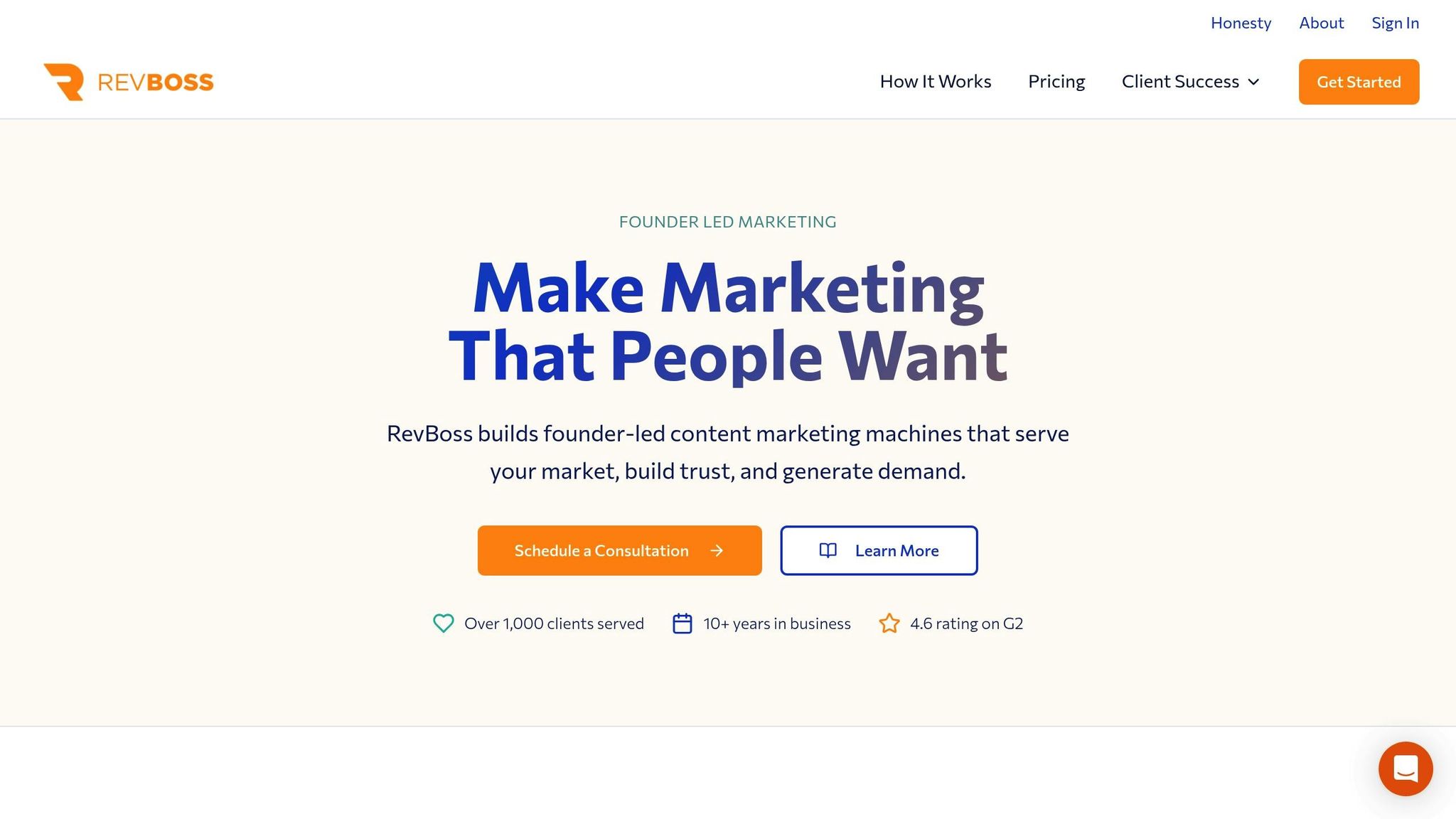
RevBoss focuses on helping founder-led B2B businesses turn their unique vision into content that drives real sales conversations. Their approach is built on the belief that a strong, personal brand voice is essential for connecting with customers. As the RevBoss team puts it, "People buy from people that they 'know, like and trust'".
Custom Content Strategy That Reflects Your Voice
RevBoss starts by developing a strategy tailored to your Ideal Customer Profile and personal brand. Instead of using cookie-cutter templates, they dive into your story, values, and style to create content that genuinely speaks to your audience. They emphasize that when customers choose small marketing agencies, SaaS companies, or service providers, they’re often buying into the Owner, Founder, or CEO - not just the product itself.
Turning One Hour Into a Marketing Machine
One of RevBoss’s standout features is how they maximize your time. With just one hour of input per month, they can build a cross-channel content system that sparks sales conversations. Whether through LinkedIn, email, or SEO, this system ensures your founder-led brand voice reaches your audience across multiple touchpoints, building trust and familiarity.
Data-Driven Audience Development
RevBoss doesn’t stop at content creation. They use data and customized workflows to turn your audience into qualified leads. By managing the entire content production process, they allow you to focus on running your business, all while ensuring the messaging stays true to your voice. This data-focused strategy strengthens the impact of founder-led branding.
Accessible Investment
For companies looking to scale without the cost of a full in-house team, RevBoss offers their Founder Brand as a Service starting at $2,500 per month. This service is designed specifically for founder-led businesses, addressing challenges like limited time, authentic messaging, and building trust with potential customers.
Conclusion: Why Founder-Led Brand Voice Matters
In the B2B world today, a founder's voice stands out as a powerful tool for growth. Consider this: 84% of C-suite executives rely on social media to guide their purchasing decisions, while 90% of decision-makers ignore cold outreach entirely. These stats highlight a clear trend - traditional sales tactics just don’t cut it anymore. Instead, authentic and personal narratives from founders are driving real influence in the market.
When founders address industry challenges or customer pain points, they bring a level of trust and credibility that no generic brand messaging can replicate. And this isn’t just about perception - it delivers measurable results. Companies with leaders who actively share their vision and values see an average annual return on equity of 13.1% and grow three times faster than their competitors. That kind of impact proves how closely trust and market success are connected.
Founder visibility also plays a big role in building trust. Research shows that 82% of consumers are more likely to trust a company when its leadership is active on social media. Moreover, 63% of people are more inclined to buy from a company if the CEO is engaged online. Add to that the fact that 86% of US consumers prefer brands that lead with purpose, and it becomes clear: a founder’s voice can be a game-changer.
The takeaway? Your founder’s story and your company’s story are deeply intertwined. By sharing that story, you can shape how your market views challenges in your industry and inspire meaningful connections.
Today’s customers aren’t interested in overly polished corporate messages. They want real, relatable stories. By embracing a founder-led voice, you create a community that’s invested in your journey, paving the way for long-term growth. This focus on genuine connection is what ties your brand’s vision to measurable success.
FAQs
How can founders reflect their personal values in their brand voice while maintaining professionalism?
Founders can weave their personal values into their brand voice by staying genuine and consistent. Sharing real stories, experiences, or insights that reflect your beliefs can help forge a connection with your audience that feels honest and relatable.
At the same time, it's important to strike a balance between personal expression and maintaining a clear, professional tone. This is especially crucial in the B2B world, where credibility and approachability go hand in hand. By aligning your communication with your personality and values, you can create a brand voice that feels both real and engaging.
How can founders ensure their brand voice stays consistent as the company grows and new team members come on board?
Maintaining a steady brand voice as your business grows starts with establishing well-defined brand guidelines. These guidelines should lay out your tone, language, and core values, helping everyone on your team understand how to communicate in a way that reflects your brand's personality.
Equipping new team members with proper training on these guidelines is equally important. This ensures they feel prepared to represent the brand consistently. A messaging framework can also be a game-changer, offering clear instructions for how to adapt your voice across various platforms while staying true to your brand.
To keep everything on track, make it a habit to review your communications and provide feedback regularly. Having centralized resources, like templates and style guides, can simplify the process and help your team maintain consistency across the board.
How can a founder-led brand voice build trust and engagement with B2B buyers in a competitive market?
A founder-led brand voice plays a key role in building trust and engagement by highlighting authenticity, expertise, and personal values. When founders share their vision and experiences, it creates a meaningful connection that resonates deeply with B2B buyers. This openness helps establish trust and makes the brand feel more relatable and credible.
In crowded markets, a founder’s voice can set a business apart by delivering personality-driven messaging and offering a distinct perspective. Buyers are naturally drawn to brands that feel human and trustworthy, which helps cultivate stronger relationships and encourages long-term loyalty.