How to Turn Founder Insights Into Marketing That Scales

Most B2B decision-makers now ignore cold outreach - 90%, to be exact. This shift opens the door for a more personal marketing approach: founder-led marketing. By leveraging a founder's experiences, challenges, and expertise, businesses can build trust, reduce acquisition costs, and attract leads organically.
Here’s the big takeaway: Founder-led marketing isn’t just about sharing stories - it’s about creating repeatable systems that align with your business goals. From documenting customer insights to building messaging templates and automating content distribution, this strategy turns personal knowledge into scalable growth.
Key steps include:
- Documenting customer interactions to refine your Ideal Customer Profile (ICP).
- Building structured messaging templates that address customer pain points.
- Using tools like CRMs and content platforms to streamline content creation and distribution.
- Creating scalable content formats like LinkedIn posts, video series, and podcasts.
This approach keeps the founder’s voice consistent while enabling the team to handle execution. Companies that embrace this method see stronger connections, shorter sales cycles, and measurable growth.
The question is: Are you ready to turn your insights into a growth engine?
Founder Led Marketing on LinkedIn That Actually Works - How to Build a 10K RELEVANT Audience in 2025
Why Founder-Led Marketing Works for B2B Companies
Founder-led marketing taps into the power of personal stories to create meaningful connections with B2B buyers. By sharing real experiences, founders can establish trust and credibility - key factors for building strong business relationships. Let’s dive into why these personal narratives resonate so deeply in the B2B space.
Building Trust Through Personal Stories
When founders share their journey - the long nights, setbacks, and hard-earned wins - it creates an emotional connection that traditional marketing often misses. These stories reveal the human side of the business, showing transparency that’s crucial in B2B relationships. Prospects often face similar challenges, and hearing how you navigated those struggles helps position you as someone who truly understands their world.
Strong founder stories focus on pivotal moments. Highlight the challenges that inspired your business, the hurdles you faced, and the lessons learned along the way. This approach not only showcases your expertise but also keeps you relatable and grounded. It’s this mix of competence and sincerity that B2B buyers value most. Sharing these genuine experiences isn’t just storytelling - it’s trust-building at its best.
Converting Founder Knowledge Into Repeatable Systems
The real challenge isn’t gathering founder insights - it’s turning those insights into structured systems your team can consistently use. Founders often carry a wealth of expertise, but without proper documentation, that knowledge stays locked in their heads. This process is about transforming personal experience into repeatable marketing systems that scale.
Recording Your Founder's Expertise
The best way to capture founder insights is through direct customer interactions. By leading sales efforts for your first 10–20 customers, you gain firsthand exposure to customer pain points, decision-making processes, and the specific language they use. This approach provides clarity that surveys or second-hand reports often miss.
During discovery calls, ask focused questions to dig deeper into customer needs. For example: "Who are the key decision-makers?" or "What specific challenges do they face with the problem you're solving?". These conversations uncover critical motivators and obstacles in the buying process.
Document every customer interaction, especially moments that challenge your assumptions. For instance, if a prospect describes their problem in an unexpected way or raises a concern you hadn’t considered, make a note of it immediately. These insights help bridge the gap between what you think customers need and what they actually want. The goal? Build an "uncomfortably narrow" Ideal Customer Profile (ICP) that hones in on a specific segment before expanding further.
Your first sales hire can play a pivotal role here. They can formalize buyer personas by recording customer traits, common objections, and renewal trends. Their perspective, being slightly removed from the founder’s, often highlights patterns that might otherwise go unnoticed. This documentation lays the groundwork for creating structured messaging templates.
Building Message Templates and Content Themes
Once you’ve gathered insights, organize them into key messaging themes that address recurring customer pain points. Group similar challenges together - for example, if many prospects mention issues with manual processes, create a theme around automation and efficiency.
Develop messaging templates for each theme, but keep them adaptable for different scenarios. A strong template might include:
- A clear problem statement
- Your unique take on why it matters
- How your solution addresses the issue in a distinct way
To maintain consistency, document your company’s core values and weave them into your messaging. This ensures that as your team grows, your communication stays aligned with the original vision while offering a structured framework.
When crafting these templates, use the language your customers actually speak, not industry jargon. If prospects describe their challenge as "keeping track of everything" instead of "project management", stick to their phrasing. This customer-focused approach makes your messaging more relatable and impactful.
Matching Templates with Business Goals
Your messaging templates should directly support specific business objectives. Whether the goal is generating qualified leads, shortening sales cycles, or increasing average deal sizes, each template should align with measurable outcomes.
Tailor templates to different stages of the customer journey. For example:
- Early-stage content can address problem awareness, using the challenges you’ve documented.
- Later-stage messaging should tackle objections and specific concerns raised during sales conversations.
This alignment ensures your founder’s insights contribute to the entire sales process, from initial engagement to closing the deal.
Finally, leverage the unique perspective of the founder to differentiate your messaging. Highlight what sets you apart in a crowded market and ensure every template reflects real customer needs. By anchoring your communication in these insights, your messaging will resonate more deeply and deliver stronger results.
Growing Founder-Led Marketing Operations
Scaling founder-led marketing involves creating systems that maintain the founder's unique voice while making content production and distribution more efficient. By aligning processes with the founder's style and leveraging tools, you can extend their reach without losing authenticity.
Creating Repeatable Content Processes
To ensure your founder's insights connect with a wider audience, build on existing messaging frameworks and choose content formats that align with their strengths.
For example, a LinkedIn content calendar can help structure their visibility. Plan posts for specific days with clear themes - like industry insights on Mondays, customer success stories on Wednesdays, and behind-the-scenes updates on Fridays. This keeps posting consistent while giving the founder clear direction.
Another effective approach is creating a video series. Batch record 10–15 short videos addressing common customer questions, and release them over several months. This saves time while maintaining consistent quality and messaging.
Podcast appearances are another scalable way to share the founder's expertise. Create a list of relevant shows and prepare 5–7 core talking points with supporting anecdotes. This preparation minimizes the effort needed for each appearance while keeping the messaging sharp and engaging.
Documenting the entire content creation process - from brainstorming to publication - is essential. With clear workflows in place, the team can handle logistics, leaving the founder to focus on strategic and creative input.
Using Tools for Content Management
The right tools can streamline content management and ensure consistency across channels. Here are a few key options:
- Content management platforms like Buffer or Hootsuite simplify social media scheduling. These tools allow you to post across platforms simultaneously, saving time and effort.
- Customer relationship management (CRM) systems help track which content resonates with specific audiences. By tagging prospects based on their engagement, you can identify what type of content generates leads and tailor future efforts accordingly.
- Analytics dashboards provide insights into content performance. Automated reports can track metrics like engagement rates, click-through rates, and lead generation, helping you fine-tune your strategy without constant monitoring.
- A centralized content library organizes all founder-generated materials by topic, format, and audience. This allows for quick retrieval and repurposing while maintaining consistency. Include usage guidelines to ensure the founder's voice is preserved.
- Email automation tools distribute insights through newsletters and nurture sequences. Templates can highlight the founder's perspective on industry trends or customer challenges, with delivery triggered by audience behavior or timelines.
Getting Help Without Losing the Founder's Voice
Scaling founder-led marketing requires team involvement, but it’s crucial to maintain the founder's authenticity. Clear guidelines and collaborative workflows can help achieve this balance.
Start by creating a voice documentation guide. Outline the founder's speaking style, preferred phrases, and typical responses to common questions. This reference helps team members replicate their tone and approach when drafting content.
Establish content collaboration workflows to define how the team contributes while keeping the founder involved. For instance, team members could draft outlines based on the founder's insights, with the founder reviewing and personalizing the final version. This divides the workload without compromising authenticity.
Implement approval processes tailored to content type. Social media posts might only need a quick review, while thought leadership pieces may require more detailed input. Clear guidelines ensure the team knows when to proceed independently and when founder input is necessary.
Hold regular feedback sessions to refine the team’s understanding of the founder’s style. Weekly reviews can highlight what worked and what needs improvement, helping the team align more closely with the founder's voice over time.
Finally, conduct content audits to maintain quality. Monthly reviews of published content can identify deviations from the founder's tone and provide opportunities to adjust guidelines or offer additional training.
The goal is not to remove the founder from the process but to amplify their influence. By setting up systems that handle the operational side of content marketing, founders can focus on what they do best - sharing their unique perspective and expertise where it has the most impact.
sbb-itb-9354cf2
How RevBoss Supports Scalable Founder-Led Marketing
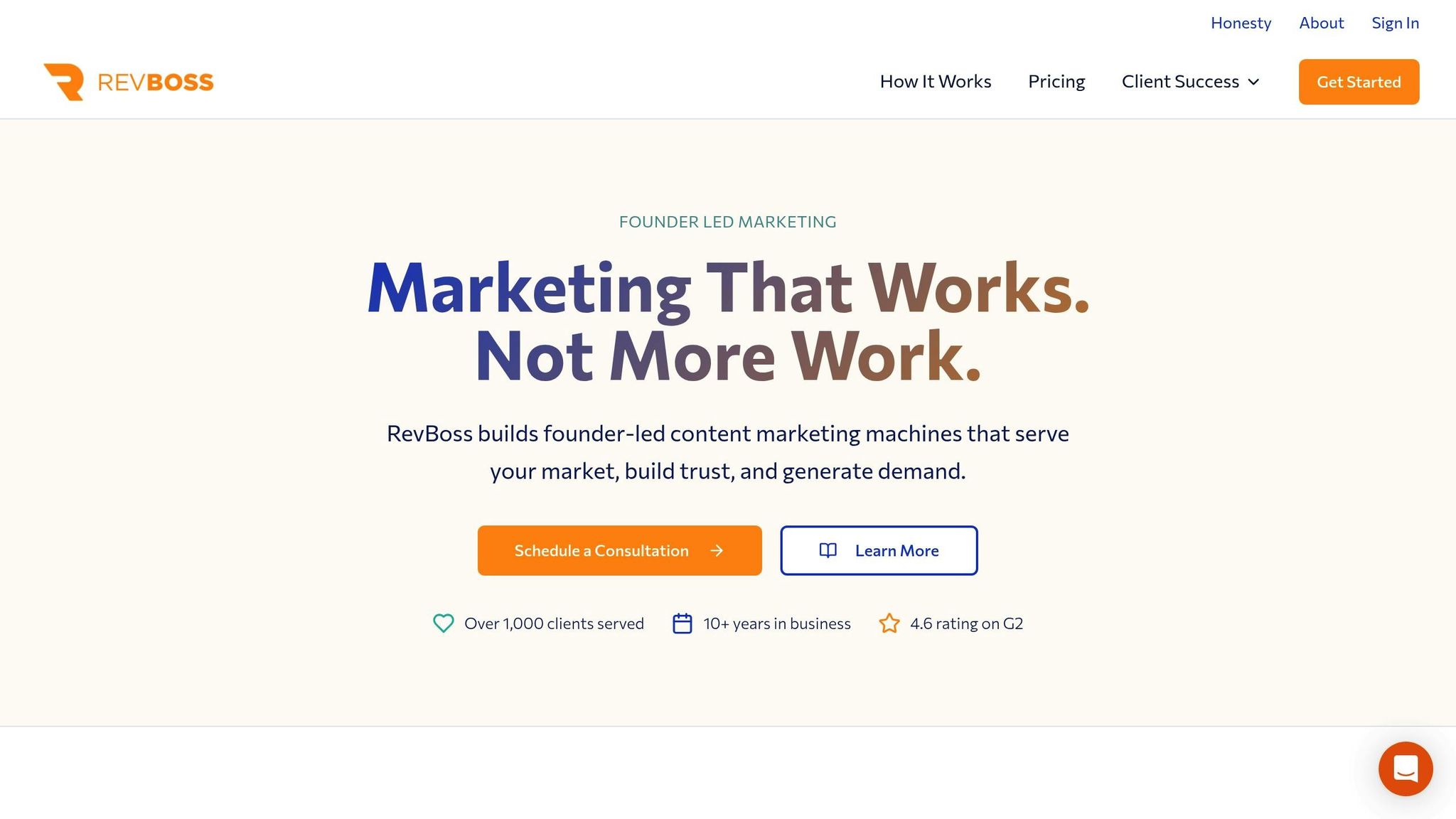
RevBoss is all about helping founder-led B2B businesses grow by amplifying the unique insights and perspectives of their founders. One of the biggest challenges founders face is keeping their marketing efforts personal and relatable as their businesses scale. RevBoss tackles this head-on.
Their "Audience-First Growth Machine" framework breaks marketing into three parts: Content, Audience, and Activation. This approach ensures that founder insights aren't just used to create content - they help build trust, connect with the market, and drive measurable demand.
What sets RevBoss apart is its focus on weaving the founder's unique personality and expertise into marketing. By doing so, it helps create meaningful connections through storytelling and thought leadership, all while laying the groundwork for expanding reach in a structured, scalable way.
RevBoss Features for Founder-Led Growth
RevBoss starts with the founder at the center of its content creation process. Through monthly one-hour interview sessions, it captures video content, transcripts, and raw ideas directly from the founder. This preserves their authentic voice and ensures that the content feels genuine.
From there, RevBoss blends human expertise with AI to transform the raw material into various content formats. These include:
- LinkedIn campaigns that highlight founder insights and expertise.
- Email outreach sequences that feel personal and tailored, not robotic.
- SEO-driven content that reflects the founder's unique take on industry topics.
When it comes to growing the audience, RevBoss focuses on building genuine relationships. Customized LinkedIn growth campaigns help attract prospects who align with the founder's vision, turning expanded reach into meaningful interactions.
The final step is Activation, where engagement is converted into business opportunities. By keeping the founder's voice consistent throughout the process, these campaigns create authentic connections that align with the overall marketing strategy.
Beyond content creation and audience development, RevBoss also handles scheduling, engagement tracking, and performance metrics. All of this is done while ensuring the founder's voice remains front and center.
Comparing RevBoss Plans for Different Growth Stages
RevBoss offers flexible plans tailored to businesses at various stages of growth and commitment levels. Here's a breakdown:
| Plan | Monthly Cost | Duration | Key Features | Best For |
|---|---|---|---|---|
| Standard | $2,500 | Month-to-month | Custom content strategy, LinkedIn campaigns, email outreach, SEO content, activation workflows | Established businesses ready for consistent founder-led marketing |
| Pilot Program | Custom pricing | Short-term trial | Core Standard features with limited duration | Companies wanting to test the approach before full commitment |
| Annual Plan | Discounted rate | 12-month commitment | All Standard features with cost savings | Businesses committed to long-term founder-led growth strategy |
The Standard Plan costs $2,500 per month and includes the full range of RevBoss services. Pricing may vary depending on specific content needs and media budgets, but this plan is ideal for businesses that have already validated their founder-led marketing approach and are ready to scale.
The Pilot Program is a short-term option with custom pricing. It’s perfect for businesses that want to try out the RevBoss system before committing to a longer-term plan. This trial period allows founders to see how their insights can drive tangible results.
For businesses ready to go all-in, the Annual Plan offers cost savings with a 12-month commitment. It’s designed for companies that have seen early success with founder-led strategies and are looking to scale systematically over time.
Each plan includes a detailed onboarding process, helping founders move from sporadic content creation to a structured, scalable marketing operation. With these options, RevBoss ensures that businesses can choose a plan that aligns with their growth goals and readiness to invest in founder-led marketing.
Balancing Personal Touch and Scale
Scaling founder-led marketing is all about keeping that personal connection alive while creating systems that can grow with your business. As your audience evolves, so should your approach. Companies that keep their founders actively involved in sales and marketing see 30% profit growth, compared to just 6.7% for those that don’t. The key is to focus on high-impact activities, build feedback loops, and refine your processes. This way, you can maintain a personal touch while ensuring your marketing efforts are scalable and effective.
Setting Limits for Founder Involvement
Founders can't - and shouldn't - do everything. To make the most of your time, focus on activities that have the greatest impact. For example, dedicate your energy to strategic tasks like monthly content planning, quarterly message reviews, or direct conversations with key prospects and customers.
For routine tasks, like writing LinkedIn posts, email sequences, or blog articles, use pre-approved templates to ensure your voice is consistent without requiring your constant input. Decision trees can also help define when your approval is necessary, such as for sensitive topics or major announcements. This approach allows you to stay involved in meaningful ways while freeing up time for other priorities.
Using Feedback Loops for Continuous Improvement
Customer feedback is a goldmine for improving your strategy. Businesses that prioritize feedback grow 41% faster, and those that follow up on feedback see three times more customer promoters. By systematically gathering insights from customer interactions, social media, email responses, and sales conversations, you can embed real-world input into your marketing.
Analyze recurring themes in the feedback to refine your messaging. For instance, if customers frequently praise your ability to simplify complex topics, use that insight to shape future content. Similarly, if prospects keep asking the same questions, make those topics more visible in your materials.
Be sure to act on the feedback and communicate those changes. When customers see that their input leads to action, they’re 21% more likely to participate in future surveys. Monthly feedback review sessions can help you track engagement metrics, customer responses, and internal observations, ensuring your marketing stays aligned with real customer needs.
Feedback loops also reinforce the market insights that made your founder-led approach effective in the first place. With 91% of people believing innovation should come from customer reviews and suggestions, these insights are critical for keeping your messaging relevant.
Staying Relevant to Your Target Audience
Markets shift, and customer needs evolve. What worked six months ago may no longer resonate today. That’s why it’s crucial to regularly assess and update your messaging. Quarterly message audits can help you determine if your content still addresses current customer pain points. Reviewing your most successful content can also highlight changes in language or priorities that signal broader market trends.
While it’s important to monitor industry conversations, your focus should remain on addressing the topics that matter most to your audience. If engagement metrics show that certain themes are losing traction, adjust your strategy to reflect what your customers care about now. With 80% of customers willing to leave after a single bad experience, staying in tune with their needs is essential for retention.
Keep your customer personas and messaging frameworks up to date to reflect these shifts. By doing so, you ensure that your founder’s voice continues to address the evolving challenges and priorities of your audience.
The goal is to preserve the personal insights and authenticity that only a founder can bring, while building a marketing system that can grow with your company. These practices transform individual contributions into a scalable, sustainable marketing engine.
Conclusion: Converting Founder Knowledge Into a Growth Engine
As we've explored, turning founder insights into a structured system can shift your marketing from ordinary to extraordinary. These insights aren't just stories or experiences - they're your edge, the unique perspective that can transform your messaging into a powerful engine for growth, trust, and loyalty.
The real magic happens when founder knowledge isn't treated as a one-off blog post or a casual LinkedIn update. Instead, it becomes the backbone of your marketing strategy. By documenting your expertise, crafting reusable templates, and building processes around your unique viewpoint, you create something more impactful than traditional campaigns - you amplify trust and credibility.
Using structured workflows and templates proves that being authentic and scalable can go hand in hand. When you systematize what makes you stand out, you don't lose your authenticity. Instead, you expand your influence, ensuring your voice cuts through the sea of generic messaging that so many B2B buyers tune out.
Companies that thrive with this approach share one key mindset: they see founder knowledge as a strategic asset. By embedding this asset into repeatable systems, they elevate their marketing efforts. They invest in the right tools - whether that’s content platforms, team training, or services designed to scale a founder's authentic voice - and use them to reach broader audiences without losing their unique touch.
Your insights have already played a crucial role in building your business. Now, it's time to let them drive its growth. The framework is ready, the tools are at your disposal, and the market is waiting for your perspective. The only question left is: Are you ready to take the next step?
FAQs
How does founder-led marketing help lower customer acquisition costs for B2B companies?
Founder-led marketing offers B2B companies a way to cut customer acquisition costs (CAC) by tapping into the founder's authentic voice and personal connections. When founders step into the marketing spotlight - whether through storytelling, thought leadership, or direct engagement - they naturally build trust and credibility. This approach often leads to more organic leads and word-of-mouth referrals.
By prioritizing genuine, value-focused communication, founders can move away from heavy reliance on costly paid ads and other expensive acquisition strategies. Their hands-on involvement in crafting tailored content or joining industry discussions not only strengthens relationships but also fosters long-term customer loyalty, ultimately keeping acquisition costs in check.
How can founders turn their unique insights into scalable marketing strategies?
Founders have a unique opportunity to turn their personal experiences and strategies into marketing approaches that can grow with their company. By creating detailed playbooks, they can outline proven methods and transform them into repeatable processes that teams can easily follow and apply.
Another key step is building a centralized knowledge hub. This ensures that the founder's insights are always within reach and continue to shape marketing efforts as the business scales. This method not only preserves the brand's genuine voice but also ensures campaigns stay true to the company's vision and connect with the audience. Incorporating data-backed strategies alongside these insights can further strengthen their impact and support sustainable growth.
How does RevBoss help maintain a founder's unique voice while growing their marketing strategy?
RevBoss places a founder’s personal voice at the heart of their marketing efforts, seamlessly integrating their values, vision, and unique storytelling into the brand’s messaging. This strategy not only strengthens trust but also enhances credibility, particularly in the B2B space, by ensuring that communication feels genuine and stays true to the founder’s identity.
To maintain this authenticity while scaling, RevBoss develops clear, repeatable guidelines that safeguard the founder’s voice as the business expands. These frameworks ensure messaging remains consistent across all platforms, using approaches like founder-led storytelling and open communication to build strong connections with the target audience.