How to Build an “ICP-Rich” LinkedIn Audience (Without Spam or Virality Chasing)

Building a LinkedIn audience packed with potential buyers (not just random connections) isn’t about chasing likes or spamming inboxes. It’s about focusing on your Ideal Customer Profile (ICP) - the companies and decision-makers most likely to buy from you. Here’s the game plan:
- Define your ICP: Identify your best-fit customers by analyzing traits like industry, company size, revenue, tech stack, and buying triggers. Create a clear framework to guide your targeting.
- Target connections carefully: Use LinkedIn’s advanced search filters to find ICP-aligned profiles. Prioritize quality over quantity - focus on decision-makers and buying committees.
- Personalize connection requests: Skip the generic invites. Mention shared interests or posts to boost acceptance rates (aim for 45% or higher).
- Engage meaningfully: Comment on posts, like updates, and start conversations. Small, consistent actions build trust over time.
- Create content for your ICP: Share posts that educate, solve problems, or tell relatable stories. Stick to 2–4 posts per week for maximum impact.
- Turn engagement into leads: Monitor profile views, comments, and other buying signals. Follow up with tailored messages or offers that make it easy to take the next step.
This strategy is about doing less but doing it better. No spam. No gimmicks. Just real connections that drive real results.
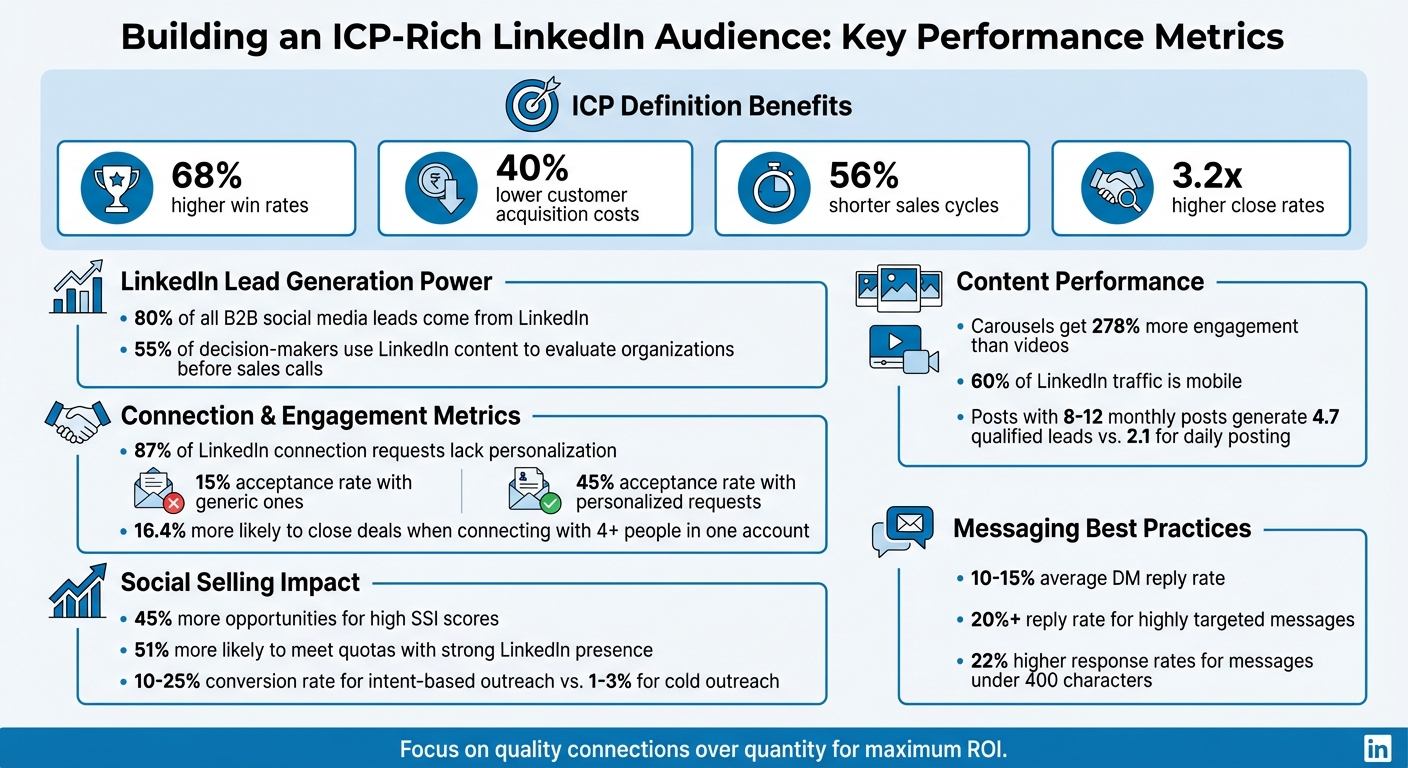
LinkedIn ICP Targeting: Key Statistics and Performance Metrics
How to turn your LinkedIn profile into an inbound & outbound lead engine
sbb-itb-9354cf2
Define Your ICP Before You Start Building
Before diving into building your network, take a step back and define your Ideal Customer Profile (ICP). Think of your ICP as the blueprint for identifying the companies that are the perfect fit for your product or service. This isn’t about reaching out to everyone - it’s about laser-focused targeting that turns LinkedIn into a lead-generating powerhouse.
Why does this matter? A well-defined ICP can lead to some serious wins: up to 68% higher win rates, 40% lower customer acquisition costs, 56% shorter sales cycles, and close rates that are 3.2x higher. The logic is straightforward: when you focus on the right companies from the start, you save time, energy, and resources by avoiding mismatched prospects.
"The companies that dominate their markets aren't the ones who talk to everyone. They're the ones who know exactly who to talk to, and more importantly, who to ignore."
LinkedUpSales
Start by analyzing your top 20–30 customers - the ones that bring in the most value, close deals quickly, and stick around long-term. Look for commonalities in areas like company size, industry, revenue, tech stack, and growth stage. Dig deeper into what triggered their buying decision: Was it a leadership change? A recent funding round? Or maybe a shift in market dynamics? Also, don’t ignore the red flags - things like limited budgets or incompatible technology stacks that signal a bad fit.
Identify Key Company and Role Characteristics
Your ICP should include specific attributes that help you zero in on the right targets. Focus on these five areas:
- Firmographics: Details like industry, company size, revenue, and location.
- Technographics: The tools and software the company uses (e.g., CRM platforms, marketing automation).
- Buying Triggers: Key events, such as a new VP hire, funding announcements, or rapid team expansions.
- Decision-Making Structure: On average, B2B software purchases involve five decision-makers.
- Environmental Factors: Things like regulatory changes, market trends, or recent mergers and acquisitions.
Here’s an example: CastorDoc realized they were wasting time on companies transitioning from on-premise systems to the cloud. By narrowing their focus to businesses already using a "modern data stack", they slashed their target list from 36,000 to 3,000 highly qualified prospects. Similarly, Owner.com skyrocketed from $3 million to $21 million in annual recurring revenue in just 22 months by refining their ICP and saying no to accounts that didn’t align.
To keep things manageable, tier your audience:
- 70% of your effort goes to Tier A accounts (perfect matches).
- 25% to Tier B (good fits).
- 5% to Tier C (experimental opportunities).
This way, you’re always prioritizing the accounts with the biggest potential impact.
Document Your ICP Criteria in a Targeting Framework
Once you’ve nailed down your ICP, turn it into a targeting framework. This document will guide your list-building, messaging, and lead evaluation efforts. Keep it simple by organizing it into these key categories:
- Firmographics: Size, industry, and location.
- Technographics: Tools and platforms they use.
- Triggers/Pain Points: Events or challenges that make them likely to buy.
- Goals/Motivations: What they’re looking to achieve in the next 6–12 months.
Don’t skip the disqualification criteria. Outline the traits that make a company a poor fit, even if they check some of the right boxes. This could include things like an outdated tech stack, overly complex procurement processes, or insufficient budgets.
"Skipping the disqualification criteria step of developing an ICP can be very costly."
Andrei Zinkevich, FullFunnel.io
Validate your framework using the 5W Technique: Who is the ideal customer? What do they buy? Why do they buy? Where are they located? When do they buy? To refine it further, interview at least 10 of your best customers to uncover the motivations behind their decisions. These insights will sharpen your targeting and messaging.
"The tighter the ICP, the higher your reply rates, close rates, and overall pipeline quality."
Cleverly
Finally, revisit your framework every 90 days. Markets change, products evolve, and new buying signals emerge. Treat your ICP as a living document. By keeping it updated, you’ll build a LinkedIn audience that’s not just large, but filled with high-potential prospects. With this framework in hand, you’re ready to take on LinkedIn with purpose.
Grow Your Network with Targeted Connection Strategies
Once you've nailed down your Ideal Customer Profile (ICP), it's time to focus on connecting with the right people on LinkedIn. This isn't a numbers game about amassing endless connections. Instead, it’s about building a network packed with prospects who align with your ICP and can add genuine value. LinkedIn generates 80% of all B2B social media leads, but only if you approach connections thoughtfully.
The process is simple: identify profiles that match your ICP, send personalized connection requests that feel human, and manage your outreach pace to avoid triggering LinkedIn's restrictions. Done right, this strategy builds a pipeline-friendly network while safeguarding your account. To start, use LinkedIn's advanced filters to find and organize ICP-aligned contacts.
Find and Segment ICP Contacts on LinkedIn
LinkedIn’s advanced search filters are your best friend when hunting for prospects that fit your ICP. You can refine your search by job title, seniority, company size, industry, and even growth indicators like years in a role or company expansion. If you’re targeting tech startups, try using Boolean logic to search for terms like ".io" or ".ai" in company names - this can help you pinpoint early-stage businesses. Beyond demographics, look for intent signals like recent posts, news mentions, or job changes, which indicate higher responsiveness. Sales Navigator’s "Spotlights" feature is especially useful for this.
"Your LinkedIn personal brand, your visibility, and your inbound leads are all a direct reflection of your network."
Indrek Põldvee, Founder, B2B Growth
Geography is another critical factor. Narrow your focus to 1–2 countries where you already have strong references or customers. Once you've identified ICP-aligned profiles, check LinkedIn’s "People Also Viewed" section to uncover similar prospects and companies.
Here’s a key insight: Sales Navigator users who connect with at least four people within a single account are 16.4% more likely to close a deal. Instead of targeting just one decision-maker, map out the entire buying committee. This could include the economic buyer (CEO/CFO), functional leaders (like Heads of Sales or Marketing), and frontline advocates who can champion your solution internally.
Lastly, audit your existing connections and sort them into categories like Tier 1 ICP, Tier 2 ICP, or Partners/Referrers. This makes prioritizing engagement much easier.
Write Personalized Connection Requests
Did you know 87% of LinkedIn connection requests are sent without a personalized message? That’s a huge missed opportunity. Personalized requests can boost acceptance rates to 45%, compared to just 15% for generic ones.
The catch? LinkedIn limits free accounts to 200 characters for connection requests (300 for Premium), so every word matters. Use a simple structure:
- Hook: Grab attention in about 50 characters.
- Context: Add relevance in 100 characters.
- Value: Highlight what they gain in another 100 characters.
- Soft CTA: Wrap up with a polite call to action in 50 characters.
Here’s an example:
"Noticed your post on sales automation and loved your insights on reducing manual effort. I help teams cut follow-up time by 40%. Would love to connect and exchange ideas."
Before reaching out, find shared connections, mutual groups, or even a post you’ve both engaged with. These small details build rapport and make your message feel genuine. Avoid overused lines like "Your name popped up" or "I’d like to add you to my network"; they come across as lazy and impersonal.
"Personalized LinkedIn outreach isn't a luxury anymore; it's the key to unlocking meaningful B2B relationships and accelerating your sales pipeline."
Premanand Arumugam, B2B Content Strategist, eGrabber
Timing also plays a role. Mid-week mornings (Tuesday–Thursday, 9–11 AM local time) are prime time for LinkedIn activity. For an extra edge, engage with a prospect’s content before sending a request - a thoughtful comment can make your name familiar and boost your chances of acceptance.
Be clear and respectful in your approach. If you’re reaching out with a specific solution in mind, mention it without pushing a hard pitch. A soft ask like, "Would you be open to connecting?" keeps the tone professional and approachable.
Pace Your Connection Requests to Stay Within Platform Limits
Even with personalized messaging, the pace of your outreach matters. LinkedIn monitors metrics like acceptance rates and pending requests to gauge account health. Sending too many requests too quickly can flag you as spam. Start slow and build trust with the platform.
Free accounts are typically capped at around 100 connection requests per week, while Premium or Sales Navigator users can manage 150–200 requests. However, even at maximum capacity, avoid sending more than 40 requests per day.
Here’s a suggested warm-up schedule:
- Weeks 1–2: Start with 5 requests per day, targeting "warm" contacts like those familiar with your brand.
- Week 3: Increase to 10–15 requests daily.
- Week 4: Scale to 15–20 requests per day, with a mix of 60% warm and 40% cold prospects.
| Warm-Up Phase | Target Audience | Daily Volume | Target Acceptance Rate |
|---|---|---|---|
| Week 1–2 | Warm (Customers, Referrals) | 5 | 75%+ |
| Week 3 | Warm + 2nd Degree | 10–15 | 70%+ |
| Week 4 | 60% Warm / 40% Cold | 15–20 | 60%+ |
| Week 5+ | ICP-Targeted Cold | 20–30 | >20% |
Monitor your acceptance rates regularly and adjust your targeting if rates dip below 20%. Withdraw ignored or pending requests to keep your account healthy. If you’re using automation tools, make sure they mimic human behavior by randomizing actions and sticking to local business hours. For a more personal touch, spend 30–60 minutes daily manually engaging with profiles and sending requests.
"The best performers know that account health comes first, volume comes second."
Botdog
Finally, always reserve a few connection slots for ad-hoc opportunities from events or meetings. By combining targeted outreach, personalized messaging, and a steady pace, you’ll grow a LinkedIn network that consistently supports your sales goals.
Turn Connections Into an Engaged Audience
Accepting a connection request is just the start. The real challenge lies in transforming those connections into an audience that not only knows you but also trusts your expertise and remembers you when they need your services. This isn’t about bombarding people with messages - it’s about showing up consistently with small, meaningful actions that build recognition and trust over time.
LinkedIn actively encourages this approach. Those with higher Social Selling Index (SSI) scores generate 45% more opportunities and are 51% more likely to meet their quotas. Think of LinkedIn as a professional networking event - not a platform for cold pitches. Build relationships first, and the sales will follow naturally.
Use Simple Engagement Actions to Build Familiarity
Sometimes, small gestures make the biggest impact. Actions like liking posts, leaving thoughtful comments, or sharing content tap into the mere-exposure effect. This psychological principle suggests that people grow more comfortable with things they see repeatedly. By consistently engaging in someone’s feed with authentic interactions, you become a familiar and trusted presence.
"Trust isn't built through one big gesture. It's built through repeated small gestures. When you show up in someone's feed week after week with thoughtful micro-interactions, you become a known entity."
Kolin Simon, Sales & Marketing Expert
The data backs this up. High-quality, consistent commenting can significantly increase profile views, engagement, and follower growth. For instance, every comment you leave boosts a post’s reach by 5% within the author’s network and 2.8% within yours.
Here’s a simple 15-minute daily routine to get started:
- Spend 5 minutes commenting on 3–5 posts from your ideal clients or prospects (ICP).
- Dedicate 5 minutes to reacting to 10–15 posts in your network.
- Use the final 5 minutes to send 1–2 quick direct messages to recent engagers.
Timing can make a difference, too. Engaging with a post within the first hour of it being published maximizes visibility for both you and the author.
Avoid generic comments like "Great post!" or "I agree!" Instead, try the "Context-Insight-Question" method:
- Context: Explain why you’re commenting.
- Insight: Add value with your expertise or experience.
- Question: Keep the conversation going with a thoughtful query.
For example: "We faced a similar challenge with lead qualification last quarter. Switching to a scoring model streamlined our process. Have you tried any scoring frameworks yet?"
"Commenting on LinkedIn is the most hated and the most underrated strategy of all time. But it's also the best. Treat your comments as mini-posts. You want to educate in 90% of them."
Jasmin Alić, Co-founder of Linkbound.io
When sharing someone’s post, always include your own analysis or actionable takeaway. This not only supports your connection but also positions you as an expert. Don’t overlook "silent" users either - those who view your profile or follow you without engaging. These individuals are often warm leads, and reaching out to them can transform passive interest into active conversations.
Once you’ve established a habit of micro-engagement, shift your focus to starting direct conversations.
Start Conversations Through Direct Messages
After building familiarity through engagement, it’s time to move to direct messages (DMs). But don’t rush into pitching right after someone accepts your connection request. That "pitch-slap" approach not only lowers reply rates but also harms your credibility.
Instead, treat LinkedIn DMs like conversations at a networking event. Start by building a relationship rather than pushing for a sale. The average DM reply rate is 10–15%, but highly targeted messages can achieve rates above 20%. Keep your messages short - under 400 characters - since shorter messages see about 22% higher response rates.
A good format to use is "Context-Insight-Soft CTA":
- Context: Reference something relevant, like a recent post or shared experience.
- Insight: Offer value, such as a tip or resource.
- Soft CTA: End with a low-pressure call-to-action.
For example: "Saw your post on reducing sales cycle time - we’ve been testing a similar approach with our team. Automating follow-up sequences has streamlined our process. Would it be helpful if I sent over the playbook we used?"
"LinkedIn isn't an email inbox. It's a social platform, and people expect something real, more authentic."
Chooseflow.ai
Messages between 80 and 120 words are ideal for mobile readability. Replace hard asks like "Can we schedule a meeting?" with softer CTAs like "Would it be helpful if I sent over a resource?" or "Worth a quick idea?". These low-pressure options make it easier for people to engage without feeling overwhelmed.
Timing is key. Focus on "warm" prospects - those who’ve viewed your profile, followed you, or interacted with your posts. If someone doesn’t respond, space out your follow-ups by 3–5 business days and stop after 2–3 attempts if there’s no engagement.
"LinkedIn is a trust platform. Treat it like a conversation, not a campaign."
Bill Rice, Founder and CEO, Bill Rice Strategy
Once conversations are rolling, keep an eye out for signs that indicate a potential buyer.
Monitor Engagement Activity for Buying Signals
Not all prospects will interact openly, but their actions - like viewing your profile or engaging with your posts - can signal interest. These subtle cues are essential for identifying high-intent leads.
Outreach based on intent converts at rates between 10–25%, far outperforming cold outreach, which converts at just 1–3%. Combining profile visits with messages nearly doubles reply rates, achieving an 11.87% response rate compared to message-only approaches. Look for cumulative intent signals, like someone who comments on a post, views your profile, and attends a webinar. These leads are 10x more likely to convert than cold connections.
Focus on prospects with repeated engagement. For example:
- Multiple likes or comments.
- Repeated profile views.
Here’s a quick guide for prioritizing follow-ups:
| Signal Level | Action/Behavior | Recommended Follow-up Priority |
|---|---|---|
| High Intent | Commenting with questions, profile view after engagement | Immediate (Same day) |
| Medium Intent | Liking multiple posts, viewing profile (cold) | Within 24–48 hours |
| Low Intent | New follower, single post like | Nurture via content engagement |
Regularly check the "Who’s Viewed Your Profile" section to spot decision-makers matching your ICP. Reaching out to these visitors can yield reply rates as high as 20–30% due to their existing interest. However, avoid directly mentioning that you’ve noticed their activity - phrases like "I saw you viewed my profile" can come across as intrusive.
"Most people don't interact with your posts, but they're watching. When they need what you offer, you're top of mind."
Maximilian Flietman, Founder, Magier
Track your efforts over 90 days to establish patterns. Monitor how many conversations you start and how many lead to meetings. This helps refine your strategy, ensuring your time is spent on activities that bring real results. By focusing on genuine engagement and intent signals, you’ll build stronger connections that convert into opportunities.
Create Content Your ICP Actually Wants to Read
Creating connections is one thing, but keeping your audience engaged and turning those connections into action? That’s where tailored content comes in. It’s not about chasing viral moments or piling up likes. Instead, it’s about crafting posts that make your Ideal Customer Profile (ICP) pause, think, “This person gets it,” and remember you when they need solutions.
LinkedIn, despite its massive user base, still has a gap when it comes to high-quality B2B content. This shortfall makes it easier to stand out with well-thought-out posts. But keep in mind, LinkedIn’s March 2026 algorithm update now prioritizes meaningful engagement over clickbait tactics. Posts that hold attention and spark genuine interaction are the ones that win.
"The platform now rewards expertise, authenticity, and genuine engagement over growth hacks and engagement pods."
– Shanjai Raj, Founder, Postking
To succeed, your content strategy needs balance. Focus on these four pillars: Industry Expertise (think trends and analysis), Personal Experience (share lessons learned and even mistakes), Practical Value (like frameworks or templates), and Thought Leadership (unique opinions and predictions). A good rule of thumb? Follow the 60-30-10 approach: 60% educational content, 30% personal stories to humanize your brand, and 10% promotional material. This mix not only grabs attention but also builds trust and strengthens relationships.
Mix Different Content Types to Maintain Interest
To keep your audience engaged, try the 3-1-2 framework:
- Three educational posts (how-to guides, industry insights).
- One piece of social proof (case studies, testimonials).
- Two engagement posts (polls, open-ended questions).
Educational posts establish your credibility. For instance, Neal O'Grady from Demand Curve garnered nearly 550,000 views on a single post by sharing a sharp insight into B2B marketing strategies, despite having just 7,000 followers. Personal stories, on the other hand, build trust. Taylor Offer grew his following from zero to 50,000 in just nine months by blending industry knowledge with candid reflections on his own challenges.
Social proof, like testimonials or success stories, nudges prospects closer to making a decision. Olto, a live demo platform, leverages short customer videos to highlight real-world results, including success stories from companies like Birdeye.
"Success on LinkedIn isn't about posting more or sticking to rigid rules - it's about spotting what everyone in your niche is doing and deliberately heading in the opposite direction."
– WoopSocial Blog
Staying focused is key. Avoid scattering your content across unrelated topics, as LinkedIn’s algorithm now tracks your posting patterns to define your expertise.
Post Consistently, Not Constantly
You don’t need to bombard your audience to stay relevant. Posting 2–4 high-quality posts per week is enough to maintain visibility without overwhelming your followers. A study of 247 B2B company pages found that posting 8–12 times monthly generated an average of 4.7 qualified leads, while daily posting (20–30 times monthly) resulted in just 2.1 leads. Timing also matters - pages with consistent posting schedules see 6.1% engagement rates compared to 4.2% for random timing.
"Consistency beats intensity. Better to post 8X/month for 24 months than 20X/month for 6 months and then quit."
– Junaid Khalid, Founder of LiGo
To stay consistent without burning out, consider batching your content creation. Hailley Griffis from Buffer grew her LinkedIn audience by 26% in 2025 by dedicating specific time blocks to draft and schedule posts in advance. Another effective approach is the 4R Repurposing Framework:
- Reframe: Explore a different angle.
- Re-angle: Offer a fresh perspective.
- Repackage: Change the format (e.g., turn a blog into a carousel).
- Resurface: Update with new data or insights.
A steady rhythm paired with varied content keeps your audience engaged and coming back for more.
Choose Content Formats That Work for B2B
Some formats just work better on LinkedIn. For instance:
- Carousels (native document posts) are ideal for breaking down complex ideas. They get 278% more engagement than videos and 596% more than plain text posts.
- Short-form videos (under two minutes) are LinkedIn’s fastest-growing format, with a 36% annual growth rate. Showing your face or brand in the first four seconds can boost engagement by 69%.
- Text posts are still effective, especially since 60% of LinkedIn traffic comes from mobile users. Keep sentences short, use white space, and hook readers in the first 2–3 lines to encourage clicks on "see more".
When sharing links, avoid putting them directly in your post. LinkedIn’s algorithm tends to penalize posts with external links. Instead, place them in the first comment or use LinkedIn’s native lead-generation forms.
Timing matters, too. The first 60 minutes after posting - often called the "golden hour" - are critical, as the algorithm evaluates your post’s value based on early engagement. Responding quickly to comments during this window can significantly boost visibility.
Charlie Hunt, co-founder of The Lime, embraced a structured engagement strategy in late 2025. He spent 15–60 minutes daily, 3–5 days a week, commenting on others’ posts and replying to comments on his own. Over 90 days, this effort led to a 305% increase in impressions and a 483% boost in overall performance. The takeaway? LinkedIn success isn’t just about posting - it’s about actively engaging in the conversations that matter.
Convert Your Engaged Audience Into Sales Opportunities
Having an engaged audience is great, but the real win comes when you turn that interest into meaningful business conversations. The challenge lies in moving from visibility to action in a way that feels natural, not pushy. Let’s dive into some practical ways to turn your LinkedIn connections into real sales opportunities.
Build Email Lists from Your LinkedIn Audience
An email address is like a direct line to your audience, outside of LinkedIn’s platform. But earning that access requires trust - no one wants to feel like they’re being added to a spam list. One effective way to do this is through a Content Upgrade Strategy. Share most of a valuable resource publicly, but save the final piece - like scripts, templates, or checklists - behind an email signup on your website.
Jake Jorgovan, Founder of Lead Cookie, nailed this in 2018 with a guide on LinkedIn lead generation. He gave away most of the process for free but required an email signup to access the detailed scripts and examples. That single guide became a major driver of email subscribers and new clients for his business.
"The goal is to get a simple small 'Yes' that they want to see your resource. That gives you permission to then send it over and increases the chances that they will actually engage."
– Jake Jorgovan, Founder, Lead Cookie
Another option is to turn your LinkedIn profile into a lead magnet. Use the Featured section to pin valuable resources, case studies, or guides, and add a clear call-to-action in your About section that directs visitors to a signup page. You can also create a "focused feed" by bookmarking 20–30 high-priority prospects. Regularly engage with their posts to build familiarity, then transition to direct messages where you can offer a resource in exchange for their email.
Reach Out to Engaged Followers with Personalized Messages
While email lists are great for long-term engagement, personalized messages can fast-track trust and conversions. The best opportunities come from people who’ve already shown interest - profile viewers, post engagers (those who like or comment), and recent followers. These individuals are already paying attention, making them more likely to respond to a thoughtful message.
When reaching out, skip the sales pitch. Instead, follow a "Context → Insight → Soft CTA" framework. Start by referencing why you’re reaching out - maybe a recent post they engaged with or a shared connection. Then, share a relevant insight tied to their role, and close with a low-pressure question. For example: “I saw you’re tackling attribution challenges. We’ve helped similar teams reduce tracking gaps by 40%. Worth a quick chat?” This approach is easy for them to respond to without feeling overwhelmed.
In 2024, a ChooseFlow client named Simon used this strategy to focus on engaged followers and profile viewers. By prioritizing warm signals and sending personalized, conversational messages, he booked 105 sales calls in just six to eight weeks. His secret? Treating LinkedIn like a social platform, not an email inbox, and starting genuine conversations instead of relying on templated pitches.
"LinkedIn isn't an email inbox. It's a social platform, and people expect something real, more authentic."
– ChooseFlow
Keep your initial messages short - about 80–120 words - so they’re easy to read on mobile. And if someone replies with a polite “everything’s fine,” don’t let the conversation fizzle. Acknowledge their success and ask about their next goal to see if you can help them get there faster.
Design Offers That Make It Easy to Say Yes
Once you’ve built trust and engagement, the next step is presenting offers that are easy for your audience to accept. Start small. Instead of pitching a 30-minute discovery call, offer something quick and low-commitment that delivers immediate value. Examples include a 3-minute case study, a 10-minute framework walkthrough, or a tailored industry audit. These smaller asks feel less intimidating and more actionable.
Timing also matters. Trigger-based offers - tied to moments when your audience is most likely to need help - can be especially effective. For instance, if you work with CFOs, offer a resource related to recent regulatory changes. If you target HR leaders, share a framework for managing rapid team growth. Content tied to these decision points is 61% more likely to get comments and twice as likely to be shared.
Another great tactic is the "Value Ping." A few days after someone accepts your connection request, send a quick message offering something helpful with no strings attached. For example: “I saw you’re focused on reducing CAC. We helped a similar company lower theirs with a three-step playbook. Want me to send it over?” This positions you as a problem-solver, not just another salesperson.
| Offer Type | Commitment Level | Best For |
|---|---|---|
| 3‑Minute Case Study | Very Low | Initial outreach/First DM |
| 10‑Minute Framework Walkthrough | Low | Warm leads/Follow‑up 2 |
| Co‑hosted Webinar | Medium | Building authority/Lead capture |
| Specific Industry Audit | High | Qualified prospects/Bottom of funnel |
Finally, make sure your LinkedIn profile and resources act like a "digital storefront." Use your Featured section to showcase case studies, testimonials, and booking links. If you’re using LinkedIn Premium, add a custom button linking directly to your portfolio or booking page. And since 88% of LinkedIn users browse on mobile devices, ensure all your landing pages are mobile-friendly. The easier it is for someone to take the next step, the more likely they’ll do it.
Conclusion
Building an audience on LinkedIn that's packed with your ideal customer profile (ICP) takes a mix of precision, patience, and genuine effort. It’s not about spamming inboxes or chasing viral trends. When you define your ICP with laser focus - considering factors like company size, recent funding rounds, and specific challenges - they stop being just names and start becoming meaningful connections.
LinkedIn stands out as a powerhouse for lead generation, supported by solid metrics. But success here isn’t about treating it like another email marketing tool. Instead, it’s about creating real conversations. Personalized connection requests, engaging authentically with your prospects’ posts, and sharing content that adds real value are what build trust - and trust is what turns followers into customers.
"The goal of your outreach isn't to book a meeting in the first message. It's to start a real conversation. When you shift your mindset from 'selling' to 'helping,' your reply rates will skyrocket."
– Colin Gallagher, Growlancer
This method strengthens your online presence over time. And it’s worth noting that 55% of decision-makers rely on LinkedIn content to evaluate organizations before even agreeing to a sales call. Your activity on the platform - your profile, your posts, and your interactions - acts as a filter, weeding out poor fits while drawing in the right ones. Focus on offering value first, limit your outreach to 10–15 well-targeted requests a day, and craft offers that make it easy for your ICP to take the next step.
FAQs
How do I clearly define my Ideal Customer Profile (ICP) on LinkedIn?
Defining your Ideal Customer Profile (ICP) on LinkedIn starts by digging into your current customer base. Pinpoint the commonalities among your best clients - things like their industry, company size, location, revenue, or the specific problems your product or service addresses. This information helps you craft a clear picture of the type of company or decision-maker that’s most likely to benefit from what you offer.
Once you’ve nailed down your ICP, take advantage of LinkedIn’s advanced search tools or Sales Navigator to track down prospects that fit the profile. Go a step further by building buyer personas that include firmographics (like company size and industry), technographics (the tools or platforms they rely on), and buying triggers (such as recent funding rounds or signs of rapid growth). Keep in mind, your ICP isn’t static - refine it regularly using engagement and sales data to make sure it stays on point.
With a mix of research, data-driven tweaks, and ongoing adjustments, you’ll develop an ICP that not only connects you with the right people but also helps you grow your LinkedIn presence in a meaningful way.
What’s the best way to personalize LinkedIn connection requests?
To make your LinkedIn connection requests stand out, focus on being clear and sincere about your reason for reaching out. Highlight something specific, like a shared interest, a mutual contact, or how their work has inspired you. For instance, you might write, "Hi [Name], I came across your work in [specific area], and it really resonated with me. I’d love to connect and learn more about your perspective."
Keep your message short - under 300 characters works best - and aim to build trust by emphasizing relevance. Timing matters too. Sending requests during peak activity hours, typically Tuesday through Thursday between 8 AM and 2 PM, can increase your chances of getting noticed. A little authenticity and respect can open the door to meaningful conversations.
How can I turn LinkedIn engagement into qualified sales leads?
To turn LinkedIn activity into qualified sales leads, focus on building genuine connections and targeting the right audience. Start by fine-tuning your LinkedIn profile to highlight your expertise and make it appealing to your Ideal Customer Profile (ICP). Think of your profile as your personal landing page - it should grab attention and encourage engagement.
When reaching out to others, make it personal. Explain why you're connecting, and skip the overly salesy pitch. Instead, aim for real conversations. Regularly share useful and relevant content to establish yourself as a go-to expert in your field. Engaging thoughtfully with others - whether through meaningful comments or interactions on their posts - can also help build trust and open the door to conversations.
Don’t forget to track your progress and tweak your approach as you go. By blending authentic engagement with a strategic plan, you can turn LinkedIn into a powerful tool for generating high-quality leads and creating real sales opportunities.