LinkedIn Executive Content Plan

Executives who actively use LinkedIn can drive business growth, attract talent, and build thought leadership. Yet, only a small percentage of users create content, leaving a huge opportunity for leaders to stand out. Here's what you need to know:
- Why It Matters: 82% of B2B buyers engage with thought leaders on LinkedIn, and 78% of deals start with a profile view. Active executives see 48% higher revenue growth and 119% better employee engagement.
- How to Start: Define your personal voice, focus on 2–3 core topics, and post consistently (2–5 times weekly). Authenticity and meaningful interactions are key.
- Content Strategy: Use a mix of formats like short videos, text posts, and carousels. Plan your content with clear goals and track metrics like engagement and follower growth.
- Tools to Save Time: Scheduling tools like Taplio or Buffer can simplify posting, while services like RevBoss offer end-to-end content management.
LinkedIn isn't just a networking tool - it's a platform for driving measurable results. With the right strategy, executives can turn their LinkedIn presence into a powerful business asset.
The Ultimate 90-Day LinkedIn Content Plan
Building Your Executive Personal Brand on LinkedIn
A compelling LinkedIn presence is more than just a polished photo and catchy title - it's about showcasing your expertise in a way that resonates with your audience. Top executives know that personal branding isn't just a buzzword; it's a way to build trust and credibility through meaningful interactions. The first step? Define your executive voice so your LinkedIn activity reflects your unique leadership style.
Defining Your Executive Voice and Position
Before diving into LinkedIn content, take a step back and figure out what sets you apart. What are your core values? What topics truly energize you? What skills do you excel at? These answers form the backbone of your personal brand.
"Your personal brand is the authentic expression of who you are and what you stand for."
Your voice on LinkedIn should reflect the tone, language, and personality that align with your leadership style. Maybe you're a numbers-driven executive who simplifies complex market data, a leader focused on culture and team growth, or a forward-thinking strategist challenging conventional ideas. Whatever your approach, your voice should feel real and consistent.
Consistency is key. From your headline and summary to your posts and comments, every piece of your LinkedIn activity should echo the same values and tone. The goal is to become instantly recognizable - when people come across your content, they should immediately know it's yours.
Position yourself as a thought leader who shapes conversations and influences decisions. Share insights regularly, comment thoughtfully on industry trends, and contribute value to discussions. Companies with active social media engagement are 40% more likely to be seen as competitive and 58% more likely to attract top talent.
Stick to 2–3 core content themes that align with your expertise. Whether it's leadership, market trends, or another area, focus on topics that reflect both your interests and professional strengths.
Why Being Real Matters in LinkedIn Content
Once you've nailed your voice, authenticity becomes the secret ingredient that strengthens your presence. Real, relatable content stands out in a sea of generic posts and helps you connect on a deeper level.
Justin Nassiri, who advises executives on LinkedIn strategies, emphasizes this point:
"Authenticity is the cornerstone of successful engagement on LinkedIn. In a world where generic content abounds, standing out requires a genuine approach. People are increasingly adept at sniffing out inauthenticity, and they crave real, relatable content from the leaders they follow."
Instead of simply announcing achievements or sharing generic advice, dive into the lessons you've learned from challenges. This humanizes your leadership and makes your content stick in people's minds.
Engage actively by asking questions, replying thoughtfully, and interacting with your network. This shows you're not just broadcasting messages - you’re building relationships.
The benefits of being authentic are tangible. Executives who are active on social media are viewed 23% more favorably than those who are absent. Plus, 92% of stakeholders are more likely to trust a company when its senior leaders are visible on platforms like LinkedIn.
Being authentic doesn’t mean sharing every detail of your life - it’s about providing insights rooted in real experiences while staying professional and approachable. If you use AI tools to draft content, make sure to edit and personalize the output so it reflects your voice and perspective.
A consistent and genuine presence keeps your network engaged and informed. Aim for two to five posts a week to stay on their radar without overwhelming them.
Planning Your LinkedIn Content Strategy
Turning random posts into a focused LinkedIn strategy can transform your efforts into a tool that delivers measurable results.
Setting Clear Goals and Objectives
Before you start posting, take a moment to define what success looks like for your LinkedIn presence. Executives should align their LinkedIn goals with broader business objectives to ensure their efforts have purpose and direction. Without clear targets, your content risks being scattered and ineffective.
Some common goals for executives include generating leads, building brand awareness, attracting top talent, expanding professional networks, driving website traffic, and establishing thought leadership. The key is to pick one or two goals that closely align with your business priorities and identify specific metrics to measure progress.
A great way to set actionable goals is by using the SMART framework - specific, measurable, achievable, relevant, and timely. For example, instead of vaguely aiming for "more engagement", set a goal like, "I want to boost my post engagement rate by 25% in the next quarter while generating 50 qualified leads through LinkedIn."
If your focus is on recruiting top talent, track metrics such as the organic reach of job postings, the number of applicants per role, offer acceptance rates, and the source of hires. For thought leadership, monitor follower growth, content shares, media mentions, and any speaking opportunities that arise.
Interestingly, LinkedIn posts from CEOs tend to see engagement rates three times higher than posts from corporate accounts. This aligns with Ronn Torossian, Chairman & Founder of 5WPR, who explains:
"Personal brands outperform corporate messaging by a factor of 10 to 1 on social media platforms."
Set quarterly benchmarks to evaluate your progress and adjust your approach as needed. With clear goals in place, you can structure your content around specific themes and use a content calendar to stay organized.
Creating Content Themes and Calendars
A content calendar removes the guesswork from daily posting and ensures your efforts align with your strategy. It keeps your messaging consistent and focused on achieving your goals.
Start by identifying two or three core content themes that reflect your expertise and resonate with your audience. These themes, often called content pillars, help anchor your messaging and reinforce your executive brand. A content calendar allows you to plan posts in advance, maintain a steady posting rhythm, and ensure your content supports your broader marketing objectives.
Your calendar should include details like post titles, summaries, scheduling, and performance tracking. While it might seem like extra work, these elements ensure every post serves a purpose.
Consistency is key to building trust and growing your audience. Research shows that companies posting more than 20 times per month on LinkedIn see 60% more engagement than those posting less frequently. However, quality always comes first - focus on delivering value rather than simply meeting a posting quota.
Schedule your posts for times when your audience is most active. Studies suggest that mornings from Tuesday to Thursday often yield the best engagement, but LinkedIn analytics can help you pinpoint the best times for your specific audience.
A great example of strategic planning comes from XploreIntellects, a marketing agency that boosted engagement by 45% and reduced content creation time by 30% through a structured approach. They audited their content, defined strong content pillars, created a master calendar with client-specific sub-calendars, batched content weekly, and used AI tools for inspiration.
While planning is essential, leave room in your calendar to respond to timely industry news or trends that align with your expertise.
Picking the Right Content Formats
LinkedIn offers a variety of content formats, including text posts, images, carousels, short videos, external links, and long-form articles. Each format serves a different purpose, so rotating between them can help you engage your audience and diversify your content.
Short-form video is currently LinkedIn's fastest-growing content type. Video viewership increased by 36% in the first quarter of 2025, and executive video posts saw a 23% rise over the past year. Videos are especially impactful, as viewers retain 95% of a message through video compared to just 10% with text.
Text posts are still highly effective for sharing quick insights, asking questions, and sparking discussions. They're perfect for leadership tips, industry observations, and personal anecdotes that don't require visuals.
Interactive content like polls or posts encouraging comments can generate 40% more engagement than standard formats. These posts boost visibility and foster meaningful interactions.
For more in-depth content, LinkedIn articles and newsletters are excellent options. LinkedIn Newsletters, for instance, have grown to over 450 million subscriptions worldwide - three times more than the previous year. Starting a newsletter can help you build a loyal audience.
Document carousels are another engaging format, ideal for breaking down complex topics, sharing frameworks, or presenting data insights. Focus on topics like leadership lessons, industry trends, and personal stories. A good content mix follows the 60-20-20 rule: 60% professional advice and insights, 20% personal experiences, and 20% content that reflects your values and interests.
Pay attention to which formats and topics resonate most with your audience. Often, about 20% of your content will drive 80% of your engagement.
Bill Stathopoulos, CEO of SalesCaptain, sums it up well:
"Every post is either building trust or just filling space. Make it count."
Personal stories are particularly impactful in executive content strategies. People connect more deeply with narratives than with numbers, so don’t hesitate to share the human side of leadership while keeping it professional. By choosing the right formats and focusing on meaningful interactions, you’ll set the stage for impactful and engaging LinkedIn content.
Making Content Creation and Distribution Easier
When it comes to building a professional presence, time is a luxury most executives don’t have. That’s why having streamlined strategies for content creation and distribution is key.
Finding and Creating Great Content
The best content often comes from what you’re already doing - your daily work. Think about your meeting notes, industry insights, team discussions, or even client conversations. These can all be transformed into engaging content.
For example, a keynote speech can be repurposed into LinkedIn posts, newsletter articles, or even short videos. Similarly, client success stories could evolve into case studies, lessons-learned posts, or industry trend observations.
AI tools can help draft outlines and organize your ideas, but your personal insights are what make the content stand out. To keep it manageable, set aside 30–60 minutes each week for planning, creating, and reviewing content. During this time, you could batch tasks like writing multiple posts or recording several short videos.
A quick five-minute daily habit of engaging with industry content can also help you stay visible and spark new ideas. Pay attention to what resonates with your audience - look at the questions or comments your posts receive. These often lead to excellent ideas for future content.
Once you have a solid foundation of content, the right tools and workflows can make the entire process even more efficient.
Tools and Workflows That Save Time
Capturing great content is one thing, but distributing it effectively is another. While LinkedIn’s native scheduling feature is a starting point, it has its limits. It doesn’t support video uploads, polls, or carousels, and lacks bulk scheduling and team collaboration options. For executives with a steady content strategy, third-party tools can be game-changers.
Third-party scheduling tools offer advanced features like AI-driven content creation, bulk scheduling, detailed analytics, and team collaboration. Here’s a quick comparison of some popular options:
| Tool | AI Writing | Bulk Upload | Advanced Analytics | Team Collaboration | Starting Price | Best For |
|---|---|---|---|---|---|---|
| Supergrow | ✅ Yes | ✅ Yes | ✅ Yes | ✅ Yes | $19/month | Personal branding & LinkedIn-first creators |
| Buffer | ❌ No | ✅ Yes | ✅ Yes | ✅ Yes | $6/channel | Cross-platform content scheduling |
| Taplio | ✅ Yes | ✅ Yes | ✅ Yes | ✅ Yes | $39/month | Growth-focused creators & solopreneurs |
| Sprout Social | ❌ No | ✅ Yes | ✅ Enterprise-grade | ✅ Yes | $199/seat | Enterprise social media teams |
To maximize engagement, aim to post during peak hours, typically between 7 a.m. and 4 p.m. on weekdays, but use analytics to fine-tune timing for your specific audience.
Consistency is crucial. Companies posting 20+ times a month see 60% more engagement than those posting less frequently. That doesn’t mean you need to post daily - two to three posts per week or even one strong post weekly can keep your audience engaged and maintain visibility.
For better alignment with your business goals and industry events, plan your themes and topics 4–6 weeks in advance. This approach ensures your content stays relevant while leaving room for spontaneous posts about breaking news or emerging trends.
If these strategies still feel overwhelming, professional support can take your content game to the next level.
How RevBoss Supports Founder-Led Marketing
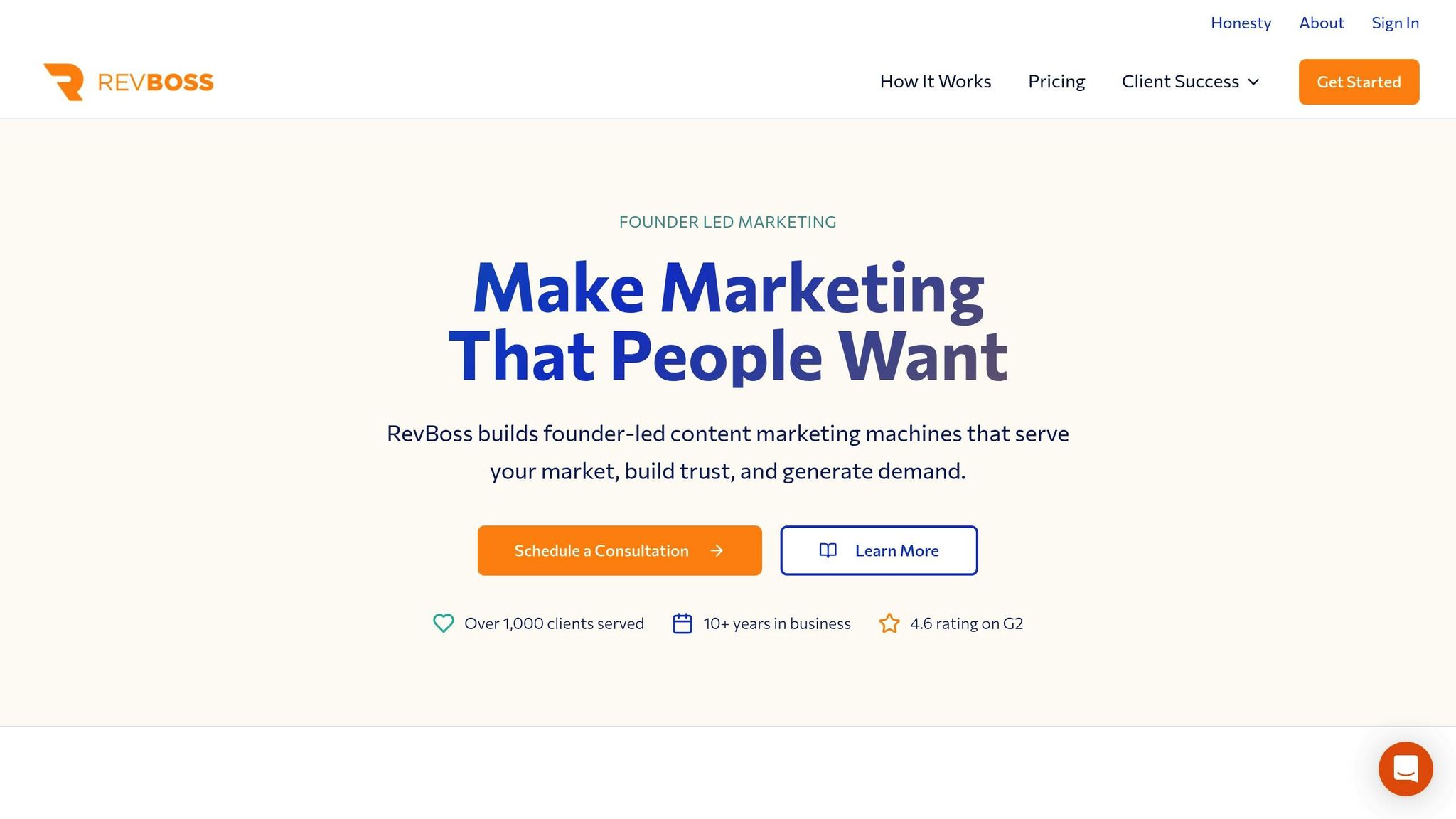
RevBoss understands that personal brands often outperform corporate messaging on platforms like LinkedIn - by as much as 10 to 1. Their services are designed to help executives build a strong, authentic presence while managing the operational side of content creation and distribution.
Their approach starts with custom content strategies tailored to reflect your expertise, industry role, and business goals. Instead of cookie-cutter templates, they focus on what makes your perspective unique.
With in-house content creation, RevBoss handles the research, writing, and production. This ensures every piece feels authentic to your voice while freeing you to focus on strategic priorities.
Their LinkedIn audience growth campaigns are designed to expand your network by connecting with decision-makers, industry peers, and potential clients. This isn’t just about sending connection requests - it’s about building meaningful relationships.
Activation campaigns take things further by turning your personal brand into a lead-generation engine. By combining LinkedIn content with email outreach, SEO strategies, and demand generation workflows, they create a comprehensive system that drives measurable results.
The RevBoss Standard plan starts at $2,500 per month, covering custom content strategy, audience development, and lead activation campaigns. While it’s an investment, the results can be substantial. Companies with socially active CEOs are 40% more likely to attract top talent, 50% more likely to be perceived as desirable workplaces, and report 40% better customer acquisition outcomes. Plus, executives using agencies for social media management often see 50% higher engagement rates compared to those managing everything in-house.
RevBoss takes care of the heavy lifting, allowing you to focus on the insights and experiences that make your content resonate. It’s about amplifying your voice without adding to your workload.
sbb-itb-9354cf2
Measuring Performance and Improving Your Content Strategy
Having a solid content plan is just the beginning. To keep your strategy effective and results-driven, you need to measure its performance and adjust as needed. LinkedIn’s analytics can turn guesswork into actionable insights, helping you refine your approach and maximize impact.
Best Practices for Engagement
Engagement on LinkedIn goes beyond simply posting updates. It’s about creating conversations and fostering genuine connections. The most effective leaders understand that meaningful interactions on the platform are what make the difference.
One key strategy is focusing on LinkedIn-native engagement. As Ibby Hussain, Vice President of Digital & Creative at Vested, puts it:
"Prioritizing content that drives comments and interactions within LinkedIn, rather than linking out, will enhance both follower engagement and performance in LinkedIn's algorithms."
This means creating posts that encourage dialogue - ask thoughtful questions, respond to comments quickly, and keep the conversation going. Such activity signals to LinkedIn’s algorithm that your content is sparking meaningful discussions.
Another powerful tool is employee advocacy. Your team can extend your message’s reach by engaging with your content. Hussain highlights this advantage:
"Employees are your most powerful advocates on LinkedIn, driving both engagement and reach."
When employees share and comment on your posts, it not only amplifies your message but also adds a layer of authenticity to your brand. Tracking their engagement can help you identify the topics that resonate most with your audience.
It’s also important to focus on meaningful growth instead of chasing vanity metrics. Jennifer Heimann, AVP of Marketing Strategy & Operations at L&L Collective, advises:
"Realistic expectations are key! Slow, authentic growth is better than quick growth with people who aren't interested in your content."
Engage thoughtfully by joining relevant LinkedIn Groups, contributing insightful comments, and showcasing your expertise. Targeted interactions often yield more substantial business outcomes than broad but shallow engagement.
By following these engagement practices, you set yourself up to track the metrics that matter most.
Key LinkedIn Metrics to Track
Tracking the right metrics is essential for evaluating your content’s success. For example, LinkedIn calculates engagement rate by combining interactions, clicks, and new followers, then dividing that total by post impressions.
Here are a few performance benchmarks to consider:
- Multi-image posts typically achieve an engagement rate of 6.60%, while native documents and videos see rates of 6.10% and 5.60% respectively. The average engagement rate hovers around 5.00%.
- For video content, aim for a view rate between 30–40%, with top-performing videos hitting 50–60%. To maximize impact, keep videos under two minutes and deliver your key message in the first 5–10 seconds.
Beyond engagement, monitor audience growth and demographics. It’s not just about the number of followers but whether you’re connecting with decision-makers and key players in your industry.
Also, keep an eye on website traffic and conversion metrics. While LinkedIn ads average a 6% conversion rate, well-optimized organic content can also drive substantial traffic. Comparing your performance to competitors - looking at engagement rates, follower growth, and content themes - can help identify opportunities and areas for improvement.
These metrics provide a foundation for refining your content strategy.
Using Analytics to Improve Your Content
Metrics are only valuable if they lead to action. Start by defining clear goals - whether it’s boosting brand awareness, generating leads, or positioning yourself as a thought leader. These objectives will guide which metrics you prioritize.
Use the data to understand your audience better. For example, analyze behavior to determine the best times to post and which topics generate the most interest. Experiment with A/B testing for headlines, formats, and calls to action to see what resonates most.
Track performance trends over time rather than focusing solely on individual posts, as results can vary due to timing or external factors. Sharing insights with your sales team can align your content efforts with business development goals, improving lead qualification and the customer experience.
If certain themes or formats consistently underperform, don’t hesitate to pivot. With LinkedIn’s vast network of over 900 million professionals, even small improvements in engagement can significantly boost your reach.
Best Practices for US-Based Audiences
When crafting LinkedIn content for US professionals, aligning with their preferences and standards is key to boosting engagement. From formatting details to communication style, tailoring your approach can make all the difference.
Formatting Standards for US Audiences
To resonate with US readers, follow these formatting conventions:
- Currency: Place the dollar sign before the amount, using commas for thousands and a period for decimals. For example, write $1,000.50 (not 1,000.50$ or $1.000,50). For larger figures, use formats like $2,500,000 or $2.5 million to improve readability.
- Dates: Use the MM/DD/YYYY format. For instance, write 08/05/2025, not 05/08/2025 or 2025-08-05. When spelling out dates, go with "August 5, 2025", avoiding variations like "5th August 2025."
- Numbers: Commas separate thousands, and periods indicate decimals. For example, write 10,000 employees, not 10.000 or 10 000. Percentages should appear as 15.5%, and decimals as 3.14 (not 3,14).
- Measurement Units: Use imperial units like feet, inches, miles, and pounds. If you include metric measurements, provide US conversions in parentheses, e.g., "5 kilometers (about 3.1 miles)" or "25°C (77°F)."
- Temperature: Always use Fahrenheit. For example, write 72°F or "temperatures reached 95°F" instead of Celsius values.
- Spelling: Stick to American spellings such as "organization" (not "organisation"), "analyze" (not "analyse"), "color" (not "colour"), and "center" (not "centre"). These small details show cultural alignment and attention to detail.
By adhering to these formatting guidelines, your content will feel familiar and professional to US audiences.
Communication Style for US Professionals
US professionals favor content that is clear, direct, and relatable. Here’s how to refine your tone and style for LinkedIn:
- Be Direct: Replace lengthy phrases with concise statements. For instance, say "I recommend" instead of "My recommendation is."
- Use a Conversational Tone: Avoid overly formal or corporate language. A study showed LinkedIn comments increased by 37% year-over-year in January 2025, reflecting a preference for interactive, authentic content. US readers appreciate posts that feel human and approachable.
- Tell Stories: Share personal experiences, challenges, and lessons learned. These narratives resonate more than generic advice and help build a connection with your audience.
- Keep It Short: Shorter posts - around 150 characters for updates with links - perform better. For story-driven posts without links, focus on clarity and avoid unnecessary fluff.
- Balance Expertise and Approachability: Showcase your knowledge while staying relatable. Use inclusive language like "we" and "you" to foster connection, and engage with comments promptly to encourage dialogue.
- Provide Data: US professionals value measurable results. Instead of saying "our strategy worked well," specify outcomes like "our approach increased qualified leads by 40% over six months."
- Stay Culturally Sensitive: Avoid divisive topics unless they’re central to your industry expertise. Highlight team achievements and express gratitude, but steer clear of excessive self-promotion.
With 1.5 million pieces of LinkedIn content being shared every minute, standing out means striking the perfect balance between professionalism and relatability. By focusing on actionable insights, storytelling, and formatting tailored to US standards, your content will be positioned to capture attention and drive engagement.
Key Takeaways for Executives
A well-crafted LinkedIn content strategy can deliver tangible business results. Your personal brand on LinkedIn isn’t just about being seen - it’s about driving leads, attracting top talent, and building thought leadership that directly influences your business outcomes.
Start with the basics. Your LinkedIn profile is the foundation of your personal brand. As Jane Deehan puts it: "The LinkedIn profile page is the foundation for your personal branding". Create a headline that clearly communicates your value, craft an engaging "About" section that tells your professional story, and use high-quality visuals that align with your brand. Once your profile is polished, focus on posting regularly to amplify your message.
Consistency is key. Posting two to three times a week is more effective than striving for perfection. Alternate between leadership insights, industry updates, and personal stories. Personal posts from executives outperform corporate content by a wide margin - engagement rates for CEO posts are three times higher than those from company accounts. Authenticity matters more than overly polished corporate language.
Engage meaningfully. Building quality connections matters more than sheer numbers. Send personalized connection requests, join relevant industry groups, and thoughtfully respond to comments on your posts. Adding five or more skills to your profile can make you nearly three times more likely to receive connection requests. Fine-tuning these details can significantly enhance your networking efforts.
Track your progress. Pay attention to metrics like post impressions, follower growth, profile views, and engagement rates to refine your approach. Use LinkedIn Analytics or third-party tools to understand what resonates with your audience. Companies active on social media are 58% more likely to attract top talent, so taking the time to measure and adjust your strategy pays off.
Don’t hesitate to seek help. Managing a LinkedIn strategy alongside business responsibilities can be overwhelming. If time is a barrier, consider professional support. Services like RevBoss offer founder-focused content marketing programs, including tailored content strategies, audience development, and LinkedIn optimization starting at $2,500 per month. They create 8 to 12 pieces of content monthly while managing profile updates and engagement workflows, all while ensuring your voice stays authentic.
With nearly all B2B marketers using LinkedIn and 80% of B2B leads originating from the platform, having a strong LinkedIn presence is no longer optional - it’s a necessity for today’s executives. Start implementing these strategies, monitor your progress, and watch as your personal brand evolves into a powerful tool for business growth.
Your LinkedIn strategy isn’t just a side project - it’s a critical component of building relationships, generating leads, and establishing yourself as a thought leader in 2025 and beyond.
FAQs
How can executives build a strong personal brand and authentic voice on LinkedIn?
To establish a strong personal brand on LinkedIn, executives should emphasize clarity, consistency, and staying true to themselves. Begin by crafting a clear value proposition that showcases what sets you apart - your expertise and leadership approach. Let this core message shine through in everything you post and every interaction you have, reinforcing your professional identity.
Keep your audience engaged by sharing relatable experiences, career highlights, and insights into your industry. This not only helps you come across as knowledgeable but also makes your content more appealing. It's also key to maintain a unified tone, style, and visual theme across your profile and posts to ensure a seamless and recognizable presence. By being both sincere and intentional, you'll foster meaningful connections with your professional network.
How can executives stay authentic while posting consistently on LinkedIn?
To keep your LinkedIn presence genuine while sticking to a regular posting schedule, focus on sharing content that truly represents your knowledge, values, and perspective. Skip the overly promotional or generic posts - being real is what builds trust and creates meaningful connections.
Try posting 2-3 times a week and mix things up. Share professional tips, personal thoughts, updates on industry trends, or news about your company. This variety not only keeps your audience interested but also highlights the different sides of your expertise.
Don’t just post - engage. Reply thoughtfully to comments, join conversations, and stay true to your voice. Make sure your content reflects both your personal and professional values. A consistent tone and clear messaging go a long way in building a trustworthy and relatable LinkedIn presence.
How can executives track and improve the performance of their LinkedIn content strategy?
To gauge the effectiveness of a LinkedIn content strategy, executives should keep an eye on key performance indicators (KPIs) such as engagement rates (likes, comments, shares), click-through rates (CTR), follower growth, and content reach. These metrics shed light on how well the content connects with the audience and how far it spreads.
Regularly tracking these KPIs can reveal what’s hitting the mark and what needs improvement. For instance, if engagement seems underwhelming, it might be time to tweak your messaging, experiment with different content formats, or adjust your posting schedule. By consistently reviewing performance and fine-tuning your approach, you can build a stronger personal brand, boost audience interaction, and make meaningful progress toward your LinkedIn goals.