Checklist: Marketing When You Don't Have a Marketing Team

Marketing without a team? No problem. Most small business owners spend less than an hour a day on marketing - or skip it entirely because it feels overwhelming. But here's the deal: marketing isn’t optional. It’s how you get customers, build trust, and grow revenue. The good news? You don’t need a big budget or a marketing degree to make it work.
Here’s a quick breakdown of what you need to do:
- Define your audience: Know exactly who you’re targeting and what they care about.
- Set up basic tools: Use a CRM, analytics, and automation to save time.
- Create simple content: Focus on what your customers need to know, and repurpose it across platforms.
- Leverage LinkedIn: Post regularly, engage with your network, and share your expertise.
- Run email campaigns: Segment your list, automate follow-ups, and stay consistent.
- Measure results: Track what’s working and tweak as you go.
Start small. Focus on 2–3 platforms where your customers hang out. Consistency beats complexity every time. Ready? Let’s dive in.
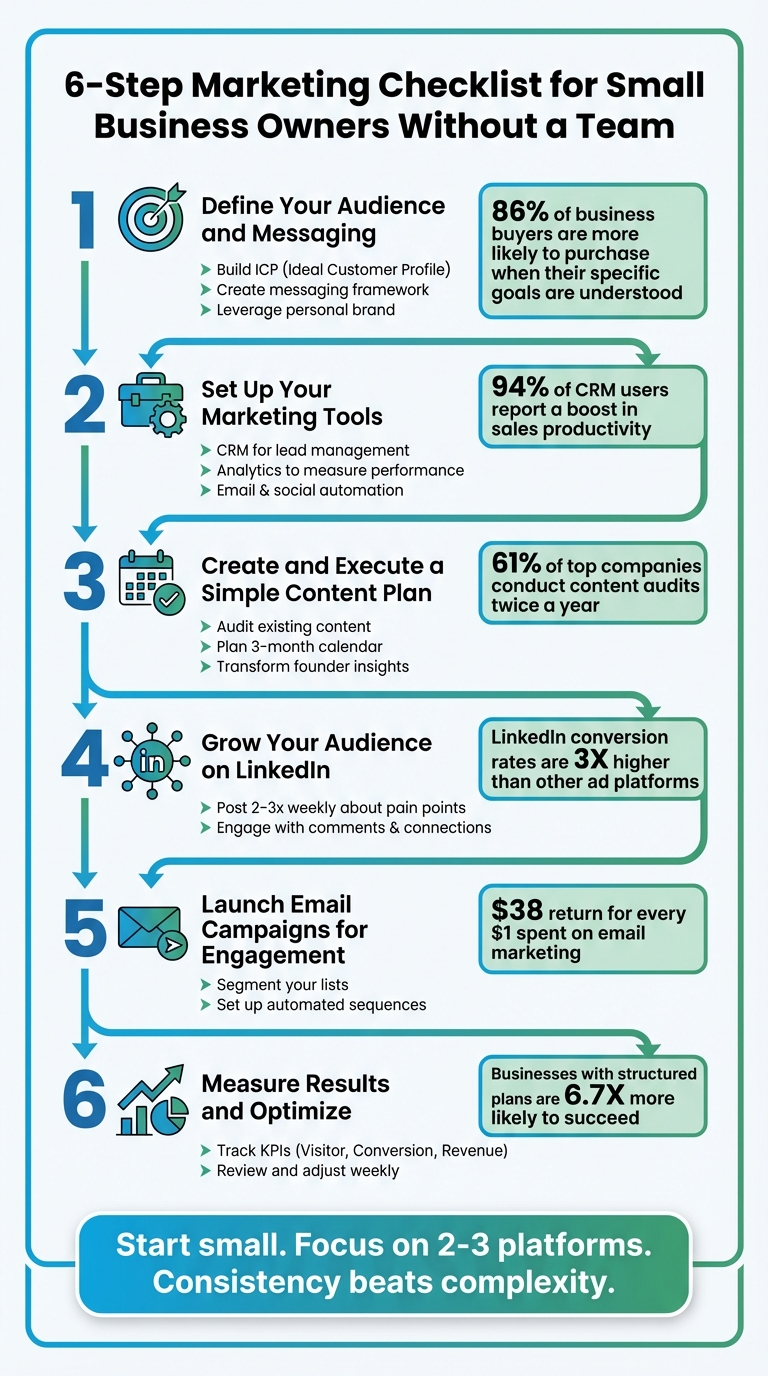
6-Step Marketing Checklist for Small Business Owners Without a Team
Founder Led Marketing 101 - Content Creation for Business Owners
Step 1: Define Your Audience and Messaging
Marketing without a clear target is like throwing darts blindfolded - you waste time, money, and energy. In fact, 86% of business buyers are more likely to purchase when their specific goals are understood. That’s why defining your Ideal Customer Profile (ICP) and crafting a messaging framework should be your first move. It’s the foundation for everything else.
Identify Your Ideal Customer Profile (ICP)
Your ICP is essentially a blueprint of the people or companies that benefit the most from what you offer. Start by analyzing your current customers - who brings in the most value with the least friction? These are your golden examples.
When building your ICP, focus on these key areas:
- Firmographics: Industry, company size, and annual revenue.
- Technographics: Tools and platforms they use.
- Geographics: Where they’re located.
- Behavioral Patterns: How they make decisions and purchase.
For example, if you’re targeting B2B, you might zero in on "SaaS companies in the Northeast with 50-200 employees and $5M-$20M in revenue." If you’re in B2C, think in terms of demographics like age and income, paired with psychographics like hobbies or values.
Here’s the trap: going too broad. As Belal Batrawy, founder of learntosell.io, puts it:
"I advise a lot of companies, and almost unanimously their ideal customer profile is far too broad".
A company with 100 employees has vastly different needs than one with 700. Trying to lump them together will only result in your message getting lost. Be specific, or risk being ignored.
To nail your ICP, talk to at least 20 current or potential customers. Ask about their daily struggles, what solutions they’ve tried, and where they go for advice. And don’t forget your sales and customer success teams - they’re on the front lines, hearing objections and motivations firsthand.
Once you’ve locked in your ICP, your messaging will naturally fall into place.
Create a Messaging Framework
Now that you know who you’re talking to, it’s time to figure out what to say. A solid messaging framework should cover three things: the pain point, your solution, and the action you want them to take.
Start by identifying the problems your ICP faces. Use customer interviews, competitor reviews, and online forums to get real insights. Then, frame your solution around benefits, not features. For instance, instead of saying, "Our software has automated reporting", say, "Save 10 hours a week by automating your reports."
Every message should include a clear and direct call-to-action (CTA). Whether it’s "Book a Consultation", "Download the Guide", or "Start Your Free Trial", make it bold and visible. And don’t underestimate consistency - stick to the same tone, colors, and fonts across all platforms to avoid confusing your audience.
Use Your Personal Brand
Once your messaging is set, don’t forget to leverage your personal brand. As a founder, you’re not just pitching a product - you’re building trust. Your personal story can be a powerful marketing tool, especially if you’re running a lean operation without a big team. Sharing your journey makes your business relatable.
Keep your brand story short and punchy - three paragraphs max. Highlight how you started and the problem you’re solving. Then, consistently share content that aligns with your expertise and resonates with your audience. Remember, potential customers often need to see your message seven times or more before they’re ready to buy.
Finally, connect with your local community. Speak at events or participate in local activities to build credibility and trust. These personal touches can make all the difference in standing out.
Step 2: Set Up Your Marketing Tools
Once you've nailed down your audience and messaging, it's time to establish a solid marketing system. The right tools can save you hours of work and keep everything organized. You'll need systems to track leads, analyze what’s working, and automate those tedious tasks that eat up your day.
Set Up a CRM for Lead Management
Think of a CRM as your business's memory bank. It organizes all your leads - whether they come from your inbox, website forms, or spreadsheets - into one centralized hub. Without a CRM, leads can easily slip through the cracks, costing you potential sales.
Here’s a telling stat: 82% of businesses use CRM tools to streamline processes and generate sales reports. Even more impressive, 94% of CRM users report a boost in sales productivity after implementing one. Why? A CRM offers clear pipeline visibility. You can move deals through stages, automate follow-up reminders, and pinpoint bottlenecks.
Start with something simple. The key is to connect your CRM to your email and website forms right away, so your data flows in automatically.
"OnePageCRM creates a sales process, and all we have to do for our success is to follow it".
Once your leads are organized, it’s time to measure how well your efforts are paying off.
Use Analytics to Measure Performance
If you’re not measuring, you’re guessing. Google Analytics is a must-have tool for tracking where your website traffic comes from, identifying where visitors drop off, and understanding which campaigns are driving conversions. Take Lider as an example - they used Google Analytics to achieve an 18X improvement in their conversion rate and cut their cost-per-acquisition by 85%. McDonald’s Hong Kong saw equally impressive results, increasing in-app orders by 550%.
To get started, enable enhanced measurement in GA4 and use the Realtime report to confirm your data is flowing within 30 minutes. If you’re on platforms like Shopify, Wix, or HubSpot, you can easily integrate Google Analytics by entering your "G-" Measurement ID directly into their settings.
For even deeper insights, pair Google Analytics with Google Search Console. This combo lets you monitor how your site appears in search results and track your organic keyword performance.
Once you’ve got a handle on your data, the next step is to automate your outreach.
Automate With Email and Social Tools
Posting manually every day? That’s a fast track to burnout. Email marketing platforms like Mailchimp, MailerLite, and Brevo offer free tiers that let you create campaigns, segment your audience, and set up automated follow-ups. No wonder 76% of marketers rely on email to stay in touch with customers. A simple three-part welcome sequence is a great place to start - send a thank-you email with a resource link, follow up with a customer success story, and wrap it up with a soft call-to-action.
For social media, tools like Buffer and SocialPilot let you schedule posts across multiple platforms from a single dashboard. Businesses that post consistently see a 50% jump in visibility and a 30% increase in organic reach.
To take automation even further, use Zapier to sync data between apps, cutting out manual data entry.
| Tool Category | Recommended Tools | Starting Price |
|---|---|---|
| CRM | HubSpot, Zoho Bigin, monday CRM | Free to $12/user/month |
| Email Marketing | Mailchimp, MailerLite, Brevo | Free tiers available |
| Social Scheduling | Buffer, SocialPilot, Loomly | Free to $26+/month |
| Analytics | Google Analytics, Google Search Console | Free |
| Automation | Zapier | Free tier available |
"If you're not monitoring the performance of your marketing, you're doing it all wrong" – Lean Marketing.
Step 3: Create and Execute a Simple Content Plan
With your marketing tools ready, it’s time to focus on crafting content that truly connects with your audience. Don’t worry - you don’t need a massive content library or a dedicated writer. A smart, streamlined approach that taps into your existing knowledge will do the trick.
Audit Existing Content and Spot the Gaps
Before diving into new content, take stock of what you already have. Review your website, blog posts, social media, and email campaigns to identify what’s performing well and what’s outdated.
Here’s why this step matters:
- 61% of companies excelling in content marketing conduct content audits at least twice a year.
- Pinpointing your best-performing content can guide visitors toward actions like purchases, sign-ups, or demos.
Start with a competitive gap analysis. Check out three to five of your direct competitors to see how their pricing pages, messaging, and content strategies stack up [1, 11]. Ask yourself: Where are they doing better? What topics are they covering that you’re not? Combine this analysis with keyword research to find gaps in your content and discover the terms your audience is searching for [29, 1].
Don’t forget the technical stuff. Look for broken links, missing page titles, slow load times, and mobile-friendliness. These factors are crucial - 75% of search clicks go to the first page of Google results, so technical issues can hurt your visibility. Updating and optimizing existing content has delivered more traffic for 49% of marketers and higher engagement for 53%.
"Without a clear picture of your content and its impact, you can't predict key opportunities and areas for optimization."
Plan a 3-Month Content Calendar
Long-term planning can feel overwhelming. Instead, focus on the next three months. This shorter timeline gives you the flexibility to adapt to shifts in your business or seize unexpected opportunities.
Create a quarterly content calendar that outlines post titles, hashtags, due dates, and statuses. Keep it realistic: aim for one blog post every two weeks, two to three LinkedIn posts per week, and a monthly or bi-weekly email newsletter. Social media is a powerful tool - 54% of consumers discover small businesses through it, and 46% of small businesses rank email marketing as a top strategy.
Stick to two or three platforms where your audience is most active. Here’s a quick breakdown of what your schedule might look like:
| Content Type | Frequency Goal | Time Investment |
|---|---|---|
| Founder Insight Blog | Every 2 weeks | 15–30 minutes |
| LinkedIn/Social Post | 2–3 times per week | 10 minutes per post |
| Email Newsletter | Monthly or bi-weekly | 5 minutes (if prepped) |
Transform Founder Insights into Content
Your daily experiences are a goldmine for content ideas. Customer questions, completed projects, and lessons learned can all be turned into blog posts, LinkedIn updates, or email newsletters. Just make sure every piece aligns with your core messaging to reinforce your brand.
Use the "4-Reasons" Framework to shape your content around why people choose to work with you: experience, expertise, likeability, and values. Keep it simple - use prompts to answer specific questions and craft a blog post in just 15 minutes. Then, repurpose that content across multiple platforms. For example, one blog post could become Instagram slides, a LinkedIn update, and even a short video script.
"Content Marketing is all the marketing that's left."
Authentic, founder-driven content builds trust. In fact, 78% of consumers trust online reviews and personal recommendations as much as advice from someone they know. By sharing your real experiences and insights, you create a connection with potential customers long before any sales pitch.
Consistently delivering content like this lays the groundwork for a stronger online presence.
sbb-itb-9354cf2
Step 4: Grow Your Audience on LinkedIn
LinkedIn stands out as a powerhouse for generating leads, with conversion rates that are three times higher than other major ad platforms. For founders juggling marketing on their own, it’s a goldmine for building credibility and connecting with the right audience. It’s a platform that pairs perfectly with lean marketing strategies, offering a direct way to engage and share expertise.
Post Consistently About Customer Pain Points
Your LinkedIn posts should zero in on the issues your ideal customers are trying to solve. Look for conversations around the challenges your business addresses and craft posts that genuinely add value. This is where "smart content" shines - content that speaks directly to your audience’s struggles.
Aim to post two or three times a week to keep your presence steady and relevant. Companies that post at least once a week see engagement double. Mix it up - share behind-the-scenes glimpses, highlight customer success stories, and weigh in on industry trends. Don’t underestimate the power of visuals: posts with images get twice as many comments as text-only ones, and videos drive five times more engagement.
"Pinpoint the parts that overlap [between what is compelling to the audience and what you enjoy talking about], and use those as the themes for your content over and over again."
Make it manageable. Use scheduling tools to batch your posts and maintain consistency. Posting regularly keeps you visible and trustworthy, ensuring you’re top-of-mind when prospects are ready to make a move. Focus on addressing customer pain points with targeted, thoughtful content.
Engage With Comments and Connections
LinkedIn’s algorithm rewards engagement. The more interaction your posts get, the more visible they become. Engaging with posts from your network or industry leaders not only builds goodwill but also encourages them to engage with your content in return.
When someone comments on your post, respond within 24 hours. This shows that your page is active and approachable, which helps build trust and loyalty. Every comment can spark a conversation, boosting your reach and driving more profile visits.
"On LinkedIn, helpfulness = visibility."
To stay active without feeling overwhelmed, try the 3-2-1 Rule: engage with three posts, leave thoughtful comments on two, and create one post each week. When sending connection requests, make them personal - mention a shared connection, a post they recently shared, or something about their company that caught your attention. Once they accept, follow up with a short thank-you message, and give it a few days before reaching out with any requests or pitches. Keep in mind, only about 10% of people respond to cold messages, so focus on providing value and nurturing relationships. These small but consistent actions fit seamlessly into a streamlined marketing strategy.
Step 5: Launch Email Campaigns for Engagement
Once you've polished your content and nailed down your LinkedIn strategy, it’s time to tap into the power of email campaigns. Email marketing provides a direct line to your subscribers, ensuring your message gets delivered without the unpredictability of social media algorithms.
With an average return of $38 for every $1 spent, email campaigns are a solid investment. Unlike social posts that may only reach about 2% of your audience, emails land directly in inboxes, making them an essential tool for engagement. By using smart segmentation and automating your sequences, you can engage effectively while keeping your workload manageable.
Segment Your Email Lists
Personalization is the secret sauce of email marketing, and segmentation makes it possible. Break down your email list based on factors like purchase history, engagement level, and geographical location. This allows you to tailor your messages to resonate with specific groups.
For a more refined approach, try RFM analysis - that’s Recency, Frequency, and Monetary value. This technique helps identify your most loyal and profitable customers. Another layer of targeting can come from tracking website activity. For instance, segment users based on the products they’ve browsed or the blog posts they’ve clicked. Even small tweaks, like adding the recipient’s name to a subject line, can make a big difference - boosting open rates by 50% and click rates by 58%.
"Which data you collect depends on your personalization and segmentation strategies."
To keep your list healthy, regularly clean it up. Move inactive subscribers - those who haven’t opened an email in six months - into a re-engagement segment. Give your subscribers control by setting up a preference center. This way, they can choose the type of content they want and how often they want to hear from you, rather than being forced to click a global "unsubscribe" button.
Set Up Automated Sequences
Automation is your best friend when it comes to email marketing. Start by defining a clear goal for each sequence, whether it’s encouraging free trials or bringing back disengaged subscribers. Then, map out the customer journey - from subscription to conversion - and plan a series of 3–10 emails, spaced out at a rate of 1–3 per week.
Welcome emails are your first handshake with a new subscriber, so make it count. The top 10% of welcome email flows boast an average placed order rate of 9.89%. For visitors who browse but don’t add items to their cart, send a browse abandonment email within 2–3 hours. These emails achieve a 0.82% placed order rate, over 10 times better than standard campaigns. Meanwhile, abandoned cart sequences are email gold, generating an average revenue of $3.07 per recipient - 30 times higher than typical campaigns.
Keep your emails short and snappy. You’ve got about five seconds to grab attention, so limit your content to 100 words. Trigger emails based on actions like downloading a lead magnet or clicking a product link. Post-purchase emails are another high-performing category, with an impressive average open rate of 59.77%. Use these to onboard new customers or encourage repeat purchases.
"Email remains one of the most effective ways to connect with your audience, but it's even more powerful when it's part of a well-orchestrated system."
To fine-tune your campaigns, A/B test everything - subject lines, call-to-action wording, and even send times. Many email platforms offer starter plans beginning at $29/month. Once your sequences are set up, automation will take care of the heavy lifting, leaving you free to monitor performance and tweak as needed.
Step 6: Measure Results and Optimize
Once your campaigns are live, the real work begins - keeping tabs on performance and tweaking strategies to get the best results. Consistent tracking and thoughtful adjustments are what turn good marketing into great marketing. The key? Focus on the numbers that actually matter to your goals.
Track Key Performance Indicators (KPIs)
To measure success, zero in on three main areas: Visitor Acquisition (how much traffic your efforts are pulling in), Conversion (how many visitors are turning into leads or customers), and Revenue (how your campaigns are impacting the bottom line).
For your website, keep an eye on metrics like unique visitors, page views, and bounce rates. A bounce rate over 50% could mean it’s time for a website tune-up. If lead generation is your goal, track email sign-ups, contact form completions, and free trial requests. On the revenue side, focus on conversion rates, average order value, and overall revenue growth.
Two additional metrics worth monitoring are Cost Per Acquisition (CPA) and Customer Lifetime Value (CLV). These figures help you figure out if your spending is hitting the sweet spot.
"One way to increase efficiency is to stop tracking data that isn't helping you make strategic, purposeful choices."
Review and Adjust Weekly
Don’t let your data gather dust - use it. Set up automated analytics reports to land in your inbox every week, saving you the hassle of pulling numbers manually. Dedicate 30 minutes each week to reviewing your metrics. This simple habit can help you make quick, meaningful adjustments.
When reviewing, focus on actionable insights. For example, if your traffic looks solid but conversions are lagging, dig into your lead forms - are you asking for too much information? Test different approaches with A/B testing on email subject lines, landing page designs, or call-to-action buttons to see what resonates. Pair your data with customer feedback for a more complete picture.
Here’s a motivator: Small businesses with a structured marketing plan are 6.7 times more likely to achieve success compared to those without one. Plus, 80% of small and medium-sized business (SMB) marketing teams are already refining their strategies based on customer interactions. If they can do it, so can you.
Conclusion
Marketing on your own doesn’t have to feel overwhelming. The key is to keep it simple and focus your energy on a few platforms that actually matter to your audience. Forget trying to dominate every social media site or hopping on every new trend. Instead, pick 2–3 platforms where your target audience spends their time and let your efforts build momentum over time. You don’t need to be everywhere to make an impact.
Start small and grow steadily. Lay the groundwork on a couple of platforms before branching out. Begin with low-cost, organic strategies like SEO, engaging on LinkedIn, and email automation before diving into paid ads. Your website should act as the central hub for your content and lead generation efforts. Maximize your content’s reach by repurposing blog posts into social media updates or video scripts - it’s a smart way to get more mileage out of your work.
Consistency is more powerful than complexity. Showing up regularly on one channel is far more effective than sporadically posting across many. As Seth Godin wisely said:
"Content Marketing is all the marketing that's left".
The businesses that succeed are those that keep showing up, week after week. Even small, steady efforts can lead to meaningful results over time.
Use your voice and expertise to stand out. Pay attention to what’s working, tweak what isn’t, and keep moving forward. As your business grows, consider reinvesting 5–10% of your revenue into more streamlined marketing strategies. Automate tasks where possible and lean into your personal brand to create content that feels genuine. Start with one small action today - whether it’s crafting a blog post, engaging on LinkedIn, or refining your email list - and build from there.
FAQs
How can I clearly define my Ideal Customer Profile (ICP)?
To nail down your Ideal Customer Profile (ICP), start by pinpointing the traits of businesses or individuals that gain the most value from what you offer. Look at details like their industry, company size, revenue bracket, geographic location, tech stack, and the challenges they’re trying to solve. Go deeper by examining their buying habits - what sparks their interest, how they make decisions, and what pushes them to look for solutions like yours.
Lay all this out in a clear, structured way to keep things consistent and easy to follow. A strong ICP isn’t just a guide - it’s your shortcut to reaching the right people, fine-tuning your marketing, and getting better results.
What tools do I need to handle marketing on my own?
If you're handling marketing solo, having the right tools can make all the difference. First, invest in an email marketing platform to connect directly with your audience - it’s a must-have for staying in touch. Pair that with a social media scheduling tool to plan and automate your posts, saving you time and keeping your content consistent. A website builder or CMS is crucial for creating and managing your online presence, ensuring everything looks polished and professional. To keep tabs on your efforts, a basic analytics dashboard will help you measure performance and make smarter choices. Lastly, a simple CRM or lead capture system can keep your leads organized, making it easier to follow up and build relationships. With these tools, you’ll be equipped to handle marketing like a pro, even without a full team.
How can I consistently create engaging content when I have limited time?
To stay on top of your content game without feeling overwhelmed, carve out a dedicated hour each week to plan and create in batches. A straightforward content calendar can be your best friend here - jot down your ideas, map out what goes live when, and let automation tools handle the heavy lifting of scheduling. This way, your posts stay consistent and engaging without demanding daily attention. Stick to topics that strike a chord with your audience and reflect your brand’s vibe to make your efforts truly count.