The Modern Demand Gen Team: When to Use SDRs, When to Use LinkedIn, and How to Blend Both

Struggling to choose between SDRs and LinkedIn for demand generation? You don’t have to. The best results come from combining both. Here’s the breakdown:
- SDRs are perfect for direct, high-value outreach - think personalized emails, cold calls, and quick follow-ups for accounts worth $50K+.
- LinkedIn shines when building awareness, nurturing long-term relationships, and educating prospects who prefer self-research.
- Together, they create a powerful multi-channel strategy: LinkedIn builds trust and familiarity, while SDRs turn that into meaningful conversations and pipeline.
Key Stats:
- Multi-channel outreach (email, LinkedIn, phone) increases reply rates to 14.2% (vs. 2.3% for email alone).
- LinkedIn generates 80% of B2B social leads and boasts response rates of 18–25% for personalized messages.
- Top SDRs book 15–21 meetings monthly but only succeed when supported by clean data, a clear ICP, and the right tools.
Quick Tip: Use LinkedIn engagement as a signal for SDRs to follow up within 24–48 hours. This layered approach boosts reply rates to 22.1%, making your efforts more effective and coordinated.
Let’s dive into the details of when to use each approach and how to combine them seamlessly.
The Role of SDRs in Demand Generation
What SDRs Do and Why They Matter
SDRs, or Sales Development Representatives, are the front line of your sales process. They’re the ones cutting through the digital clutter to spark conversations with cold prospects using a mix of email, phone calls, and LinkedIn outreach. Their mission isn’t to close deals - it’s to set the stage by creating opportunities that your closing team can turn into revenue.
"SDRs create opportunities; closers advise, negotiate, and close. The system protects both roles."
The most effective SDRs rely on personalized outreach, leveraging quick research to gather key details about their prospects. This approach works: personalized cold emails are 2.7x more likely to be opened compared to generic blasts. Once SDRs make contact, they qualify leads based on factors like fit, timing, and pain points, ensuring only the most promising prospects are passed on to Account Executives (AEs). They also stay in touch with longer-term leads, delivering value-packed follow-ups every 60–90 days until those prospects are ready to make a move.
Using multiple channels - email, LinkedIn, and phone - can improve results by an impressive 287%. But here’s the kicker: 83.4% of SDRs still miss their monthly targets, often due to flawed processes or bad data rather than lack of effort. Top-performing SDRs aim to book 15–21 meetings a month, with a show rate of 70–80%. On average, though, most SDRs grind through 94.4 daily activities but only manage 4.4 meaningful conversations.
"Stop celebrating activity and start engineering quality conversations - pipeline comes from the handful of real interactions you earn each day, not the dashboard volume."
The key to SDR success starts with a well-thought-out strategy and the right infrastructure, which we’ll dive into next.
What You Need Before Deploying SDRs
Launching an SDR team without the right infrastructure in place is like trying to race without a car. First, you need clean, reliable data: verified contact details, deduplicated records, and real-time data enrichment processes. Given that 70% of B2B buyers do their homework before ever talking to sales, having accurate data from the start is non-negotiable.
Next, nail down your Ideal Customer Profile (ICP). This means identifying firmographics (like company size and industry), technographics (their current tech stack), and buying triggers such as funding rounds or hiring surges. A clear ICP ensures SDRs can focus their efforts where they’ll have the most impact. Then, set up your tech stack: a CRM with clear pipeline stages and lead ratings, a sales engagement tool for sequencing, a parallel dialer, and LinkedIn Sales Navigator. Just one tool, like a parallel dialer, can boost live conversations by dialing 3–10 lines at once.
Email deliverability is another critical piece. Authenticate your domains with SPF, DKIM, and DMARC protocols, and make sure you’re using warmed-up email inboxes with blended sending profiles. For cold outreach, protect your main corporate domain by using dedicated, aged domains to avoid blacklisting.
"A perfect script can't overcome a spam folder. Fix deliverability before debating copy tweaks."
Once deliverability is handled, focus on lead scoring and qualification. Create a clear lead rating system (e.g., a 0–10 scale) and establish criteria to ensure SDRs only pass high-quality leads to AEs. To keep things running smoothly, schedule regular syncs between SDRs and AEs, backed by documented SLAs for lead handoffs. Building an in-house SDR team isn’t cheap - it can cost $12,000 or more per month when you factor in salaries, commissions, tools, and management. That’s why getting the groundwork right is so important.
sbb-itb-9354cf2
Using LinkedIn for Demand Generation
Why LinkedIn Works for B2B Demand Gen
LinkedIn dominates as the go-to platform for B2B lead generation, accounting for a large share of social-sourced leads. With 74–75% of B2B buyers researching vendors on social media and LinkedIn showing 277% higher lead generation effectiveness, it’s clear why businesses rely on it. The platform reduces the friction often present before conversations even start.
By consistently sharing useful content, you allow prospects to become familiar with you long before you reach out. This familiarity helps cut through the skepticism that often accompanies cold outreach. As Marinus Nutma puts it:
"The LinkedIn plays that used to feel predictable suddenly feel… sluggish. Buyers already feel a certain sense of familiarity with [successful sellers], so their outreach doesn't trigger the usual skepticism."
Your LinkedIn profile isn’t just a digital resume - it’s a trust-building tool and a landing page all in one. Instead of listing job titles, a well-crafted profile should clearly communicate who you are, the problems you solve, and why your audience should care. This approach leads to better results: inbound leads driven by authority close at a rate of 14.6%, compared to just 1.7% for traditional outbound methods.
The numbers back up LinkedIn's effectiveness. Personalized messages and InMails see response rates of 18–25%, far outperforming the 3% average for cold emails. Additionally, 84% of B2B marketers say LinkedIn provides the best value among organic social platforms. With 82% of B2B deals now involving buying committees averaging 8.2 people, building organizational familiarity across multiple stakeholders is more important than ever. Pair LinkedIn’s strengths with targeted SDR outreach, and you’ve got a winning demand generation strategy.
LinkedIn Tactics That Build Demand
To make LinkedIn work for you, try the 10-3-1 Framework: send 10 connection requests, leave 3 meaningful comments, and post 1 original piece of content every day. This steady rhythm builds trust and visibility without overwhelming your schedule.
Content forms the backbone of thought leadership. Focus on three key themes: Industry POV (your take on market trends), Methodology (your approach to solving problems), and Proof (evidence that your methods deliver results). Share frameworks, tutorials, and original research to establish credibility and boost buyer confidence. Research shows sales professionals who share content regularly are 45% more likely to exceed their quotas.
Before sending a connection request, engage with a prospect’s profile or content 24–48 hours in advance. This small step can improve acceptance rates by 30–40%. Once connected, avoid jumping straight into a hard pitch. Instead, start with curiosity, context, or a low-pressure question.
"LinkedIn lets you earn attention before asking for it. You can engage with someone's content, visit their profile, send a connection request - all before writing a single message."
Use the Featured section of your profile to showcase case studies, frameworks, and testimonials that build credibility. Craft an outcome-driven headline, such as "Helping SaaS companies generate $12M in pipeline". Profiles with professional headshots get about 14 times more views, and headlines play a critical role in search relevance, increasing it by 46%.
For high-value prospects, try sending a 30-second personalized voice message. These messages can generate 15–20% more replies than standard text, signaling effort and authenticity. Lastly, LinkedIn outreach works best as part of a multi-touch sequence - 8–12 engagements over 2–4 weeks that combine social interactions, connection requests, and personalized messages. This approach complements SDR outreach, creating a cohesive, multi-channel strategy.
RevBoss Audience System: Getting More from LinkedIn
If you’re looking to streamline LinkedIn efforts, the RevBoss Audience System offers automated strategies to expand your reach and engagement. Their LinkedIn Content + Audience program, priced at $1,500/month, includes weekly strategy calls, 8–12 monthly posts, and workflows to grow your audience efficiently.
This system turns your expertise into consistent, polished content that builds trust with your ideal audience. It positions you as a trusted advisor and attracts an engaged network of prospects. For those ready to scale further, the Content + Coaching + Activation program at $4,000/month adds direct outreach campaigns, event support, and sales offer development - helping convert warm connections into qualified leads.
The ultimate goal? Not just building an audience, but creating a steady pipeline where prospects already know, trust, and remember you - long before a sales conversation even begins.
How to Post on LinkedIn for BDR/SDR (Business & Sales Development Representative)?
When to Use SDRs vs. LinkedIn
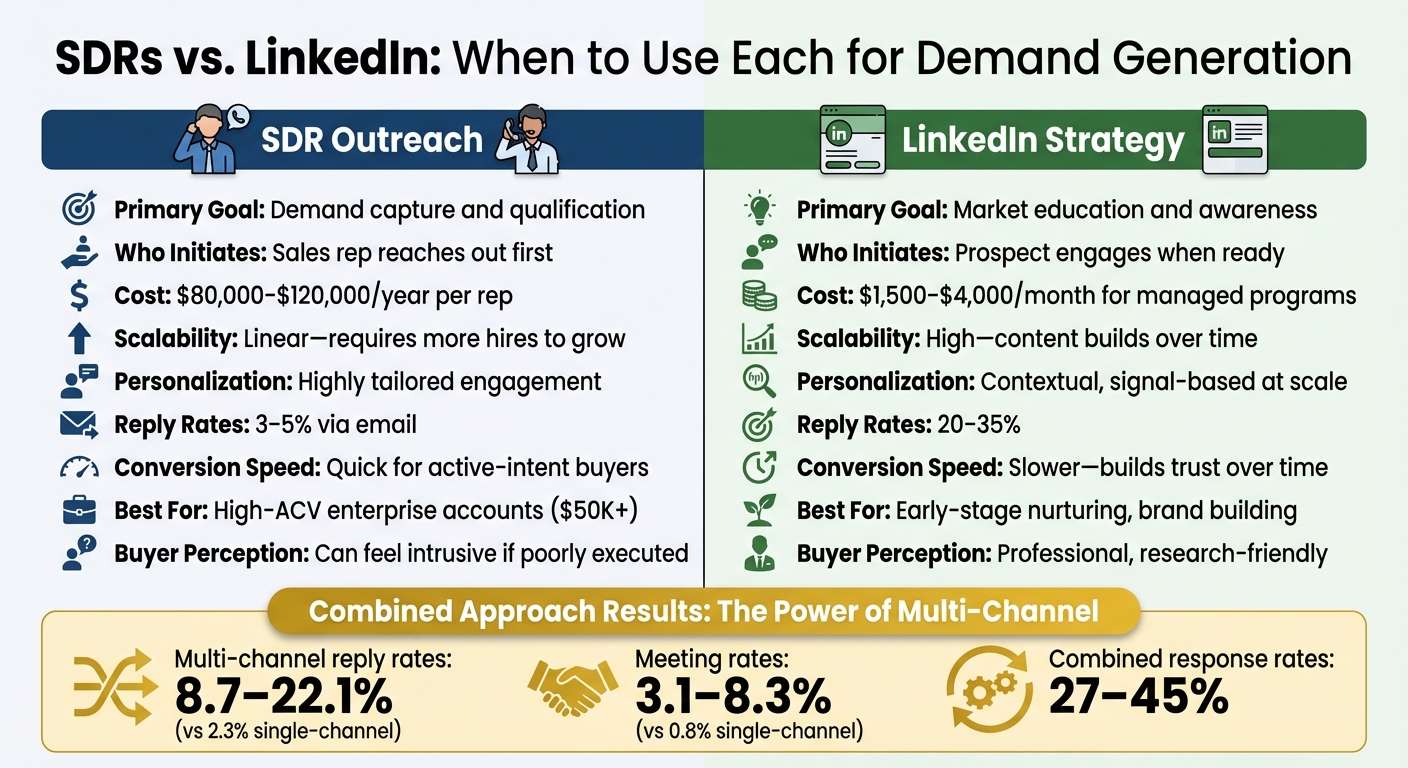
SDRs vs LinkedIn: B2B Demand Generation Strategy Comparison
When SDRs Work Best
SDRs are your go-to option for targeting high-value accounts (those over $50,000 with sales cycles longer than 90 days). They excel in creating meaningful connections with multiple stakeholders and can address objections in real-time, making them ideal for deals that demand a personal touch.
SDRs are particularly effective when you need to act fast. For example, if a prospect has just visited your pricing page, downloaded a high-intent resource, or experienced a significant trigger event like securing funding or a leadership change, an SDR can jump in immediately. Their direct approach - through personalized emails or phone calls - enables them to address concerns right away, something automated sequences just can’t replicate.
Another area where SDRs shine is in enterprise and niche markets. For small pools of high-value accounts, like Fortune 500 companies or specialized industries, the human element becomes crucial. These deals often involve multiple decision-makers and require thorough research. Interestingly, outbound-sourced deals in these settings tend to be around 50% larger than those sourced through inbound efforts, making the investment in an SDR team well worth it.
"SDRs aren't educators - they're connectors. Their job is to engage and qualify existing demand - not create it from scratch."
If, however, your focus is on building early-stage brand awareness rather than immediate engagement, LinkedIn might be the better tool.
When LinkedIn Works Best
LinkedIn is perfect for establishing early-stage awareness, especially for newer brands. When prospects aren’t actively searching for your solution, LinkedIn lets you share valuable, educational content that positions you as a trusted resource. This falls under "Market Education", where consistent thought leadership helps lay the groundwork for future sales conversations.
It’s also a great option for businesses with limited budgets or those targeting mid-market accounts, where the cost of an SDR team might not make financial sense. A managed LinkedIn program can start at around $1,500 per month and still deliver reply rates of 20–35%, which is up to seven times better than the average cold email campaign.
LinkedIn is especially effective for engaging buyers who prefer to avoid direct interaction with sales reps. With 61% of B2B buyers leaning toward a rep-free experience, LinkedIn allows them to explore your content and profile at their own pace, creating a more comfortable environment.
Additionally, LinkedIn is a powerful tool for nurturing long-term relationships. By keeping your brand visible over extended sales cycles, it ensures that when SDRs eventually reach out, the interaction feels more like a natural next step rather than an intrusive interruption.
Comparison Table: SDRs vs. LinkedIn
Here’s a quick breakdown of how SDR outreach compares to LinkedIn strategies:
| Factor | SDR Outreach | LinkedIn Strategy |
|---|---|---|
| Primary Goal | Demand capture and qualification | Market education and awareness |
| Who Initiates | Sales rep reaches out first | Prospect engages when ready |
| Cost | $80,000–$120,000/year per rep | $1,500–$4,000/month for managed programs |
| Scalability | Linear - requires more hires to grow | High - content builds over time |
| Personalization | Highly tailored engagement | Contextual, signal-based at scale |
| Reply Rates | Around 3–5% via email | 20–35% |
| Conversion Speed | Quick for active-intent buyers | Slower - builds trust over time |
| Best For | High-ACV enterprise accounts | Early-stage nurturing, brand building |
| Buyer Perception | Can feel intrusive if poorly executed | Professional, research-friendly |
Combining SDR and LinkedIn Strategies
How to Integrate Both Approaches
Instead of choosing between SDR outreach and LinkedIn engagement, modern demand generation teams are finding success by combining these strategies. The key is coordination - using LinkedIn activity as a signal and having SDRs follow up while interest is still fresh. For example, if a prospect interacts with your LinkedIn profile, comments on a post, or clicks an ad, an SDR should reach out within 24–48 hours to capitalize on that momentum.
Start by building familiarity. Before SDRs send connection requests, have them engage with a prospect's posts for a few days. This small step can boost connection acceptance rates by 30–40%. Once connected, implement a multi-touch sequence: begin with a LinkedIn connection, follow up with a personalized message, then add an email and a phone call. This layered approach is 3.2x more effective than relying on email alone.
"Inbound or outbound? Stop choosing. Start combining."
For top-tier accounts, SDRs should personalize their outreach by referencing specific posts or recent news about the prospect’s company. For mid-tier prospects, use tailored messaging that addresses their role or industry challenges. The goal is to make every interaction feel like a natural continuation of the LinkedIn engagement.
Timing and channel diversity are critical. Multi-channel sequences that include email, LinkedIn, and phone calls see reply rates as high as 22.1%, compared to just 2.3% for email-only campaigns. To make this work, your CRM must capture LinkedIn activity - profile views, ad clicks, and message responses - so SDRs have the context they need before reaching out.
RevBoss Tools for Combined Strategies
RevBoss offers tools to simplify this integrated approach. Their Content + Activation plan ($4,000/month) is designed for teams looking to combine content creation, audience building, and outreach. This package includes creating LinkedIn content (8–12 posts per month), running targeted connection campaigns to grow your audience, and activating that audience with outreach tied to events like trade shows or webinars.
The standout feature is how seamlessly it all works together. The RevBoss platform tracks which prospects engage with your content, identifies high-intent signals, and triggers personalized outreach at the right time. Instead of guessing when to follow up, you’re responding to clear buying signals. The platform also supports SDRs by creating sales offers and marketing assets, ensuring they have everything they need to continue the conversation started on LinkedIn.
This approach eliminates the common headaches of juggling separate systems for LinkedIn and SDRs. With everything running through a unified platform, your outreach becomes more organized, visible, and repeatable.
Comparison Table: Combined vs. Single-Channel Approaches
| Factor | Single-Channel (Email or LinkedIn Only) | Hybrid (SDR + LinkedIn) |
|---|---|---|
| Reply Rate | 2.3% | 8.7–22.1% |
| Meeting Rate | 0.8% | 3.1–8.3% |
| Reach | Limited; easily overlooked | Multi-touch; reaches buyers where they are |
| Insights | Basic open/click data | Detailed intent data from social engagement |
| Coordination | Disconnected; risk of "spray and pray" | Streamlined; LinkedIn preps the lead for SDRs |
| Cost | Lower upfront tool cost | Higher (requires CRM sync and SDR time) |
| Buyer Perception | Can feel cold or intrusive | Feels professional and well-researched |
Conclusion
Choosing between SDRs and LinkedIn isn’t an either-or decision - it’s about knowing how to use each effectively. LinkedIn works best for building awareness with prospects who aren’t quite ready to buy and for nurturing those long, drawn-out sales cycles. On the other hand, SDRs shine when you need timely, personalized engagement with high-value accounts or when you’re looking to quickly load up your sales pipeline. The magic happens when you combine both: LinkedIn builds trust, while SDRs leverage that trust to close deals. In fact, multi-channel sequences that include LinkedIn, email, and phone calls boast response rates between 27% and 45%, compared to the meager 1–3% response rate of email alone. With buyers now interacting across multiple channels, relying on just one is like trying to win a race on one leg - it’s not going to get you far.
"LinkedIn is your precision and trust channel; email is your scale channel; phone is your urgency channel."
For small and medium-sized B2B businesses, managing these channels doesn’t have to be overwhelming. Platforms like RevBoss take the headache out of juggling multiple systems. Their Content + Activation plan, priced at $4,000/month, covers LinkedIn content creation, connection campaigns, and personalized outreach triggered by engagement signals. This all-in-one solution ensures you’re not left guessing when to follow up or how to coordinate efforts.
As we’ve explored, blending LinkedIn with SDR outreach delivers the best of both worlds: credibility and speed. Modern demand generation strategies let each channel play to its strengths while tools like RevBoss handle the heavy lifting. When LinkedIn sets the stage and SDRs close the deal, you’re not just building your pipeline - you’re laying the foundation for long-term customer relationships.
FAQs
How do I know if I should hire SDRs or start with LinkedIn first?
Deciding whether to hire SDRs or focus on LinkedIn boils down to your specific sales needs, available resources, and overall goals. LinkedIn is a great tool for targeted outreach, creating trust through engaging content, and nurturing leads gradually. On the other hand, if you’re aiming for a more scalable and consistent way to generate qualified leads, SDRs excel at structured outreach and driving pipeline growth. The choice really depends on whether your priority is warming up leads or expanding your pipeline.
What LinkedIn engagement signals should trigger an SDR follow-up?
SDRs should pay close attention to LinkedIn signals that hint at strong interest. These might include actions like engaging with your content, visiting your profile, or interacting with your posts. Other useful triggers to monitor are company updates, such as new hiring sprees, recent funding announcements, or product launches. These signs often point to potential buyers who are open to starting a conversation.
How do I measure ROI from a combined SDR + LinkedIn program?
To figure out ROI, start by calculating total costs for your SDRs (including labor, tools, and outreach efforts) and LinkedIn (covering ads, content creation, and platform fees). Next, link revenue back to each channel using data points like qualified leads, scheduled meetings, and closed deals. Use this formula to crunch the numbers: ROI = (Total Revenue - Total Costs) ÷ Total Costs × 100%. This gives you a clear picture of how these efforts are performing together, allowing you to fine-tune your approach effectively.