The “No-Ask” Outreach Framework: How to Start Conversations with Value (DM Templates Included)

Prospects hate cold pitches. Their inboxes are flooded with generic messages asking for meetings they don’t want. The "No-Ask" Outreach Framework flips this script. Instead of pitching, you lead with value - offering insights, resources, or genuine recognition. This approach lowers pressure, sparks conversations, and builds trust over time. Here’s the gist:
- Why it works: It’s based on reciprocity - when you give first, people feel inclined to respond. Plus, it avoids inbox fatigue by standing out from cookie-cutter pitches.
- How it’s different: Traditional cold outreach is transactional and pushy. This approach is relational and focused on starting meaningful conversations.
- Key stats: Conversation-led messages get 40% higher response rates. LinkedIn DMs see 35–45% replies vs. 12–18% for cold emails.
The goal? Start a dialogue, not close a deal on the first message. Think of it as earning the right to share your offer later. Keep reading for actionable steps, DM templates, and tips to apply this framework today.
Cold Outreach Strategies That Actually Work in 2025
sbb-itb-9354cf2
What Is the 'No-Ask' Outreach Framework?
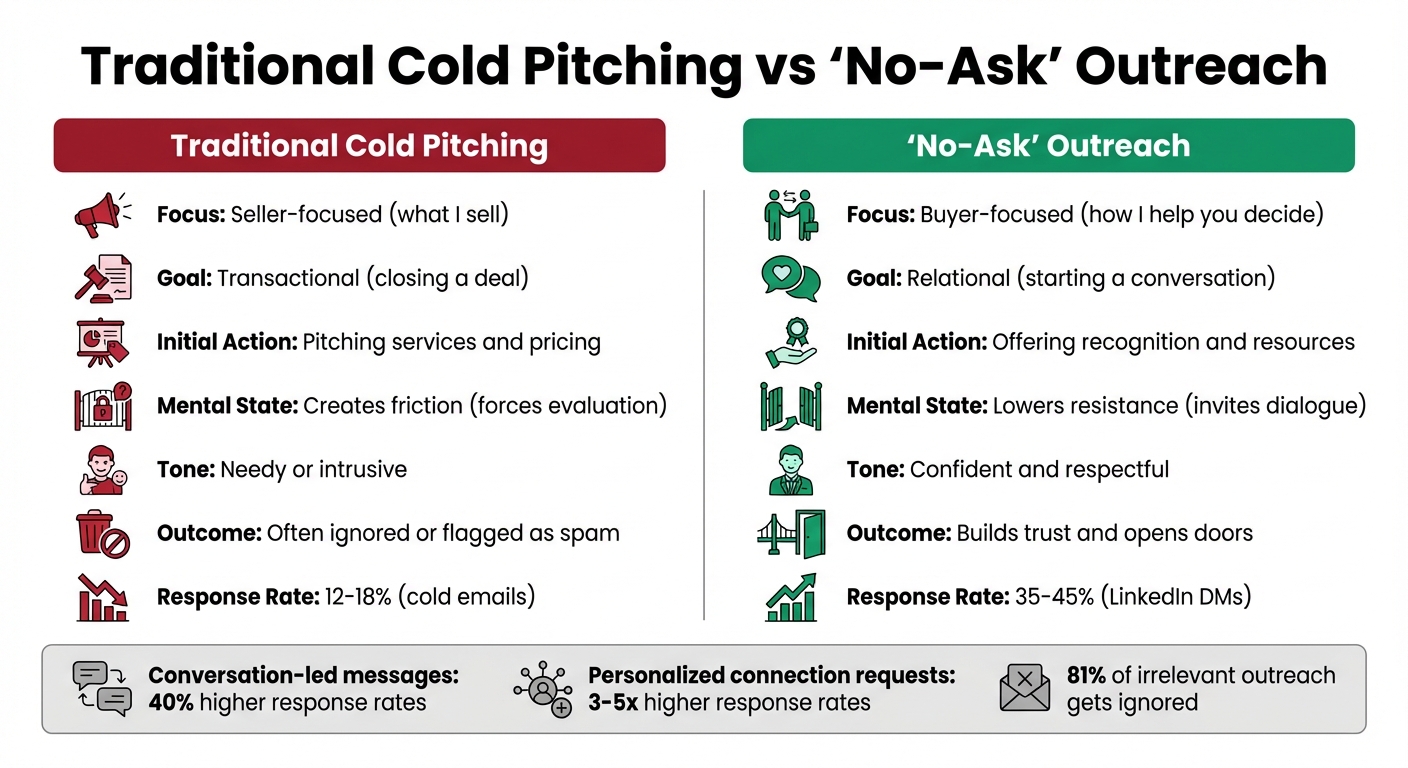
Traditional Cold Pitching vs No-Ask Outreach Framework Comparison
The 'No-Ask' Outreach Framework, also known as "Buyer-First" or "Conversation-Led" outreach, flips the script on traditional cold outreach. Instead of focusing on your product, it prioritizes what benefits the recipient. The concept is straightforward: help the buyer make informed decisions rather than pushing your agenda.
Traditional cold pitches often demand immediate attention and credibility checks, which can stifle meaningful dialogue. The 'No-Ask' approach removes that pressure by offering upfront value instead of making demands.
This isn't about hiding your intent to eventually discuss business - it’s about starting with genuine rapport. As Brynne Tillman, a LinkedIn and AI Sales Trainer, explains:
"You are not asking for attention. You are earning it."
Modern buyers are bombarded with generic, automated pitches daily. By taking a slower, value-driven approach, you demonstrate that you understand their needs and challenges, setting yourself apart from the crowd.
The Psychology Behind the Framework
The 'No-Ask' framework is rooted in key psychological principles. When you offer something valuable - like an insightful article, a thoughtful observation, or relevant industry data - you trigger the principle of reciprocity. People are naturally inclined to respond positively when they feel recognized or receive something useful.
Another key factor is trust-building through restraint. By not jumping straight into a pitch, you convey confidence and respect, positioning yourself as a peer rather than a pushy salesperson. This approach lowers the recipient's defenses, making them more open to future interactions. In fact, research shows that salespeople with high emotional intelligence are 50% more likely to close deals.
The framework also taps into curiosity. Instead of pushing for a demo, asking a low-pressure, open-ended question can spark interest and engagement. This approach allows the recipient to explore the idea on their own terms, creating a more natural and enjoyable conversation.
These psychological elements highlight how the 'No-Ask' approach stands apart from traditional, transactional sales tactics.
How It Differs from Cold Pitching
The 'No-Ask' framework takes these psychological insights and applies them in a way that fundamentally contrasts with traditional cold pitching.
Traditional cold pitches are transactional. They aim to book a meeting or close a deal as quickly as possible, often leading with services, pricing, and a value proposition that forces the recipient to decide if it’s relevant. This approach can feel intrusive or desperate, leading many messages to be ignored or marked as spam.
In contrast, the 'No-Ask' framework is relational. The goal isn’t to close a deal right away but to start a meaningful dialogue. By offering recognition and helpful resources upfront, you give the buyer the opportunity to engage on their own terms. The tone is confident and respectful, which naturally earns you the chance to continue the conversation later.
| Feature | Traditional Cold Pitching | 'No-Ask' Outreach |
|---|---|---|
| Focus | Seller-focused (what I sell) | Buyer-focused (how I help you decide) |
| Goal | Transactional (closing a deal) | Relational (starting a conversation) |
| Initial Action | Pitching services and pricing | Offering recognition and resources |
| Mental State | Creates friction (forces evaluation) | Lowers resistance (invites dialogue) |
| Tone | Needy or intrusive | Confident and respectful |
| Outcome | Often ignored or flagged as spam | Builds trust and opens doors |
The numbers back it up: conversation-led messages outperform pitch-first approaches by over 40%, and personalized connection requests see 3–5x higher response rates than generic ones. This shift from a quantity-driven mindset to a relationship-focused one not only sparks better conversations but also strengthens your pipeline for long-term success. By prioritizing genuine connections over quick wins, you lay the groundwork for more meaningful business opportunities.
How to Use the 'No-Ask' Outreach Framework
Learn how to turn cold prospects into warm, engaging conversations using the 'No-Ask' framework in just four steps.
Step 1: Find and Research Your Target Prospects
Start by pinpointing your ideal audience and understanding what makes them tick. Define your Ideal Customer Profile (ICP) by breaking it down into specifics like industry sub-verticals, company size, location, and the tools they use.
Next, look for triggers that suggest a prospect might be open to new ideas. Think recent funding rounds, new hires, or company growth announcements. For example, if a company has just secured Series B funding, odds are they’re expanding and might need solutions to scale effectively.
Don’t forget to tap into your existing network. Revisit contacts from the past two years, old clients, or even people you’ve met at events. These “warmer” leads already know you, which makes starting a conversation much easier.
When researching, shift your mindset. Instead of asking, “How can they help me sell?” ask, “How can I help them make a better decision?”. Dive into their LinkedIn activity, company news, or even podcast appearances to find something personal to mention. Personalized outreach has been shown to boost response rates by 3–5x compared to generic messages, while 81% of irrelevant outreach gets ignored.
Use tools like LinkedIn Sales Navigator, company websites, and industry news to gather insights. Pay attention to details like how long they’ve been in their role, their company’s tech stack, or any public content you can reference. A handy trick is to score your leads on a 0–3 scale for Trust (do they know you?), Fit (are they in your ICP?), and Timing (is now the right moment?).
Once you’ve done your homework, it’s time to craft a message that puts their needs front and center.
Step 2: Write a Value-First Message
Your message should be short, clear, and tailored to the recipient’s needs. If you’re using LinkedIn DMs, aim for 200–300 characters. The goal? Provide value upfront instead of jumping straight into a sales pitch.
Follow the ABC Method:
- Acknowledge: Mention something specific about the prospect to show you’ve done your research.
- Build a Bridge: Connect their world to yours with shared interests or challenges.
- Call to Conversation: End with a low-pressure, open-ended question that invites dialogue.
For instance, if they’ve recently talked about productivity challenges, acknowledge their insights, share a helpful resource, and ask a thoughtful question to keep the conversation going. The idea is to spark curiosity, not push for a sale. With digital attention spans averaging just 8.25 seconds, your message needs to be compelling and easy to digest.
Instead of asking for a meeting right away, offer something low-commitment, like a free resource - think a guide, report, or case study that aligns with their challenges. As Brynne Tillman, LinkedIn & AI Sales Trainer, says:
"Slowing down at the start is what speeds up meaningful conversations later."
Skip the corporate jargon and overly formal tone. Write like you’re talking to a colleague. Messages written at simpler reading levels tend to perform better, with higher open and reply rates. Once your message is polished, decide the best way to deliver it.
Step 3: Pick the Right Outreach Channels
Select channels based on where your audience is most active and comfortable.
- LinkedIn DMs: Great for B2B outreach, as they feel personal and avoid the clutter of email inboxes.
- X (Twitter) DMs: Ideal for reaching founders, CTOs, and marketing leaders who engage in public discussions. Start by interacting with their posts before sliding into their DMs.
- Email: Best for sharing in-depth resources like reports or webinars, though it often has lower initial reply rates and higher spam risks. If using email, consider sending from a dedicated subdomain to protect your main domain’s reputation.
A multi-channel approach often works best. For instance, engage with someone’s LinkedIn content, follow up with a personalized DM, and send an email if needed. This creates multiple touchpoints without overwhelming them.
Tara Lassiter, Founder-Brand Growth Strategist, sums it up perfectly:
"Professionalism isn't platform-dependent, it's purpose-dependent."
Try a 14-day, 3-touch cadence: send a value-driven DM on Day 0, follow up with more context around Day 5–7, and wrap up with a soft close by Day 12–14. This gives prospects time to respond without feeling pressured.
Once your outreach is underway, focus on tracking meaningful interactions.
Step 4: Track Conversations, Not Activity
Forget about vanity metrics like how many messages you sent or emails you opened. The 'No-Ask' framework prioritizes quality over quantity. The real measure of success? How many genuine conversations you’ve started.
Instead of tracking just activity, monitor engagement. Look at how many people replied, asked questions, or engaged in meaningful dialogue. Kolin Simon, Sales & Marketing Expert, explains it well:
"Every touch should give the recipient a reason to engage, not just a reminder that you exist."
Key metrics to watch include reply rates, the depth of conversations, and how quickly prospects respond. If someone replies within 24 hours or shares their own challenges, you’re on the right track. The 'No-Ask' approach is all about building trust and nurturing these conversations into long-term opportunities.
DM Templates for 'No-Ask' Outreach
With the groundwork of a four-step process, these DM templates are your tools for executing the 'No-Ask' approach effectively. They’re designed to lead with value, spark genuine conversations, and avoid the hard sell. Here are three templates you can tweak to fit your outreach needs.
Template 1: Share a Relevant Insight
This template is perfect when you’ve noticed something specific about their business that could be improved or adjusted. It’s all about offering helpful insights without expecting anything in return.
Example:
"Hi [Name], I took a look at [Company's] website and noticed [specific technical detail, e.g., your CTA button contrast might be affecting conversions on mobile]. Would you like me to write up a quick fix your team could implement? No strings attached - just thought it might help."
Here’s a real-world success story: In March 2022, designer Andy Kennedy used this exact approach with entrepreneur Justin Welsh. Kennedy pointed out a UI issue on Welsh’s landing page, specifically low button contrast. Later, he followed up with a custom Google Sheet resource after Welsh mentioned a website refresh. This thoughtful, value-driven outreach led to Kennedy landing a $50,000 branding and design contract.
The key is to focus on a concrete detail, like a recent product update or technical challenge. This strategy builds credibility and invites authentic engagement.
Template 2: Offer a Useful Resource
This template works well when you can share a free, tailored resource that aligns with a challenge they’re likely dealing with.
Example:
"Hi [Name], saw your post about [specific challenge, e.g., reducing customer acquisition costs]. We helped a similar team in [industry] cut CAC by 22% using a simple playbook. Want me to send it over? It's a quick read - about 10 minutes."
What makes this effective? It’s specific, actionable, and easy for them to say "yes" without committing to a lengthy call. Personalized messages like this have an 18% reply rate, compared to just 6% for generic outreach.
To make it work, ensure the resource is genuinely relevant and useful. Reference something timely, like a recent post, milestone, or trend, to show why you’re sharing it now. This small gesture can turn a cold DM into a meaningful conversation.
Template 3: Start with a Personal Observation
This template is all about connecting on a personal level before transitioning to business. It’s great for breaking the ice in a way that feels natural and genuine.
Example:
"Hi [Name], I checked out your LinkedIn and noticed you're a [specific hobby or interest, e.g., marathon runner]. I'm training for my first half-marathon and saw you ran Chicago last year. Do you have any advice for a beginner? Also, how are you addressing [relevant business challenge] at [Company]?"
Lily Ugbaja, a Fractional Content Manager, sums it up perfectly:
"Be human, be worthy. See the receiver as another person, not just someone to get something from."
This approach shifts the focus to personal interests rather than business stats. It’s conversational and authentic, creating a connection that naturally transitions into professional topics. Just make sure your observation is genuine and ties smoothly into the business-related part of your message. It’s all about starting a real dialogue.
Conclusion
The "No-Ask" Outreach Framework shifts the focus of cold outreach by leading with genuine value rather than an immediate pitch. Whether it's offering a relevant insight, sharing a helpful resource, or making a thoughtful observation, this approach prioritizes connection over sales. And the results back it up.
Studies highlight that messages designed to spark conversations perform far better than those that jump straight into a pitch. On the flip side, outreach that feels irrelevant is often ignored completely. The takeaway? Instead of chasing leads directly, invest in building relationships that naturally lead to opportunities - a strategy endorsed by industry experts.
To put this into practice, dedicate just 20 minutes a day to sending 10 value-driven DMs using the ABC Method. Small tweaks, like swapping "Let's book 30 minutes" for low-pressure questions like "Want the playbook we used?" can make a big difference. These subtle changes encourage meaningful dialogue and help build stronger connections. By consistently leading with value and focusing on authentic conversations, you're setting the stage for trust-based relationships that last.
FAQs
When should I switch from value-first to making an ask?
Switch gears from offering value to making your pitch only after you've established trust and a solid connection. Pay attention to cues that show the prospect is genuinely engaged or ready to take the next step. Rushing into your pitch too early can disrupt the flow and make the conversation feel forced instead of organic and effective.
How do I personalize fast without over-researching?
To make your outreach feel personal without getting bogged down in excessive research, zero in on the recipient's context. Mention something specific, like a recent post they shared, a mutual connection, or a common interest. The key is to show you're paying attention to their world, not just firing off generic messages. Keep it relevant and timely - this approach strikes a balance between being thoughtful and efficient, making your message more human and engaging.
What do I send if I don’t have a “resource” to share?
When you don’t have a specific resource to share, shift your focus to delivering value through personalized and meaningful communication. Craft your messages to fit the prospect’s situation, offering insights, posing thoughtful questions, or suggesting ideas that align with where they are in their journey. This method helps establish a genuine connection without depending entirely on external materials.