The Three-Offer Rotation: A Simple Way to Keep Campaigns Fresh

The Three-Offer Rotation is a straightforward strategy to counter declining campaign engagement and audience fatigue. Instead of endlessly creating new products, focus on one solution and package it into three offers tailored to buyer mindsets:
- Educational Offers: Build trust early by sharing insights like guides, webinars, or reports. Perfect for prospects in the awareness stage.
- ROI-Focused Offers: Prove the financial value of your solution with tools like ROI calculators, case studies, or demos. Ideal for buyers evaluating options.
- Urgency-Driven Offers: Push for action with time-sensitive deals or capacity-limited offers. Effective for decision-ready prospects.
This method aligns with the buyer's journey, keeps messaging relevant, and maximizes existing resources. By rotating these offers, you maintain interest, reduce friction, and drive better results - all without overwhelming your audience or your team.
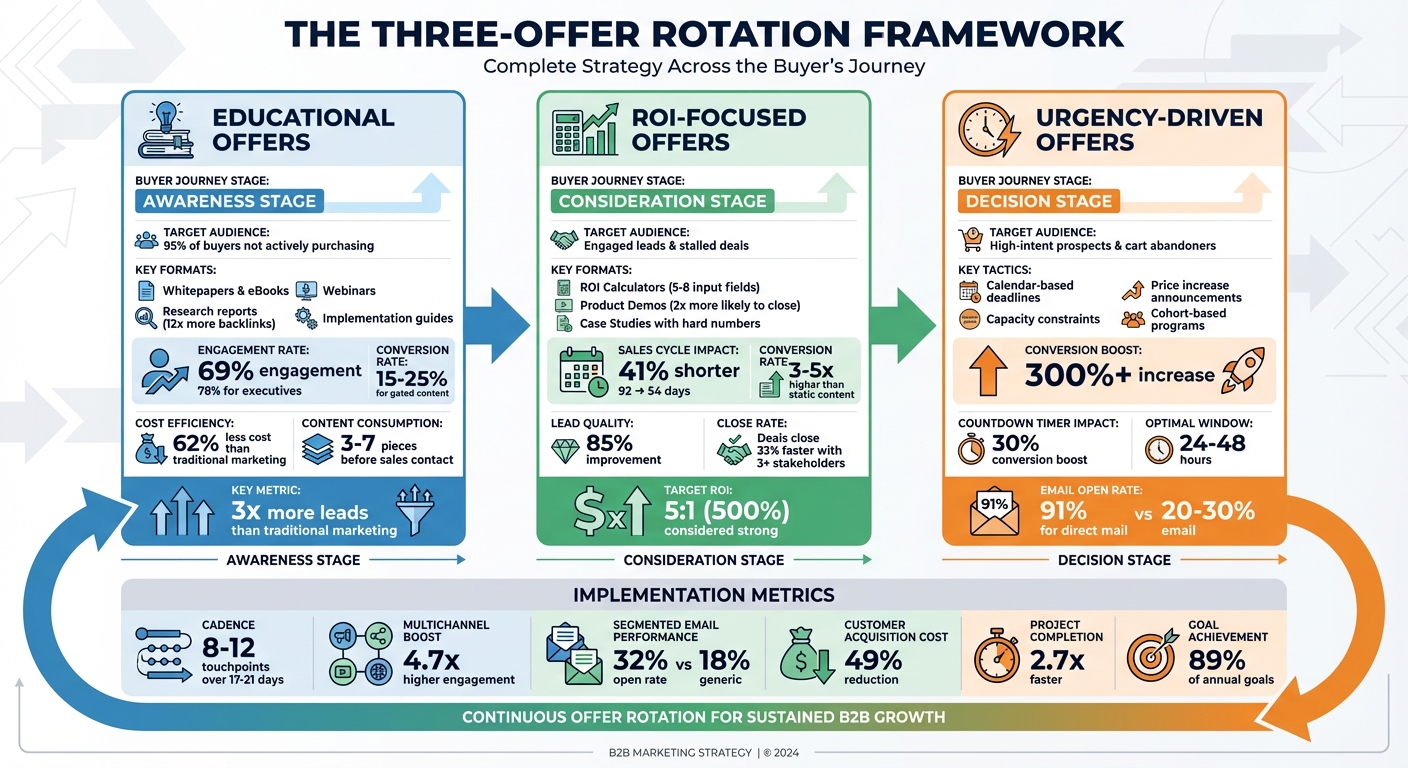
Three-Offer Rotation Framework: Educational, ROI-Focused, and Urgency-Driven Offers
5 NEW B2B Marketing Strategies That Will Blow Up ANY Business
sbb-itb-9354cf2
The Three-Offer Rotation Framework
The Three-Offer Rotation connects specific types of offers to different stages of the buyer's journey: Educational offers address the awareness stage, where buyers are identifying their problem. ROI-focused solution offers target the consideration stage, as buyers evaluate their options. Finally, urgency-driven activation offers focus on the decision stage, helping prospects commit to a purchase. This approach ensures your messaging aligns with where buyers are mentally and emotionally during their journey.
The idea is simple: three offers strike the right balance between variety and simplicity. Fewer than three can limit your appeal to diverse buyer needs, while too many options risk overwhelming prospects, leading to decision fatigue. Decision fatigue, as noted in the SMS-iT Blog, can cause buyers to abandon purchases altogether. They emphasize, “The 'Three Offers' rule strikes a balance between offering variety and avoiding overwhelming customers”. Let’s dig into why this framework works so well.
Why Three Offers?
Three offers allow you to cater to the diverse priorities within a typical B2B buying group, which often includes 6 to 10 stakeholders, each with their own concerns. For instance, a decision-maker might care most about ROI, while a technical evaluator may need proof of functionality, and an executive sponsor could be driven by urgency. By tailoring three distinct offers, you can meet these varied needs effectively.
Additionally, research shows that B2B buyers engage with an average of 13 pieces of content before making a purchase decision. With three rotating offers, you ensure that your messaging remains relevant and engaging throughout their journey.
Benefits of Rotating Offers
Rotating offers keeps your campaigns fresh and prevents audience fatigue. Cycling through educational, ROI-focused, and urgency-driven messaging not only maintains interest but also provides valuable performance data. This helps you identify which messages resonate most with your audience.
This approach also reduces friction in your sales funnel by meeting buyers where they are. The 95-5 rule highlights that 95% of potential buyers aren’t actively in the market at any given time. Educational and ROI-focused offers keep your brand in their minds, while urgency-driven offers are perfect for the 5% who are ready to make a decision.
Offer Type 1: Educational Offers
Educational offers aim to solve specific challenges for your prospects without pushing for an immediate sale. This approach focuses on building trust with the 95% of your audience that isn’t actively looking to buy right now. The objective is straightforward: position your company as a knowledgeable expert who truly understands their needs.
What Educational Offers Include
Educational offers come in a variety of formats, each designed to provide valuable insights. Whitepapers and eBooks offer in-depth analysis of industry challenges and potential solutions. Webinars provide a platform to showcase expertise in real-time while fostering personal connections with your audience. Research reports and benchmark studies carry significant weight, generating 12 times more backlinks on average than standard blog posts. Additional formats include implementation guides, comparative matrices, and checklists designed to help prospects build business cases.
Tailoring content to your audience’s role is critical. Technical evaluators benefit from detailed guides and practical resources, while C-suite executives prefer content that highlights strategic trends and high-level insights. Educational content focused on AI has shown particular success, achieving a 69% engagement rate across industries and reaching 78% among executives.
When and How to Use Educational Offers
Educational offers are ideal for early engagement, laying the groundwork for later stages where ROI and urgency take center stage. These formats excel at nurturing awareness at the top of the funnel.
Since B2B buyers typically consume 3 to 7 pieces of content before reaching out to a sales rep, your educational materials must be both easy to find and immediately useful.
"The most successful content answers the question, 'What's in it for me?' not 'What do we want to tell them?'"
For early-stage content, such as blogs and introductory guides, keep it ungated to boost organic visibility and brand recognition. Reserve gating for high-value resources, like benchmark reports or toolkits, to encourage lead conversion. When gating content, keep forms short - reducing fields from five to two can increase conversion rates by 40-60%. Align your content with specific triggers, such as leadership changes, new tool implementations, or missed quarterly goals, to ensure relevance.
Original research and proprietary insights help your content stand out in a crowded landscape. Interactive tools, like ROI calculators or self-assessments, offer personalized value that static content simply can’t match.
Measuring Educational Offer Performance
To gauge the effectiveness of your educational offers, focus on engagement metrics. These include pageviews, time spent on the page, scroll depth, and return visitor rates, all of which indicate whether your content resonates with your audience. For gated content, track conversion metrics such as opt-in rates, form submissions, and cost per Marketing Qualified Lead (MQL). Gated assets aimed at top-of-funnel audiences typically see conversion rates of 15-25%.
Ultimately, the success of educational offers hinges on their impact on your pipeline. Monitor how many prospects who engage with your educational content transition into opportunities and closed deals. Content marketing, when done right, generates about three times as many leads as traditional marketing while costing roughly 62% less. The key is to measure the right metrics and adjust your strategy based on data-driven insights.
Offer Type 2: ROI-Focused Solution Offers
After capturing early interest with educational offers, the next step is to show prospects the financial impact of your solution. ROI-focused solution offers are all about proving the value in dollars and cents. At this stage, decision-makers - especially CFOs and finance teams - need clear evidence that your product or service delivers measurable results. Tools like calculators, product demos, and data-driven case studies help translate features into financial outcomes, making the case for your solution’s return on investment.
What ROI-Focused Offers Include
These offers are designed to turn technical features into tangible business benefits, such as cutting costs, boosting productivity, or improving efficiency. Here’s how they work:
- ROI Calculators: These tools let prospects plug in their own data - like team size, current expenses, or task frequency - and instantly see how much they could save or earn.
- Product Demos: Interactive demos let potential buyers see your solution in action. Data shows that opportunities involving demo engagement are twice as likely to close.
- Case Studies: By presenting real-world examples with hard numbers, case studies validate your claims. For instance, they might highlight specific cost reductions or productivity gains.
ROI-focused offers also tap into buyers’ natural loss aversion. Instead of vague promises like "improves efficiency", they provide concrete numbers like "saves $47,300 annually". Beyond cost savings, these tools can also highlight benefits like risk reduction and streamlined processes. For example, one company found that using ROI calculators shortened their sales cycle by 41% - from 92 days to 54 days - and nearly doubled their proposal-to-close ratio.
Creating ROI-Focused Messaging
Effective ROI messaging uses the prospect’s own data to make benefits feel personal and relevant. Here are some best practices:
- Limit Input Fields: Stick to 5–8 fields to avoid overwhelming users. Each additional field increases the chance they’ll abandon the tool.
- Use Smart Defaults: Pre-fill fields with industry benchmarks so prospects see instant results. They can then adjust the data to reflect their specific situation.
- Show Immediate Results: Display top-line outcomes upfront to build trust. For detailed reports, use a lead capture form to collect contact information.
- Visualize the Data: Use charts or graphs to compare the “current state” with the “proposed state.” This makes the impact easier to grasp than raw numbers alone.
- Add Context: Translate dollar amounts into relatable terms. For example, “This is like adding two full-time employees without increasing headcount.” Clearly document the assumptions and benchmarks behind your calculations to maintain credibility.
"Your buyer doesn't want hype - they want proof."
| ROI Focus Type | Key Metrics/Inputs | Key Buyer Concern |
|---|---|---|
| Cost Savings | Current spend, resource usage, labor hours | High operational costs and inefficiency |
| Revenue Growth | Conversion rates, deal size, traffic volume | Missed opportunities or flat growth |
| Time Efficiency | Hours per task, team size, salaries | Bottlenecks and low productivity |
| Risk Reduction | Compliance risks, downtime costs | Fear of breaches or regulatory penalties |
Tracking Solution Offer Performance
Measuring the success of these offers is critical. Here’s what to track:
- Completion Rates: How many users finish the tool and view results? This shows how engaging the experience is.
- Demo Sign-Ups: Are users progressing to the next step, like requesting a demo or scheduling a sales call?
- Lead Quality Scores: The data prospects input can reveal their readiness to buy.
ROI tools often outperform static content, delivering 3–5x higher conversion rates and improving lead quality by 85%. Another key metric is influenced revenue - how much pipeline or closed business involved the ROI tool as a touchpoint. Deals with engagement from multiple stakeholders (e.g., three or more viewers per account) tend to close 33% faster.
For overall campaign performance, a 5:1 ROI (500%) is considered strong in most industries. Since B2B sales cycles often exceed 90 days, evaluate results over a longer timeframe rather than focusing on short-term windows like two weeks. Combined with insights from earlier educational offers, these metrics provide a full picture of how well your strategy aligns with the buyer’s journey.
Offer Type 3: Urgency-Driven Activation Offers
After laying the groundwork with education and ROI insights, the final step is to prompt action. Urgency-driven activation offers create a "now or never" moment, pushing prospects to overcome hesitation. Research highlights their effectiveness, with urgency-based offers boosting conversion rates by over 300% and increasing win rates by 14–21% for companies that use them well. These offers tie the entire strategy together by encouraging immediate decisions.
What Activation Offers Include
Activation offers rely on genuine constraints to create urgency. Some common approaches include:
- Calendar-based deadlines: Align offers with fiscal year-end or quarterly budgets, which are natural decision points for B2B buyers.
- Cohort-based programs: Limit enrollment to specific start dates, such as training programs beginning on a set schedule.
- Capacity constraints: Highlight real resource limits, like "only 2 onboarding slots left for Q1."
- Price increase announcements: Notify prospects of upcoming rate changes, giving them a chance to lock in current pricing.
- Event-based triggers: Tie offers to industry events, product launches, or seasonal trends.
Unlike consumer marketing, where discounts dominate, B2B buyers respond better to added value. Instead of cutting prices, offer perks like free implementation, premium support for the first 90 days, or bonus licenses for early adopters. For instance, in June 2025, Evgen Kushnirchuk, CEO of Hire Developers Biz, ran a 48-hour discount on consulting services, which led to a 35% increase in signups. Even scarcity marketing in unrelated industries, like McDonald's limited-time McRib sandwich, generates impressive results - adding $30 million annually.
Creating Urgency Without Losing Credibility
Today’s buyers are savvy - they can spot fake scarcity a mile away. Misleading claims about urgency damage trust, so authenticity is key. Always provide a clear explanation for your deadlines. Instead of vague phrases like "limited time", use specifics, such as "Offer expires October 31 at 11:59 p.m. EST." If spots are limited, state the exact number and stick to it.
"Urgency isn't about pressure – it's about priority. Buyers don't need more time to think, they need a compelling reason to act now."
Frame urgency as a way to help buyers prioritize their challenges rather than pressuring them to buy. Quantify the cost of delay to make the stakes clear. For example: "Delaying implementation could cost your team $8,200 per month in lost productivity." This shifts the focus from "Should I buy?" to "Can I afford to wait?".
Visual tools like countdown timers can also help, boosting conversion rates by up to 30%. However, it’s crucial to follow through - once the deadline hits, the offer must truly expire. Extending "final" deadlines or using resetting timers undermines future urgency.
| Urgency Type | B2B Application Example | Why It Works |
|---|---|---|
| Capacity Constraint | "Only 2 implementation slots left for Q1" | Credible due to resource and quality limits |
| Future Price Increase | "Lock in current rate before April 1 increase" | Feels helpful rather than pushy |
| Cohort-Based | "Enrollment closes Friday - training starts Monday" | Operational necessity provides clear rationale |
| Cost of Delay | "Current bottleneck costs $12K monthly" | Uses prospect’s own data to highlight urgency |
Deploying Activation Offers Across Channels
Different channels amplify urgency in unique ways:
- Email: Ideal for countdown sequences. A series of emails leading up to the deadline - featuring subject lines like "Last Chance: Offer Ends Tonight" - can boost open rates without triggering spam filters. For example, an online education platform ran a back-to-school push notification offering 30% off courses with a Friday deadline, increasing conversions by 22%.
- Direct mail: Surprisingly effective for high-value offers, with a 91% open rate compared to email’s 20–30%. Use it for promotions like "Weekend Only" events or exclusive VIP offers to stand out in a crowded digital landscape.
- LinkedIn: Leverage social proof by sharing real-time updates. For example, post: "28 companies signed up in the last 24 hours" or "Only 3 spots remaining." This validates scarcity and encourages others to act. Paid campaigns can feature high-contrast banners with animated countdowns to reinforce urgency.
Keep activation windows short - 24 to 48 hours works best. If prospects don’t act within this timeframe, the likelihood of conversion drops significantly. Make it easy for them to respond by reducing friction. Include tools like QR codes, personalized URLs, or fast-track approval options.
"It's not so much about lowering the price - it's about giving a valid reason to act now."
The golden rule: stick to your deadlines. Never extend a "final" offer or reset countdown timers. Consistency builds trust, ensuring that when your next urgency-driven offer arrives, prospects will take it seriously.
How to Implement the Three-Offer Rotation
The three-offer rotation strategy hinges on tailoring your approach to different prospect segments. By aligning offers with each group's needs, you can keep campaigns fresh and drive consistent results.
Segmenting Your Audience for Each Offer
Start by dividing your audience based on their journey stage and firmographic data. For example:
- Educational offers: Perfect for new leads or cold traffic - those just starting to explore their challenges. These prospects benefit from trust-building resources like industry reports or guides.
- ROI-focused offers: Target engaged leads or stalled deals. These individuals are evaluating solutions and need proof, such as case studies or ROI calculators.
- Urgency-driven offers: Aim at high-intent prospects who show buying signals, like visiting your pricing page or abandoning their cart.
A great example of segmentation comes from VERB Brands, which targeted over 1,000 affluent consumers in 2020. The result? Increased inbound leads, website traffic, and email list growth. The takeaway: Precision matters more than sheer volume.
Incorporate firmographic details such as company size, industry, and revenue to prioritize high-value accounts. For instance, a $10 million enterprise might get a personalized executive roundtable invite, while a $500,000 SMB might receive an automated ROI calculator. Research shows segmented email campaigns can achieve open rates of about 32%, compared to 18% for generic emails, while reducing customer acquisition costs by nearly 49%.
"Adopting one approach for everyone rarely hits the mark. Audience segmentation allows you to zero in on your target audience... so you can make sure your marketing lands."
Refine targeting further by grouping prospects into Cold (new visitors), Warm (returning or engaged), and Hot (active email responders or cart abandoners) categories. Cold prospects receive educational content, warm prospects get ROI-focused offers, and hot prospects see urgency-driven offers. This framework ensures you build trust before asking for a commitment.
| Offer Type | Target Segment | Buyer Journey Stage | Awareness Level |
|---|---|---|---|
| Educational | New Leads / Cold Traffic | Awareness | Unaware / Problem Aware |
| ROI-Focused | Engaged Leads / Stalled Deals | Consideration | Solution / Product Aware |
| Urgency-Driven | High-Intent / Cart Abandoners | Decision | Most Aware |
Once your audience is segmented, the next step is creating a rotation schedule that matches their level of engagement.
Setting Up Your Rotation Schedule
A well-planned rotation schedule balances consistency with variety. High-performing cadences often involve 8–12 touchpoints spread over 17–21 days. Focus on the first 10 business days to build momentum, then ease into a lighter nurture phase to avoid overwhelming prospects.
Here’s a suggested structure:
- Early-stage education: 1–2 touches per week.
- Active evaluation: Increase to 2–3 touches per week as prospects engage through actions like opening emails or clicking links.
- Stalled deals or re-engagement: Scale back to 1 touch every 2–4 weeks to stay visible without being intrusive.
Avoid relying solely on email. After three attempts, switch to other channels like LinkedIn, phone, or video to prevent inbox fatigue. Multichannel outreach boosts engagement by 4.7x compared to single-channel efforts.
For timing, consider Fibonacci spacing - start with intervals of 2–3 days, then gradually extend (e.g., 4 days, then 7 days). For example, send an educational offer on Day 1, follow up with related insights on Day 3, and introduce an ROI-focused offer on Day 7. This creates a natural rhythm that feels helpful rather than pushy.
Behavior-triggered cadences often outperform fixed schedules. Instead of sending emails on pre-set days, activate sequences based on intent signals like downloading a guide or visiting a pricing page. This approach ensures your offers hit when prospects are most receptive.
| Cadence Stage | Frequency | Primary Offer Type |
|---|---|---|
| New Inquiry/Education | 1–2 touches/week | Educational (Reports, Blogs, Insights) |
| Active Evaluation | 2–3 touches/week | ROI-Focused (Case Studies, Calculators) |
| Stalled/Re-engagement | 1 touch/2–4 weeks | Urgency/Value (Event Invites, Features) |
To maintain a good reputation, cap touches per prospect at 3–5 per day or 2–3 emails per week. Regularly audit your segments (every 3–6 months) to remove unresponsive leads, merge duplicates, and adjust tagging rules.
"A great cadence isn't more messages - it's a clearer path from relevance to proof to a simple next step."
Tracking and Adjusting Your Rotation
Once your campaigns are live, monitor performance to ensure each offer connects with its intended audience. Focus on outcome-based metrics - like meetings booked or revenue generated - rather than just activity-based ones like emails sent.
- For educational offers, track content downloads and click-through rates.
- For ROI-focused offers, monitor positive reply rates and case study engagement.
- For activation offers, measure meetings booked, pipeline created, and revenue generated.
If results fall short, dig into diagnostics. Low open rates might suggest the need for better subject lines, while weak click-through rates could point to issues with CTA placement.
"We recommend judging sequence health by reply rate, positive reply rate, meetings booked per 100 contacts, and meeting-held rate - then using opens and clicks only as diagnostic signals."
A/B testing is key to optimization. For instance, test different subject lines for your educational emails or experiment with CTA placement in your ROI-focused offers.
Track pipeline velocity to measure how quickly deals progress. Multiply opportunities by average deal size and win rate, then divide by the cycle length. This reveals whether your rotation speeds up deals or creates bottlenecks. Link each offer type to closed deals to calculate revenue per campaign and identify which offers deliver the most financial return.
Finally, use engagement data to adjust offers dynamically. For example, if a prospect opens multiple educational emails but doesn’t click, shift them to an ROI-focused offer. If they engage with a case study, follow up with an activation offer. Retargeted visitors are 70% more likely to convert than non-retargeted ones, so let engagement data guide your next steps.
To avoid prospect fatigue, limit impressions to 3–5 per day or 2–3 emails per week. Remove hard bounces immediately and pause outreach for unresponsive prospects after a full 12-touch cycle.
Conclusion
The Three-Offer Rotation strategy streamlines campaign management by focusing on one core transformation, divided into three tiers, rather than constantly creating new products to address revenue fluctuations. This method reduces creative fatigue and ensures consistent messaging - every piece of content reinforces the same promise, no matter which offer tier is being promoted.
For founder-led B2B teams, this approach also eases negotiation. Instead of a rigid "take it or leave it" stance, it creates a consultative dynamic where prospects feel empowered to choose what suits them best. Melody DiCroce from The Launch Library highlights this perfectly:
"One highly-sought-after transformation packaged three ways can totally sustain a profitable business".
Equally important is tracking performance. Analyzing results helps pinpoint which elements drive the best conversions. This kind of systematic measurement has enabled clients to complete projects 2.7× faster and achieve 89% of their annual goals. As Bill Brelsford, a B2B marketing consultant, advises:
"The time you invest in perfecting your offer will pay dividends for years to come".
The formula is straightforward: define your core transformation in one sentence, then split it into Starter, Core, and Premium tiers. Use engagement data to guide prospects through the funnel.
The beauty of this strategy lies in its simplicity. It's not about chasing more clients - it's about attracting better clients by offering clear, tailored options that match their buying readiness. Keep testing, tracking, and letting the data shape your next steps.
FAQs
How do I choose my one core transformation?
To zero in on your core transformation, start by pinpointing the main problem your offer solves or the change it brings about. What is the big shift your audience is craving? Make sure it aligns with their most pressing needs. By defining this clearly, you set a solid base for your offer, making it simpler to craft versions that genuinely connect with your audience.
How often should I rotate the three offers?
To keep your audience engaged and avoid campaign fatigue, it’s a good idea to rotate between three offers about 3 to 8 times throughout the campaign. Ideally, each message should reach your audience 3 to 7 times for maximum impact. On top of that, updating your creative elements every 2–3 weeks can ensure your offers stay fresh and continue to grab attention.
When should I move someone from education to ROI to urgency?
When someone’s interaction with educational content has hit a standstill or they seem primed to move forward, it’s time to shift gears. Start by reinforcing the value they’ve learned (education). Then, highlight the tangible outcomes they can expect (ROI). Finally, create a sense of urgency to encourage immediate action, minimizing hesitation and ensuring your campaign stays top-of-mind while driving conversions.