Partner Pipeline: Building Referrals into a Repeatable Motion

Referrals aren’t random strokes of luck - they’re a goldmine waiting to be systemized. Here’s the deal: referred leads close 2–3x more often, convert 69% faster, and slash acquisition costs by 24%. Yet, most businesses don’t have a structured process to tap into this powerhouse channel.
Here’s how to turn referrals into a predictable growth engine:
- Focus on trust: Referrals work because they come with built-in credibility.
- Define your Ideal Customer Profile (ICP): Know who your best customers are and target similar ones.
- Partner smartly: Collaborate with businesses that serve your audience but don’t compete with you.
- Motivate with rewards: Use tiered incentives or non-cash perks to keep partners engaged.
- Make it easy: Provide templates, tools, and simple processes for partners to refer leads.
- Automate the boring stuff: Use AI and CRM tools to handle follow-ups, tracking, and updates.
Referrals may only account for 10% of your pipeline, but they can drive 31% of your revenue. Stop leaving money on the table - build a system that works for you.
How to Scale B2B & SaaS Sales with Referral Marketing (Not Cold Outreach)
sbb-itb-9354cf2
Why Referrals Beat Other Lead Sources
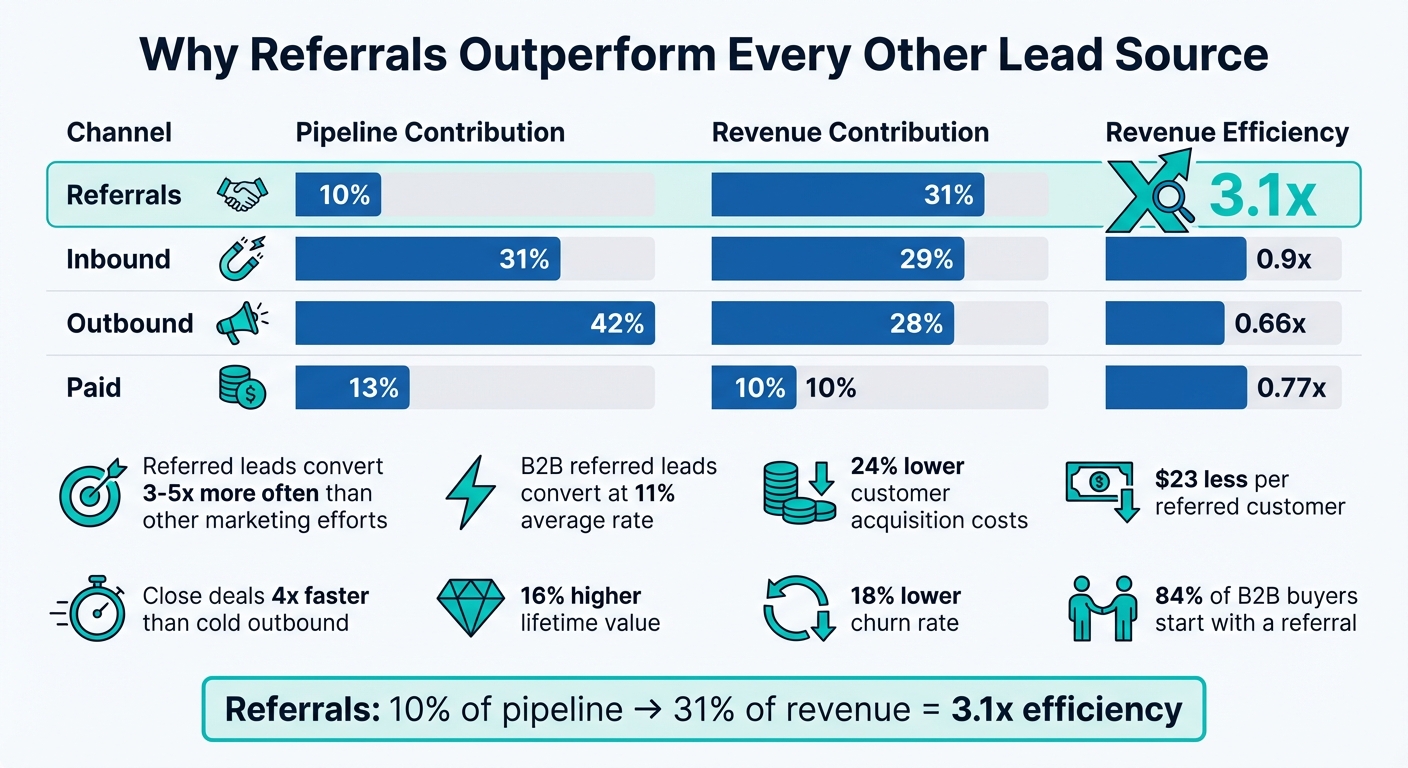
Referral vs Other Lead Sources: Revenue Efficiency Comparison
Building a referral pipeline doesn’t just boost numbers - it taps into the power of trust that comes with peer recommendations.
When stacked against cold outreach, paid ads, or inbound marketing, referrals deliver unmatched revenue efficiency. They may only account for 10% of your pipeline, but they generate a massive 31% of total revenue. That’s a 3.1x revenue efficiency, compared to outbound sales, which lag behind at just 0.66x. Simply put, every dollar invested in referrals delivers far more bang for your buck than traditional outbound methods.
Higher Conversion Rates and Lower Costs
Referrals don’t just bring in revenue - they convert at rates that leave other channels in the dust. Referred leads convert 3 to 5 times more often than leads from other marketing efforts. For B2B companies specifically, the numbers are even more striking: referred leads convert at an average rate of 11% and close deals four times faster than cold outbound leads. Why? Because referrals come with built-in credibility. Prospects trust the referrer, so they skip the awkward, time-consuming trust-building phase.
The financial perks are hard to ignore, too. Companies with structured referral programs cut customer acquisition costs by 24%. On average, acquiring a referred customer costs $23 less, and these customers tend to stick around longer, with a 16% higher lifetime value and an 18% lower churn rate.
| Channel | Pipeline Contribution | Revenue Contribution | Revenue Efficiency |
|---|---|---|---|
| Referrals | 10% | 31% | 3.1x |
| Inbound | 31% | 29% | 0.9x |
| Outbound | 42% | 28% | 0.66x |
| Paid | 13% | 10% | 0.77x |
But numbers only tell part of the story. The real magic lies in trust.
Trust and Peer Recommendations Drive Decisions
A staggering 84% of B2B decision-makers kick off their buying journey with a referral or recommendation. Peer recommendations are trusted twice as much as branded content or ads. When a respected colleague vouches for a solution, it immediately earns credibility, sidestepping the skepticism that often slows down other sales channels.
This trust factor is even more critical today. With inboxes flooded by AI-generated outreach and ad fatigue hitting its peak, buyers are increasingly tuning out unfamiliar sources. In fact, only 2% of people say traditional ads play a major role in their purchase decisions. Referrals, on the other hand, stand out because they come from trusted sources who are staking their professional reputation on the recommendation. Referrers don’t casually suggest solutions - they only recommend what they genuinely believe in. This means referred leads are not only high-intent but also a better match for your Ideal Customer Profile. They often skip drawn-out budget discussions, accelerating the sales process.
"Trust, not just targeting, is the real currency."
Finding the Right Referral Partners and Customers
Referrals can be a powerhouse for driving revenue, but their success hinges on targeting the right people. Not every customer or partner will deliver the kind of high-value referrals you need. The secret to a referral program that consistently delivers lies in carefully qualifying both your customers and your partners.
Define Your Ideal Customer Profile (ICP)
Your Ideal Customer Profile (ICP) serves as the foundation for identifying customers who are not only likely to succeed with your product but also to advocate for it. Companies that define their ICP well are 50% more likely to attract new customers and see 68% higher account win rates compared to their competitors.
Start by examining your top 20% of customers. Look for patterns such as high Lifetime Value (LTV), Net Revenue Retention (NRR) of at least 120%, and quick adoption of key features. A strong ICP typically considers three essential factors:
- Pain Intensity Matrix: Assess how severe and frequent the customer's problems are. For instance, in 2025, Vymo partnered with RevvGrowth to target financial institutions struggling with daily sales tracking (Pain Severity: 9/10). This focus boosted their MQL-to-SQL conversion rate from 4.5% to 18%, generating a $41.5 million marketing-sourced pipeline.
- Operational Readiness: Evaluate if the customer has the infrastructure, internal advocates, and resources to succeed. Docsumo, for example, tackled a low 0.7% conversion rate in 2025 by aligning product demos with customer timelines for value realization. This approach increased their conversion rate to 2.5% and doubled their opportunities.
- Value Realization Timeline: Target customers who can achieve a "first success" within a standard timeframe - typically 14 to 30 days for moderately complex tools. This prevents referred leads from stalling in lengthy implementation cycles.
Equally important is defining an Anti-ICP. By analyzing churned customers and failed implementations, you can identify red flags like missing technical requirements or poorly defined success metrics. By 2025, 75% of companies are expected to intentionally avoid poor-fit customers. This saves time and protects your reputation.
"The difference between a good customer and a great customer is rarely luck – it's strategic qualification."
To help referral partners send you the right leads, provide a clear "Who to Refer" guide. Include specific phrases they might hear from potential customers, such as "We're scaling but drowning in operations". This ensures your pipeline stays focused on high-quality opportunities.
Choose Partners Who Reach Your Audience
Once your ICP is solid, the next step is to partner with people who can extend your reach. The best referral partners are those who serve your ICP but offer complementary, non-competing services. For example, a CRM specialist might partner with a sales trainer, or a startup advisor could refer clients to a growth consultant. These partnerships work because they address different needs for the same customer at various stages of their journey.
An example of this in action comes from 2026 when a CRM implementation specialist named Leandro realized his direct sales efforts had hit a ceiling at $100,000 per month. By identifying complementary partners, Leandro onboarded four key collaborators, increasing revenue by 67% in just 16 weeks.
When evaluating potential partners, focus on three key factors:
- Customer Overlap: Do they already work with your ICP?
- Trust Transfer: Will their recommendation carry weight with potential customers?
- Operational Fit: Are they professional and easy to collaborate with?
Take Aircall, a cloud-based call center platform, as an example. In 2024, they used PartnerStack to manage their "Introducer" referral program. Partners submitted leads through a portal, answering specific qualifying questions about technical integration needs. This approach led to a 3,900% increase in partner-driven business, which now accounts for over 20% of Aircall's revenue.
To find the right partners, look for those who engage with customers just before or after your services are needed. For SaaS companies, reviewing your technology stack can help identify businesses offering complementary integrations. Their sales teams often make excellent referral partners. Interestingly, 72% of companies facing revenue stagnation lack a systematic partnership strategy, highlighting how critical this step is.
"Referrals happen when three things are true: The referrer trusts you, they clearly understand who you help and how, and it is easy and safe for them to introduce you."
Finally, create an Ideal Partner Profile (IPP) to streamline your recruitment efforts. Include details like industry focus, audience size, location, and business model. This ensures you're spending your time on partnerships that align with your goals.
How to Build a Referral System That Scales
Turning occasional referrals into a steady stream of revenue doesn’t have to be overly complicated. It comes down to three core elements: motivating rewards, easy-to-use tools, and collaborative marketing efforts. Once you’ve identified the right partners and customers, the next step is structuring your referral process so it can grow effectively.
Here’s a compelling statistic: companies with formal referral programs see conversion rates that are 71% higher than those without one. And no, you don’t need a massive budget or fancy software to make it happen. What you do need is a clear understanding of partner motivations, a seamless process, and a focus on creating mutual wins.
Set Up Rewards That Motivate Referrals
The right incentives can turn casual introductions into consistent, high-quality referrals. In B2B settings, two-sided rewards - benefiting both the referrer and the new customer - tend to outperform single-sided models. Why? They not only make the referrer look good but also offer immediate value to the person being referred.
Think beyond basic cash commissions. Tiered reward systems, for instance, can encourage higher performance by increasing payouts as partners hit milestones. Imagine rewarding partners more generously as they bring in 10, 50, or even 100 referrals. As Blossu puts it:
"A single reward offers no incentive for a high-performing partner to generate 100 referrals instead of 10. Tiered structures solve this by aligning rewards with contribution."
For industries with long sales cycles, consider offering smaller rewards tied to milestones, like a bonus when a referral books a discovery call. Other options include product credits, free upgrades, early access to new features, or even charitable donations for partners who prefer non-cash incentives.
Transparency is key here. Partners should have access to real-time dashboards to track their referrals, conversions, and pending payouts. Using tools like Partner Relationship Management (PRM) software integrated with payment systems like Stripe ensures timely and accurate payouts. When partners trust that their contributions are handled professionally, they’re far more likely to keep referring.
Give Partners the Tools They Need
Even the most motivated partner won’t stick around if the referral process is clunky or confusing. That’s why simplicity is everything. Start by providing a partner enablement kit that includes your Ideal Customer Profile (ICP), an overview of your service, key buying signals, and ready-to-use email templates. For example, train partners to spot comments like, “We’re scaling but drowning in operations,” or “Revenue is up, but I’m working 70 hours a week.”
Make it easy for them to take action by offering pre-made marketing materials like co-branded email templates, LinkedIn messages, social media graphics, and case studies. These tools allow partners to share referrals without having to create custom messaging. You can also simplify lead submissions with no-login forms through platforms like Typeform or Jotform.
To keep the program top-of-mind, provide each partner with a personalized UTM link for tracking and a monthly “Referral Ready” card summarizing ideal prospects. For example, the card might say, “If your customer uses 3+ vendors for unified communications, they’re a fit.”
Finally, automate updates to maintain engagement. When a partner submits a lead, send an immediate notification confirming receipt and provide updates as the lead progresses. This level of communication builds trust and keeps partners invested in your success. After all, 84% of B2B buyers start their journey with a referral.
Run Joint Marketing Programs
Taking it a step further, collaborative marketing efforts can deepen relationships and expand your reach. Strong referral partnerships aren’t just about exchanging leads - they’re about building trust and positioning both parties as experts. Joint marketing programs, like co-hosted webinars or co-branded content, can make referrals feel natural rather than transactional.
For example, a CRM specialist and a sales trainer might co-host a webinar on “Building a Scalable Sales Process,” addressing different challenges for a shared audience. Attendees from this event then become warm leads for both businesses.
Co-branded materials like case studies, whitepapers, or blog posts are another effective way to extend your reach. Partners can use these resources to engage their networks while showcasing your expertise. Event partnerships, whether virtual or in-person, also provide opportunities for deeper connections and higher-quality leads.
The secret sauce here is reciprocity. When you actively promote your partner’s services to your audience, they’re more likely to return the favor. In some cases, partners even prefer receiving leads over monetary rewards. This mutual exchange turns a basic referral program into a strategic partnership that benefits both sides and creates a more reliable pipeline for growth.
Use Automation and AI to Scale Your Referral Program
Once your referral system is up and running, the next hurdle is scaling it without bogging yourself down in manual work. This is where automation and AI step in, taking over repetitive tasks so you can focus on building meaningful, high-value relationships.
Scaling efficiently is critical, especially since many B2B companies only manage to ask 10–20 customers per quarter for referrals due to time constraints. AI changes the game here. Take Ian Myers, founder of Oceans, as an example. He grew his outsourcing business to over $15 million in revenue in just three years, largely thanks to an automated referral engine built within HubSpot CRM - without relying on traditional advertising. The magic wasn’t just in having a referral program; it was in automating every step to ensure consistent execution. AI also plays a key role by optimizing the timing and personalization of these processes.
Automate Referral Campaigns with AI
AI tools are incredibly effective at identifying the right customers to ask for referrals, figuring out the best time to make the ask, and even crafting personalized messages. For starters, AI can use promoter identification scoring to monitor customer signals such as NPS scores of 9–10, positive support interactions, product usage milestones, or even social media activity. This allows the system to pinpoint customers who are ready to refer.
Once a customer hits a milestone - like resolving a support issue or achieving a measurable success - AI can trigger a personalized referral request within 48 hours. This approach often leads to response rates of 25–35%, compared to the 5–10% seen with generic, quarterly requests. Personalization is key here. Generative AI can tailor messages to include specific achievements, such as, “You saved 20 hours this month using our platform,” making the request feel relevant and genuine. Some tools even go a step further by mapping a customer’s LinkedIn connections to your target accounts, allowing you to ask for a specific introduction instead of a generic referral.
AI doesn’t stop at the initial ask - it ensures ongoing engagement throughout the referral process. Automated systems can handle follow-ups, sending thank-you notes immediately after a referral, nudging customers if an introduction hasn’t been made within five days, and updating them when their referral progresses in the pipeline. These consistent touchpoints keep the momentum going and show customers that their efforts are appreciated. As Rob Rebholz, an expert in partner automation, puts it:
"Automation multiplies capacity: it handles repeatable, predictable tasks so your people can focus on the highest-value work."
For businesses already using tools like HubSpot, Pipedrive, or Salesforce, integrating AI into these systems eliminates the need for manual data entry. For example, Flowbird linked Pipedrive with ActiveDEMAND to automate lead nurturing during live conversations, reducing lead drop-offs and boosting business by 23%. The goal is to create a seamless workflow where referral tracking, attribution, and status updates happen automatically in the background.
Track the Right Metrics
Automation only works if you’re keeping an eye on the right numbers. To build a scalable referral program, focus on metrics like referral volume, conversion rates, win rates, pipeline velocity, and overall deal value. For example, velocity measures how quickly referred deals move through your sales pipeline - referrals can often shorten sales cycles by 30% to 50% in early-stage SaaS companies.
Even if referrals make up just 10% of your pipeline, they can account for 31% of your revenue, making them about three times more efficient than outbound channels. If you’re not tracking these metrics, you’re missing out on insights into your most effective revenue source.
Set up your CRM to enforce referral attribution from the start by requiring a "Lead Source" field for every new deal. Use calculated properties to track metrics like total deals referred, win rates, and average deal size in real time. Build dashboards to highlight your top-performing partners based on revenue impact and close rates.
Engagement tracking is equally important. If a partner hasn’t made a referral in 90 days, trigger a reactivation sequence with a quick check-in. Similarly, set up alerts for stalled deals from partner referrals, so you can loop the partner back in to re-engage the prospect. Regular tracking not only keeps everyone accountable but also helps refine your referral strategy over time.
Conclusion
Building a referral system isn’t about wishful thinking - it’s about creating a structured process that guarantees results. Start by defining your Ideal Customer Profile (ICP) so your partners know exactly who to refer. Next, connect with complementary businesses that already engage your target audience. Equip these partners with tools that make referring seamless, and offer clear incentives to motivate their efforts. Finally, track every referral in your CRM to maintain visibility and accountability.
While referrals might only make up 10% of your pipeline, they punch above their weight, delivering up to 31% of total revenue and slashing sales cycles by 30% to 50%. Why? Because referred prospects come to the table with trust already built.
Growth thrives on systems, not chance. 72% of businesses stuck in a plateau lack a structured partnership strategy. Don’t fall into that trap. Treat referrals as a core part of your Go-to-Market strategy, complete with dedicated resources, defined workflows, and consistent follow-through.
If you’re ready to transform referrals into a reliable growth engine, RevBoss has you covered. Our approach focuses on building relationships, growing ICP-rich networks, and crafting campaigns that turn warm introductions into meaningful conversations. We take care of content creation, audience building, and activation workflows so you can focus on closing deals.
Schedule a consultation to see how RevBoss can help you scale your referral system - starting at $1,500/month with no long-term contracts. Let’s turn word-of-mouth into measurable, predictable growth.
FAQs
How do I pick the right referral partners?
To build a strong referral network, partner with individuals or businesses that already have the trust of your target audience. Look for those who maintain established relationships in your market - this could include happy customers, consultants, agencies, or vendors offering complementary products or services. Focus on collaborators who share your ideal customer profile (ICP), genuinely care about providing value to their clients, and hold credibility and influence within your industry.
What rewards work best for B2B referrals?
The most effective rewards for B2B referrals often include tangible incentives such as cash bonuses, exclusive perks, or charitable contributions. These types of rewards not only motivate partners but also help nurture lasting relationships. It’s important to choose rewards that align with your business objectives and reflect the values of your partners, ensuring they feel appreciated while reinforcing mutual goals.
What should I track to prove referrals are working?
To show that referrals work, focus on tracking a few key metrics: how many leads or customers come through referral channels, the consistency and volume of referrals over time, and how well referred leads convert compared to other sources. You should also look at the revenue brought in by referrals to gauge their contribution to your growth. Tools like CRMs or automation platforms can help you keep tabs on these numbers and fine-tune your referral strategy as needed.