From Posts to Pipeline: 12 Campaign Ideas That Convert Warm Connections into Sales Conversations

Stuck turning LinkedIn likes and email subscribers into sales calls? You're not alone. Most founders face the same gap: warm leads that never make it to the pipeline. Here's the fix: personalized outreach, smarter campaigns, and human-first tactics. Think custom Loom videos, LinkedIn polls, and trigger-based emails that actually spark conversations.
Here’s what you’ll learn:
- Turn LinkedIn engagement into leads: Use profile views, comments, and polls to start real conversations.
- Personalized outreach that works: Tailored emails, multi-channel sequences, and AI research with a personal touch.
- Content that nurtures leads: Frameworks, webinars, and interactive tools to build trust over time.
- Event strategies for quick wins: Skip the booth and focus on small, focused gatherings for high-impact connections.
The takeaway? Speed, personalization, and structure turn warm leads into booked meetings. Let’s break it down.
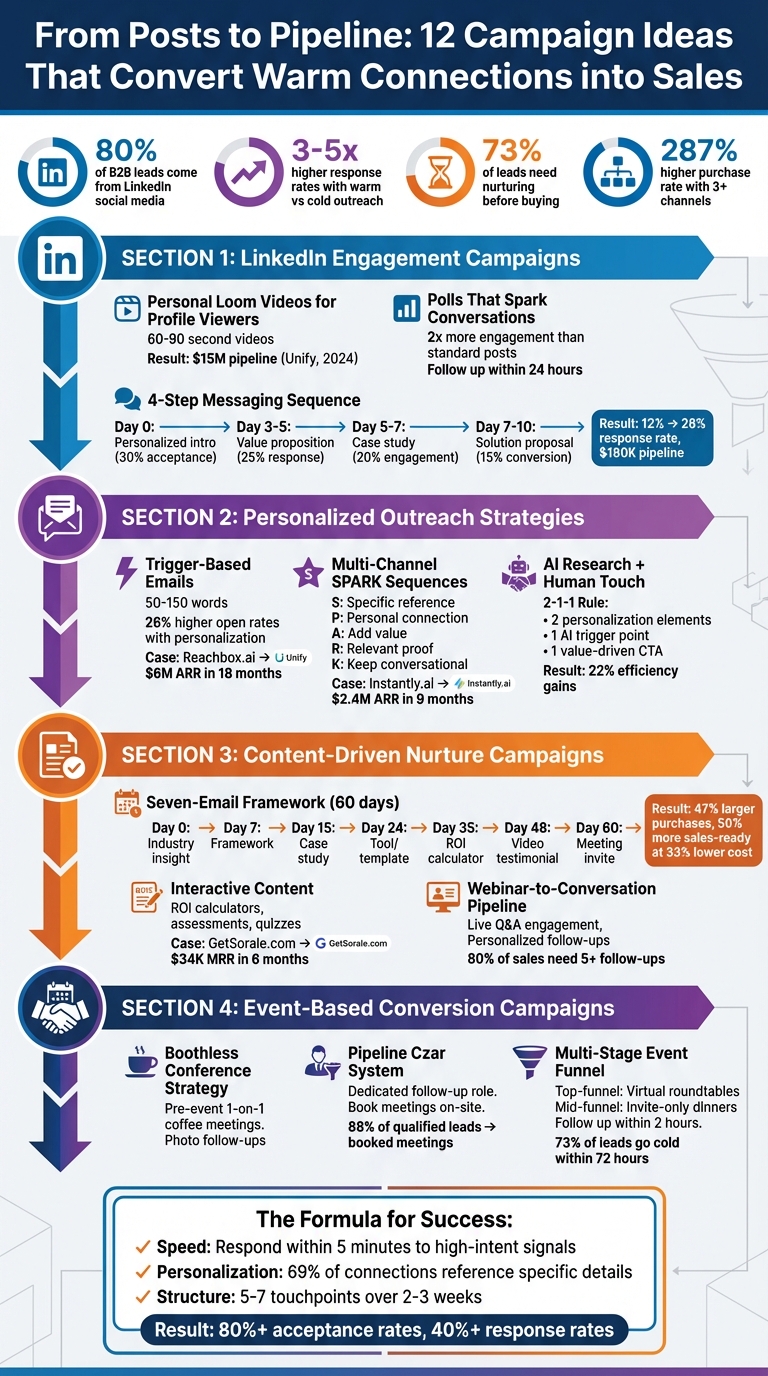
12 Campaign Ideas to Convert Warm Leads into Sales Conversations
How To Convert B2B LEADS Faster | 3 Powerful Tips and Strategies
sbb-itb-9354cf2
1. LinkedIn Engagement Campaigns
LinkedIn drives a whopping 80% of all B2B leads generated via social media. Yet, many founders miss out on the goldmine of warm signals sitting right in their notifications. Think about it: profile views, poll votes, and post comments aren't just interactions - they're intent signals from people who are already curious about you. The key? Turn these micro-moments into real conversations.
Idea 1: Personal Loom Videos for Profile Viewers
When someone checks out your LinkedIn profile, it's like a digital wave - they're showing interest. Instead of sending a generic connection request, why not stand out with a 60-90 second Loom video? Mention something specific from their profile, like a recent post, a shared connection, or a milestone they’ve achieved. Toss in a quick tip or insight tailored to their role, and wrap up with a soft call-to-action like, “Would love to hear your thoughts on this.”
This approach bridges the gap between your LinkedIn presence and email outreach. It's not just theory - Unify used this exact strategy in 2024 to pull in $15 million in pipeline by tracking social engagement and layering it into a multi-channel follow-up.
Idea 2: Polls That Spark Conversations
LinkedIn polls? They’re engagement magnets, pulling in twice the interactions of standard text or image posts. Even better, they’re not anonymous - you can see who voted and what they chose. This makes polls a sneaky-good way to build a pre-qualified lead list.
Here’s how to make it work: ask about an industry pain point, like “What’s your biggest challenge in scaling outbound?” Always include an "Other (tell us in comments)" option. This invites high-intent leads to share qualitative insights and kick off public discussions. Then, follow up fast - within 24 hours. Send a quick thank-you message or share a resource like an ROI calculator or template to keep the conversation flowing.
Idea 3: A 4-Step Messaging Sequence That Converts
For structured follow-ups, a 14-day messaging sequence can work wonders. Intercom nailed this in Q2 2023, boosting response rates from 12% to 28% and generating 45 qualified leads worth $180,000 in pipeline value. Here’s the breakdown:
- Day 0: Start with a personalized introduction from the founder (30% acceptance rate).
- Day 3-5: Share a value proposition (25% response rate).
- Day 5-7: Follow up with a relevant case study (20% engagement rate).
- Day 7-10: Wrap up with a specific solution proposal (15% conversion rate).
The secret sauce? Properly spaced touchpoints and personalization. In fact, 69% of accepted connection requests reference specific profile details. Avoid cookie-cutter templates - people can spot those a mile away.
2. Personalized Outreach Strategies
Once you've captured engagement signals on LinkedIn, it's time to take things further with tailored outreach strategies. Warm leads already have some familiarity with you - they’ve grabbed your playbook, joined your webinar, or interacted with your content. This familiarity gives you a solid advantage, with 3x–5x higher response and conversion rates compared to cold outreach. But here’s the catch: 73% of B2B buyers actively avoid suppliers who send irrelevant outreach. The secret to bridging the gap between a response and being ignored? Personalization. It’s about acknowledging their specific actions and addressing their challenges directly. These strategies will help turn warm leads into meaningful conversations, all while staying true to a founder-led, human-first marketing approach. Let’s dive into tactics like tailored emails, multi-channel sequences, and blending AI insights with a personal touch.
Idea 4: Trigger-Based Emails That Deliver Value
Instead of jumping straight to a meeting request, start by offering something useful. For instance, if someone downloads a resource or checks out your pricing page, follow up with a short and thoughtful email (50–150 words). Reference their action and share something relevant, like an ROI calculator, a quick video walkthrough, or a case study. Here’s a success story: Reachbox.ai reached $6 million in ARR in just 18 months by using this approach. CEO Allan Duza sent ultra-personalized emails, often including custom videos tailored to each prospect’s company, along with three actionable growth tips. Unlike generic outreach, this method ties directly to what the prospect has already done. The key? Keep the focus on their needs. Even small touches like personalized subject lines can make a difference - they’re 26% more likely to be opened.
Idea 5: Multi-Channel "SPARK" Sequences
Using multiple channels can dramatically improve results. Campaigns that incorporate three or more channels see a 287% higher purchase rate. Enter the SPARK method:
- Specific reference to their recent activity
- Personal connection
- Adding value with a resource
- Relevant social proof
- Keeping it conversational
Spread these touchpoints across email, LinkedIn, and even voice notes, with 2–4 days between each step. This multi-channel approach builds on earlier LinkedIn and email strategies, creating a seamless outreach system. For example, Instantly.ai scaled to $2.4 million in ARR in nine months with a direct message like: “Hey [Name], we built a tool that helped us hit 100k MRR in just a few months. Want to see if it could work for you too?”. Simple, direct, and highly effective.
Idea 6: AI-Powered Research + Human Touch
Let AI handle the heavy lifting - like tracking LinkedIn for trigger events such as job changes or new funding - so you can focus on crafting authentic messages. Use the "2-1-1" rule:
- 2 personalization elements (like their name and company)
- 1 trigger point from AI research (e.g., “Congrats on hiring a new VP of Sales”)
- 1 value-driven line with a soft call-to-action, such as “Worth exploring?”
Keep your emails concise (under 150 words). Let AI draft the initial message, but always refine it to ensure it sounds natural and genuine. While mature AI marketers report 22% efficiency gains in their processes, the real magic comes from adding that final human touch. It’s the balance of automation and authenticity that truly resonates.
3. Content-Driven Nurture Campaigns
Did you know that only 27% of B2B leads are ready to buy right away? That leaves a whopping 73% who need more time and nurturing before they're prepared to make a decision. Instead of rushing to secure a meeting, focus on delivering ongoing value and building trust. The results speak for themselves: nurtured leads tend to make purchases that are 47% larger compared to those who aren’t nurtured. Plus, companies that prioritize nurturing see 50% more sales-ready leads at 33% lower costs. By using tailored content to guide prospects, you can transform early interest into meaningful sales conversations.
Idea 7: The Seven-Email Framework
After your initial outreach, nurture your leads with a structured email sequence designed to build trust and interest over 60 days. Here’s how it works:
- Day 0: Kick things off with an industry insight or by highlighting a common challenge to grab attention.
- Day 7: Share a framework or methodology to showcase your expertise.
- Day 15: Send a case study that proves your solution works.
- Day 24: Offer a practical tool or template they can use right away.
- Day 35: Provide an ROI calculator or assessment to personalize the value of your solution.
- Day 48: Share a 90-second video testimonial to build credibility and trust.
- Day 60: End the sequence with a direct invitation to connect for a conversation.
This method works because 68% of B2B buyers prefer vendors who consistently deliver relevant, helpful content. The key is to focus on your prospect's needs and provide value instead of pushing for a hard sell.
Idea 8: Interactive Content That Gathers Intel
Interactive tools like ROI calculators, assessments, or quizzes are a great way to engage prospects while learning more about their specific needs. For example, an ROI calculator can help them see potential savings or revenue increases while giving you insights into their budget or timeline.
Take a page from Yash Siobhan, CEO of GetSorale.com. In 2025, he grew his Monthly Recurring Revenue (MRR) to $34,000 in just six months by sending personalized Loom videos of Figma mock-ups to influencer marketing managers on LinkedIn. Instead of pitching, he asked for feedback, which lowered resistance and opened doors for conversations. Framing your outreach as advice rather than a sales pitch can make all the difference.
Idea 9: Webinar-to-Conversation Pipeline
Live webinars are a fantastic way to showcase your expertise while engaging directly with prospects. Use the Q&A and chat features to build connections in real time. But the real magic happens after the event. Send personalized follow-ups referencing specific questions they asked or topics they engaged with.
For those who registered but didn’t attend, share the recording with a note like, "I saw you couldn’t make it - here’s the session. The segment at 18:32 on [specific topic] might be especially useful for your business." This approach keeps the conversation going for both attendees and no-shows. And remember, persistence pays off: 80% of sales require at least five follow-up attempts. Use additional resources, case studies, and meeting invites to keep the momentum alive.
4. Event-Based Conversion Campaigns
Events - whether virtual or in-person - can turn warm connections into meaningful sales conversations, but only if you act fast. Research shows that 73% of B2B event leads go cold within just 72 hours. So, timing and a clear plan matter far more than flashy booths or polished presentations.
Interestingly, the most effective strategies aren’t always the priciest. Small, focused gatherings, like a dinner for six, can generate six-figure pipelines. Nicola Anderson from CMO Circle emphasizes this point:
Start small. A six-person dinner can drive six figures in pipeline.
Top-performing B2B companies understand this well. They convert 88% of qualified event leads into booked meetings by using structured follow-up strategies. These methods bridge digital engagement with real-world interactions, reinforcing trust - a cornerstone of founder-led marketing. Here’s how you can bring this approach to life.
Idea 10: The "Boothless" Conference Strategy
Skip the costly booth setup at major conferences. Instead, focus on pre-event outreach to arrange one-on-one coffee meetings with high-potential prospects who are attending. Tools like Calendly or QR codes make it easy to lock in these meetings on the spot. For an extra personal touch, snap a photo during your conversation and include it in your follow-up email. This small gesture makes your outreach stand out and harder to ignore. By prioritizing individual connections, you can spark meaningful conversations without the need for a booth.
Idea 11: The Pipeline Czar System
At your event - whether it’s a booth, dinner, or roundtable - assign one person as the "Pipeline Czar." Their sole responsibility is ensuring that no high-fit prospect leaves without a follow-up meeting scheduled. Use voice recording tools right after each conversation to capture details and log them into your CRM while the information is still fresh. Better yet, book the next meeting during the conversation itself. This role keeps your follow-up process organized and ensures no opportunity is missed.
Idea 12: The Multi-Stage Event Funnel
Different events serve different purposes, so structure them accordingly. For top-of-funnel efforts, host virtual roundtables or community breakfasts to explore key challenges and establish credibility. For prospects further along the funnel, organize invite-only dinners where they can interact with your happy customers and get a deeper sense of your value. Kartik Krishnan from Expedite GTM highlights the impact of these smaller events:
Digital is getting noisier and less effective. Micro-events let you handpick the right people, create a moment of value, and build trust at scale.
As with digital outreach, the success of these event strategies hinges on quick, personalized follow-up. Aim to follow up within two hours, referencing specific pain points or questions raised during the event. This immediacy shows you’re attentive and committed, making it easier to move the conversation forward.
Conclusion
Converting warm connections into productive sales conversations doesn’t have to be complicated or expensive. It boils down to three essentials: speed, personalization, and a structured approach. The 12 campaign ideas shared here are designed to help you act on the signals your prospects are already giving - whether it’s a comment on LinkedIn, a content download, or a quick chat at an event.
The numbers speak for themselves. Companies that respond to high-intent signals within five minutes experience significantly higher conversion rates. Multi-touch sequences - spanning 5–7 touchpoints over 2–3 weeks - keep you on your prospects’ radar without overwhelming them. And LinkedIn engagement-based outreach can deliver acceptance rates of over 80% and response rates above 40%. As Chaviva Gordon-Bennett from monday.com puts it:
Success is no longer about volume. It's about turning generic outreach into relevant, well-timed conversations that move prospects toward meetings and pipeline.
Start small by focusing on one or two campaigns that match where your warm leads are most active - be it LinkedIn, email, or events. Test your approach, monitor results, and tweak as needed. Use lead scoring to prioritize your efforts - target high-intent leads (scores of 80+) for immediate sales follow-up, while nurturing those in the 60–79 range. Automate processes to avoid delays, and tools like RevBoss can help scale personalized outreach, starting at $1,500/month.
When you deliver the right message at the right time, those warm connections turn into booked meetings, driving your pipeline forward.
FAQs
How can I use LinkedIn engagement to turn connections into sales leads?
To turn LinkedIn engagement into sales leads, focus on building real connections and trust. Start by personalizing your connection requests - be clear about why you're reaching out. A thoughtful, honest message not only improves acceptance rates but also helps you establish credibility right from the start.
Stay active by engaging with your prospects' posts. Leave meaningful comments, share insights, and join LinkedIn groups related to your industry. These actions position you as a knowledgeable and approachable professional, making it easier for potential leads to connect with you. Sharing content that’s both relevant and valuable to your audience keeps them interested and shows you understand their needs.
Lastly, combine personalized outreach with well-timed follow-ups to nurture these relationships. When you focus on genuine interactions and offering real value, sales conversations happen naturally.
What are the best personalized outreach strategies to boost response rates?
To get better response rates, focus on making your outreach personal and relevant. Tailor your messages to highlight the recipient's interests, needs, or recent accomplishments. For instance, when connecting on LinkedIn, mention something specific about their work or a shared interest - it’s a small effort that can lead to a big boost in acceptance rates.
Take advantage of AI tools to refine your messaging and timing. These tools can help you craft engaging messages and automate follow-ups while keeping the interaction authentic. Sharing helpful resources - like reports, templates, or guides - can also establish trust and encourage replies.
For even stronger results, use multiple channels, such as LinkedIn and email, to create a unified outreach strategy. Advanced prospecting tools can help you build precise contact lists, ensuring your messages reach the right people. By blending smart tech with a personal approach, you can spark meaningful conversations and turn warm leads into productive sales opportunities.
How can events help turn warm leads into sales conversations?
Event-based strategies can be a game-changer for turning warm leads into meaningful sales conversations. These approaches help build trust while opening doors for more personalized interactions. Hosting smaller, targeted events - like micro-gatherings, intimate meetups, or hybrid conferences - creates a setting where you can connect with potential clients on a deeper level.
Instead of pouring resources into large, impersonal events, focus on quality over sheer numbers. For instance, skip the pricey booths and opt for curated dinners or private meetups. These create space for authentic, impactful conversations, which are far more likely to lead to conversions. Combine these efforts with tailored follow-ups and digital outreach to fast-track your sales pipeline, transforming casual connections into real business opportunities.