Relationship-First Demand Generation: A Practical Playbook for B2B Teams

B2B buyers are overwhelmed. 77% of them find their purchasing process too complicated, thanks to endless sales pitches and generic outreach. The old-school spray-and-pray approach? It’s dead. Cold emails barely get responses, and buyers have learned to ignore impersonal noise.
The solution? Focus on relationships, not numbers. A relationship-first strategy prioritizes trust, personalized interactions, and quality over quantity. Here’s the kicker: while traditional cold outreach takes 300 activities for one meeting, relationship-based prospecting can do it in just 40 activities.
Key Takeaways:
- Trust wins: Buyers purchase from people they trust, not spammers.
- Quality over quantity: Engage fewer, higher-fit prospects with tailored outreach.
- Efficiency: Founder-led, personalized efforts drive faster results with fewer resources.
This playbook walks you through defining your ideal customer, mapping their journey, personalizing outreach, and activating multi-channel campaigns - all while measuring what actually builds trust. Let’s cut the noise and build connections that convert.
B2B Demand Generation Playbook Webinar
Step 1: Define Your Ideal Customer Profile and Relationship Goals
To build strong, purposeful relationships, you first need to identify who those relationships should be with. This starts with crafting a clear Ideal Customer Profile (ICP). Think of your ICP as the blueprint for deciding which companies are worth your time and effort. Without this clarity, teams end up wasting 60% to 70% of their outreach on the wrong prospects. For resource-strapped, founder-led teams, that's a loss you simply can't afford.
Once you've nailed down your ICP, shift your focus to setting relationship-centered goals. This means stepping beyond traditional metrics like email open rates or call volumes. Instead, prioritize trust-building activities - like engaging multiple stakeholders within buying committees or offering value-driven touchpoints. The payoff? An ICP-driven approach can boost MQL-to-SQL conversion rates by as much as 50%. Precision, in this case, beats sheer volume every time.
How to Build a Detailed Ideal Customer Profile
Start by examining your top 5 to 10 current clients - those with the highest Lifetime Value (LTV), fastest sales cycles, and lowest churn rates. These are your success stories, and they hold the clues to your future growth. Look for patterns across five critical areas:
- Firmographics: Industry, company size, revenue, and location.
- Technographics: Their existing tech stack and how well it aligns with your solution.
- Behavioral Signals: Events like executive hires or recent funding that might indicate readiness for change.
- Pain Points: Specific, costly challenges they face that your solution addresses.
- Relationship Fit: Alignment with your mission and potential for long-term collaboration.
"Your ideal customer profile defines the companies you should target, not the individuals within them."
To stay organized, create an ICP Scorecard. Assign weights to key attributes, such as Industry Fit (30%), Employee Count (25%), Tech Stack Compatibility (20%), and Pain Point Severity (25%). This helps you rank accounts systematically, allowing you to focus 80% of your resources on Tier-1 accounts - the ones with the highest scores across all categories.
Don’t forget to define an "Anti-ICP" - a clear picture of who isn't a good fit. This might include companies with limited budgets, those requiring extensive customization, or industries where your solution doesn't deliver clear results.
Lastly, watch for buying triggers that signal a prospect's readiness for change. These could include events like a new VP of Sales hire, a recent funding announcement, or rapid team expansion. Timing your outreach around these moments can significantly increase your chances of engagement.
With a well-defined ICP, you’re ready to set actionable, relationship-focused goals.
How to Set Relationship-Focused Goals
When it comes to building relationships, the goal is progression - guiding prospects from curious to informed to ready to buy through meaningful interactions. Instead of focusing on output metrics, set specific targets for trust-building activities.
For Tier-1 accounts, aim to engage at least 10 stakeholders across the buying committee with 20 personalized touchpoints over a 40-day period. Research shows that B2B buying groups often include 6–10 decision-makers. These typically include:
- The Champion: Your internal advocate.
- The Economic Buyer: Focused on ROI.
- Technical Influencers: Concerned with security and integration.
By engaging multiple stakeholders, you reduce the risk of your relationship hinging on a single contact.
Develop a targeted content package tailored to each stage of the buyer journey. Include:
- Symptom-related content: Highlight warning signs that signal the need for a solution.
- Solution-related content: Help them evaluate their options.
- Value proposition content: Show why your approach works.
- Customer stories: Provide proof of success.
Strategically deliver this content to guide prospects through their decision-making process.
Track relationship health indicators instead of vanity metrics. For example:
- The percentage of personalized emails that get responses within 30 days.
- The frequency of LinkedIn interactions with key stakeholders.
- The number of unique personas engaged within each target account.
These metrics reveal whether you’re truly connecting or just adding to the noise.
"Being precise in your understanding of your ICP is the cornerstone of high-impact demand generation."
Finally, treat your ICP as a living document. Review and update it every 3 to 6 months based on data from wins, losses, and market changes. As your business evolves and you gain insights into what drives customer success, your ICP should evolve too. Regular updates ensure your relationship goals remain aligned with shifting market dynamics.
Step 2: Map the Buyer Journey for Relationship Building
After defining your ideal customer profile (ICP), the next step is to understand how potential buyers move from recognizing a problem to becoming advocates for your solution. B2B buying is rarely quick or straightforward - it often involves multiple stakeholders and can take anywhere from 6 to 18 months. The key is to focus on building meaningful relationships at critical points in the buyer journey, rather than forcing prospects through a rigid sales funnel.
Think of the buyer journey as a customer-first process, not something dictated by your internal campaign calendar. This shift in perspective can be incredibly effective: nurtured leads generate 50% more sales while cutting costs by a third compared to leads that aren't nurtured. Using your ICP and relationship goals as a foundation, mapping the buyer journey helps you pinpoint the best opportunities for personalized engagement.
The 4 Buyer Journey Stages
To connect with buyers effectively, you need to understand the stages they go through. Each stage represents a shift in their needs and how they want to engage.
Awareness marks the starting point. This isn’t about a prospect landing on your website - it’s triggered by an event, like a missed forecast, a tense board meeting, or a security breach. At this stage, buyers are identifying problems and exploring trends. Your role? Educate, don’t sell. Share thought leadership pieces, industry reports, or engage with them on LinkedIn to establish credibility and trust.
Consideration is when buyers start exploring solutions. But with 77% of B2B buyers saying their last purchase was complex or overwhelming, your job is to simplify their decision-making process. Offer content that cuts through the noise - ROI calculators, comparison guides, or webinars can help. This is also your chance to build trust by proving your expertise.
Decision is where buyers evaluate vendors and rally internal support for their choice. With 75% of buyers preferring a rep-free experience, your focus should be on empowering your internal champion. Equip them with tools like security documents, implementation plans, and tailored business cases. Digital Sales Rooms (DSRs) can be a game-changer here; PagerDuty saw 46% higher adoption of DSRs by integrating them into their sales process. Since many deals stall during this stage, addressing objections head-on is crucial.
Advocacy begins post-sale and is vital for long-term success. Even a small 5% increase in customer retention can boost revenue by 25% to 95%. Plus, referred leads are 3–5 times more likely to convert than cold outreach. However, unhappy customers rarely voice their dissatisfaction - only 1 in 26 will complain, while the rest quietly churn. Focus on creating standout moments, like celebrating a successful implementation, to ask for referrals, testimonials, or co-marketing opportunities.
Where to Build Relationships in the Buyer Journey
Once you’ve outlined the stages, it’s time to align your relationship-building efforts with each one. Keep in mind that up to 90% of the B2B buyer’s journey happens before they ever reach out to sales. By mapping out these stages, you can ensure every interaction strengthens trust and reinforces your relationship-first approach.
In the Awareness stage, focus on building credibility from the get-go. Spend 15 minutes daily commenting on LinkedIn posts from key prospects to establish rapport. Share content like industry reports or thought leadership pieces that address their challenges. For example, Fal.ai offered free access to its AI tools, attracting over 500,000 developers and driving its revenue run rate to nearly $10 million in under a year.
During the Consideration stage, create a "Content Capsule" with 2–3 targeted pieces that address symptoms, solutions, and proof points. Personalized video messages can also be effective - use them to walk prospects through case studies or ROI calculators. Vapi, a voice AI platform, used this strategy and saw rapid growth, reaching millions in revenue and over 100,000 developers within six months of launching its self-serve product.
"The true purpose of lead nurture is progression. That is, moving a lead from one meaningful state of readiness to the next. From curious to informed. From passive to engaged."
In the Decision stage, remove barriers for your internal champion. A personalized Digital Sales Room can serve as a one-stop shop for buying committees, housing proposals, security documents, and implementation plans. Transparency around pricing and next steps can help avoid common roadblocks that delay deals.
For Advocacy, focus on moments when customers are most satisfied, like right after a successful implementation. This is the perfect time to ask for referrals or testimonials. With 83% of customers willing to provide a referral if asked at the right time, timing is everything. DataHub, for instance, built a Slack community that grew to nearly 14,000 members by 2020. By leveraging this community, they secured a $35 million Series B in 2021, supported by champions from companies like Netflix and Visa.
Lastly, remember that modern B2B deals involve multiple stakeholders. Map out the buying committee - C-suite executives, technical evaluators, end users, and financial decision-makers - and tailor your approach for each group. Coordinated tactics like LinkedIn engagement, personalized videos, and retargeting ads can deepen relationships across the board, ensuring you’re building meaningful connections with everyone involved.
Step 3: Personalize Outreach with Founder-Led Content and AI
After mapping the buyer journey, the next step is turning those insights into meaningful, personalized outreach. The challenge? Making your messages feel genuine, even when scaling. Founder-led content is a game-changer here. Your unique perspective and direct connection to customer pain points offer an edge that automated platforms or SDRs simply can't replicate. This approach has been key for many startups scaling from $0 to $1 million. But let’s be real - you can’t write every message yourself. The solution lies in combining AI with your personal touch: let AI handle the bulk of the work, and you step in for a quick human edit to keep the tone personal and authentic.
The stats underline this need: 77% of B2B buyers expect personalized content, yet only 25% feel vendors deliver it. Personalization isn’t about faking familiarity - it’s about showing you understand what matters to them right now. Signals like a new hire, a funding announcement, or a tech stack update can guide your approach.
How to Create Founder-Led Content
Your voice as a founder is a powerful tool for building trust, especially in the early stages of the buyer journey. LinkedIn is a great place to start. Engage with posts from key prospects and share content that addresses their challenges. This could include industry insights, lessons from your own journey, or even bold takes that spark discussion. By being consistent and genuine, you strengthen the trust you’ve built through earlier relationship-focused strategies.
Take Yash Siobhan, CEO of GetSourl.com, as an example. In 2025, before even writing a single line of code, he used Loom videos of Figma mock-ups to gather feedback from influencer marketing managers on LinkedIn. This personal, founder-led approach helped him pre-sell his software to five customers at $99 each and scale to $34,000 in monthly recurring revenue within six months.
Email newsletters are another valuable tool for founder-led content. Unlike generic marketing emails, newsletters written by founders position you as a trusted advisor. Keep the tone conversational and focus on educating your audience - share what you’re learning, the challenges you’re tackling, and the trends you’re noticing. This builds visibility and makes your eventual outreach feel more natural and warm.
For high-value accounts, consider personalized video messages. Allan Duza, CEO of Reachbox.ai, used this strategy to grow his platform to $6 million in annual recurring revenue in just 18 months (ending October 2025). He sent custom video emails to SaaS companies, outlining three specific ways they could gain more customers using his platform. While this level of effort is time-intensive, it pays off for strategic Tier A accounts.
"You can't outsource your way to $1M."
To keep your outreach focused, try the "3-Bullet Talk Track":
- A personalized hook based on a real signal
- A relevant pain point tied to their role or industry
- An open-ended question to spark conversation
For example: "Congrats on hiring a new VP of Sales! Curious how you’re planning to ramp them on your outbound strategy. Are you seeing any friction with your current process?"
How to Scale Personalization with AI
AI can amplify your efforts by handling research, data enrichment, and initial drafts. The 80/20 rule works well here: let AI do 80% of the heavy lifting, and you or your founder spend a few seconds tweaking the message to ensure it feels personal and relevant. This approach keeps your outreach timely and aligned with the relationship-first strategy from earlier steps.
Start by organizing your CRM with key fields that AI can reference. Include details like:
- Trigger Event (e.g., "Hired new VP of Sales")
- Tech Stack (e.g., "Uses HubSpot")
- Persona Pain (e.g., "Low SDR productivity")
- Company Goal (e.g., "International expansion")
These data points allow AI to craft messages that answer the question prospects often have: "Why are you reaching out to me today?".
Platforms like RevBoss help founder-led teams scale this approach across email and LinkedIn. Instead of blasting mass emails, focus on micro-campaigns of 100–200 leads centered on a single trigger, such as companies that recently raised Series A funding or hired a new CMO. This keeps your messaging sharp and helps you spot patterns quickly.
Tiered personalization is essential for managing your time and resources effectively. Not every account needs the same level of effort:
| Account Tier | Personalization Depth | Outreach Strategy |
|---|---|---|
| A (Strategic) | Trigger + Persona Hypothesis + Tailored Proof Point | Coordinated Email, Call, and LinkedIn |
| B (Mid-Market) | Trigger or Industry Signal + Persona Angle | 1–2 custom lines generated programmatically |
| C (Long-tail) | Segment-based template with light context | Prioritize learning over deep research |
For instance, Fullfunnel.io used LinkedIn engagement triggers during their first year (ending 2025) to target people who interacted with their content. This resulted in an 80% connection acceptance rate, a 40% response rate, and 61 inbound deals worth five figures each. Similarly, Instantly.ai reached $2.4 million in annual recurring revenue in just nine months by leveraging their own cold outreach tool with a straightforward message: "Hey [Name], we built a tool that helped us get to $100k MRR in a few months. Want to see if it can do the same for you?".
AI can also help you identify key signals that show you're tuned into what matters to prospects right now. As the Predictable Revenue team says: "AI assists. You direct".
"It's not the volume that kills trust, it's pretending you know them when you clearly don't."
Finally, analyze your wins. Look at your last three closed deals to find the signal that led to the initial call - a job change, a tech stack update, or a funding announcement. Use these insights to guide your next campaign.
Once your personalized outreach is dialed in, the next step is activating these connections across multiple channels to deepen engagement.
sbb-itb-9354cf2
Step 4: Run Multi-Channel Activation Campaigns
Getting personal with your outreach is just the start. To truly connect, you need to meet prospects where they are - whether that’s LinkedIn, email, industry events, or your own content platforms. Adding even one extra touchpoint, like LinkedIn, to an automated email sequence can increase meeting bookings by 14%. When you mix in manual emails, phone calls, and LinkedIn interactions, that number jumps to 24%. These multi-channel strategies build on personalized outreach, ensuring your message consistently fosters trust and keeps engagement alive.
The trick is staying consistent without crossing into pushy territory. Half of all B2B sales only happen after the fifth follow-up. But this doesn’t mean bombarding people; it’s about delivering ongoing value through various channels over time. For instance, in 2024, BuildingConnected sent over 1,000 handwritten letters to their top prospects. The result? More than 200 callbacks and a response rate above 20%. This thoughtful, physical touchpoint, combined with digital efforts, helped them cut through the noise. The goal here is clear: build genuine, trust-based relationships throughout the buyer’s journey.
Multi-Channel Strategies for Better Engagement
Start with LinkedIn as your go-to relationship builder. Before diving into messages, take a moment to visit the prospect’s profile, engage with their posts by leaving a meaningful comment, and then send a personalized connection request. Mention something specific about their work to make the connection feel authentic. This approach builds familiarity before you make any kind of ask.
Once connected, resist the urge to pitch immediately. As Stevie Casey, CRO at Vanta, shared:
"This poor guy was probably over 100 touches in before he found success. But he went multichannel. It was deeply thoughtful, personal engagement, more than half of which actually had no ask in it whatsoever. It was purely relationship building".
The takeaway? Focus on building trust first - make deposits into that emotional bank before you try to make a withdrawal.
Use email as a precision tool, not a numbers game. Follow the “useful or silent” rule: every email should either solve a problem, answer a question, or offer insight. For high-value accounts, tie your message to specific triggers, like a recent hire or a funding announcement, to address a relevant pain point.
Event-driven outreach can also be a game-changer. Instead of splurging on flashy conferences, think smaller and more practical - workshops, peer panels, or breakout sessions where prospects can learn from each other. After the event, follow up within 24 hours with a personalized note referencing a specific conversation or insight. This keeps the connection alive and shows genuine interest.
A great example comes from SafetyWing. They tested 290 personalized sequences across channels, focusing on value-driven messaging. This coordinated effort - combining email, LinkedIn, and calls - helped them generate $7 million in outbound revenue.
How to Activate Content for Deeper Connections
Content isn’t just about broadcasting information - it’s a tool to build relationships at every stage of the buyer’s journey. Early on, use blogs and case studies to educate. As prospects move toward evaluation, offer webinars and ROI calculators to help them compare options. To keep your message consistent, repurpose content across channels: turn a webinar into LinkedIn posts, email snippets, and a blog article to maximize its reach.
The key is matching content to where your prospects are in their journey. If they’re just starting to recognize a problem, share material that frames the issue without pushing a solution. When they’re evaluating options, send them case studies or invite them to webinars that align with their specific challenges.
Companies that prioritize lead nurturing see big payoffs. They generate 50% more sales-ready leads at 33% lower costs per lead. Plus, nurtured leads tend to make purchases that are 47% larger than those who aren’t nurtured. The secret sauce? Trust. Build it over time, and when prospects are ready to buy, you’ll be their first choice.
Daniel Cmejla, VP of Community at Apollo, sums it up perfectly:
"Everyone has an emotional bank, so to speak. You can make deposits into that bank by sending them a gift, being a good person, or delighting them in some way".
Whether it’s a thoughtful LinkedIn comment, a well-timed email, or a valuable piece of content, every interaction adds to that emotional bank. When the time comes, prospects will remember you - and that’s when it all pays off.
Step 5: Measure and Improve Your Relationship-Driven Pipeline
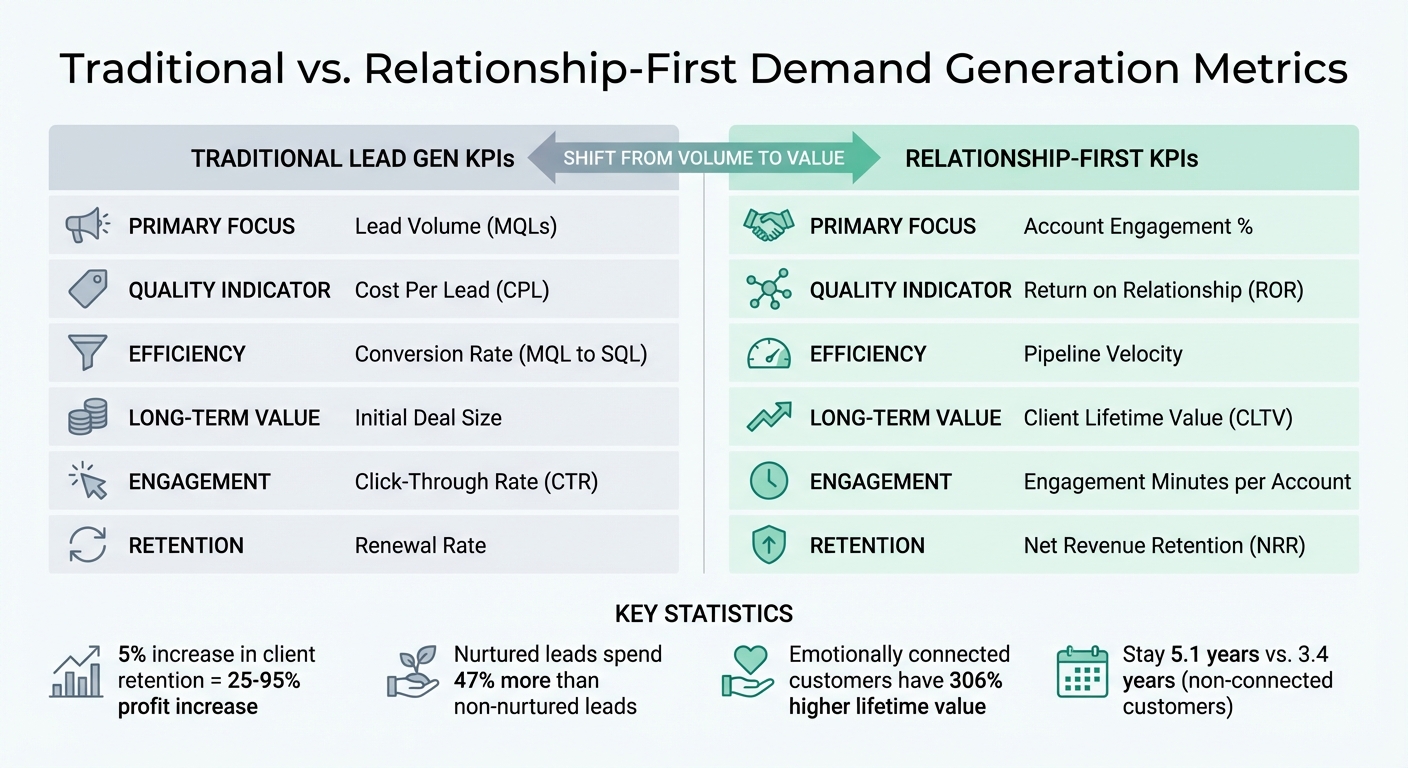
Traditional vs Relationship-First B2B Demand Generation Metrics
Once your multi-channel campaigns are up and running, it’s time to measure how well your relationship-focused strategy is performing and find ways to make it even better. You’ve worked hard to build connections, deliver value, and engage across platforms, but the real question is - are these efforts creating meaningful relationships or just generating noise? Traditional metrics like MQL counts or cost per lead might tell you about activity, but they don’t show if you’re building trust or driving real progress. A relationship-first approach calls for a new kind of scorecard that prioritizes engagement depth, account progression, and connection quality. These insights are key to refining your strategy as you move forward.
Shifting from Volume to Value
Instead of celebrating a flood of new leads, focus on the quality of engagement. For example, how many of those accounts are actively engaging with you? Are you connecting with multiple stakeholders within your target companies? Are prospects spending significant time with your content? The truth is, only a small percentage of your audience is immediately ready to buy.
Here’s why focusing on relationships matters: boosting client retention by just 5% can increase profits by 25% to 95%. Leads that are nurtured tend to spend 47% more compared to those that aren’t. Plus, customers who feel emotionally connected to your brand have a 306% higher lifetime value and stick around for an average of 5.1 years versus 3.4 years for others. These numbers make it clear - strong relationships are not just a bonus; they’re a critical driver of sustainable growth.
Key Metrics for Relationship-First Demand Generation
Start by defining what meaningful engagement looks like. Not all clicks or interactions are created equal. For instance, a single blog read isn’t as impactful as a visit to your pricing page or a webinar attended by multiple decision-makers. Identify 5–8 specific actions (like attending a webinar, revisiting a pricing page, or engaging multiple stakeholders) that signal deeper interest - these are your "depth events".
A few key metrics to track include:
- Buying group engagement: Measure how many unique stakeholders you’re connecting with within a single account. If you’re only engaging one person, losing that contact could jeopardize the entire deal.
- Engagement minutes: Track how much time accounts spend with your high-value assets like webinars, demos, or pricing pages. This is far more telling than simple clicks.
Here’s a comparison of traditional metrics versus relationship-first KPIs:
| Metric Category | Traditional Lead Gen KPI | Relationship-First KPI |
|---|---|---|
| Primary Focus | Lead Volume (MQLs) | Account Engagement % |
| Quality Indicator | Cost Per Lead (CPL) | Return on Relationship (ROR) |
| Efficiency | Conversion Rate (MQL to SQL) | Pipeline Velocity |
| Long-term Value | Initial Deal Size | Client Lifetime Value (CLTV) |
| Engagement | Click-Through Rate (CTR) | Engagement Minutes per Account |
| Retention | Renewal Rate | Net Revenue Retention (NRR) |
To make these metrics actionable, create a scoring system that assigns weight to different engagement actions. For example, a casual social media like might rank as a Tier 1 action, while a demo request could be Tier 4. This helps you identify which accounts are nearing a purchase decision and which ones need more nurturing.
As ViB Editorial puts it:
"If you build your reporting around fit, engagement, intent, and progression, you'll spend less time arguing about lead quality and more time improving relevance."
How to Optimize Based on Data and Feedback
Once you’ve nailed down the right metrics, use them to fine-tune your strategy. Start with pipeline velocity, which you can calculate by multiplying the number of qualified opportunities by your average deal size and win rate, then dividing by your sales cycle length. This will give you a daily revenue figure and highlight where deals are stalling.
Use tools like stage-aging heatmaps to identify bottlenecks and review stage-level losses weekly to uncover underlying issues. For instance, if prospects tend to drop off after the first demo, it might mean your messaging isn’t addressing their key concerns. If accounts are engaged but not advancing, consider reaching out to additional stakeholders within that account.
Negative scoring can also be a game-changer. Deduct points for inactivity - say, 10 points after 14 days without engagement - to flag accounts that may need re-engagement or even a "break-up" sequence. Sometimes, a simple check-in can reignite interest and restart the conversation.
Predictive modeling is another powerful tool. For example, Amazon used predictive lead scoring to boost qualified lead conversions by 32% and cut lead conversion time by 125%. Running cohort analyses can help you rank channels based on metrics like Sales Qualified Opportunity (SQO) rate, win rate, and customer acquisition cost (CAC) payback. This allows you to shift resources toward channels that genuinely build relationships.
Finally, standardize your lifecycle stage definitions (e.g., MQL, SQL, SQO) with clear entry and exit criteria. This alignment between marketing and sales not only minimizes confusion but also frees up time to focus on what matters most - building trust and deepening relationships.
Let your data guide you as you refine your approach, strengthen relationships, and accelerate your pipeline.
Conclusion: Building Long-Term Growth Through Relationships
This approach strikes a balance between automation and authentic engagement. A striking statistic reveals that 93% of buyers choose a firm they already had on their radar - those they were familiar with from "Day One". This highlights the importance of making your presence known early in the game.
By applying these strategies, you now have a clear path to reshape your demand generation efforts. This includes identifying your ideal customer profile (ICP), pinpointing key relationship moments, tailoring outreach with founder-driven content and AI, running campaigns across multiple channels, and keeping an eye on metrics like engagement, involvement of buying groups, and pipeline speed. Between 2015 and 2019, InVision demonstrated the power of this approach, scaling to over $100M in annual recurring revenue (ARR) by focusing on human connections - bringing in nearly 100,000 leads without relying on a direct sales pitch.
"Human proximity will become the new moat"
In a digital world increasingly filled with AI-generated noise, your ability to create personal, founder-led connections sets you apart. Use AI for tasks like research and list building, but invest the time you save into strengthening meaningful relationships.
Shifting from prioritizing lead volume to emphasizing value isn’t just a mindset change - it’s a financial strategy. While lead generation brings conversions, demand generation drives sustainable growth. Strong relationships open doors to referrals, warm introductions, and loyal advocates.
To deepen trust, interview 20–30 of your top customers to understand why they choose your business. Swap out generic "just checking in" emails for value-packed touchpoints - share a helpful resource, celebrate a customer success story, or send a personalized video. Engage with buyers in the spaces they already frequent, like Slack groups, LinkedIn discussions, and forums, and contribute without expecting anything in return.
FAQs
What is an Ideal Customer Profile (ICP) and how can I create one for my business?
An Ideal Customer Profile (ICP) is essentially a blueprint for identifying the type of company that stands to gain the most from what you offer - and in turn, provides the greatest value to your business over time. To build one, start by diving into your existing top-tier customers. Pinpoint commonalities like their industry, company size, revenue, location, and the challenges they’re tackling.
Here’s what to include when crafting your ICP:
- Firmographics: Details like the industry they operate in, their size, and where they’re located.
- Technographics: The tools, platforms, or technologies they rely on.
- Pain Points: The specific struggles or needs your product addresses.
- Buying Triggers: Situations or events that nudge them toward finding a solution.
Once you’ve outlined your ICP, test it against real sales data to make sure it aligns with what’s actually happening. A clear and accurate ICP keeps your team zeroed in on the most promising prospects, paving the way for stronger connections, better conversion rates, and consistent business growth.
What metrics should B2B teams track to evaluate the success of relationship-driven demand generation?
To evaluate how well relationship-driven demand generation is working, focus on metrics that highlight trust, engagement, and results. Here are the key areas to watch:
- Trust indicators: Look at customer testimonials, online reviews, and other forms of social proof to see how credible your brand appears to your audience.
- Engagement metrics: Measure things like email response rates, meeting requests, or how often your content gets shared. These numbers show how much your messaging resonates.
- Conversion performance: Keep an eye on how well your relationships translate into outcomes like qualified leads or closed deals.
Focusing on these metrics helps B2B teams build genuine connections while driving meaningful, long-term growth.
How can B2B marketers use AI to create personalized outreach?
AI empowers B2B marketers to deliver personalized outreach by diving into data such as company specifics, social media trends, and user behaviors. This makes it possible to craft messages that directly address a prospect's individual challenges and objectives.
By automating the heavy lifting of data analysis, AI allows teams to scale their efforts without losing that personal edge. It can spot patterns, recommend content that resonates, and even pinpoint the optimal time to reach out, ensuring interactions feel more relevant and impactful.