Top 7 Storytelling Techniques for Founder-Led Brands

Your story is your edge. As a founder, your personal journey gives your brand a unique advantage that no competitor can replicate. Forget polished, forget perfect - what connects with people is authenticity, emotion, and proof that you’ve been in the trenches. Here’s the quick playbook:
- Share Your Origin Story: Why did you start? Skip the timeline - focus on the frustrations or aha moments that set you on this path.
- Talk About Challenges: Nobody buys perfection. Share the struggles and how you overcame them. Vulnerability builds trust.
- Use the Hero’s Journey: Your customer is the hero; you’re their guide. Take them on a journey from problem to solution.
- Show Your Values: What do you stand for? Let your beliefs shape your story and connect with like-minded customers.
- Structure Your Story: Every story needs a beginning, middle, and end. Don’t skip the messy middle - it’s where the real connection happens.
- Add Emotion: Facts inform; emotions stick. Share the raw moments - fear, grit, relief - that make your story human.
- Show Results: Back it all up with numbers, milestones, and real-world outcomes. Proof seals the deal.
Start small: post your origin story on LinkedIn or share a challenge you’ve faced. Your story isn’t just a narrative - it’s your competitive advantage.
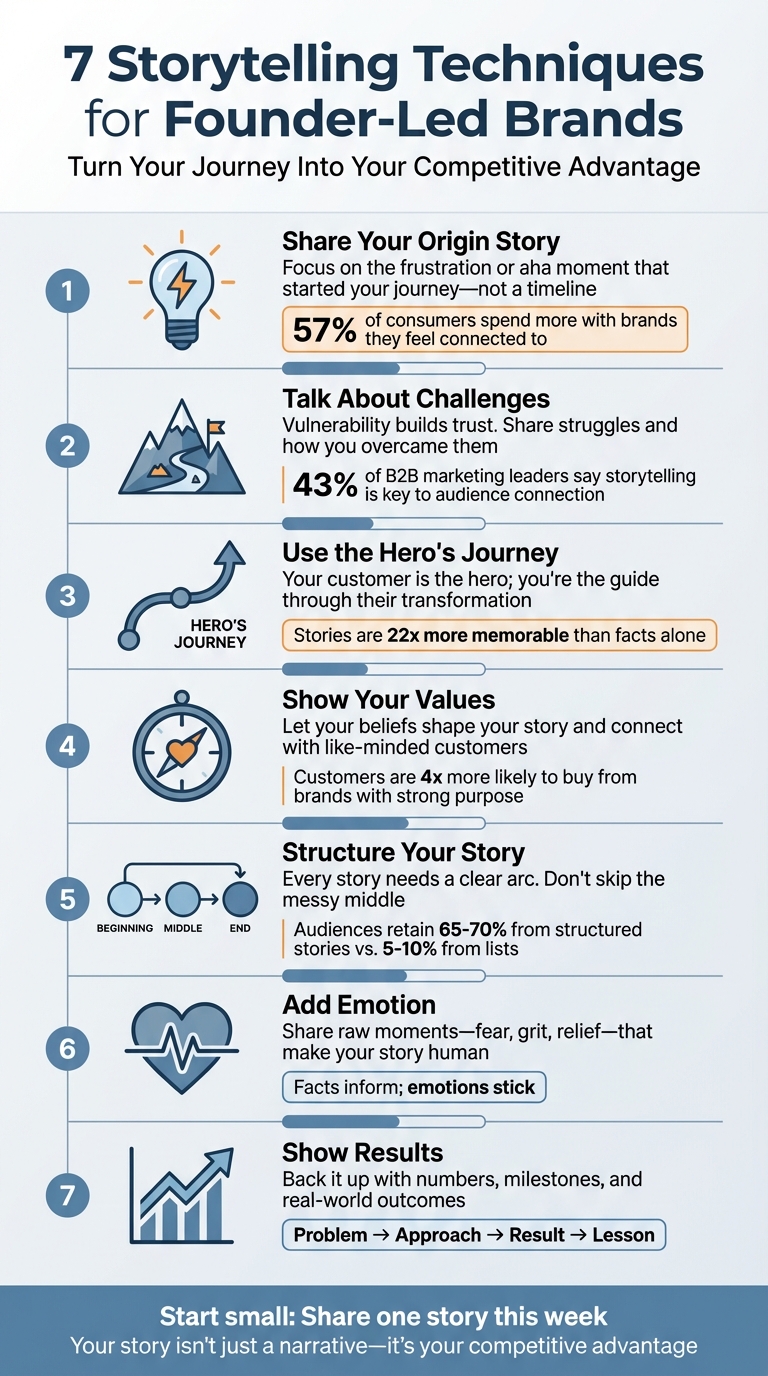
7 Storytelling Techniques for Founder-Led Brands
How to Turn Your Setbacks Into a POWERFUL Founder Story
1. Share Your Origin Story
Your origin story is about why you started, not a dull timeline of events. The best stories skip the corporate play-by-play and dive into the frustration or aha moment that made you take action. This is what sets you apart - competitors can copy your features, but they can't duplicate your journey.
Let’s look at some examples. Warby Parker's founder took a personal loss during grad school and turned it into a mission to challenge monopoly pricing in eyewear. Howard Schultz? A trip to Italy in 1983 completely shifted his vision for Starbucks, transforming it into a community hub. These stories resonate because they’re vivid. Schultz didn’t just say, “I liked Italian coffee culture.” He named the place (Italy), the year (1983), and the exact feeling that sparked his idea. Similarly, Uber’s founders, stuck in the freezing cold in Paris in December 2008, found inspiration in their frustration, leading to the creation of a ride-hailing app.
Here’s why this matters: research shows that 57% of consumers spend more, and 76% choose brands they feel connected to. A genuine origin story builds that connection. As Rebecca Rosenberg from the U.S. Chamber of Commerce explains:
"Your origin story is your differentiator. It is what sets you apart from other companies that provide similar services or products".
Want to test your story? Try the "bar test." Share it with a friend, as you would over drinks - ditch the jargon and focus on the emotional journey.
2. Talk About Challenges You've Overcome
Let’s be real - no one buys the “perfect” brand story. Sharing the tough stuff, the failures, and the setbacks doesn’t make you look weak; it makes you relatable. In fact, being open about your challenges builds trust. People connect with honesty, not perfection. And in B2B, where 43% of marketing leaders say storytelling is key to audience connection, showing your human side is more important than ever.
Want an example? Look at L.L. Bean's founder, Leon L. Bean. Back in 1912, his first batch of boots had a major flaw - they leaked. Instead of sweeping it under the rug, he refunded every customer and fixed the problem. That decision didn’t just save his business; it set the tone for over 100 years of commitment to quality.
But don’t just share what went wrong - focus on how you handled it. Don Faul, CEO of Crossfit, nails it:
"If you're willing to tell everyone on your team about your mistakes, your shortcomings, what you're currently working on to get better, you seem more human. It's easier for people to connect with you".
By sharing your own struggles, you position yourself as a guide, not the hero. Your customers are the heroes of their own stories - you’re just the one who’s been through the fire and can help them navigate their own challenges. Whether it’s adapting to rapid industry changes, tackling the fear of failure, or battling the frustrations of outdated B2B marketing strategies, your experiences make you relatable. They show your audience you get it because you’ve been there.
Here’s a tip: test your story with the "bar test". If you wouldn’t tell it over drinks in the same words, it’s probably too polished. Drop the corporate tone and keep it raw. That kind of honesty? It sticks.
3. Use the Hero's Journey Framework
The Hero's Journey is a classic storytelling structure: the hero leaves their comfort zone, faces obstacles, grows through the experience, and returns with something valuable. When it comes to your brand, think of your customer as the hero and position yourself as their guide. Your narrative should take them on a journey - starting from an ordinary market situation, moving through the challenges they face, and culminating in the solution you provide that creates real impact. This approach naturally connects with real-life examples and makes your story resonate.
Take this example: a founder was burning $20,000 a month on generic outbound campaigns. Feedback started rolling in - customers were unimpressed, citing a lack of real insight. This sparked a change. Over the next two years, the founder dove into interviews, tested content, and endured setbacks. Eventually, they pivoted to authentic, founder-led storytelling. The results? Better pipeline quality, improved close rates, and even lower churn. That’s the kind of transformation people remember.
Don’t shy away from sharing personal, concrete moments. Maybe you missed payroll once, celebrated your first big enterprise deal, or lost a key client. Research shows that stories with conflict and resolution stick - they’re up to 22 times more memorable than plain facts.
4. Include Your Personal Values and Beliefs
Your core values are like the fingerprint of your leadership - completely yours and impossible to duplicate. They’re what set you apart from every competitor, no matter how crowded your space. Take Sara Blakely, for example. When she launched Spanx, she didn’t focus on product specs or flashy marketing. Instead, she told a story - how she cut the feet off her pantyhose, believing women deserved better options. That bold, personal belief, paired with her willingness to challenge an entire industry, turned Spanx into a billion-dollar brand - all without a massive ad budget.
In B2B settings, sharing what drives your decisions can have a similar effect. Whether it’s a commitment to transparency, prioritizing community over transactions, or refusing to compromise on quality, these values resonate deeply with like-minded customers. Nick Bare and Ben Francis are prime examples. Bare built trust by openly documenting his early mornings, training struggles, and business challenges on YouTube, showcasing his dedication to discipline, integrity, and transparency. Meanwhile, Francis grew Gymshark into one of the UK’s fastest-growing fitness brands by sharing candid stories of failures, pivots, and hard-earned lessons - offering a refreshing alternative to overly polished corporate messaging.
Here’s the thing: competitors can copy your features or try to undercut your pricing, but they can’t replicate your personal experiences or the beliefs that shape your company’s direction. That’s your edge.
Rather than simply listing your values on an “About” page, bring them to life with real examples. Did you turn down a lucrative deal because it didn’t align with your principles? Or reinvest in customer support while others were cutting corners with automation? These stories carry weight. Studies show customers are four times more likely to buy from brands with a strong purpose, and they’ll even defend those brands when the going gets tough.
The goal isn’t to win over everyone - it’s to deeply connect with the right people. RevBoss summed it up perfectly:
"Authenticity, trust, and audience are the only durable marketing differentiators in an AI-first market".
When your values consistently shine - whether in LinkedIn posts, sales calls, or product decisions - you’re doing more than marketing. You’re creating a movement. And that’s something people want to be part of.
sbb-itb-9354cf2
5. Structure Your Story with a Clear Arc
Every great story has a beginning, middle, and end - it’s how we naturally process information. When your founder story follows this structure, it becomes more than a collection of facts; it transforms into a narrative that sticks. Research backs this up: stories are 22 times more memorable than plain facts, and audiences retain 65-70% of information from structured stories compared to just 5-10% from lists or stats. Let’s break this down with a real-world example.
Take Warby Parker, for instance. They didn’t just sell eyewear; they told a story. Their journey began with a relatable problem, moved through a challenging middle filled with obstacles, and culminated in a transformative ending that disrupted the eyewear market. This arc made their mission relatable and turned customers into loyal advocates.
Why does this structure work so well? Because it mirrors life. Your beginning should grab attention by sharing the frustration or discovery that sparked your journey - the moment you knew something had to change. The middle builds tension, showcasing the challenges, pivots, and personal stakes that humanize your brand and create empathy. Finally, the end delivers closure with tangible milestones and lessons learned, giving your audience a satisfying payoff. This progression not only keeps people engaged but also frames your challenges and achievements in a way that feels earned and relatable.
Here’s a tip: Don’t skip the middle. Leaving it out can make your story feel like a shallow sales pitch. Similarly, avoid wrapping up without real results - no one wants to be left wondering, “So what?” Instead, map out your arc before you even start writing. Tie every achievement to the struggles that made it meaningful.
In today’s AI-driven content landscape, where anyone can churn out polished words, a well-structured founder story is one of the few ways to stand out. As RevBoss puts it:
"Authenticity, trust, and audience are the only durable marketing differentiators in an AI-first market".
A clear and compelling narrative arc builds trust, fosters connection, and keeps your audience hooked.
6. Add Genuine Emotional Elements
A strong narrative is good, but weaving genuine emotions into it? That’s what makes your story unforgettable.
Sure, facts and stats can tell people what you’ve done, but emotions reveal who you really are. Take Sara Blakely, for example. When she turned Spanx into a billion-dollar empire, she didn’t just focus on product specs. Instead, she shared her personal struggle - like the embarrassment of cutting up pantyhose that didn’t work. That honesty made her relatable, turning customers into loyal fans and advocates. The same goes for B2B brands led by founders. People don’t connect with logos; they connect with real faces and raw emotions.
The emotions that hit hardest in B2B storytelling are the ones your audience has likely felt too - frustration with outdated systems, fear before a big leap, grit through setbacks, or the relief of finally solving a problem. Nick Bare, for instance, grew Bare Performance Nutrition by sharing his early mornings, failed workouts, and the weight of running a business while serving in the military. By showing his struggles, he resonated deeply with people who saw their own challenges in his journey.
Instead of just sharing polished outcomes, dive into the moments that mattered. Don’t just say, "We tripled our growth last year." Talk about the Sunday night when you weren’t sure payroll would clear or the tough conversation with your co-founder when quitting felt like the only option. Make the stakes personal - jobs, reputations, key client relationships - because when you say, "I was terrified we’d lose our biggest client", your audience who’s faced that same fear will feel an instant connection. This kind of storytelling not only enriches your narrative but also positions you as a leader they can relate to.
But let’s be clear: emotional storytelling isn’t about oversharing or manipulating your audience. It’s about connecting every emotional moment to a meaningful business takeaway. Emily Weiss, for example, grew Glossier by sharing behind-the-scenes looks at product tests, team milestones, and even her personal routines. She made her customers feel like they were part of the process - professional yet human. Here’s a quick gut check: if you wouldn’t be comfortable with a key client seeing your story on a giant screen at a conference, it’s time to rethink it.
The beauty of authentic emotional storytelling? It’s impossible for competitors to copy. As RevBoss perfectly sums up:
"Most B2B marketing is boring, soulless, and self-centered".
Your emotions make your brand stand out and build trust. Up next, we’ll explore how showcasing real results can strengthen these emotional connections.
7. Show Real Results and Milestones
Once you've tugged at the heartstrings with your story, it's time to back it up with solid, measurable results. While a compelling narrative can capture attention, it's the hard data that seals the deal - especially for B2B buyers. They need proof that your solution delivers in practical, everyday scenarios. Metrics like revenue growth, improved retention rates, increased efficiency, or reduced time-to-value carry far more weight than any origin story.
The milestones you share should go beyond basic company updates. Focus on pivotal moments that validate your progress - launching your MVP, closing your first big deal, hitting $1,000,000 in ARR, or achieving SOC 2 compliance to unlock larger contracts. These milestones show that you're not just telling a good story; you're building something that resonates with the market and stands the test of time.
A helpful way to present these achievements is through a simple framework: Problem → Approach → Result → Lesson. Start by outlining the problem, briefly explain your approach, share the metrics that matter, and wrap up with a takeaway insight. For example, instead of saying, "We improved our sales pipeline", you could say, "We helped a mid-market SaaS client boost qualified meetings by 40% - from 10 to 14 per week - over one quarter by shifting from cold email to LinkedIn engagement." It’s specific, measurable, and leaves no room for ambiguity.
To add even more credibility, consider using short video clips under 60 seconds where clients talk about their experiences - highlighting trust, partnership, and concrete outcomes. These clips go beyond traditional case studies, offering a personal touch that resonates. Be transparent about the factors behind your success, like team size, budget, or timeline, to make your results relatable and credible. As RevBoss puts it:
"We don't just create and wait. We execute campaigns that generate conversations and convert into pipeline".
This level of clarity turns your story into undeniable proof of your impact.
Finally, anchor your narrative in measurable benchmarks - whether it's a 4.6-star rating on G2 or a client retention rate exceeding 95%. These numbers give decision-makers the confidence to champion your solution internally. When your storytelling is backed by real, quantifiable results, it shifts from being merely inspiring to being a sound investment.
Conclusion
Bringing together these seven storytelling techniques helps you shape a brand that people trust and remember. By sharing your journey - from your beginnings to the milestones you've achieved - you create a connection that builds trust, which is crucial for turning interest into action. Each piece of your story adds to an emotional bond that sets your brand apart from the competition.
This storytelling approach positions you as a guide, someone who not only has authority but also genuinely serves their audience. When potential customers truly understand your journey, they’re much more likely to feel connected to you. By weaving your unique experiences into your messaging, you turn your personal story into a powerful tool for driving business growth.
Of course, many founders know the value of storytelling but struggle to turn it into a consistent and scalable marketing strategy. That’s where having a clear system comes into play. Companies like RevBoss specialize in helping founders build content marketing systems that transform these storytelling techniques into ongoing campaigns. These campaigns spark meaningful conversations and lead to a steady stream of sales opportunities.
Why not start small this week? Pick one storytelling technique and put it into action. Share your origin story on LinkedIn, or write about a recent challenge you overcame. Use what you’re already doing as the foundation, and let your natural voice shine through. Over time, these stories will stack up, becoming a unique asset that no one else can copy. That’s when storytelling stops feeling like a chore and starts driving real results.
FAQs
What’s the best way for founder-led brands to share their origin story?
Founder-led brands have a unique advantage: their origin story. It’s not just a tale - it’s a powerful way to build trust and connect with your audience on a personal level. Start by digging into the why behind your company. What sparked the idea? What problem were you determined to solve? What values continue to drive your business? Sharing these details creates a foundation of authenticity. Include vivid moments - like a major challenge you overcame or a game-changing milestone. Add personal touches, such as specific dates or anecdotes, to make the story stick in people’s minds.
Once you’ve nailed down your story, don’t let it gather dust. Feature it prominently on your website’s “About” page, sprinkle bits of it into newsletters, and repurpose it for LinkedIn posts, podcasts, or other platforms. Make sure your team knows it inside and out so they can share it consistently. And whenever possible, let the founder’s voice shine through in communications - it adds a personal touch that resonates. By weaving an authentic and consistent origin story into your brand, you’ll not only stand out but also nurture meaningful, long-term relationships with your audience.
Why is vulnerability essential in brand storytelling?
Vulnerability has a way of turning a brand from something faceless into something real. When founders open up about their personal struggles, missteps, or defining moments, they’re not just sharing stories - they’re building a bridge. That emotional connection isn’t just nice to have; it’s what makes people trust you. And trust? That’s gold in today’s B2B world.
For companies led by founders, these honest stories strike a chord. They show that the brand isn’t just about selling - it’s about shared experiences and values. By stepping into the role of a guide rather than just a vendor, vulnerability sparks deeper conversations and real engagement that can fuel growth. RevBoss steps in to help founders craft these heartfelt narratives, making connections that truly matter.
How do personal values shape a founder-led brand’s story?
Personal values are the beating heart of any founder-led brand's story. When a founder openly shares what truly matters to them - whether it's a sense of purpose, a commitment to community, or ethical principles - it adds depth and relatability to the brand. These stories resonate because they reflect shared ideals, creating a sense of trust and connection. And let's face it, people are far more likely to support a brand that aligns with their own beliefs.
For founder-led businesses, weaving these personal values into everything - your website, social media, pitch decks, you name it - turns your brand story into a trust-building powerhouse. When your purpose clicks with your audience, it sparks meaningful conversations, strengthens loyalty, and fuels growth. RevBoss specializes in helping founders shape and amplify these value-driven stories, ensuring they reach the right people and make a lasting impact.