How to Turn Founder Expertise into 30 Days of Content (Interview-to-Post Workflow)

Hook: Hate staring at a blank page? Try this instead: talk for 60 minutes, and let one conversation fuel a month’s worth of content.
Value Summary: This workflow flips content creation on its head. Instead of writing from scratch, record a 60–90 minute interview where you share insights, stories, and expertise. That recording gets turned into video clips, blog posts, and social updates - all in your voice. Bonus? It’s faster than typing and builds trust with your audience.
Quick Overview:
- Time commitment: 45–90 minutes per interview
- Output: 30+ pieces of content (e.g., videos, blogs, posts)
- Why it works: People trust expertise and real stories over generic marketing fluff.
- Results: Example: A SaaS founder tripled demo requests by posting weekly clips from a single Zoom call.
Bridge: Let’s break down how to turn one conversation into a content machine.
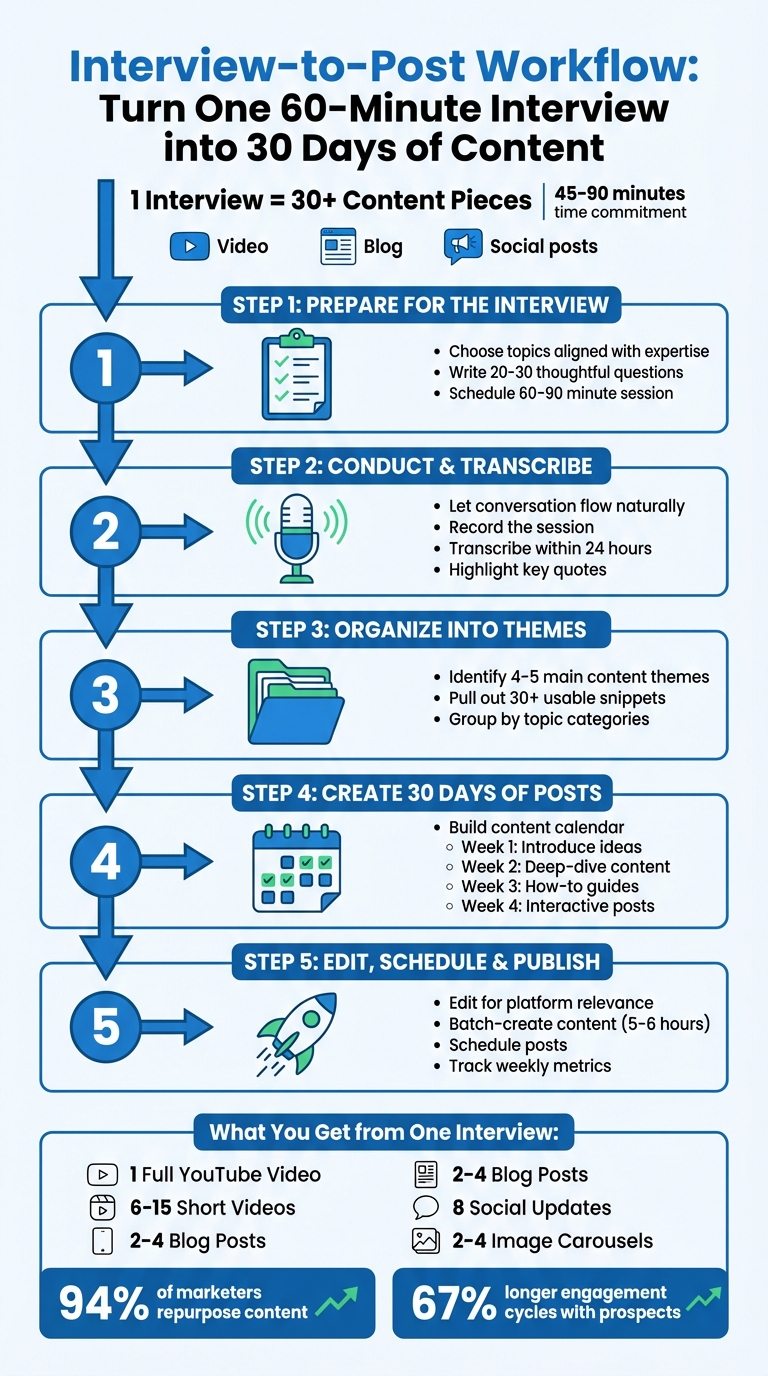
Interview-to-Post Workflow: 5 Steps to Create 30 Days of Content
35 Mins to Develop Your Founder Brand Content Playbook
sbb-itb-9354cf2
Why the Interview-to-Post Workflow Works
This approach tackles two challenges simultaneously: it captures the expertise you might not even realize you have - those insights you use instinctively - and it ramps up your content production without demanding more of your time. Let’s break down why it’s more effective than traditional content creation methods.
Founder Expertise Builds Trust and Authority
B2B buyers are skeptical of polished marketing copy. What they trust are people who’ve faced the same challenges they’re trying to solve. When you share lessons from building your product, adapting to industry changes, or solving customer pain points, your credibility becomes undeniable.
"Founder-led content delivers what traditional marketing can't replicate: credibility. Buyers can tell when insight comes from someone who's actually built the product and faced real customer problems."
The beauty of the interview format is how it captures those buried gems of knowledge - the frameworks, lessons, and “obvious” truths that aren’t so obvious to your audience. A skilled interviewer knows how to surface these insights by asking the right questions. Unlike AI-generated content, which often feels generic, or traditional ghostwriting, which can miss your tone, interview-based content uses your actual words to lead industry conversations. This authenticity builds trust and makes repurposing content a breeze.
One Interview Creates Multiple Content Pieces
A single 45–60 minute interview can generate a treasure trove of content. Instead of creating dozens of pieces from scratch, you’re pulling them from one conversation.
This method turns one recording into a variety of formats, saving time while boosting output. You record once and publish many times. It’s no wonder 94% of marketers repurpose content to meet demand, especially when brands are posting an average of 9.5 times per day across social platforms.
| Asset Type | What You Get from One Interview |
|---|---|
| Video | 1 Full YouTube Video, 6-15 Shorts/Reels/TikToks, 6 LinkedIn Clips |
| Written | 2-4 Blog Posts, 2 Email Newsletters, 1 Case Study |
| Social | 8 Social Updates, 2-4 Image Carousels, 2-4 Quote Graphics |
This efficiency isn’t just for show - it delivers real results. Sales teams that embrace content repurposing see 67% longer engagement cycles with prospects. In just one hour, you can fuel a month’s worth of content that reflects your voice and expertise.
Step 1: Prepare for the Interview
The difference between a forgettable interview and one that fuels a month’s worth of content lies in preparation. Showing up with generic questions won’t cut it. The most engaging interviews happen when you’ve done your homework - digging into topics your founder is passionate about and crafting questions that lead to compelling stories instead of short, unremarkable answers.
Choose Topics That Align with Expertise and Audience Interests
Start by identifying content gaps your founder casually mentions but hasn’t fully unpacked. These often represent areas where they have deep knowledge but assume others already understand. Review sales calls and customer feedback to spot recurring challenges your audience faces. Elena Martinez, a Content Strategist, explains this concept of "autopilot" expertise:
"The real problem is that experts don't naturally communicate in content-ready formats. They think in frameworks, patterns, and experiences that make perfect sense to them. But your audience isn't inside their heads."
Zero in on the unique insights your founder uses daily - especially those that your audience might find complex or game-changing.
Instead of tackling broad, generic topics, focus on specific, actionable ones. For example, rather than “Using AI in Your Business,” go for something like “How We Use AI to Forecast Inventory 5x Faster.” Similarly, instead of “Improving Team Productivity,” try “3 Systems We Automated to Save 10+ Hours a Week.” This specificity ensures your interview generates content that’s both practical and engaging.
Once you’ve nailed down the topics, craft questions that get to the heart of these areas.
Write 20-30 Thoughtful Questions
Think of your list of questions as a guide, not a script. Prepare thoroughly for your 60-minute session so you can dig deeper into meaningful topics. Review your founder’s recent posts, articles, or even casual remarks to identify points where they’ve shown enthusiasm but haven’t fully explained their ideas.
Craft questions that invite storytelling by starting with “What,” “How,” or “Why.” For example, instead of asking, “Do you use automation?” try, “Can you walk me through the last time you automated a process - from identifying the problem to achieving the result? What challenges did you encounter?” Morgan Short, Director of Content & Web Strategy at Vendavo, emphasizes the importance of this approach:
"Good content and good storytelling start with compelling and thought-provoking questions."
Use the “Grandma” technique to simplify complex ideas: ask your founder to explain things as if they were talking to someone with no industry knowledge. This not only makes the content clearer but also ensures it connects with a wider audience. Prepare 5–7 high-level “anchor” prompts that naturally lead to follow-up questions, keeping the conversation dynamic and engaging.
These carefully crafted questions will set the stage for a productive and insightful interview.
Schedule and Record the Session
Plan for a 60–90 minute interview - long enough to explore topics in depth without exhausting your founder. Choose a quiet, distraction-free location, and invest in a basic USB microphone to improve audio quality over your laptop’s built-in mic.
For remote interviews, platforms like Riverside.fm are ideal, as they record separate audio and video tracks, making editing easier. Jake Gibbs, Tech Writer at Rev, offers this advice:
"A great interview seems more like a conversation among peers as opposed to a structured Q&A session, and the best way to prepare for that is to know what you're talking about."
Before the session, do a quick test run to check the audio, and set up a backup recorder just in case. Save the recording immediately in multiple places - cloud storage, your device, or an external drive. Start with an easy, informal question to help your founder relax and ease into the conversation.
With these steps, you’ll be ready to capture insights that resonate and create meaningful content.
Step 2: Conduct and Transcribe the Interview
Once your questions are ready, it’s time to dive into the interview. The goal? Capture your founder’s real voice and turn those conversations into text.
Let the Conversation Flow Naturally
Think of the interview as a casual chat rather than a rigid Q&A session. As Brittany Wren, a ghostwriter, puts it:
"Approach your SME like a human being, not a prisoner being interrogated."
Your prepared questions are there to guide the discussion, not dictate it. If your founder gets animated about a topic or drops an intriguing comment, seize the moment and explore it further. These off-the-cuff moments often reveal the most valuable insights.
Watch for areas where the founder might skim over details or use technical jargon. For example, if they mention something like "assume breach posture", follow up with, "What does that look like in practice?" This kind of probing helps translate expert knowledge into content your audience can easily grasp.
As the conversation unfolds, jot down timestamps for standout moments - those quotable or surprising nuggets that will make your life easier when it’s time to refine the content. Focus on capturing your founder’s authentic speaking style rather than aiming for polished soundbites.
Once the interview wraps, the next step is to transcribe everything while the discussion is still fresh.
Turn the Recording into Text and Highlight Key Quotes
Aim to transcribe the interview within 24 hours to keep the context sharp. Tools like Descript ($12/month) or ScreenApp ($19/month) can transform an hour-long recording into text in just a few minutes. These platforms also let you tweak the audio or video directly by editing the transcript - talk about a time-saver. For highly technical content, you might want to use Rev.com’s human transcription service for $1.50 per minute to ensure precision.
Stick to a "clean verbatim" transcription style - cut out filler words while keeping the meaning intact - and label speakers as you go. As you review the transcript, highlight the standout quotes that are clear, concise, or particularly insightful. These will become your "selects." Hayley Hershman, Senior Producer at Marketplace, shares her approach:
"I have my outline in a doc, and then any tape that I've liked, I pull [that quote] under the bullet points of my outline."
Step 3: Organize the Transcript into Content Themes
Turn your transcript and highlighted quotes into well-organized themes that fuel your content calendar. By structuring your ideas, you’ll make content repurposing a smoother process.
Identify 4-5 Main Content Themes
Start by duplicating your transcript and marking it specifically for theme development. As you review it, group sections under clear categories like "Founder's Journey", "Industry Trends", or "Customer Success Stories." These categories will act as your content pillars.
Take your topics up a notch by refining broad ideas into sharper, more specific themes that bring new perspectives to light. As Baylee Gunnell, Account Director at Motion, puts it:
"A vague or generic topic will leave you with surface-level insights. But a smart, specific topic gives your content depth".
For a 60-minute interview, aim for 3-4 distinct "Chapters" - each representing a major theme that stands on its own. For example, a marketing-focused interview might divide into themes like "AI Tools", "Copywriting", and "SEO." Each chapter should ideally cover 15-20 minutes of discussion, offering enough material to create multiple content pieces.
To ensure your themes resonate with your audience, compare them to real-world data. Dive into sales calls, customer feedback, and website search queries to align your content with genuine pain points instead of assumptions. This approach helps you leverage the founder's expertise to create 30 days of engaging, meaningful posts.
Pull Out 30+ Usable Content Snippets
Once your themes are set, start pulling out key snippets to build a variety of content assets. Focus on high-impact quotes, surprising stats, and actionable advice.
Document each theme and organize relevant sections of the transcript beneath it. Look for standout quotes that are concise and memorable, stories that illustrate a point, and tips that are immediately useful. For example, in April 2025, BlitzMetrics applied this method to a 60-minute video featuring Liana Ling, CEO of AdSkills. They broke the conversation into 6-12 sub-topics grouped under broader themes, ensuring each piece offered a unique perspective without redundancy.
Aim to extract at least 30 distinct snippets, including video clips, carousel posts, quote graphics, or blog articles. For instance, a B2B SaaS company in 2025 repurposed a 45-minute call into 15 Shorts, 5 LinkedIn videos, and one long-form video, which helped them gain 5,000 new followers monthly.
As you refine your snippets, cut out filler words and repetitive phrases. Keep the founder's voice authentic, but polish the content enough so that each snippet stands strong on its own. This process ensures your content is both engaging and professional.
Step 4: Turn Content into 30 Days of Posts
Now that you’ve got your themes and snippets prepared, it’s time to transform them into a month’s worth of diverse and engaging content. The next step is organizing these ideas into a dynamic 30-day content calendar.
Build a 30-Day Content Calendar
Using your themes and snippets, a well-structured calendar helps ensure your content is distributed effectively. Aim for a weekly rhythm that keeps your audience engaged. For example:
- Week 1: Introduce key ideas with a compelling statistic, a sneak peek video, and teaser posts.
- Week 2: Share a deep-dive blog post, supported by carousels or quick tips.
- Week 3: Focus on practical application with how-to guides, checklists, or behind-the-scenes content.
- Week 4: Wrap up with interactive posts like polls, myth-busting content, and clear calls-to-action.
Here’s a real-world example. In March 2025, AI Stream Solutions applied this approach with a 60-minute webinar titled "Social Media Algorithms in 2025." They repurposed it into 5 blog posts, 12 short video clips, 8 quote graphics, and 3 LinkedIn carousels. The results? Over 127,000 impressions, more than 1,450 new email subscribers, and approximately 85 hours saved on manual content creation.
To keep things fresh and avoid repetition, try using a Format × Angle Matrix. Combine six formats (like quick tips, myth vs. reality, step-by-step guides, mistakes, stories, and checklists) with five angles (beginner, contrarian, proof, objection, and workflow). This method can generate 30 unique posts from your core themes.
Use RevBoss Workflows to Save Time
Once your calendar is ready, streamline the execution process with RevBoss workflows. These workflows take care of the heavy lifting, allowing you to focus on producing high-quality content. RevBoss automates LinkedIn audience growth campaigns, engagement workflows, and email newsletter distribution, ensuring your founder’s content consistently reaches the right audience without requiring manual effort.
This automation saves hours every month, with plans starting at $2,500. It’s a smart way to make sure your content gets seen while giving you back valuable time.
Keep the Founder's Voice Consistent
A critical part of your strategy is maintaining the founder’s distinct voice across every piece of content. Authenticity is the cornerstone of founder-led content. Each post should feel like it comes directly from the founder, not like a generic rewrite. Use the interview transcript to pull exact phrases, personal anecdotes, and unique objections to keep the tone genuine.
"Repurposing is about transforming one pillar asset into platform-native posts - not copy/paste cross-posting".
This means adapting each post to fit the platform while staying true to the founder’s language. For instance, a LinkedIn post might lean toward a professional tone with clear takeaways, while a short video clip can feel more relaxed and conversational.
To ensure consistency, use exact phrases from the transcript and rely on a "Hook Bank" of 10–12 templates. Examples include:
- "I used to think [X] until [Y]."
- "Most people get [X] wrong; here’s the fix."
These hooks help maintain a unified voice across all posts while keeping the content engaging and relatable.
Step 5: Edit, Schedule, and Publish
With your 30-day content calendar ready, it’s time to refine your posts, set a consistent schedule, and track how they perform. This step turns your content plan into a steady system that drives results, wrapping up the journey from interviews to published posts.
Edit for Clarity and Platform Relevance
Before you hit "schedule", take the time to read each post out loud. This simple habit helps you catch awkward phrasing and ensures the tone feels natural and conversational. Aim for short paragraphs with clear takeaways, and tailor the formatting to fit each platform. For instance, LinkedIn posts should be concise with plenty of white space, while TikTok videos should grab attention immediately with a strong opening. Resist the urge to copy-paste the same content across platforms. Instead, tweak the hooks and structure to match the vibe of each channel while staying true to your core message.
Stick to a Reliable Publishing Schedule
Save yourself hours of stress by batch-creating your content. In a focused 5–6 hour session, you can prep an entire month’s worth of posts - cutting down on the 50+ hours you’d spend creating daily. Batch creation can even boost your output by up to five times while slashing effort by 80%. Once your posts are polished, upload and schedule them to avoid the chaos of last-minute posting. Follow the 70/30 rule: dedicate 70% of your content to evergreen topics that stay relevant over time, and leave 30% of your schedule open for timely or trending posts. With your schedule locked in, shift your attention to tracking performance.
Track Metrics and Fine-Tune Your Strategy
Instead of obsessing over daily stats, check your metrics weekly. Look for engagement indicators like comments, saves, and shares to understand what’s connecting with your audience. On LinkedIn, pay special attention to dwell time - how long users spend reading your post - as the algorithm favors this type of engagement. For video content, focus on watch time and completion rates. Identify your "repurpose winners" - posts with high engagement like saves or comments - and use those topics to guide your next interview session.
For example, freelance writer Anna Burgess Yang grew her LinkedIn following to 4,500 in just 18 months by automating her repurposing process. She scheduled two posts per day, which not only boosted her visibility but also brought in steady inbound work. By creating a feedback loop, you can refine your interview questions and content themes for your next 30-day cycle, ensuring your strategy evolves with your audience’s preferences.
Conclusion
The interview-to-post workflow reshapes how founders approach content creation, turning daily struggles into an organized, repeatable system. With just one 60-to-90-minute conversation, you can generate a month’s worth of posts across various platforms - all while staying true to your voice and expertise. Instead of scrambling for ideas and rushing to create posts every day, you’re building a dependable content engine fueled by preparation rather than last-minute bursts of creativity.
Remember, speaking is about three times faster than typing, and it naturally retains the personality and insights that help build trust with your audience. By crafting thoughtful questions, recording a focused interview, breaking down the transcript into themes, and tailoring the content for each platform, you create a self-reinforcing cycle that improves with every iteration.
This isn’t just theory - it works in practice. Take Mark Slade, a real estate agent who doubled his listing close rate from 45% to 90% in just one year by systematically turning his knowledge into high-impact content. Similarly, a B2B SaaS company saw demo requests triple after their CEO committed to recording a single 45-minute call each week, transforming it into 15 shorts and five LinkedIn posts weekly.
"The percentage of listings that I now get when I go on these appointments is up to about 90 percent, when it had been trending at about 45 percent a year ago. The book is an amazing tool to use."
- Mark Slade, Real Estate Agent
These results highlight how a structured content engine can elevate your marketing efforts. By following the outlined steps - from preparation to repurposing - you save time, establish authority, and build trust with your audience. Consistency breeds recognition, which ultimately fosters stronger connections. Shifting from reactive daily posting to proactive monthly planning not only simplifies your workload but also positions you as a reliable voice in your field. This way, you can focus more on running your business and serving your customers, all while maintaining a steady flow of impactful content.
FAQs
What should I ask in the founder interview to get usable content?
Ask questions that invite the founder to open up and share their journey in depth. For example: "What motivated you to start this company?" or "Can you describe a moment that changed the course of your business?" These types of questions dig into personal experiences, challenges, and lessons learned, offering a treasure trove of stories and insights. The responses can then be transformed into compelling content for blogs, social media, or even video storytelling.
How do I turn one interview into 30 posts without sounding repetitive?
To turn a single interview into 30 unique posts, start by pulling out the main themes, standout quotes, and key insights. Divide the material into bite-sized pieces that work well for different formats, like short social media captions, blog excerpts, or quick video clips. Tailor each piece to fit the tone and style of the platform you're using. You can also use templates for catchy hooks or creative angles to keep the posts interesting. This approach helps maintain variety and keeps the content engaging and relevant, no matter where it's shared.
How do I keep the founder’s voice consistent across every platform?
To keep a founder's voice consistent across platforms, start by developing a communication style that genuinely mirrors their personality and expertise. Use tools like templates or a "hook bank" to ensure each piece of content stays true to their tone. Simplify the process by turning interview insights into multiple formats, all while maintaining their unique voice. Make it a habit to review content regularly to ensure it stays true to their perspective and feels genuine.