Ultimate Guide To Social Proof In B2B Marketing

Social proof is a game-changer in B2B marketing. Why? Because buyers no longer trust sales pitches alone - they want evidence. Whether it’s testimonials, case studies, or expert endorsements, showcasing how others have succeeded with your product or service can build trust, reduce doubts, and speed up decision-making.
Here’s why social proof matters:
- 91% of B2B buyers rely on peer recommendations for decisions.
- Decisions often involve multiple stakeholders and high financial stakes.
- Third-party validation is 2.4x more trusted than brand messaging.
Key types of social proof:
- Client Testimonials: Written, video, or graphic feedback from satisfied customers.
- Case Studies: Detailed success stories showing measurable results.
- Expert Endorsements: Validation from respected industry professionals.
Social proof improves results by:
- Building trust: Reduces uncertainty for buyers.
- Boosting conversions: Increases conversion rates by up to 34%.
- Shortening sales cycles: Helps buyers make faster decisions.
For founder-led brands, personal stories combined with client success can create deeper connections. Integrate social proof across websites, emails, and social media for maximum impact. The bottom line? Buyers want proof, not promises.
Mind Tricks In B2B Marketing part 3: The Power Of Social Proof
Types of Social Proof for B2B Brands
B2B companies have several ways to showcase social proof, each tailored to different stages of the buyer's journey. Knowing these types can help you select the right approach to connect with your audience and achieve your goals. Let’s break down some of the most effective forms of social proof that can build trust and drive conversions.
Client Testimonials
Client testimonials are powerful because they show real customer experiences with your product or service. They address potential buyers' concerns and provide reassurance.
- Written testimonials work best when they highlight specific results rather than vague praise. For instance, mentioning measurable outcomes, timeframes, or challenges resolved makes them more relatable and believable.
- Video testimonials go a step further by creating an emotional connection. Hearing a satisfied customer speak and seeing their enthusiasm can build confidence in a way that written words often can’t.
- Graphic testimonials combine visual elements like customer photos, company logos, or designed quote cards. These are particularly effective for marketing materials and social media, where visuals grab attention.
The secret to gathering great testimonials is to make the process simple for your customers. Mariana Delgado, Head of Marketing at DesignRush, shares her approach:
"Instead of asking for a 'testimonial,' I highlight their wins and offer an effortless way to share their experience, whether through a quick call, bullet points they can approve, or even a brief interview. The easier it is, the more authentic and compelling the story becomes."
Statistics underscore the impact of testimonials: 88% of consumers trust them as much as personal recommendations, and landing pages with testimonials can boost conversions by up to 34%. Grove Collaborative, for example, strategically placed testimonials throughout their customer journey, leading to a 25% increase in conversions.
Case Studies and Success Stories
Case studies take social proof a step further by offering in-depth narratives about how your product or service solved a specific problem. They’re particularly useful for complex B2B purchases where buyers need detailed information.
A strong case study typically includes three key elements: the challenge the client faced, the solution provided, and the measurable results achieved. For instance, a cartridge heater manufacturer shared a case study showing that its custom heaters lasted 35% longer, reduced energy consumption by 20% (saving $100,000 annually), and improved process consistency. Adding data visualizations like charts or graphs can make these results even clearer and more compelling.
Case studies can be shared in various formats - PDFs, blog posts, or videos - to reach different audiences. Real-world examples highlight their effectiveness. KPMG, for instance, launched a consumer advisory campaign that exceeded industry click-through benchmarks by 480%, generated over 9 million impressions, and boosted opportunity value by 68%. Similarly, Marathon Health achieved $66 million in net-new pipeline and a 211% growth in in-market buying with its marketing strategy.
Expert and Influencer Endorsements
Expert endorsements lend credibility by associating your brand with respected industry professionals. These endorsements signal that your product or service meets high standards, which is particularly important for B2B buyers.
Endorsements from customer executives are especially impactful, showing that your offering delivers value at the highest levels of an organization. Third-party validations, such as awards, certifications, or positive analyst reports, further reinforce your brand’s quality.
The influencer marketing industry is projected to exceed $240 billion in 2024, but B2B influencer marketing often looks different from its consumer counterpart. Instead of social media personalities, B2B brands typically collaborate with industry experts, analysts, or executives. As Jordan Stevens, a Digital Marketing Consultant, explains:
"It depends on the type of business, but overall, I prefer testimonials. These are simple to manage and can be used in many places. Case studies can be effective for B2B companies or complex products. If you're in the consumer space, influencer posts offer reach that the other types can't."
Combining various types of social proof can amplify their impact. For example, a comScore study found that adding client logos to a product landing page increased conversions by 43%, while pairing those logos with testimonials led to an 84% increase. This layered approach can create a robust validation strategy that resonates with B2B buyers.
How Social Proof Impacts B2B Marketing Results
Social proof plays a crucial role in shaping key B2B marketing outcomes, from building trust to increasing conversions and speeding up the sales process. Here's how it makes a measurable difference.
Building Credibility and Trust
In B2B relationships, trust is everything. Social proof - whether in the form of testimonials, case studies, or endorsements - gives potential clients the confidence they need to choose your business. Seeing that others have benefited from your solutions reassures prospects that you're capable of delivering results.
This kind of third-party validation is especially important in B2B settings, where decisions often involve significant investments and long-term commitments. In fact, 24% of B2B marketers report that customer testimonials are the most effective way to establish credibility. By reducing doubt and perceived risk, social proof makes it easier for prospects to engage with your brand.
Take Order.co, for example. Their homepage features customer logos, testimonials, and case studies that showcase specific financial gains and operational improvements. This layered approach not only builds trust but also demonstrates tangible business outcomes. Similarly, Shipyard uses client logos and testimonials from companies like Equal Exchange and Joybird to highlight how their services simplified data processing. These real-world examples offer both validation and clear evidence of value.
By providing this reassurance, social proof helps turn curiosity into action.
Increasing Conversion Rates
Social proof doesn't just build trust - it also drives conversions. Research shows that featuring social proof can boost conversion rates by up to 34%. When prospects see that others have successfully used your product or service, it eases their concerns and makes them more comfortable moving forward.
This confidence is particularly important at critical moments, such as when prospects are comparing vendors or seeking approval from internal stakeholders. Companies that actively incorporate social proof into their strategies report 51% more leads, showing that the benefits extend beyond converting existing prospects to attracting new ones as well.
Different types of social proof work better for different goals. For example, 41% of B2B marketers rely on case studies, with 16% naming them the best tool for ROI. Meanwhile, 21% find customer reviews on external platforms to be highly effective. These external reviews carry extra weight because they come from unbiased sources. In fact, 70% of buyers check online reviews before making a purchase, and 84% trust them as much as personal recommendations.
By addressing objections and providing reassurance, social proof not only improves conversions but also smooths the entire decision-making process.
Shortening Sales Cycles
Another major benefit of social proof is its ability to speed up the sales cycle. By addressing common questions and concerns early, it reduces the need for prolonged research and deliberation.
For example, detailed case studies that showcase ROI or testimonials tailored to specific industries can answer objections before they arise. This makes prospects feel more confident about advancing without needing extensive additional information. Social proof also helps secure buy-in across multiple departments by presenting clear technical, financial, and operational benefits.
Peer validation is particularly powerful in B2B settings. Buyers are more likely to trust recommendations from other businesses or industry peers than they are to trust direct advertising. By featuring testimonials and success stories early in the buyer's journey, you can set a positive tone and reduce the friction that often slows down the process.
Smart B2B marketers understand this and make social proof highly visible on websites, landing pages, and in sales presentations. They use case studies to highlight specific results, showcase customer logos, and emphasize partnerships to instantly convey credibility and a proven track record.
sbb-itb-9354cf2
How to Implement Social Proof in B2B Marketing
Understanding the importance of social proof is just the beginning - putting it into action is where the real work begins. To make the most of it, you need a structured approach that encourages clients to share their experiences while capturing stories that truly resonate with your audience.
Collecting and Showcasing Testimonials
Start by identifying customers who’ve had great experiences with your business, are open to sharing their stories, and have a long-standing relationship with you. These are the people whose testimonials will feel genuine and connect with potential clients.
Timing is everything. Ask for testimonials at key milestones or during routine check-ins, but steer clear of moments when your clients might be under stress.
When reaching out, use the communication method your client prefers - whether it’s email, a phone call, or a LinkedIn message. This personal touch shows you value the relationship beyond just marketing purposes.
Make the process as easy as possible by offering different formats, providing templates, or even drafting a testimonial for their approval after an initial conversation. For instance, you could start with a quick phone call to gather their thoughts, then follow up with a polished draft for their review.
Ask thoughtful, specific questions to guide the testimonial. Focus on challenges they faced, measurable results, and their overall journey with your company. Don’t forget to follow up with gentle reminders and ensure you have explicit consent to use their feedback.
A great example of this in action is Sleeknote, which successfully encouraged clients to participate in case studies by offering perks like a DR54 backlink and logo placement.
Once you’ve gathered testimonials, shift gears to creating case studies that dig deeper into these success stories.
Creating and Promoting Case Studies
Case studies provide a detailed look at how your solutions work in the real world. They’re incredibly effective - 73% of successful content marketers use them, and large SaaS companies often maintain dozens of active case studies at any given time.
To create impactful case studies, follow a Problem → Solution → Outcome structure. This format clearly outlines the challenge, your approach, and the results. For example, Plaid showcased its work with Betterment by using data visualizations and client testimonials to highlight its impact. Similarly, Apollo Digital shared a detailed strategy and results from a nearly two-year process, solidifying its expertise.
Tailor each case study to address the specific needs of your audience. Optimize them for search engines with relevant keywords, and make sure they’re easy to access and share. Distribute them across your website, social media, email newsletters, and even industry publications. Regular updates are also crucial to keep the data accurate and relevant.
"Case studies can provide more value than almost any other content asset – from social proof to data-driven examples of product success; there's not much to dislike about this kind of content."
Adding Social Proof to Marketing Materials
Once you’ve collected testimonials and case studies, the next step is to strategically integrate them into your marketing efforts. Peer validation plays a major role in decision-making, with 86% of B2B buyers trusting recommendations from their professional communities when evaluating products and services.
Video testimonials are especially powerful because they add a personal, human element that written content can’t always capture. Use short videos of clients discussing their challenges and how your solutions helped them. These can be included on landing pages, in email campaigns, or shared on social media platforms. For social media, try showcasing before-and-after case studies in LinkedIn carousels or Twitter/X threads, or turn client feedback into visually engaging graphics or highlight reels.
Focus on platforms like LinkedIn, Facebook, and YouTube for B2B marketing, but don’t overlook Instagram, Twitter/X, or TikTok for expanding your reach. Tailor your content to each platform - LinkedIn is ideal for detailed testimonials and case studies, while shorter, more visual content works better on platforms like Instagram or TikTok.
In email campaigns, feature testimonials that align with the recipient’s industry or specific challenges. For sales presentations, maintain a well-organized library of case studies sorted by industry, company size, or common pain points - this helps your team quickly find the most relevant examples. On your website, highlight client logos on your homepage, include testimonials on product pages, and showcase case studies in a dedicated resource section.
Social Proof for Founder-Led B2B Brands
Founder-led brands have a unique edge in leveraging social proof through personal branding. In B2B marketing, social proof plays a crucial role in building trust, and founder-led businesses can amplify this by sharing their personal stories. Unlike traditional corporate brands, these businesses can use the founder's credibility and experiences to create deeper connections with their audience.
Building Trust Through Personal Branding
A founder's personal brand becomes inseparable from the company's reputation, making honesty and openness critical for success. Customer testimonials, cited as highly effective by 89% of B2B marketers, become even more impactful when paired with a founder's personal journey and expertise. By sharing their entrepreneurial story - complete with both struggles and triumphs - founders can humanize their brand, making it relatable and trustworthy.
Platforms like LinkedIn Pulse provide an excellent space for founders to share insights and experiences specific to their industry. As one expert aptly noted:
"In B2B, your personal brand isn't optional, it's essential. It builds trust, deepens connections, and positions you as a go-to expert in your field."
To make these stories resonate, founders can highlight defining moments that showcase their journey, turning ordinary success stories into compelling narratives of perseverance. Thought leadership opportunities, such as speaking engagements, industry articles, or educational resources, further reinforce credibility. A dedicated resource center on the company website - featuring case studies, whitepapers, and in-depth guides - can showcase expertise and provide tangible value.
Strategic collaborations also enhance social proof. For instance, Chris Meade, co-founder of CROSSNET, built partnerships with a diverse group of influencers, maintaining relationships with 317 influencers through direct communication channels. Consistent social media engagement - whether sharing industry updates, advice, or behind-the-scenes content - further solidifies trust and keeps the audience engaged.
RevBoss and Social Proof Strategies
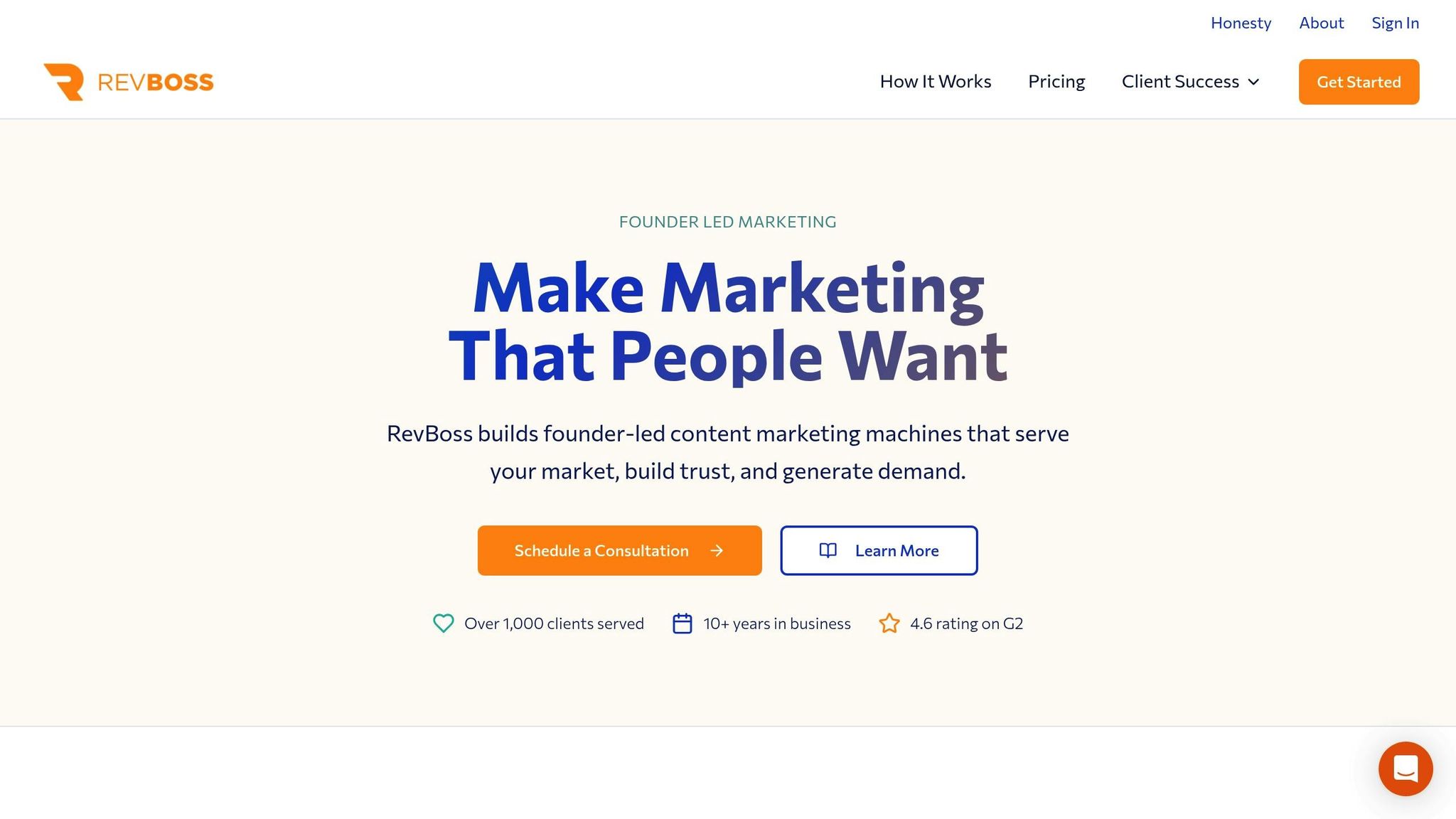
RevBoss offers a great example of how founder-led brands can tailor social proof strategies to emphasize personal branding and genuine connections. Unlike traditional methods, RevBoss focuses on integrating the founder's story with client success narratives to create a seamless and impactful approach.
B2B companies that include testimonials and case studies in their outreach see an average of 32% higher response rates. RevBoss takes this a step further by crafting personalized content that blends client achievements with the founder's vision. Their approach uses LinkedIn campaigns to grow the founder's audience while positioning them as thought leaders. Industry-specific case studies, which can convert up to 5x better than generic ones, are central to this strategy.
RevBoss incorporates social proof at every stage of the customer journey, from initial awareness to final conversion. Their onboarding process ensures that collecting and showcasing testimonials becomes a natural part of client relationship management.
This approach highlights how founder-led businesses thrive on trust and strong relationships. By weaving social proof into every aspect of their strategy, companies can not only boost credibility but also create a more effective lead generation process over time.
Conclusion
A striking 79% of B2B buyers rely on social proof to guide their purchasing decisions, and businesses that embrace these strategies experience 51% more leads and conversion rate boosts of up to 34%.
These numbers highlight how social proof reduces uncertainty for buyers. When potential clients see testimonials, case studies, or endorsements from businesses like theirs, they gain the confidence to take the next step. It’s about showing them they’re not alone in their decision-making.
Founder-led brands hold a unique advantage here. By sharing their entrepreneurial journey and blending it with client success stories, founders can forge deeper, more personal connections. This approach creates a level of trust that traditional corporate strategies often struggle to achieve. A founder’s direct involvement adds a layer of sincerity that resonates powerfully with B2B audiences.
The key to success lies in being specific and relevant. Generic testimonials or outdated case studies won’t cut it. Instead, focus on gathering fresh, detailed feedback that tackles your audience’s unique challenges. Use industry-specific examples and measurable results to make your case stronger.
Integrating social proof effectively across all customer touchpoints is crucial. From the moment a prospect becomes aware of your brand to the final stages of conversion, social proof should be a constant presence. Sales teams can weave client testimonials and case studies into their pitches, while marketing materials should spotlight real, tangible client outcomes instead of vague success stories.
This guide has underscored how testimonials, case studies, and personal branding build trust and credibility. B2B buyers want to see proof of success before making a commitment. By crafting a social proof strategy that prioritizes trust and real relationships, businesses can set the stage for long-term growth. For founder-led brands, combining personal branding with strong social proof - like the approaches championed by RevBoss - takes credibility to the next level.
FAQs
What are the best ways for B2B companies to gather and use client testimonials to strengthen their marketing efforts?
B2B companies can collect client testimonials through surveys, interviews, or by encouraging happy clients to leave reviews on platforms like G2 or Clutch. The key is to make it as easy and convenient as possible for clients to share their thoughts.
To get the most out of these testimonials, display them prominently across your website, landing pages, and social media channels. Focus on highlighting specific results or success stories to make the testimonials relatable and impactful. You can also weave them into case studies, email campaigns, or presentations to build trust and credibility throughout the buyer's journey. By sharing real client experiences, you effectively showcase the value and dependability of your services.
What are the best ways to use social proof at each stage of the B2B buyer's journey?
To make the most of social proof in the B2B buyer's journey, it's important to align your strategy with each stage of the process:
- Awareness Stage: Introduce your brand by sharing customer testimonials and success stories. These help create a strong first impression and establish initial trust.
- Consideration Stage: Provide detailed case studies, client endorsements, and data-backed results. These demonstrate your expertise and reliability, giving potential buyers the confidence to explore further.
- Decision Stage: Offer peer recommendations, influencer endorsements, or personalized references. These tools can reassure buyers and reinforce their confidence in choosing your solution.
By using a variety of social proof methods across different channels and touchpoints, you can build trust and guide prospects smoothly through their decision-making process.
How can founder-led B2B brands use personal branding and social proof to build trust and stronger customer connections?
Founder-led B2B brands have a unique opportunity to build trust by sharing genuine stories, values, and experiences that reflect their distinct viewpoints. When founders focus on personal branding, they create a connection that feels human, making it easier for their audience to relate to and trust them.
Adding social proof - like testimonials, case studies, or client success stories - can further reinforce their expertise and showcase the real-world impact of their work. By consistently engaging in meaningful conversations and using storytelling to connect with their audience, founders can make their brand feel approachable while strengthening trust and credibility.