Ultimate Guide to Thought Leadership Consistency

Consistency in thought leadership is the key to building trust, authority, and long-term business growth. For founder-led businesses, delivering regular, meaningful insights can set you apart in crowded markets. Here’s why it matters and how to get it right:
- Why Consistency Matters: Regular messaging builds trust, strengthens brand recall, and attracts leads, partnerships, and opportunities.
- Risks of Inconsistency: Confused messaging erodes trust, creates a "purpose gap", and allows competitors to dominate.
- Key Components for Success:
- Define your brand voice and stick to it.
- Align content with business goals and audience needs.
- Focus on a few core themes to establish authority.
- Practical Steps:
- Use a content calendar to stay organized.
- Repurpose content across platforms for efficiency.
- Establish systems and delegate tasks to avoid bottlenecks.
- Overcoming Challenges:
- Avoid founder bottlenecks by documenting processes and delegating.
- Prevent burnout with boundaries and recovery time.
- Measure success using both quantitative and qualitative metrics.
Takeaway: Consistent thought leadership isn’t about creating endless content - it’s about delivering focused, reliable insights that address your audience’s needs. Whether managing it in-house or with external support like RevBoss, the goal is to stay consistent, measure impact, and build trust over time.
Become a Thought Leader in Just 10 Minutes a Day
Building the Foundation for Consistent Thought Leadership
To establish yourself as a consistent thought leader, you need a strong foundation built on three key elements: your brand voice, alignment with business goals, and a focus on core themes. These pillars will guide every piece of content you create and every message you share.
Defining Your Brand Voice
Your brand voice is what sets you apart and makes your content recognizable. It’s the personality that shines through in everything you produce - whether it’s a LinkedIn post, a podcast, or a keynote speech. A clear and consistent voice helps solidify your reputation as a trusted leader in your industry.
Start by defining your brand’s personality, values, and positioning. Are you analytical and data-driven, or do you lean toward a conversational and story-centered approach? Your values reflect the principles that guide your actions, while your positioning determines how you want to be perceived compared to others in your field.
Once you’ve nailed down your voice, document it. Write guidelines that detail your tone, preferred vocabulary, and messaging style. Test different tones, gather feedback, and refine your approach until it resonates with your audience. While your tone might shift slightly depending on the platform - formal on LinkedIn, casual on Twitter - the core personality and values should remain consistent across the board.
Aligning Content with Business Goals
To make your thought leadership efforts impactful, align them with your business objectives. This ensures your content not only engages your audience but also drives measurable results.
Start by identifying your goals. Are you looking to generate leads, build awareness in a new market, establish credibility for an upcoming product launch, or secure speaking opportunities? Each goal demands a tailored content strategy. For example, Salesforce creates content that highlights its leadership in customer relationship management, reinforcing its position as a market leader. Similarly, Kainos uses its blog to showcase expertise in digital transformation, aligning with its broader business goals.
Every piece of content should serve a purpose. If you’re discussing industry trends, include a call-to-action that directs readers to a relevant resource. A case study should clearly demonstrate the value you bring to the table. To ensure your content resonates, research your audience’s needs and challenges through surveys, social media insights, and industry reports.
Finally, track metrics that align with your goals. If lead generation is your focus, measure engagement from qualified prospects. For brand awareness, monitor reach and shares. The key is to connect your content’s performance to tangible business outcomes.
Setting Core Themes
Focusing on a few key themes allows you to establish authority and deliver consistent value. The most effective thought leaders zero in on areas where they have deep expertise and can offer unique insights.
Choose themes that align with your expertise, your audience’s needs, and your business goals. For instance, if you’re a fintech founder, you might focus on topics like regulatory changes, user experience in financial apps, and the future of digital payments. These themes should reflect what your audience is looking for - whether it’s inspiration, education, or entertainment. For B2B audiences, content that informs and inspires tends to resonate most.
Stick to your chosen themes and reinforce them through a rotating content calendar. This approach ensures your messaging remains consistent while keeping your content fresh and engaging. The goal isn’t to cover every topic under the sun but to become the go-to expert for the specific challenges your audience faces. When someone in your industry has a question related to your core themes, you want your name to be the first that comes to mind.
Strategies for Staying Consistent
Once you’ve laid the groundwork, the real test is keeping up a steady flow of high-quality content that reinforces your position as a thought leader. The trick? Building systems that align with your schedule, resources, and goals while consistently delivering insights that matter. By doing so, you’ll stay true to your brand voice, business objectives, and core themes. These strategies help translate your foundational work into an ongoing, impactful content strategy.
Creating a Content Calendar
Think of a content calendar as your editorial blueprint. It helps you plan what to publish, when to post it, and where it will live across your platforms. In short, it keeps you organized and ensures you’re publishing consistently.
Start by setting clear, realistic publishing goals for each platform. For instance, you might decide to publish one LinkedIn article weekly, three LinkedIn posts, and a newsletter every two weeks. The key here is consistency - it’s better to maintain a steady rhythm than to overwhelm yourself with an unsustainable schedule.
Your content calendar should include details like your target audience, publication dates, content status, assigned creators, topics, headlines, calls to action, formats, and key performance indicators. This level of planning prevents last-minute chaos and ensures every piece of content serves a purpose.
Don’t forget to factor in seasonal trends and major events. For example, SaaS companies might align their content with industry events like SaaStr or Dreamforce, while those in fintech could time their posts around regulatory updates. Tools like HubSpot, Buffer, Asana, or even a simple spreadsheet can help you stay on top of your schedule without becoming overwhelmed.
Once your calendar is in place, you can maximize its impact by repurposing your content across different formats.
Using Content Repurposing
Smart thought leaders know how to get the most mileage out of their content. Repurposing allows you to take one piece of content and reshape it into multiple formats, extending its reach and value. For example, a webinar can become a blog post, a series of LinkedIn updates, a Twitter thread, and even a feature in your email newsletter.
Start with a long-form anchor piece - like a blog post, podcast episode, or video series - and use it as the foundation for other content. Break down a detailed blog into several social media posts, create a Twitter thread summarizing its key points, or pull out stats and quotes for an email.
It’s also helpful to balance evergreen and timely content. Evergreen pieces that cover foundational industry topics can be reshared with updated intros, while trend-focused content should be repurposed quickly to stay relevant. This approach ensures your audience gets your insights in the formats they prefer.
Setting Up Content Creation Systems
Planning and repurposing are crucial, but without efficient systems, even the best strategies can fall apart. To maintain consistency, you need streamlined processes that make content creation manageable and sustainable.
Start by clearly defining roles and responsibilities. If you’re a solo creator, identify collaborators who can help with tasks like research, editing, or design. For teams, assign ownership for each stage - writing, editing, publishing, and promotion - to keep everything running smoothly.
One effective approach is using a four-week content cycle. For example:
- Week 1: Respond to current events or trending topics.
- Week 2: Focus on planning and research.
- Week 3: Dedicate time to content creation and production.
- Week 4: Schedule and prepare for the next month.
This framework helps avoid the feast-or-famine cycle often seen in content creation.
Document your process with templates, style guides, and checklists. Include scheduled review stages, such as fact-checking, ensuring brand voice consistency, and proofreading for grammar. This documentation keeps your output uniform, whether you’re working solo or as part of a team.
To lighten the load, consider outsourcing tasks like graphic design, video editing, or in-depth research. This allows you to focus on your strengths while maintaining a consistent output.
When you treat content creation like any other business process - with clear systems, defined roles, and measurable goals - it becomes far less daunting and much easier to sustain over time.
sbb-itb-9354cf2
Solving Common Consistency Problems
Even with solid strategies and systems, founders often hit snags that disrupt their thought leadership efforts. These roadblocks are a natural part of building a brand while managing a business. The key to overcoming them? Spotting the issues early and addressing them head-on.
Avoiding Founder Bottlenecks
One of the biggest challenges to consistent thought leadership is becoming a bottleneck. If every piece of content needs your approval or every decision waits on your input, things can grind to a halt. The solution? Document your decision-making process so your team can take the reins on content creation.
Set up straightforward rules or guidelines to help your team make decisions without needing constant input. This not only speeds things up but also gives you more freedom. As one expert puts it, "Delegating your social media doesn't mean losing control - it means gaining freedom."
Focus on tasks that require your unique expertise, like strategy or storytelling, and delegate everything else - whether it’s formatting, scheduling, graphic design, or research. You can still stay involved in key decisions through voice notes, interviews, or structured feedback sessions, ensuring your authentic voice shines through without being a bottleneck.
Preventing Burnout
Streamlining decisions is important, but so is protecting your mental health. The constant pressure to generate insights, keep up with trends, and maintain a public presence can quickly lead to burnout. Consider this: 88% of founders say stress impacts their decision-making, and 83% link stress to team burnout. A 2024 survey even found that 53% of founders experienced burnout in the past year.
Jason Patterson, Founder of Jewel Content Marketing Agency, says, "Burnout doesn't happen when you're tired. It happens when you don't see the point in what you're doing anymore."
To avoid burnout, set clear boundaries. Turn off content alerts at night, skip checking work notifications after dinner, and carve out at least one day a week for personal time. Focus on high-impact channels, say no to opportunities that don’t align with your goals, and replace the hustle mentality with a more sustainable approach. Build recovery time into your schedule by planning lighter content weeks after big launches or keeping backup content ready for stressful periods.
Measuring and Adjusting
Without proper measurement, it’s easy to feel like your thought leadership efforts aren’t paying off. In fact, 98% of senior marketers say tracking thought leadership is tough, and 82% are dissatisfied with their current approach. That’s because traditional digital marketing metrics don’t always fit a long-term strategy like thought leadership, which is more about building relationships.
Take a mixed-metric approach. Balance quantitative metrics - like website traffic and social media followers - with qualitative indicators, such as meaningful comments, shares, and in-depth conversations. Look for signs of authority, like an increase in branded search volume or speaking invitations, and measure trust through customer feedback and Net Promoter Scores. Regularly reviewing these metrics will help you spot what’s working and tweak your strategy as needed.
How RevBoss Supports Consistent Thought Leadership
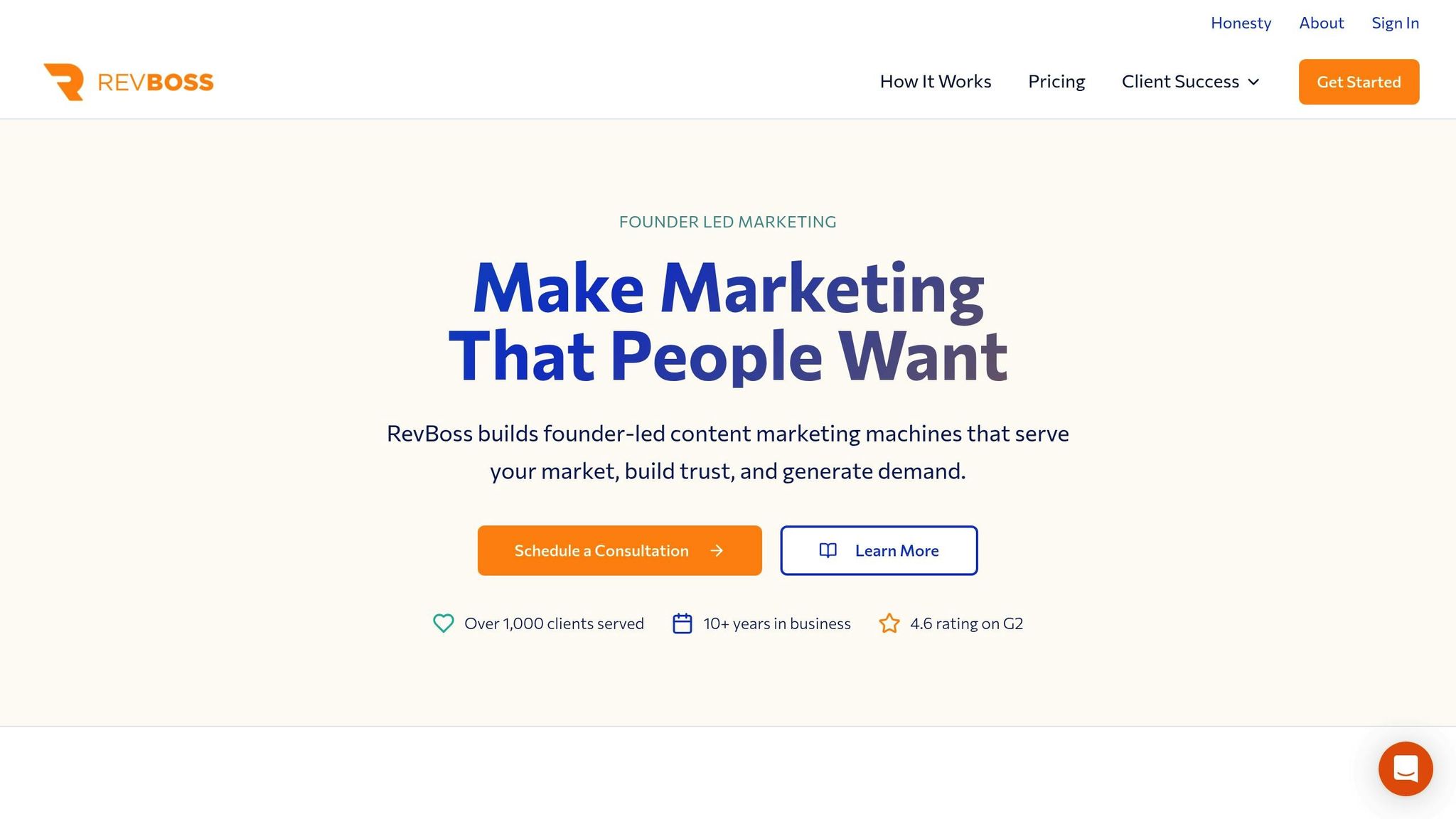
Maintaining consistent thought leadership while juggling the demands of running a business can feel like an uphill battle. Founders often find themselves stretched thin, struggling to keep their message alive while managing day-to-day operations. RevBoss steps in to bridge this gap, offering a system that preserves the founder's authentic voice and vision while lightening the operational load.
Here’s how RevBoss tackles the key elements of an effective thought leadership strategy:
Custom Content Strategies
RevBoss takes the challenge of creating impactful content and turns it into a seamless process. By focusing on your Ideal Customer Profile (ICP), they craft content that informs, entertains, and provides fresh perspectives - helping your brand stand out while delivering measurable results.
The process starts with monthly interview sessions where founders share their expertise. From there, RevBoss combines the skills of expert creators with AI technology to transform these interviews into engaging, multi-format content designed for various platforms and audiences. This method ensures your insights are amplified and your content aligns perfectly with your business objectives.
Audience Growth and Activation
Creating great content is only half the battle - getting it in front of the right audience is just as critical. RevBoss excels in LinkedIn audience development, a key platform for B2B businesses led by founders. Through targeted outreach and engagement strategies, they help you grow and activate your LinkedIn audience. This targeted approach ensures your thought leadership efforts resonate with your ideal prospects, turning your content into a driver for business growth.
Ongoing Management and Support
Consistency is the cornerstone of effective thought leadership, and RevBoss ensures you stay on track. Starting at $3,000 per month, their programs include custom content strategies, audience development, and full platform support to keep your leadership efforts steady. Regular strategy reviews, performance analysis, and timely adjustments allow founders to remain involved at a strategic level without getting bogged down in execution. This comprehensive support helps build trust, grow your audience, and create a dependable pipeline.
Conclusion
Establishing consistent thought leadership goes beyond simply producing content - it's about becoming the go-to voice your audience trusts and seeks out time and again. Companies that excel in this space understand one core principle: consistency builds credibility, and credibility translates into tangible business outcomes.
The stats speak for themselves. Businesses that focus on thought leadership are 2.4 times more likely to charge premium prices, 3.8 times more likely to close more deals, and twice as likely to dominate their market. Thought leadership contributes over $100 billion annually. Yet, nearly 20% of B2B executives admit they lack a way to measure its impact. Without proper measurement, even the best efforts can fall short.
To bridge this gap, it's essential to combine strategic planning with actionable execution. This means creating a clear brand voice, aligning content with key themes, and implementing structured processes for content creation and distribution. Most importantly, it requires tracking meaningful metrics and adapting based on real-world data.
"C-level executives may assume their influence, yet true thought leadership is determined by audience perception."
This insight highlights why consistency is non-negotiable. Your audience's trust is built over time through repeated exposure to insights that address their challenges. While one standout piece of content might capture attention, sustained thought leadership requires consistently delivering fresh ideas that solve real problems.
Key Takeaways
The foundation of effective thought leadership lies in three critical elements: strategy, systems, and support. Your strategy defines your message and target audience. Systems ensure you can deliver that message consistently. And support - whether through internal teams or external partners - keeps the process running smoothly, letting you focus on driving your business forward.
Companies like McKinsey, Salesforce, and HubSpot have mastered this balance by focusing on metrics that matter. They don’t just chase vanity metrics; instead, they prioritize engagement, lead generation, and business results directly tied to revenue growth.
Measurement is especially important. Nearly 75% of marketers are placing more emphasis on measurement and attribution. Regularly track key indicators like website visits, social media engagement, and lead conversions. Surveys can also provide insights into how well your message resonates with your audience.
This data-driven approach is the backbone of consistent thought leadership. It’s a long-term effort - more of a marathon than a sprint. Success comes from building systems that enable steady output. Whether you manage this internally or partner with a service like RevBoss to streamline your efforts, the goal is to maintain your authentic voice while removing operational roadblocks.
"As you embark on your thought leadership journey, remember the path to success is paved with data. So, start measuring, optimize consistently, and watch your influence grow."
While the potential rewards are immense, achieving them requires dedication. Start with a well-defined strategy, implement systems that ensure consistent execution, and measure the metrics that truly matter. This investment in thought leadership will pay dividends for your business in the long run.
FAQs
What strategies can founder-led businesses use to maintain consistent thought leadership?
Founder-led businesses can keep their voice strong and their influence growing by focusing on three main strategies: defining their niche, sharing genuine content, and staying connected with their audience. Start by pinpointing what makes your perspective or expertise stand out in your field. Knowing this gives you a clear direction for creating content that truly speaks to your audience.
Staying consistent is key. Build a content plan that matches your goals and fits into your routine. Share stories, practical advice, and insights that showcase your values and knowledge. Let your personality shine through - authenticity goes a long way in earning trust and loyalty.
Lastly, make engagement a priority. Reply to comments, join discussions, and actively interact with your community. Thought leadership isn’t just about putting ideas out there; it’s about sparking conversations and forming meaningful connections that last.
How can I effectively measure the success of my thought leadership efforts?
To determine how well your thought leadership efforts are working, keep an eye on key performance indicators (KPIs) that match your objectives. Look at engagement metrics such as likes, shares, comments, and how far your content is reaching - these can show how your audience is interacting with your material.
You should also examine website traffic and the quality of leads to see how effectively your content is driving conversions. On top of that, use surveys or feedback to gather insights about brand perception, and track the expansion of your professional network. By reviewing these metrics regularly, you can make sure your strategy stays effective and aligned with your goals.
Why is it important to align your content strategy with your business goals for effective thought leadership?
When your content strategy aligns with your business goals, every piece you create has a clear and defined purpose. This approach ensures your content not only supports your company’s priorities but also connects with your audience in a way that drives real results.
By tying your content to these objectives, you can build trust, enhance credibility, and create engagement that fuels business growth. It’s a way to make sure your thought leadership efforts stay consistent, meaningful, and in sync with your broader vision for the future.