How to Use Video for Founder-Led Storytelling

Video storytelling is your secret weapon to connect with your audience. Why? People remember 95% of a message through video, compared to just 10% from text. Plus, 82% of consumers are more likely to act after watching a video. Founder-led videos go even further - 98.2% of B2B buyers say leadership expertise influences their decision to work with a company. Here's how to create impactful founder-led videos:
- Step 1: Share your personal story. Focus on your "why" and connect it to your audience's challenges. Highlight struggles and growth.
- Step 2: Keep it simple. Use a smartphone, good lighting, and a lapel mic. Focus on clear audio and steady shots.
- Step 3: Hook your audience early. Start with a bold statement or relatable problem. Share vulnerabilities and achievements to build trust.
- Step 4: Edit smart. Trim unnecessary parts, add captions, and format for each platform (e.g., 9:16 for TikTok, 16:9 for YouTube).
- Step 5: Measure success. Track engagement, play rates, and conversions. Use feedback to improve.
Start small. Record a 60-second video this week and share something real about your journey. Remember, connection beats perfection every time.
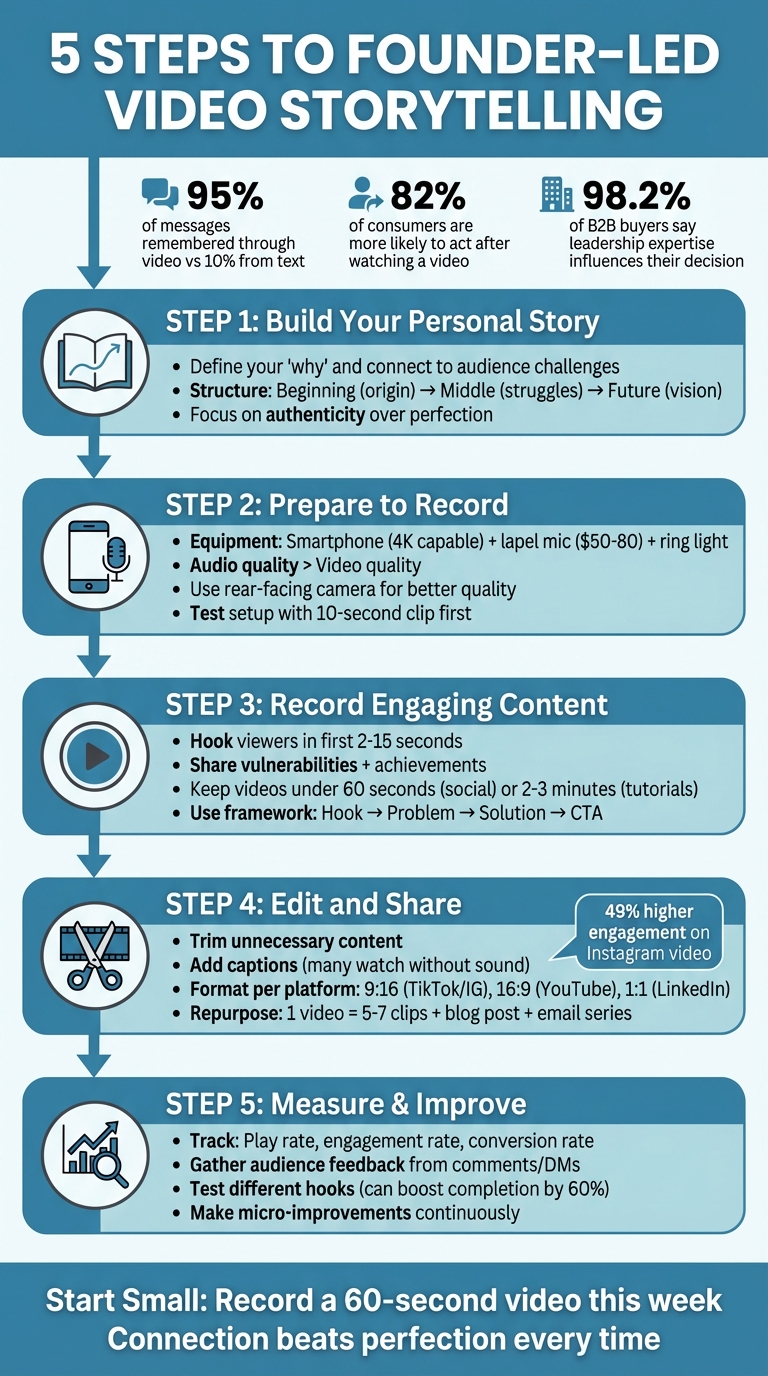
5-Step Process for Creating Impactful Founder-Led Videos
Make Your Story Your BEST Sales Tool (Founder-Led Marketing Secrets)
Step 1: Build Your Personal Story
Your personal story is the backbone of founder-led video content. But here's the thing - it’s not just about you. It’s about where your passion intersects with the challenges your audience faces. Jonathan English, CEO of Venture Videos, sums it up perfectly:
Your 'why' is the common ground you share with your audience, you just need to dig it out.
Define Your Core Story
Start by sketching out your origin story. What problem pushed you to create your solution? What values drive you to keep going every day? Think of your story in three parts: the beginning (your origin), the middle (the struggles and growth), and the future (your vision).
Take inspiration from Viddyoze’s brand story video, "How We Built An 8-Figure Bootstrapped Software Enterprise", released in November 2021. Co-founders Joey, Jamie, and David shared their journey, from starting as a three-person team to building an eight-figure business. It wasn’t just a hit - it became their most-watched YouTube video because it felt raw and real.
Here’s a quick test: Imagine your story alongside a generic competitor’s. If it blends in, it’s time to dig deeper. Highlight the moments, decisions, and struggles that are uniquely yours. Maybe you’re obsessed with a technical feature, but your audience cares more about how it improves their day-to-day. Bridge that gap.
Once you’ve refined your story, tie those personal experiences to the real-world challenges your audience is facing.
Identify Key Themes and Audience Pain Points
Your story has to resonate with your audience’s struggles. Dive into customer feedback. What questions keep surfacing? What frustrations do they share? These are your themes. Instead of rattling off product specs, focus on broader ideas - things like solving industry challenges, fostering connection, or driving innovation.
Authenticity is everything here. 82% of consumers say they’ve been convinced to make a purchase after watching a brand’s video, but only if it feels genuine. Don’t shy away from sharing your missteps or the hurdles you had to clear. As Joey Xoto, Co-Founder of Viddyoze, explains:
Your brand story video should be the hero piece that gets people to follow you and buy into who you are.
It’s your openness and honesty that make you relatable. And that relatability? That’s what transforms viewers into believers.
Step 2: Prepare to Record Your Videos
You don’t need a fancy studio or a big budget to create effective founder-led videos. Chances are, your smartphone is already equipped to handle the job. Keeping it simple lets your story shine, making your message feel more personal and relatable. As Drew Gula, Marketing Copywriter at Soundstripe, puts it:
Don't worry about the $10,000 camera you don't have... You might already have everything you need to create high-quality video marketing on a startup budget.
Once you’ve nailed down your story, using easy-to-access tools ensures you can tell it naturally.
Choose Simple, Accessible Equipment
Start with your smartphone. Modern smartphones can shoot in 4K, which is more than enough for founder-led content. Always use the rear-facing camera - it’s sharper and more detailed than the front-facing one. A basic setup - your phone, a portable light, and a lapel mic - can cost less than $50.
When it comes to videos, audio quality beats video quality every time. Greg Ciotti from Kapwing’s marketing team emphasizes this:
Audio fidelity is more important than video in determining a video's overall quality.
If you’re upgrading, start with a better microphone. A Rode smartLav+ ($60–$80) plugs directly into your phone and delivers great sound. For USB recording, the Blue Yeti ($99) is another solid pick. To avoid echo, record in a small room with rugs, curtains, or other soft furnishings - they’ll absorb sound and prevent that hollow, amateur vibe.
Lighting doesn’t need to be fancy. Natural light works wonders - just position yourself facing a window. If that’s not an option, a simple ring light or selfie light can keep things evenly lit. Before you hit record, lock your phone’s exposure settings to avoid sudden lighting shifts mid-video.
Stability is key, too. Shaky footage screams unpolished. Use a tripod or even a stack of books to keep your phone steady. Always test your setup with a quick 10-second clip before diving into the full recording. Check how it looks and sounds on a larger screen to make sure everything - framing, audio, and lighting - is spot on.
Select Video Styles That Show Your Personality
Pick a format that feels natural to you. The goal is to let your personality shine through while staying true to your story. Talking-head videos - where you speak directly to the camera - are a straightforward and effective way to build trust. They create an intimate, conversational vibe that stands out from overly polished corporate content. Ross Simmonds, Founder of Distribution.ai, explains:
A talking head video is the simplest, most direct way to communicate on camera. It's just you - sitting or standing - speaking straight to the viewer.
If talking to a camera feels awkward, try an interview or Q&A format. Having someone ask you questions can make the process feel more natural and conversational, especially for tackling complex topics.
Another great option is behind-the-scenes content. Take viewers into your workspace, share your daily routine, or show how your product is made. For example, in July 2023, Zendesk released a nearly 5-minute mini-documentary detailing their rebranding journey. It featured team members debating logos and fonts, capturing the messy, real-life process of brand evolution. The authenticity resonated with their audience.
Think of your content in three tiers:
- A-level: Polished, high-production videos for first impressions.
- B-level: Thought-out but casual, like educational series.
- C-level: Raw, unfiltered clips shot on your phone for social media.
As a founder, your C-level content often hits the hardest. Those unscripted, real moments can feel more relatable than anything overly produced. Keep it short - videos under 90 seconds tend to hold attention better, and vertical formats boost watch completion rates by 90%. The key is to match the style to your platform and personality, not some outdated idea of what "professional" should look like.
Step 3: Record Engaging Content
Now that you’ve laid the groundwork, it’s time to create content that captivates your audience. With your equipment ready and your story mapped out, focus on structuring your video to grab attention right from the start and keep viewers hooked until the very end. Every word, image, and moment should reinforce your opening hook and build momentum.
Start with a Strong Hook
Your hook - whether it’s the thumbnail, title, or opening seconds - needs to stop people in their tracks. Research shows viewers decide within 2 to 15 seconds whether they’ll keep watching. As Joseph Sugarman, a renowned copywriter, once said:
If you can't capture your audience's attention right away, you've lost them.
To nail this, lead with something relatable. For example, Casper’s product videos immediately address a common frustration: struggling to sleep because it’s too hot or too cold. They skip the small talk and dive straight into the issue, pulling viewers in before presenting their solution.
Another approach is to spark curiosity with an unexpected statement. In July 2024, Motion, a SaaS company, made waves with the headline, "There are now 13 months in a year." The bold claim left viewers intrigued, eager to hear the explanation. You can also tap into specific fears or concerns. For instance, start with, "ChatGPT won’t replace your marketing team. Here’s why", and immediately back it up.
Numbers are another powerful tool. Phrases like "an 84-page Google Doc" or "99.98274% uptime" pique curiosity and make people want to learn more. Whatever strategy you choose, script your opening lines carefully. While the rest of your video can be more relaxed, those first few moments need to be sharp and deliberate.
Share Vulnerabilities and Achievements
Once you’ve captured attention, it’s time to connect on a human level. Drawing from your personal story (from Step 1), share moments of struggle to show you’ve faced the same challenges your audience is dealing with now. These shared experiences create a sense of trust and relatability. Frontpoint co-founders Chris Villar and Aaron Shumaker did this by recounting their first customer interaction, highlighting how it shaped their dedication to customer service.
Structure your narrative like this: start with the problem you faced, walk through the obstacles you encountered, explain how those challenges shaped your mission, and end with your vision for the future. After building this emotional connection, back it up with proof. Share growth metrics, customer testimonials, or specific achievements. For instance, instead of saying, "We save businesses time", say, "Our clients save an average of 6 hours per week". Keepsake Frames adopted this approach by blending vulnerability with concrete results, leading to a 20% increase in campaign performance.
Authenticity is what resonates most. Over 60% of consumers prefer brands that feel genuine, and 81% say trust is essential before making a purchase. Don’t shy away from natural pauses or imperfections - they make you more relatable.
Once you’ve established trust and credibility, keep things concise to hold your audience’s attention.
Keep It Short and Focused
Each video should tackle one topic: a single business challenge, question, or problem. Trying to cover too much will dilute your message and overwhelm viewers. Wistia sums it up perfectly:
Don’t bore us. Get to the chorus. In other words, hook your audience from the start, stay laser-focused on your message, and keep it simple.
For social media, aim for videos under 60 seconds. Tutorials can run slightly longer, around 2–3 minutes. Wistia demonstrated this with a 34-second teaser for their Webinarpalooza event - short, engaging, and full of personality. Stick to a straightforward framework: Hook (grab attention), Problem (highlight an issue), Solution (present your approach), and Call-to-Action (prompt the next step).
Before hitting record, rehearse to avoid unnecessary tangents. Add a few seconds of silence at the beginning and end of each take to make editing smoother. If you’re going for a less polished vibe, use bullet points instead of a full script to stay on track while keeping it natural. Remember, 82% of consumers say video content has influenced their purchasing decisions. Keeping your audience engaged throughout is key to making an impact.
sbb-itb-9354cf2
Step 4: Edit and Share Your Videos
With your content ready, it’s time to fine-tune it and share it with the world. Editing doesn’t have to be overwhelming, but it does require focus. The goal here is to make your message clear, engaging, and perfectly suited for the platforms where your audience spends their time.
Edit for Clarity and Impact
Start by cutting out anything that doesn’t serve your message. As Rochi Zalani from Buffer puts it:
Trim the fat: Cut any unnecessary clips from your videos and keep only the content that's 100% necessary to deliver the message.
This means removing awkward pauses, off-topic detours, or repetitive moments. To keep things visually interesting, use B-roll - those extra shots, close-ups, or secondary footage - to smooth over transitions and add variety.
Since many people watch videos without sound, captions and text overlays are essential. Not only do they make your content more accessible, but they also help boost SEO. And don’t forget to format your video for the platform: use 9:16 for TikTok and Instagram Reels, 16:9 for YouTube, and 1:1 for LinkedIn or Facebook. Proper aspect ratios ensure your video looks polished and takes up the most screen space. Tools like CapCut, Canva, or Descript make this process much easier.
Subtle background music can add a professional touch, and batching your editing sessions helps maintain a consistent tone throughout your content.
Share on the Right Platforms
Once your video is polished, post it where your audience already hangs out. For B2B founders, LinkedIn is a powerful platform for showcasing thought leadership or behind-the-scenes content. Keep LinkedIn videos short - ideally 30 to 90 seconds - even though the platform allows longer uploads. Always post videos directly to LinkedIn (instead of linking to external sites) since its algorithm favors native content.
For Instagram, focus on high-energy, authentic videos. Reels are great for polished short-form clips, while Stories work well for quick, casual updates. Fun fact: Instagram video content gets 49% higher engagement than static posts.
TikTok is becoming a key player for B2B content, with 42% of its users now aged 30–49. Use it for relatable, personality-driven videos that feel casual yet informative.
YouTube remains the go-to platform for long-form, educational content. Since many users discover tutorials through search, structure your videos as problem-solving guides or "how-to" lessons. On Twitter (X), videos generate ten times more engagement than text posts, so don’t skip this platform for quick, impactful clips.
Tailor your message for each platform and its audience. Start with your primary platform, then adapt and share on others within 24 to 48 hours to keep the momentum going.
Repurpose Your Content Everywhere
Why let your hard work live in just one spot? A single 10-minute video can become a treasure trove of content. Break it into short clips, turn the transcript into a blog post, create an email series, and pull out key points for social media posts. As Prateek Keshari from Hearst Bay Area explains:
One 10-minute video can become 5-7 short clips, a blog post, an email series, and social media posts. Most businesses create once and post once, missing 90% of their content's potential value.
For example, you can share short, punchy clips on Instagram or TikTok, while using the transcript to write an SEO-friendly blog post. If you’re running an email campaign, include a video thumbnail that links to a landing page - this can boost click-through rates by 200% to 300%.
Adapt your content to match each platform’s strengths. On LinkedIn, combine industry insights with personal stories for deeper engagement. For TikTok or Instagram Reels, grab attention with a bold hook in the first three seconds, like "Stop doing X, start doing Y". On YouTube, break down complex topics into 8 to 12-minute segments to keep viewers engaged.
The key is to stay genuine. Whether you’re filming your work process or sharing client calls (with permission), make sure your repurposed content still feels real and relatable.
Step 5: Measure Success and Improve
Once your videos are live, the real work begins - figuring out what’s working and what’s not. Measuring the impact of your efforts is the only way to refine your strategy and keep growing.
Making videos is just step one. To level up, you need to track performance, analyze the data, and adjust your approach accordingly.
Track Key Metrics
Start by zeroing in on the numbers that align with your business goals. For example:
- Play rate: This tells you how many people who land on your page actually hit play. If the numbers are low, it might be time to tweak your thumbnail or move the video to a better spot on the page.
- Engagement rate: This shows how long viewers stick around. If there’s a big drop-off early on, heatmaps can help you pinpoint where you’re losing them. Maybe your opening needs more punch, or your script could use some fine-tuning.
- Conversion rate: This measures how many viewers take the action you’re aiming for - whether it’s booking a call, signing up for a newsletter, or downloading a resource.
Different platforms have their own quirks. For instance, LinkedIn rewards shares and audience retention, Instagram favors saves, YouTube prioritizes watch time, and on Twitter, the video completion rate is key.
As Rochi Zalani from Buffer puts it:
Video views are the most important performance metric to understand whether or not you're increasing your reach.
For B2B founders, tracking leads generated from videos is a must. You can even calculate ROI in unexpected ways - like figuring out how much time your videos save your team. For example, if a single FAQ video answers 50 customer questions a month, that’s a game-changer for your support team.
Use Audience Feedback
Numbers only tell part of the story. To get the full picture, listen to your audience. Comments and direct messages can reveal what’s clicking with viewers and where they want more detail. If a certain question keeps popping up, that’s your cue to create a video addressing it.
At the end of your videos, ask open-ended questions to spark deeper conversations. Instead of a generic “Was this helpful?” try something like, “What’s the biggest challenge you’re facing with [topic]?” This not only boosts engagement but also gives you fresh ideas for future content.
You can also mine your customer support tickets for recurring questions or check your website’s search data to see what visitors are looking for. Both are goldmines for video topics. On Instagram, use interactive tools like polls, Q&A boxes, and stickers to gather instant feedback and test ideas before committing to a full production.
With your audience’s input in hand, you’re ready to refine your content.
Experiment and Adjust
Once you’ve got some baseline data, it’s time to experiment. But don’t go overboard - small tweaks can yield big insights.
Try different hooks in the first few seconds of your videos. For example, starting with a bold statement like “Stop doing X, start doing Y” can boost completion rates by up to 60%. Record multiple versions in one session, varying your tone or style, to see what resonates. You could even release two versions of the same content with different opening lines and compare the results.
Haley Wells from seoplus+ suggests:
Start with three to five videos, and after a couple of weeks, see which videos your audience interacted with the most.
Don’t be afraid to mix up your production style, either. Test polished, professional videos against more casual, webcam-style recordings. Many founders find that raw, unfiltered content can build stronger connections than heavily produced clips. The key is to let the data guide you, not just your gut instinct.
Keep experimenting, keep tweaking, and let your audience show you what works best.
Conclusion
Founder-led video storytelling isn’t about flashy production or perfection - it’s about showing up, sharing your journey, and creating real connections. The five steps outlined here - crafting your personal story, preparing to record, creating engaging content, editing and sharing, and tracking your results - offer a simple roadmap to get started.
The key is authenticity. As Kerri Fernsworth Feazell, Co-CEO and Co-Founder of Concurrent, wisely says:
Connection, not perfection... if you get that marketing message down and truly connect with your audience on an emotional level, as long as everything else is in the 80%-95% range, your message will land.
And the numbers back it up. A striking 77% of customers prefer companies whose CEOs are active on social media. So yes, your presence on camera makes a difference.
Here’s a challenge: start small. Record a 60-second video this week. Share a lesson you’ve learned or answer a question your customers often ask. Jade Beason, Creator and Consultant, offers this practical advice:
Start with a platform that feels comfortable for you, and keep making micro-improvements in your journey. That way, creating video content won't feel like this huge mountain you have to climb.
FAQs
How can I share my personal story effectively in a founder-led video?
To create a compelling founder-led video, aim to share your personal story in a way that feels real and emotionally engaging. Think back to the pivotal moments in your journey - whether it’s a tough challenge, a breakthrough, or a big win - that truly reflect your values and the vision behind your work. These are the moments that help shape a narrative your audience can connect with.
Keep your tone casual and sincere; this makes it easier to build trust and keep people interested. Adding visuals and using storytelling techniques can bring your journey to life, highlighting the human side of what you’ve experienced. When you connect with your audience on a personal level, your story has the power to inspire, stick with them, and leave a meaningful impression.
What are some tips for creating high-quality videos on a tight budget?
Creating polished, professional videos without breaking the bank is absolutely doable if you focus on what truly matters. Start by being real and relatable - people connect with authenticity, so let your story shine through. Map out a clear narrative with a beginning, middle, and end, and aim to show your message visually rather than relying too much on words. This keeps your content dynamic and engaging.
Don’t underestimate the power of good lighting and sound - they can elevate your video quality without requiring a big budget. Use natural light whenever possible, or invest in an affordable lighting kit to brighten things up. For audio, even a basic external microphone can make a world of difference in clarity. Most importantly, concentrate on delivering content that matters. Share stories, insights, or tips that resonate with your audience and help build a connection based on trust.
How can I track the success of my video storytelling?
To gauge how well your video storytelling is performing, keep an eye on a few crucial metrics. Start with audience engagement - this includes views, likes, shares, and comments, which give you a sense of how much your content is resonating. Next, consider message retention, which measures how effectively your audience connects with and remembers your story. Lastly, track the business impact by looking at leads generated, conversions, or shifts in brand awareness.
Digging into these numbers will help you understand not just how your videos are performing but also how they’re influencing your audience and driving results for your business. But don't get too caught up in the data - storytelling is about more than metrics. It’s about building trust and creating genuine connections that stick with your audience.