How a VP of Marketing Can Operationalize Executive-Led Demand Generation

Want to turn your execs into demand-gen machines? Here’s the playbook:
- Why it works: Executives have 4x more reach on LinkedIn than company pages and influence buyers already 57% into their decision-making process. Their insights build trust and shorten sales cycles.
- Biggest challenges: Executives are busy, and poorly managed content risks compliance issues or sounding generic. Without clear workflows, initiatives stall.
- Your role as VP Marketing: Create repeatable systems to transform executive insights into a pipeline-driving engine.
5 Steps to Make It Happen:
- Align Exec Expertise with Goals: Pin down 3–5 key themes tied to revenue goals. Use execs’ unique perspectives to address customer pain points across the funnel.
- Build a Workflow: Automate repetitive tasks (AI tools help) while keeping execs involved in high-level input. Tools like RevBoss streamline this with content calendars and publishing workflows.
- Automate Engagement: Use intent signals (e.g., pricing page visits) to trigger personalized campaigns. AI-driven outreach boosts pipeline progression by 200%.
- Measure Impact: Focus on metrics that matter - Marketing-Sourced Pipeline (MSP), deal velocity, and win rates. Ditch vanity stats like clicks.
- Scale Smartly: Use tools and coaching to grow without overwhelming your team. Plans like RevBoss start at $1,500/month for LinkedIn content and outreach.
Pro Tip: Executive-led demand gen isn’t just a tactic - it’s a system. With the right processes, you can turn their authority into a revenue engine.
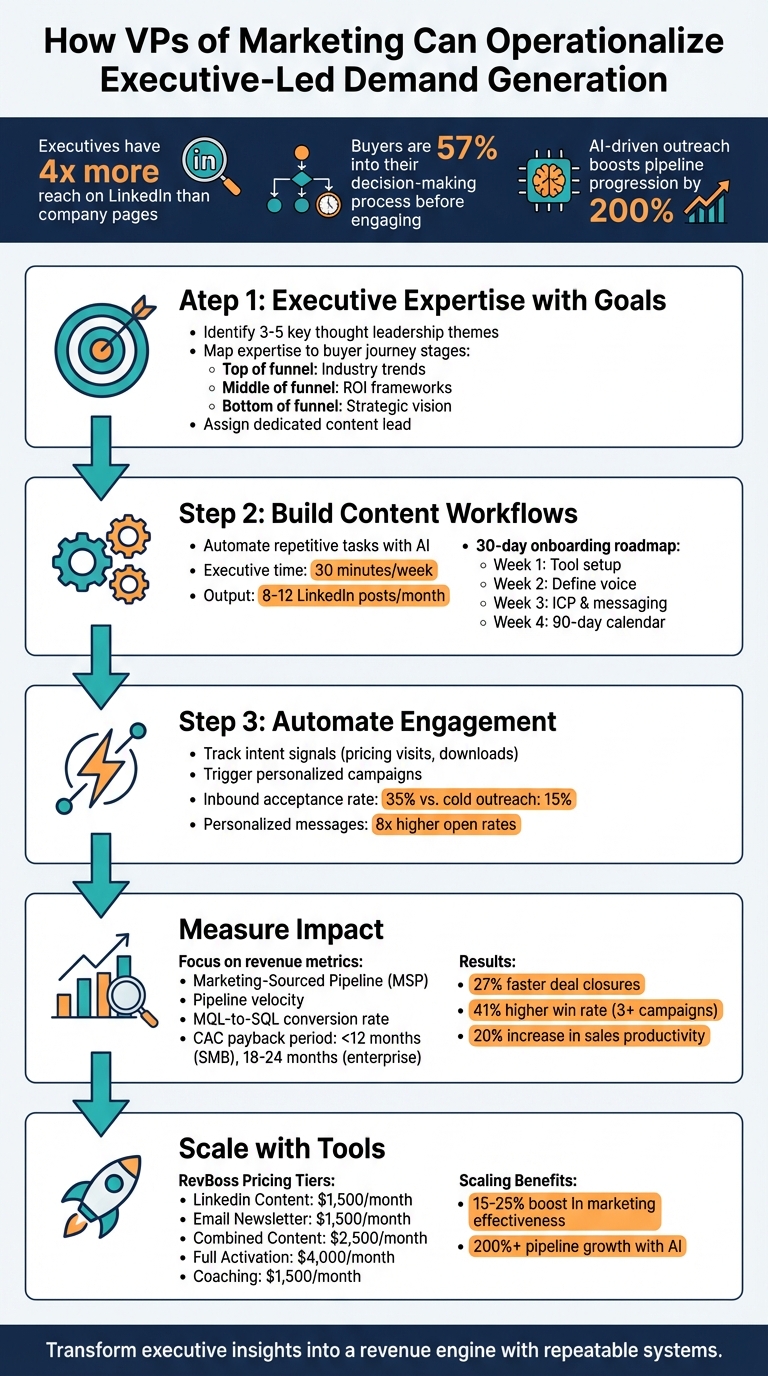
5-Step Framework for Operationalizing Executive-Led Demand Generation
Step 1: Align Executive Expertise with Marketing Goals
To have your executives effectively drive demand, you need to tap into and organize the insights that only they can provide. This involves capturing their convictions, decision-making processes, and firsthand experiences - things they've gained through years of closing deals, navigating industry shifts, and making tough calls.
The goal is to focus on what can't be replicated or automated: their unique perspectives. These insights are what will make your content stand out. Once identified, you’ll need to audit their expertise and tie it directly to your revenue goals.
Audit Executive Expertise and Knowledge
Start by identifying 3–5 key thought leadership themes that align with your company’s growth objectives. These themes should address the pain points of your ideal customers and support your business priorities. For example, topics might include AI transformation, improving operational efficiency, or tackling governance challenges.
Next, schedule sessions with your executives to align their expertise with the buyer journey. For top-of-funnel content, focus on industry trends and benchmarks to attract attention. Middle-of-funnel content should highlight ROI frameworks and practical implementation strategies. Finally, bottom-of-funnel content should emphasize their vision and strategic thinking to help buyers justify decisions internally. This ensures that every piece of content contributes to your demand generation strategy.
Assign a dedicated content lead from your marketing team to work closely with executives. This person will extract ideas through structured discussions, ghostwrite in the executive’s voice, and oversee the publishing process. Leverage AI tools to handle tasks like research and drafting, so your executives can focus on providing high-level insights and final approvals.
Once you’ve mapped out their expertise, set clear metrics to evaluate its impact.
Set Shared KPIs and Success Metrics
Define success by working backward from your board-approved revenue targets to the Marketing-Sourced Pipeline (MSP) you need. For instance, if your company closes 25% of marketing-sourced deals and requires $20 million in revenue, you’ll need to generate $80 million in pipeline.
Focus on metrics that demonstrate commercial impact rather than just engagement. These include:
- Marketing-Sourced Pipeline (MSP): The total value of opportunities generated by marketing, which forecasts future revenue.
- Pipeline Influence: Tracks deals where executive content played a role, showcasing how it builds trust and provides "air cover."
- Target Account Revenue (TAR): Measures the percentage of revenue from high-value accounts, reflecting the success of precision targeting.
| Metric | Definition | Business Impact |
|---|---|---|
| Marketing-Sourced Pipeline (MSP) | Total value of opportunities originating from marketing | Predicts future revenue and aligns with board-level goals |
| Pipeline Influence | Deals where buyers engaged with executive content | Measures trust-building and content effectiveness |
| Target Account Revenue (TAR) | Percentage of revenue from a specific Target Account List | Evaluates success in targeting high-value accounts |
Create an ROI-focused scorecard that speaks to what matters in boardrooms. Go beyond vanity metrics and track deal velocity, win-rate improvements, and pipeline predictability. For example, adding a "How did you hear about us?" field to inbound forms or tagging "executive POV referenced" in CRM notes can help capture the influence of executive content that traditional attribution models might overlook.
sbb-itb-9354cf2
Step 2: Build Content Workflows for Executive-Led Campaigns
After aligning your executives' expertise with your marketing goals, the next step is to create a workflow that can be repeated. This avoids the inefficiency of one-off projects. The trick here is automating repetitive tasks while keeping the authenticity of executive content intact - their unique perspective. Companies using AI in their marketing workflows have seen pipeline progression grow by over 200%. Why? Because automation takes care of the groundwork - like research and drafting - while executives stay focused on strategic, high-level input. This structured process ensures executive insights are consistently transformed into impactful content.
Use RevBoss for Simplified Content Creation
RevBoss offers a streamlined approach that minimizes the time executives need to spend while ensuring high-quality content. Here’s how it works: executives dedicate just 30 minutes a week to a call or respond to prompts from an automated Content Agent. From there, the RevBoss team handles everything - research, ghostwriting, image creation, and publishing.
The output? 8–12 LinkedIn posts per month, starting at $1,500/month. This also includes audience growth workflows that ensure your content reaches the right people. The onboarding process is broken into a clear 30-day roadmap:
- Week 1: Set up tools and establish a posting cadence.
- Week 2: Define the executive’s voice and perspective, creating tone guidelines.
- Week 3: Nail down your ideal customer profile (ICP) and messaging pillars.
- Week 4: Finalize a 90-day activation calendar.
This structured approach ensures the system gets up and running quickly, avoiding the usual trial-and-error delays.
"It took about a month to get everything humming. Our Account Manager understands our business, the RevBoss copywriters have embraced our voice."
The RevBoss app acts as a command center, combining a content calendar, analytics, and reporting in one place. This centralization keeps workflows consistent and transparent, solving the common issue of executive content initiatives stalling due to unclear ownership. It all ties into a calendar-driven strategy, ensuring your executive team stays engaged without missing a beat.
Build a Reliable Content Calendar
Once automated content production is underway, the next focus is creating a consistent publication schedule. Regularity is more impactful than perfection when it comes to building executive authority. Start by identifying 3–5 messaging pillars - core themes that align with your business goals and address customer pain points. These pillars act as a framework, making it easier to generate ideas without starting from scratch every week.
A dedicated content operator should manage the calendar and gather insights directly from frontline teams, like sales and customer support. These teams interact with customers daily, making them a goldmine for recurring questions and objections. Their input becomes the backbone of authentic, relatable thought leadership content.
"If executive thought leadership is a business priority, then it should be treated like one. There should be clear KPIs, and someone responsible for hitting them."
Plan a 6-month rolling campaign to provide long-term consistency and align with broader go-to-market strategies. For example, companies like Level Access - which scaled to over $100 million in ARR - use this approach to ensure executive content supports key initiatives like product launches, events, and sales cycles. Additionally, tools that track intent data can help prioritize topics based on current market trends, ensuring executives address what matters most to your audience.
Adopt a manageable posting schedule - like two posts per week - to maintain your executive’s presence without overwhelming their calendar. This steady cadence helps establish authority while supporting your overall demand generation efforts, keeping your leadership team visible and influential in the marketplace.
Step 3: Automate Audience Engagement and Campaigns
With your content calendar running on autopilot, it's time to take automation further by streamlining how you engage with prospects and drive conversions. Relying on manual outreach isn't scalable and often pulls executives away from strategic priorities. Automation takes over repetitive tasks like researching prospects, crafting personalized messages, and managing multi-channel campaigns - all while maintaining the authenticity of an executive's voice. Companies using AI-driven marketing processes have seen pipeline progression jump by over 200%, as automation can free up as much as 30% of the workweek for sales and marketing teams.
Modern B2B buyers typically complete 70% of their decision-making process before ever reaching out to sales. To stay ahead, automated systems need to track intent signals - like visits to pricing pages or downloads of case studies - and respond instantly. For instance, if a target CEO checks out your pricing page and downloads a case study, an automated workflow can immediately activate LinkedIn retargeting ads and send a tailored email from an executive within minutes. These trigger-based actions can achieve open rates up to 8 times higher than generic email blasts. This approach creates a seamless connection between your content strategy and active audience engagement.
Engage Your Ideal Customer Profile (ICP) Audience
RevBoss is a tool designed to identify and warm up ICP prospects, shifting the focus from cold outreach (with a 15% acceptance rate) to inbound engagement (which sees a 35% acceptance rate).
The platform tracks target accounts and interacts with their posts, comments, and updates. When a prospect engages with your executive's content, the system automatically sends a personalized connection request or direct message. Instead of generic, cookie-cutter templates like "Hi [First Name]", the messages directly reference specific actions or topics, such as "I saw your post about [Topic]" or "You recently downloaded our [Topic] guide." This level of tailored communication fosters one-on-one conversations that feel genuine rather than robotic.
RevBoss also ensures consistency across platforms, coordinating interactions on LinkedIn and email to maintain a unified executive voice. The system adapts its approach based on where prospects are most active - for instance, prioritizing LinkedIn direct messages or tweaking email cadences to align with the prospect's preferred channels.
Once a prospect shows interest, the next step is assessing their readiness and nurturing the relationship.
Automate Lead Scoring and Nurturing
Not every prospect who engages with your content is ready to buy. That’s where lead scoring comes in - it helps differentiate between simple interest and genuine sales potential. For example, a VP-level contact at a target company might earn 30 points for demographic alignment and another 35 points for behaviors like downloading multiple resources in a short period. However, points might be deducted (e.g., -20) for prospects from competitor companies, allowing your team to focus on the most promising leads.
RevBoss automates this dual-signal scoring and activates nurturing workflows based on the following score ranges:
| Nurture Track | Score Range | Cadence | Content Focus |
|---|---|---|---|
| Awareness | 10–24 | 1 email every 14 days | Industry trends and thought leadership |
| Consideration | 25–49 | 1 email every 7 days | Case studies, ROI frameworks, and guides |
| Decision (MQL) | 50–74 | 3 touches per week | Customer stories, pricing details, and demo booking |
Companies using lead scoring report up to a 77% higher ROI on lead generation efforts. Automation also incorporates score decay, reducing points after 30, 60, or 90 days of inactivity. This ensures sales teams focus on leads that are actively engaging rather than wasting time on those who have gone cold. Pricing for RevBoss’s automated lead qualification and nurturing campaigns ranges from $2,500 to $4,000 per month, depending on the complexity of your workflows and the number of target accounts.
This system works continuously to nurture prospects with relevant content, ensuring they’re fully sales-ready before being handed off. This is critical, as 79% of B2B leads fail to convert into sales without proper nurturing.
Step 4: Measure and Optimize for Impact
After setting up your automated campaigns, the next step is to ensure you're tracking meaningful metrics that guide improvements and validate your ROI. In 2026, executives are demanding marketing metrics that directly tie to revenue and cash flow, ditching vanity stats like clicks or impressions. As Brian Carroll, Founder of Markempa, aptly says:
"CEOs are not anti‑marketing. They are anti‑noise".
Track Key Metrics
RevBoss dashboards are designed to help VPs focus on the metrics that resonate with the C-suite. Start with Sales Qualified Opportunities (SQOs) - deals that sales has accepted and is actively pursuing. Pay close attention to your MQL-to-SQL conversion rate, which reflects lead quality and the alignment between marketing and sales. Research shows that companies with clearly defined KPIs can increase sales productivity by 20%.
Another key metric is pipeline velocity, which measures how quickly opportunities move through the sales funnel. Use this formula to calculate it:
(Number of Opportunities × Average Deal Size × Win Rate) / Sales Cycle Length.
You should also differentiate between the marketing-sourced pipeline (deals initiated by marketing efforts like executive thought leadership) and the influenced pipeline (deals where marketing supported existing opportunities). Thought leadership can accelerate deal closures by 27%, while accounts engaged in three or more campaigns see a 41% higher win rate.
To ensure smarter spending, track your Marketing Efficiency Ratio (MER), calculated as total revenue divided by total marketing spend. Additionally, monitor the CAC payback period, which measures how long it takes to recover customer acquisition costs. For SMBs, aim for under 12 months; for enterprise deals, 18 to 24 months is a good benchmark.
Using tools like cohort analysis and real-time budget adjustments can further improve efficiency. This is critical because only 30% of paid campaigns deliver results. These metrics tie your automated campaigns to measurable business outcomes, creating a foundation for continuous improvement.
Establish Feedback Loops
Tracking metrics is just half the battle - acting on them quickly is what drives real impact. Weekly revenue huddles are a great way to address issues in real time. Dedicate 25 minutes each week to tackle one specific challenge. This focused session should include Marketing, Sales, and RevOps teams to review sales-accepted leads and troubleshoot problems with routing, scoring, or messaging. As Brian Carroll puts it:
"Alignment isn't a meeting. It's a habit".
A Universal Lead Definition is essential for creating alignment. Document what qualifies as a "sales-ready" lead versus one that should be recycled or rejected. Analyze why Sales rejects leads (known as SAL leakage) to refine your MQL definitions and lead scoring models.
Additionally, establish a Service Level Agreement (SLA) between the VP of Marketing and VP of Sales. This should outline standards for lead quality and follow-up speed. To keep leadership informed, use AI-generated summaries to share campaign performance and pipeline updates via Slack or email. This eliminates the need for time-consuming manual reports. As a reminder:
"Leads don't 'underperform.' Systems do".
Step 5: Scale with Tools and Coaching
Once you've shown that executive-led demand generation delivers results, the next hurdle is scaling it without overwhelming your team. This is where the right tools and expert coaching come into play. Instead of just ramping up output, the focus for VPs of Marketing should shift to working smarter - creating repeatable systems that fuel consistent growth. As Maria Geokezas, COO at Heinz Marketing, explains:
"Funnel and process discipline is not bureaucracy - it is the infrastructure that allows growth to compound".
By building on your proven workflows, these scalable solutions ensure your executive-led initiatives keep driving demand effectively. This approach connects your successful campaigns to long-term growth strategies.
Tap Into RevBoss Coaching for GTM Strategies
RevBoss offers coaching services for $1,500 per month, designed to help VPs refine their go-to-market (GTM) strategies and activation campaigns. With experience supporting over 1,000 clients, their experts provide hands-on guidance through weekly calls. These sessions cover GTM brainstorming, campaign and offer development, content and asset strategy, and deal review.
This coaching bridges the gap between board-approved revenue goals and actionable pipeline plans. It helps you reverse-engineer your targets to define budgets, conversion rates, and other key metrics - all while ensuring your marketing spend aligns with executive expectations. For VPs who prefer a more hands-on approach but still need strategic support, this coaching offers expertise without the overhead of a full-service program.
RevBoss Plans for Scaling
RevBoss provides flexible month-to-month plans with discounts for longer commitments, making it easy to adjust as your needs evolve. Here’s a breakdown of their offerings:
| Plan Name | Monthly Cost | Key Components | Expected Benefits |
|---|---|---|---|
| LinkedIn Content + Audience | $1,500 | Weekly strategy and content calls, 8–12 LinkedIn posts/month, audience growth workflows, RevBoss platform access | Build trust, grow your audience, and establish authority through consistent thought leadership |
| Email Newsletter + Audience | $1,500 | Weekly strategy and content calls, bi-weekly newsletter creation, newsletter growth workflows, RevBoss platform access | Stay top of mind with your ideal customer profiles (ICPs) and drive engagement through email |
| Combined Content (LinkedIn + Email) | $2,500 | All features of LinkedIn and Email plans, integrated content and audience workflows | Expand reach and engagement across multiple channels |
| Content + Coaching + Activation | $4,000 | All content services, direct outreach (email + LinkedIn DMs), event support, audience targeting, sales offer development, and marketing asset creation | Comprehensive audience-building and lead-generation campaigns that turn into sales opportunities |
| Coaching | $1,500 | Weekly calls for GTM brainstorming, campaign development, content strategy, and deal review | Ideal for teams that want strategic guidance while handling execution themselves |
The Content + Coaching + Activation plan stands out as the top-tier option, combining executive content creation with direct outreach and event support. It’s perfect for VPs aiming to turn warm leads into qualified prospects. By adopting these strategies, organizations can scale their executive-led programs while preserving the authenticity and impact that make them effective.
When choosing a plan, focus on aligning with your ICP and ensure the plan provides accurate forecasting for Marketing-Sourced Pipeline (MSP). Keep in mind that nearly 60–70% of B2B content often goes unused due to poor operational execution. RevBoss’s tools and workflows are specifically designed to eliminate that waste and keep your efforts productive.
Conclusion
By now, the strategies we've explored highlight how to turn executive expertise into a steady pipeline for growth. When executive-led demand generation is implemented effectively, it becomes more than just a tactic - it evolves into a repeatable system. As a VP of Marketing, your role isn't just about running campaigns anymore; it's about designing a revenue-generating engine that connects decision-makers with measurable outcomes.
The key is to align executive input with marketing objectives, streamline workflows, automate engagement processes, and track the right metrics. Maria Geokezas, Chief Operating Officer of Heinz Marketing, put it perfectly:
"Funnel and process discipline is not bureaucracy - it is the infrastructure that allows growth to compound."
Treating your demand generation funnel as a structured operating model - complete with clear steps and data requirements - sets the stage for scalable, reliable growth.
Consider this: companies with well-developed marketing operations see a 15–25% boost in marketing effectiveness, and those using AI in their processes have accelerated pipeline growth by over 200%. VPs who shift from manual systems to scalable frameworks consistently achieve these kinds of results.
This is where having the right platform makes all the difference. RevBoss offers the tools to make this transformation seamless, providing services like content creation, audience expansion workflows, and activation campaigns - all designed to work for you. Starting at $1,500 per month with flexible, no-commitment terms, RevBoss lets you invest according to your current needs and scale as you grow. With routine tasks - like content production and audience engagement - handled for you, your focus can stay on strategy and driving revenue.
As Lewis Commercial Writing has noted, executive-led marketing is one of the most powerful opportunities in B2B today. By building systems to harness this potential, you can turn executive insights into a reliable growth engine.
FAQs
How do I get busy execs to participate consistently?
To keep busy executives actively engaged in demand generation, tie their involvement to specific, measurable goals. Highlight how building their personal brand directly influences demand. Offer a clear structure for their contributions - whether it’s speaking at events, writing articles, or participating in interviews - and ensure these activities align seamlessly with their existing priorities and workflows. Regularly track and share the results of their efforts to demonstrate the impact and sustain their commitment.
What should I measure to prove exec-led content drives revenue?
To show how executive-led content contributes to revenue, measure its effects on pipeline influence, deal velocity, pricing power, talent attraction, and overall business performance. When attribution data is available, use it to draw connections. If direct attribution isn’t feasible, focus on influence signals to gauge its impact.
How do I keep exec content authentic without compliance risk?
To keep executive content genuine while adhering to compliance standards, encourage leaders to share insights drawn from their own experiences. Let them use their natural voice to avoid content that feels overly polished or scripted.
Establish a clear review process that ensures legal and regulatory standards are met without watering down the message. Prioritize transparency, relatable insights, and consistent communication to strike the right balance between authenticity and compliance.