Why Founders Need Both Personal and Professional Branding

Combining personal and company branding is key for founder-led businesses. Here's why:
- Personal branding builds trust and human connection. Founders who share their expertise and values are seen as relatable and trustworthy. For example, LinkedIn posts from personal profiles get 3x more engagement than company pages.
- Company branding creates credibility and scalability. A strong business identity ensures the company thrives beyond the founder's involvement, boosting revenue by up to 23%.
- Together, these strategies amplify growth, attract investors, and strengthen customer loyalty. Nearly 48% of a company’s reputation depends on the founder’s personal brand, and 60% of consumers prefer businesses led by visible, active leaders.
Quick Comparison
| Aspect | Personal Branding | Company Branding |
|---|---|---|
| Strength | Builds trust and connection | Offers scalability and credibility |
| Engagement | 2.75x more impressions | Consistent, broad reach |
| Scalability | Limited by founder's capacity | Operates independently |
| Longevity | Tied to founder's involvement | Endures beyond individuals |
Balancing both ensures founders can connect authentically while building a business that lasts. Focus on aligning values, staying consistent, and leveraging platforms like LinkedIn to maximize impact.
The Difference Between CEO Branding and Personal Branding
Common Problems in Balancing Personal and Company Branding
Founders often struggle to strike the right balance between their personal and company branding. These challenges can slow growth and leave audiences feeling uncertain about the brand's direction. By identifying common missteps, founders can better understand when it's time to refine their branding strategies. Each issue highlights the importance of aligning messaging across all platforms.
Mixed Messages Between Personal and Company Identities
When a founder's personal views clash with their company's values, it sends confusing signals to audiences and weakens the overall brand identity.
The impact is even greater when a founder's personal brand overshadows the company itself. This imbalance can lower team morale and hinder productivity.
For instance, Elon Musk's 2018 tweet about taking Tesla private and Travis Kalanick's controversial leadership style at Uber illustrate how personal actions can negatively affect company performance and culture.
Overemphasis on One Type of Branding
Another common misstep is focusing too heavily on either personal branding or company branding, neglecting the other. This imbalance can limit opportunities and hinder growth, especially in founder-led B2B businesses.
When founders prioritize company branding alone, they may miss out on the trust that comes from building personal connections. B2B buyers often value knowing the people behind the business. On the flip side, founders who focus solely on personal branding risk creating businesses that can't scale beyond their individual efforts. This can raise concerns among investors, partners, and customers about the company's long-term sustainability.
Interestingly, 65% of startups fail due to co-founder disputes, many of which stem from unclear roles and conflicting priorities around branding. As Garry Tan, Managing Partner at Initialized Capital, points out:
"Cofounder disputes are the #1 early startup killer, but it doesn't have to be that way".
Maintaining Consistency Across Platforms
Keeping messaging consistent across various platforms is an ongoing challenge. The overlap between personal and professional lives can blur boundaries, making it harder to deliver a unified message.
Consistency is crucial to addressing the problems of mixed messages and imbalanced branding. Without it, brands risk appearing fragmented, leaving audiences confused when they encounter conflicting messages across channels. This issue is especially problematic when founders share divisive opinions on personal platforms, potentially straining business relationships.
As personal and professional goals evolve, founders must carefully adjust their messaging to avoid alienating their audience. Striking a balance between authenticity and professionalism is key to ensuring that personal growth aligns with the company's stability.
Lori Young highlights the importance of consistency:
"Consistency is what transforms your personal brand from a fleeting impression to a lasting memory. It builds recognition, fosters trust, and creates a seamless experience for your audience."
Asim Khaliq echoes this from a business perspective:
"A coherent brand voice for both the founder and the company prevents mixed signals and reinforces trust with audiences."
These challenges underline the importance of a balanced approach, setting the stage for the benefits discussed in the following section.
Benefits of Personal and Company Branding
Balancing personal and company branding can be challenging, but the rewards are undeniable. Together, they drive growth, build trust, and establish market leadership. Understanding these advantages helps founders see why investing in both is critical for long-term success. Let’s break down how personal and company branding work individually and together.
Personal Branding: Building Trust and Thought Leadership
Personal branding transforms founders from distant executives into relatable, trusted voices in their industries. By sharing expertise, insights, and even personal challenges, founders can form meaningful connections with their audience - not just promote themselves.
The numbers back this up. A strong founder presence on social media boosts consumer trust, with 77% of people more likely to buy from companies whose founders are active online. On LinkedIn, 73% of buyers are more engaged with sales professionals who reach out directly.
Consistent personal branding also creates thought leaders. Take Bill McDermott, CEO of ServiceNow, for example. Through LinkedIn posts about enterprise technology and digital transformation, he positions himself as a forward-thinker while aligning ServiceNow with innovation.
Kiran Mazumdar-Shaw, Executive Chairperson of Biocon Limited, takes a similar approach. She shares insights about biopharmaceutical advancements and healthcare trends, establishing herself as a global authority in her field.
Speaking engagements and media appearances amplify personal brands further. Girish Mathrubootham, Founder and CEO of Freshworks, frequently discusses SaaS innovation and entrepreneurial leadership at conferences. His dynamic presence not only strengthens his personal brand but also elevates Freshworks as a leader in customer engagement software.
Company Branding: Building Credibility and Growth Potential
While personal branding builds trust on a human level, company branding is the foundation for scalable credibility. It ensures businesses can thrive even without the direct involvement of their founders.
As Robert Hughes from Reech explains:
"Ultimately, brand identity is the foundation that trust, loyalty, and market presence are built upon".
This foundation becomes even more vital as businesses grow. A strong brand identity reassures customers who may never interact with the founder directly.
The financial impact of company branding is hard to ignore. Consistent brand presentation across platforms can boost revenue by up to 23%. Brands that stand out in the market see a 20% increase in sales performance, creating a competitive edge that only grows over time.
It’s not just about revenue - customer loyalty sees a massive boost too. Customers emotionally connected to a brand have a 306% higher lifetime value. This illustrates how effective branding fosters relationships that go beyond individual personalities.
Perhaps most importantly, company branding is scalable. Unlike personal brands, which depend on an individual’s time and energy, company brands can operate independently. This scalability is essential for attracting investors, partners, and top talent who need confidence in the organization’s longevity.
The results can be game-changing. For example, BlueHub, a software solutions provider, saw a staggering 700% increase in sales inquiries after rebranding. This shows how strategic company branding can unlock growth that personal branding alone can’t achieve.
Side-by-Side Comparison of Each Approach
Here’s a quick look at how personal and company branding contribute to success:
| Aspect | Personal Branding | Company Branding |
|---|---|---|
| Primary Strength | Builds trust and human connection | Offers scalability and credibility |
| Engagement Rate | 2.75x more impressions and 5x more engagement than company pages | Consistent, broad reach |
| Trust Building | 82% of consumers trust companies with active executives online | 81% of consumers need to trust a brand to buy from it |
| Content Amplification | Employee-shared content gets 8x more engagement | Expands reach across multiple channels |
| Scalability | Limited by individual capacity | Operates independently of individuals |
| Longevity | Tied to founder's involvement | Endures beyond individual contributions |
| Investment Impact | 87% of investors value strong founder brands | Strong brands outperform weaker ones by 20% in shareholder returns |
| Customer Lifetime Value | Built through personal connections | 306% higher with emotional brand ties |
The best founder-led companies recognize that personal and company branding aren’t competing strategies - they’re complementary. Nearly half (48%) of a company’s reputation depends on the founder’s personal brand, and 60% of consumers are more likely to engage with businesses led by leaders with strong personal brands.
The combined impact is even more striking. Strong founder brands can lead 57% of consumers to pay more for products or services, while consistent company branding can increase revenue by 23%. Together, these strategies create a multiplier effect, achieving results neither could on its own.
Jill Avery from Harvard Business Review sums it up well:
"Personal branding is an intentional, strategic practice in which you define and express your own value proposition...Your success will depend on getting others to recognize your value".
When combined with strong company branding, this recognition lays the groundwork for sustainable growth that benefits both founders and their businesses.
sbb-itb-9354cf2
How to Balance Personal and Company Branding
Finding the right balance between personal and company branding can be tricky, but it’s essential for growth. By following a focused approach, you can amplify both your personal influence and your company’s presence without sending mixed messages.
Setting Clear Boundaries and Roles
The foundation of balanced branding starts with setting clear boundaries between your personal and professional life. Without these, you risk burnout and confusing your audience.
Time management plays a huge role here. Sahil Sachdeva, CEO & Founder of Level Up PR, highlights this balance perfectly:
"Building a personal brand isn't about working endlessly - it's about aligning your professional efforts with your personal values, ensuring both aspects complement rather than compete with each other. This balance enhances productivity, creativity, and overall well-being."
Here are some practical ways to create those boundaries:
- Schedule time blocks for personal branding, company messaging, and dedicated breaks. Many leaders focus on personal branding in the morning and shift to company-related work in the afternoon.
- Set "off" hours to unplug from branding entirely. This downtime not only prevents burnout but also helps you recharge and find inspiration for future content.
- Define achievable goals for your content. Instead of trying to post daily across all platforms, focus on quality by dedicating specific days to personal and company content creation.
- Protect personal time - make family time completely work-free. This not only strengthens relationships but also provides authentic experiences that can enrich your personal brand.
The key is to be selective about your commitments. Only pursue opportunities that align with both your personal values and your company’s objectives.
Once boundaries are in place, the next step is ensuring your values and messaging align for a consistent brand voice.
Matching Values and Messages
When your personal values align with your company’s mission, both brands naturally reinforce each other. This synergy creates a foundation for authentic and impactful branding.
Start with a personal brand audit. Identify your core strengths, values, and areas where your personal beliefs connect with your company’s vision. This isn’t about forcing connections - it’s about recognizing the ones that already exist.
Take Howard Schultz, former CEO of Starbucks, as an example. In October 2024, his personal passion for community and ethical sourcing perfectly aligned with Starbucks’ dedication to social responsibility. This alignment allowed Schultz to lead with authenticity and strengthen Starbucks’ image.
Similarly, Indra Nooyi, former CEO of PepsiCo, integrated her advocacy for sustainability, work-life balance, and diversity into her leadership. Her personal values seamlessly supported PepsiCo’s brand identity.
Here’s how you can create this alignment:
- Align personal messaging with company actions. Work with employees and stakeholders to ensure consistency between your personal statements and what customers experience with your company.
- Incorporate company values into your personal story. For example, if your company emphasizes sustainability, reflect that in your personal habits and narratives. If transparency is a core value, make openness a cornerstone of your personal communication.
- Collaborate with your marketing team to ensure your personal brand supports company goals while staying authentic. This collaboration can uncover opportunities to connect personal stories with company messaging.
Using Social Platforms the Right Way
After defining roles and aligning values, social media becomes a powerful tool to balance personal and company branding. Each platform offers unique opportunities, but LinkedIn stands out for founder-led B2B businesses.
LinkedIn dominates in B2B lead generation, with 40% of B2B marketers naming it their top revenue channel. This makes it ideal for blending personal thought leadership with company promotion.
Here’s how to make the most of LinkedIn:
- Optimize your profile. Use a headline that highlights your role, unique strengths, and key achievements.
- Leverage LinkedIn Sales Navigator to connect with high-value prospects. Personalized messages that combine your expertise with your company’s solutions can build strong relationships.
- Engage in LinkedIn Groups relevant to your industry. Share insights to establish thought leadership while subtly showcasing your company’s expertise.
Employee advocacy also plays a big role. Content shared by employees can generate up to eight times more engagement than posts from official company pages. Encourage your team to share your personal content when it aligns with company messaging.
Map your content to the buyer’s journey. For example:
- Create awareness-stage content that highlights your expertise.
- Share consideration-stage content that demonstrates your company’s approach.
- Post decision-stage content that combines your personal credibility with your company’s capabilities.
Repurpose successful content across different formats. A popular LinkedIn post could become a blog article or even a case study, ensuring your message reaches a wider audience.
Brian Chesky, co-founder of Airbnb, showcased this balance in February 2025. During the pandemic, he wrote heartfelt letters to Airbnb hosts, sharing his personal fears and hopes while reinforcing the company’s commitment to its community. His transparency built trust for both his personal brand and Airbnb.
The best leaders understand that social media is not about choosing between personal and company branding. Instead, it’s about using each platform’s strengths to enhance both. Personal posts can drive interest in your company, while company content can boost your personal credibility. Done right, it’s a win-win.
Working with Specialized Services for Branding Success
Balancing personal and company branding while managing daily business operations can feel overwhelming. Many founders struggle to juggle creating consistent content, building an audience, and converting leads across multiple platforms. This is where specialized branding services can step in and lighten the load.
How RevBoss Supports Founder-Led Growth
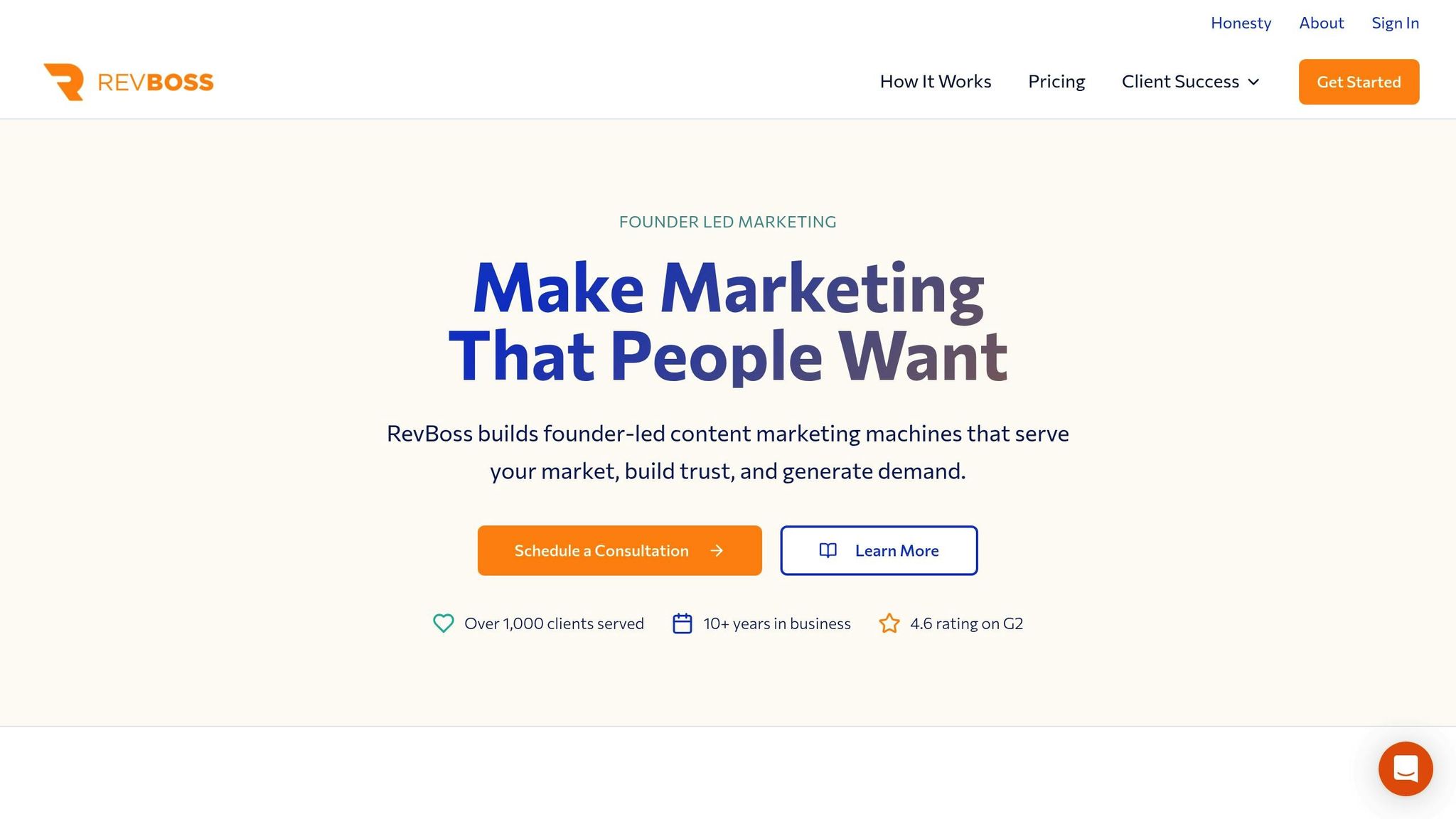
RevBoss focuses on building content marketing systems tailored for founder-led businesses. With over a decade of experience and more than 1,000 clients, they’ve developed a system to tackle the unique challenges of balancing personal and company branding.
Their philosophy is simple: "You trust people more than logos. So does everyone else." This belief highlights the power of founder-led marketing, as posts from founders tend to engage better than those from a company’s LinkedIn page. The result? Stronger, more personal connections with audiences.
RevBoss begins by capturing the founder’s authentic voice. Through monthly interviews, they delve into the founder’s expertise, stories, and perspectives. This raw material is then transformed into a variety of content formats, including LinkedIn posts, blog articles, email campaigns, and activation workflows. Their services include:
- Custom content strategy and production: Every piece of content reflects the founder’s unique voice while aligning with business goals.
- Audience development: Primarily focused on LinkedIn, this helps create an engaged community around the founder’s expertise.
- Lead activation: Strategic email campaigns and paid media turn audience interest into tangible business opportunities.
With a 4.6 G2 rating and 40% of revenue coming from referrals, RevBoss has proven its ability to deliver results.
Tooba Durraze, Founder of Amoeba.AI, shared her experience:
"RevBoss has had a direct impact on our sales. We drove a ton of leads for our beta launch."
Similarly, Donald Summers, CEO of Altruist, remarked:
"RevBoss completely altered the trajectory of my business."
By outsourcing branding tasks to experts like RevBoss, founders can amplify their voice while benefiting from a streamlined and scalable approach.
Benefits of Outsourcing Branding Tasks
RevBoss’s approach highlights the broader advantages of outsourcing branding tasks. It’s not just about saving time - it’s about tapping into specialized expertise that allows founders to focus on what they do best.
Time savings is one of the most immediate benefits. By outsourcing, founders can dedicate their energy to core business activities, knowing their branding is in capable hands.
Quality and consistency also improve when branding is managed by professionals who understand the complexities of personal and company branding. Specialists ensure that every piece of content aligns with the brand’s voice and goals.
Outsourcing additionally offers scalability without operational headaches. When a dedicated team handles your content, it’s easier to scale efforts as needed. Andrew Morton, Head of Marketing at UserVoice, praised the team’s thoughtful strategy and ability to generate high-quality leads.
Cost efficiency is another key advantage. With RevBoss programs starting at $3,000 per month, outsourcing is often more affordable than hiring a full-time marketing employee, especially when factoring in salary, benefits, and training. Plus, you gain access to an entire team of experts.
Measurable ROI makes the investment worthwhile. Justin Plant, Creative Director at Storyboard Media, put it best:
"Not only did we find more clients, but we found better clients."
Outsourcing also provides flexibility and continuity. It allows businesses to scale their marketing efforts based on current needs without the challenges of staffing changes.
Choosing the right partner is crucial. Recommendations from trusted colleagues and advisors can be a great starting point. RevBoss’s focus on founder-led B2B businesses means they understand the unique challenges of balancing personal authenticity with professional branding.
Conclusion: Combining Both Branding Types for Long-Term Success
A company's reputation is deeply tied to the personal brand of its founder or leader. In fact, 48% of a company's reputation hinges on this connection. It's not just about image - 60% of consumers engage with businesses led by leaders with strong personal brands, and 57% are even willing to pay more for their products or services. When it comes to talent, the impact is just as striking: a strong personal brand boosts talent acquisition by 70% and retention by 77%. And for investors? 87% consider a well-developed founder personal brand a key factor in their investment decisions. These numbers paint a clear picture: combining personal and company branding is not just beneficial - it’s essential for sustainable growth.
Keeping personal and company branding separate is a missed opportunity. As Benjamin Laker, Senior Contributor at Forbes, puts it:
"Personal branding is about more than just how you dress or how you present yourself in meetings. It's the unique combination of skills, experiences, values, and characteristics that make you who you are."
The key to success lies in creating a dual-brand strategy that respects clear boundaries while aligning with intentional choices. The most successful leaders understand that balance doesn’t mean perfection - it means making thoughtful decisions that reflect their values and priorities.
With these insights, the next step is to align your personal voice with your company’s mission. If managing both branding efforts feels overwhelming, tools like RevBoss can help. By focusing on authenticity, trust, and audience connection, RevBoss offers systems that effectively bridge personal and company branding goals.
To make this work, define your core values, stay consistent across platforms, and provide genuine value to your audience. When personal and company branding work in harmony instead of competing, founders unlock a sustainable competitive edge that only strengthens over time. This alignment fosters the trust and growth discussed throughout this article, proving that both strategies are vital for long-term success.
FAQs
How can founders align their personal and professional brands without causing confusion?
Founders can align their personal and professional brands by staying true to their core values and ensuring their messaging reflects them. This approach builds trust and credibility while keeping the messaging consistent across both areas.
To keep things clear, it’s important to define boundaries between the two. For instance, your personal brand can highlight your personality and leadership style, while your professional brand focuses on your company’s mission and the solutions it offers. When these two aspects work together, they enhance your overall presence and create meaningful connections with your audience.
What are the risks of focusing too much on personal or professional branding, and how can founders avoid them?
Focusing too much on personal branding can sometimes backfire, making a founder seem overly self-promotional. This can shift attention away from the business itself and might even give off a sense of instability. On the flip side, leaning too heavily into professional branding can make the company feel detached or impersonal, which could weaken trust and connection with the audience.
The key is finding the right balance. Founders should work to align their personal and professional identities by prioritizing genuine communication, clarity, and consistent messaging. This approach builds trust and helps the brand connect on both a personal and professional level, strengthening relationships with the audience in the process.
Why is it essential for founders to align their personal values with their company's mission, and how can they achieve this effectively?
When founders align their personal beliefs with their company's mission, it creates a strong foundation of trust, consistency, and a shared sense of purpose. This connection not only shapes a cohesive company culture but also ensures that decisions and messaging resonate with both employees and customers.
To make this alignment effective, founders should take the time to define their core values and weave them into the company’s mission, vision, and everyday practices. By consistently communicating these values, setting an example through their actions, and integrating them into team objectives and workflows, they can reinforce this alignment. Being genuine and open about their values helps foster a deeper connection, motivating teams and driving sustainable growth.