Why Peer Networks Matter for B2B Founders

Being a B2B founder can feel isolating. The constant pressure of decisions, financial stress, and self-doubt often goes unshared. But here’s the thing: peer networks can change everything.
- Loneliness impacts performance: 61% of CEOs say isolation hurts their ability to lead.
- Revenue grows faster: Founders in peer networks see up to 200% faster growth than others.
- Better decisions: Peer advice brings fresh perspectives, avoids blind spots, and fosters accountability.
This isn’t about networking events or surface-level connections. Peer networks are small, trusted groups where founders exchange honest feedback, share real-time strategies, and hold each other accountable. The result? Smarter decisions, faster growth, and less stress.
If you’re not part of one, you’re likely missing out on critical insights and support that could transform your business. Let’s dive into how they work and why you need them.
How to Network as a Founder: Building Genuine Connections Not Transactions | Mark Shepherd, Gathr

Problems B2B Founders Face Without Peer Networks
When B2B founders don't have access to a peer network, they encounter challenges that can seriously stunt their growth and decision-making.
Isolation at the Top
Running a business can be lonely, and the numbers back it up: more than 75% of small business owners admit to feeling stressed but avoid discussing these concerns with their employees. It's not just about feeling alone - it’s about making high-stakes decisions without someone who truly gets the pressure you're under. Whether it’s decisions about payroll, funding, or long-term strategy, being the only senior leader means the weight of it all rests squarely on your shoulders.
This lack of peer input often leads to burnout and stagnation. Nearly 45% of new businesses fail within their first five years, and 65% don’t survive a decade. Without someone to challenge your thinking or share the load, it’s easy to get stuck in a cycle of overwork and limited progress.
Isolation doesn’t just sap your energy - it narrows your ability to think strategically, making it harder to drive meaningful growth.
Limited Access to Different Perspectives
Your business is only as strong as your ability to think beyond your own experiences. Without input from peers, you risk falling into an "industry bubble" - a space where you only look at competitors in your field, mimic their strategies, and repeat the same mistakes everyone else is making. This tunnel vision keeps you from spotting new opportunities or addressing blind spots.
"A business can only go where the business owner and or CEO can go."
Take Beatrice Phillips, a former yoga studio owner turned business coach. She noticed that at industry conferences, everyone was recycling the same marketing strategies. It wasn’t until she joined a peer advisory group with business owners from unrelated industries that she saw her blind spots. This fresh perspective allowed her to implement strategies that her competitors had overlooked entirely. Without peer conversations, you miss the tough questions that push you to grow as a leader. You also miss out on strategies and approaches that are routine in other sectors but could be game-changers in yours.
Difficulty Staying Current on Industry Trends
Beyond feeling isolated or stuck in narrow thinking, staying updated on industry trends is another hurdle. Without peers, you're left relying on public data - often too late to catch early market shifts. Peer networks, on the other hand, provide real-time insights and cross-industry knowledge sharing, or what some call "inter-company pollination." This exchange of expertise helps you spot threats and opportunities before they hit the mainstream.
For example, consider how B2B buyer behavior has changed. Today, 70% of B2B buyers research online before reaching out to a vendor, and 61% prefer third-party content over vendor-created material. If you’re isolated, you might miss these shifts and base your sales strategy on outdated assumptions. This is especially risky when 83% of Millennials in B2B decision-making roles say their personal preferences heavily influence their professional purchasing choices. Without peers tracking these trends, you’re likely to fall behind.
In Buenos Aires, forward-thinking founders created a thriving ecosystem by mentoring and collaborating with others. Founders who stayed isolated missed out on this dynamic exchange and the growth opportunities it brought.
Benefits of Peer Networks for B2B Founders
Access to Trusted Advice and Emotional Support
Half of all CEOs admit to feeling lonely, with 61% saying it affects their ability to perform at work. Despite this, 66% of CEOs don’t receive external leadership advice, even though most would welcome it.
Peer networks step in to fill this void, offering a safe and confidential space - often following "Vegas rules", where everything shared stays within the group. This environment encourages founders to openly discuss challenges without fear of judgment or professional fallout. These groups also provide what researchers call "emotional nutrients" - like empathy, affirmation, and a sense of containment - that help leaders avoid burnout.
"It's lonely at the top is more than a cliché. Leaders can easily become isolated because they have no trusted peers within their organization with whom they can dig deep or share feelings."
- Ken Vaughan, President, New Horizon Partners, Inc.
Within these networks, founders can tap into the collective wisdom of the group - whether it’s advice on vendors, technology, or organizational challenges. These settings also act as a "laboratory for difficult conversations", allowing members to rehearse tough discussions, reduce stress, and improve their chances of success. This collaborative atmosphere sparks creative problem-solving and real-time support.
Opportunities for Collaboration and Growth
Peer networks bring the advantage of real-time advice, often based on strategies that have been tested as recently as the prior week. This immediacy is invaluable for founders looking to refine SEO tactics, tweak marketing campaigns, or optimize sales scripts - all while navigating similar market conditions.
"A peer... can tell you what they did last week - and whether it worked. The advice is current, and the exchange goes both ways. You're not just receiving guidance, you're collaborating."
- Aytekin Tank, Founder and CEO, Jotform
The results speak volumes. In 2023, members of BrainTrust - a group that organizes women entrepreneurs into small, curated peer groups called "Vaults" - achieved an average revenue growth of 53%. These Vault meetings offered a confidential space for sharing strategies and holding each other accountable, leading to faster growth compared to industry norms. Many peer groups also establish referral systems, creating a steady flow of new business opportunities. Additionally, by connecting with professionals from other industries, founders gain fresh perspectives that help them break out of their usual thinking patterns.
Accountability and Faster Problem-Solving
While emotional support and collaboration are key, the accountability provided by peer groups can be transformative. Research shows that 90% of people don’t change their mindset or habits without external input. When founders make commitments within a peer group, the chances of following through are far higher than when working alone.
"A peer group is probably the only place where other people hold chief executives accountable for what they say they will do."
- Josh Patrick, Founder, Stage 2 Planning Partners
These groups act as a personal advisory board, offering tailored advice and honest feedback that employees or suppliers might avoid giving. Many founders credit these networks with helping them scale faster by adopting proven systems. Interestingly, helping a peer solve their challenge often provides a mental reset, sparking fresh ideas for their own business.
Improved Credibility and Authority
Joining a respected peer network signals to the business world that you’re connected, informed, and committed to growth. In fact, 84% of B2B professionals believe strong relationships are essential for long-term success. Being part of such a network not only builds trust in your personal brand but also extends that trust to your business.
The numbers back this up: 91% of executives join peer groups to interact with others and learn from their experiences, while 87% seek objective insights from outside their own companies. These shared experiences help leaders make better decisions and position them as individuals who value diverse perspectives and continuous learning - qualities that resonate in B2B markets where trust and expertise are critical.
"Peers also provide something mentors can't always offer: emotional resonance. They're in the trenches with you, facing the same economic climate, technological changes and customer expectations."
- Aytekin Tank, Founder and CEO, Jotform
The trend is clear: networking is shifting from superficial business card exchanges to professional communities built on trust and shared experiences. Being part of a peer network not only boosts your credibility but also opens doors to new opportunities.
sbb-itb-9354cf2
Traditional Networking vs. Peer Networks
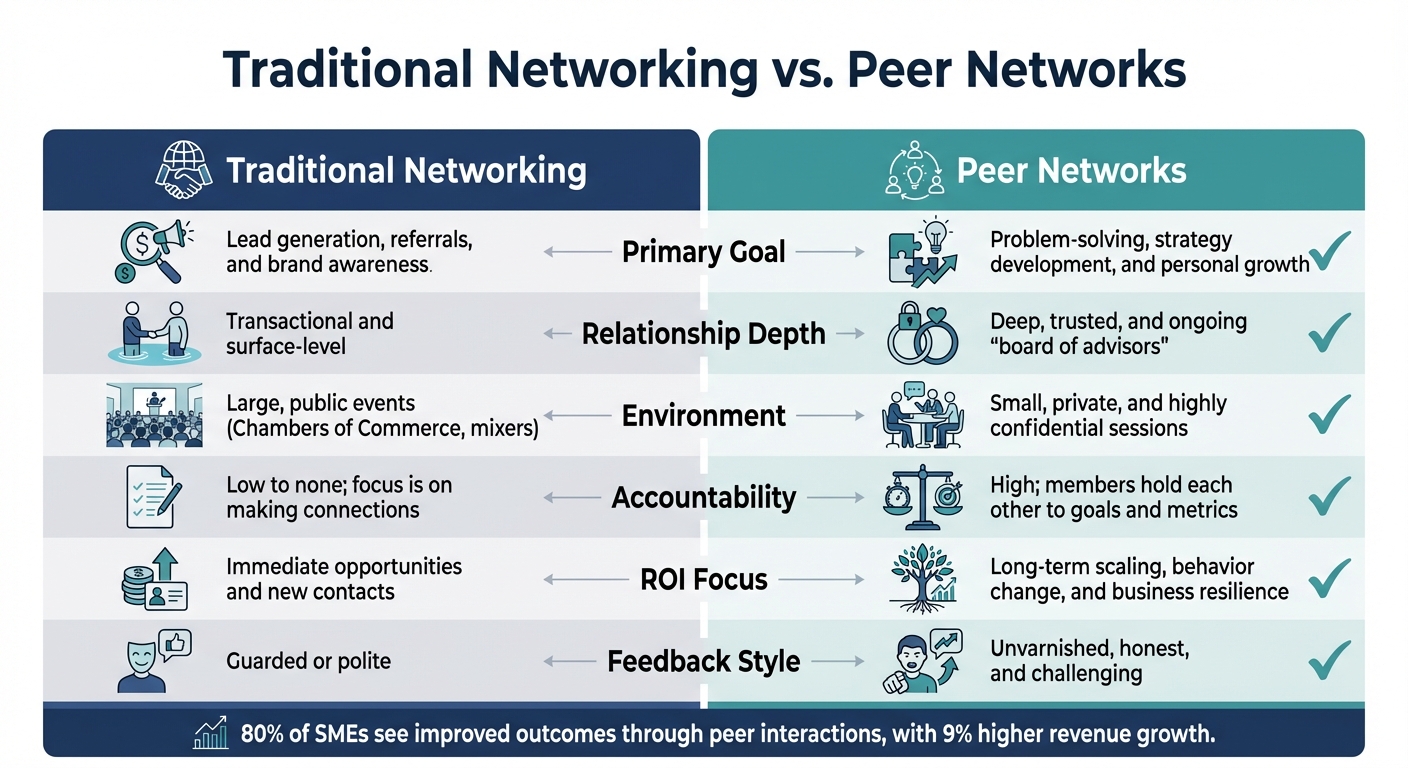
Traditional Networking vs Peer Networks for B2B Founders
Traditional networking events and peer networks serve fundamentally different purposes, especially for B2B founders. At traditional events, the focus is often on swapping business cards, generating leads, and spreading awareness about your company. While this can help expand your contact list, these events rarely go beyond surface-level interactions. The conversations tend to stay polite and transactional, leaving little room for meaningful, strategic discussions.
Peer networks, on the other hand, operate on an entirely different wavelength. Beatrice Phillips from The Alpha Group describes them as:
"Peer groups are a whole different animal. Peer groups are in general working groups... where they go, they solve difficult challenges, they evaluate opportunities, they develop strategies."
Instead of centering on immediate referrals, peer networks prioritize collaborative problem-solving and strategic planning. They create an environment where members can tackle tough challenges together, share insights, and hold each other accountable. Research backs this up, showing that 80% of SMEs see improved outcomes through peer interactions, with extended participation leading to 9% higher revenue growth. The confidential and supportive nature of these groups fosters a level of trust that allows for real, transformative growth.
Comparison Table: Traditional Networking vs. Peer Networks
| Feature | Traditional Networking | Peer Networks |
|---|---|---|
| Primary Goal | Lead generation, referrals, and brand awareness | Problem-solving, strategy development, and personal growth |
| Relationship Depth | Transactional and surface-level | Deep, trusted, and ongoing "board of advisors" |
| Environment | Large, public events (Chambers of Commerce, mixers) | Small, private, and highly confidential sessions |
| Accountability | Low to none; focus is on making connections | High; members hold each other to goals and metrics |
| ROI Focus | Immediate opportunities and new contacts | Long-term scaling, behavior change, and business resilience |
| Feedback Style | Guarded or polite | Unvarnished, honest, and challenging |
How to Build and Use Peer Networks as a B2B Founder
Finding the Right Platforms and Groups
To break through the isolation and narrow perspectives that can come with being a B2B founder, the first step is finding the right platforms where your peers gather. LinkedIn, with its massive user base of over one billion and growing engagement, is a natural starting point. For tech-focused interactions or on-demand advice, platforms like GitHub and Clarity are excellent options.
Before diving in, get clear on your goals. Are you looking to learn from peers, grow your business, or build advocacy connections? Knowing your purpose will help you zero in on the communities that align with your needs. With the market for community engagement platforms expected to hit $23.2 billion by 2035, these digital spaces are becoming increasingly important. Start small - test the waters with a tight-knit group of engaged peers before committing a lot of time or energy.
Adding Value to the Network
Networking thrives on the "reciprocity bank" principle: the more you give, the more you build a foundation of mutual support. Share resources, make introductions, and offer advice generously. Shifting your mindset from "What can I get?" to "What can I give?" turns networking into a meaningful exchange.
"Leverage is created not by the number of people you know, but by the depth of the value you share with them."
A great example of this is Dave Gerhardt, who in March 2019 started sharing daily marketing lessons on LinkedIn. His insights not only built his personal brand but also generated $10,000 in monthly recurring revenue and eventually led to a thriving B2B community. The secret? Contributing valuable insights rather than just reposting content. Whether it’s answering niche questions, celebrating others’ wins with specific shout-outs, or showing how peer advice has improved your business, the key is to lead with value.
Maintaining Consistent Engagement
Although 80% of professionals agree that networking is essential to their careers, only 48% stay in regular contact with their network. The biggest hurdle? Time - 49% of people say they just don’t have enough of it. The fix? Treat engagement like a core business task. Set aside 15 minutes each morning to connect with your network. Use a simple three-step follow-up system: respond within 48 hours, check in with a helpful touchpoint after 1–2 months, and follow up quarterly. Posting valuable content 3–5 times a week also keeps you visible and relevant.
Since 2020, LinkedIn has seen a 55% increase in conversation rates between connections, proving that consistent engagement pays off. To stay prepared, keep a running list of lessons learned, client challenges, and behind-the-scenes stories in a notes app. These small, consistent efforts keep your network active and ready to help you tackle challenges in real time.
Conclusion
Running a B2B company can feel like a lonely road.
FAQs
How can peer networks help B2B founders make smarter decisions?
Peer networks act as a trusted support system for B2B founders, offering honest advice and shared wisdom that employees or investors often can’t provide. By connecting with others who have firsthand experience navigating the ups and downs of scaling a business, founders gain fresh perspectives, escape the loneliness of leadership, and make decisions with greater clarity.
Here’s how these networks make a difference:
- Learning from shared experiences: Founders can compare their ideas with actual outcomes and gain insights from others who’ve tackled similar obstacles.
- Straightforward advice: Peer groups offer unfiltered, actionable feedback on everything from product shifts to go-to-market strategies, saving time and reducing guesswork.
- Built-in accountability: Members set goals, monitor progress, and hold each other accountable, keeping the focus on steady, long-term growth.
- Broader viewpoints: Interacting with peers from various industries sparks fresh ideas and encourages creative problem-solving.
By transforming gut instincts into collaborative decisions, peer networks equip B2B founders to move forward with confidence and agility.
How can B2B founders effectively find and join a peer network?
Finding the right peer network as a B2B founder can make a huge difference, offering support to navigate challenges and build meaningful connections. A good starting point is to look into virtual peer groups designed for founders at similar stages or revenue brackets. These groups often feature guided discussions that focus on tackling real-world problems and sharing practical solutions.
Another great option is joining online communities through platforms like forums, Slack, or Discord. These spaces are perfect for virtual coffee chats or smaller group conversations with other founders. If face-to-face interactions are more your style, check out local networking events or industry organizations that host meetups and workshops. These gatherings are excellent for meeting like-minded professionals and fostering relationships that can last.
For those seeking more structured accountability and strategic input, a peer advisory group or mastermind could be the way to go. Think of these groups as your personal board of directors, offering honest feedback and unwavering support. By mixing and matching these approaches, you can build a peer network that not only helps you feel less isolated but also speeds up decision-making and boosts your growth as a B2B founder.
Why is staying active in a peer network crucial for B2B founders?
Staying connected within a peer network offers B2B founders more than just camaraderie - it’s a lifeline for fresh ideas, accountability, and the kind of emotional support that can directly impact business growth. Regular conversations with peers help uncover challenges early, bring in a range of perspectives, and provide a testing ground for ideas among those who truly get the unique pressures of running a business. This not only speeds up decision-making but also helps sidestep costly missteps.
By actively engaging, founders build trust and establish a culture of honest, no-nonsense feedback. This feedback doesn’t just stay theoretical - it translates into actionable steps. Over time, these interactions lead to shared learning, spotting emerging trends, and adopting proven strategies from others who’ve been there. Whether it’s through face-to-face meetups or virtual platforms, staying plugged into a peer network ensures a constant stream of insights and support, driving growth and strengthening the foundation of the business.