Clean Outbound: Targeting, Messaging, QA, and Governance

Mass emails? Dead. Generic outreach? Ignored. In 2026, reply rates are under 1.5%, and meetings cost $800–$1,500. Clean Outbound flips this script. It’s about smarter, targeted, and personalized outreach that gets results without killing your sender reputation. The payoff? Reply rates of 5–12% (sometimes up to 18%) and meeting costs slashed to $150–$400.
Here’s the playbook in four steps:
- Targeting: Nail your Ideal Customer Profile (ICP) by analyzing your top customers and focusing on firmographics, technographics, and real-time signals. Refine quarterly.
- Messaging: Use founder-led, personalized outreach. Skip fluff; focus on pain points, triggers, and short, actionable emails. Reply rates soar when you show you’ve done your homework.
- Quality Assurance (QA): Keep your data clean and deliverability high. Bounce rates over 2%? Stop everything and fix it. Warm up new domains and always verify emails.
- Governance: Build scalable systems with clear playbooks and KPIs. Track the right metrics - like meeting conversion rates and domain health - to spot problems early.
The result? A system that turns cold outreach into meaningful conversations while protecting your sender reputation. Ready to leave the mass email grind behind? Let’s dive in.
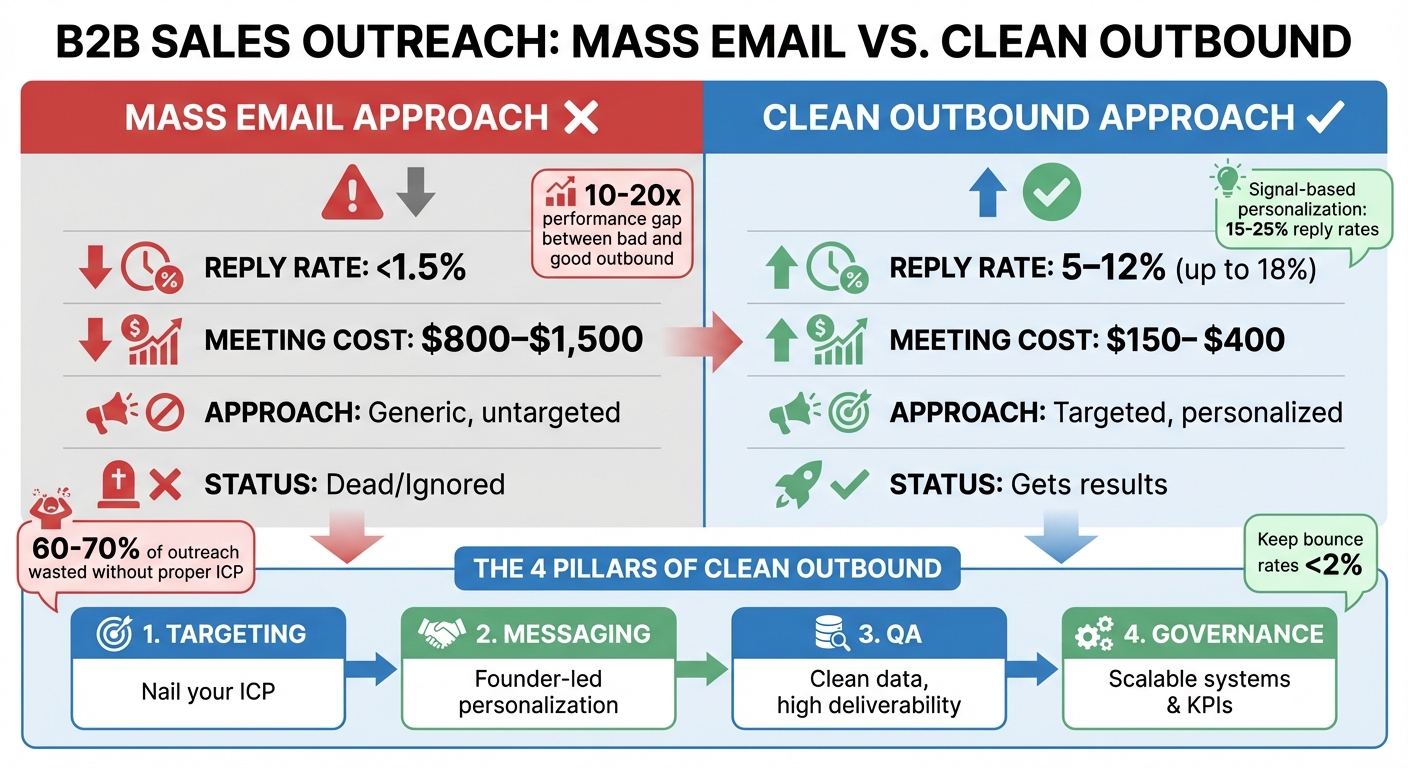
Clean Outbound vs Mass Email: Performance Metrics and ROI Comparison
Mastering Outbound Sales: Strategies for B2B SaaS Success
sbb-itb-9354cf2
Targeting: How to Build and Refine Your ICP
Getting your targeting right is the backbone of effective outreach. Without a solid Ideal Customer Profile (ICP), you risk wasting 60–70% of your outreach efforts on prospects who are never going to convert. A well-defined ICP isn't just a list of potential customers - it’s a framework built on data that highlights the companies most likely to buy, stick around, and grow with you.
The best ICPs are born from studying your top 20% of customers - those who close deals fast, stay loyal, and bring in the most revenue. Take Owner.com, for example. Between 2022 and 2024, they refined their ICP by analyzing digital presence and implementing a machine-learning "Expected GMV" score. By focusing only on accounts that fit their tightened ICP, they scaled from $3M to $21M ARR in just 22 months. Similarly, Frontify boosted sales velocity by 42% by combining ICP-based targeting with engagement triggered by specific signals.
"If your ICP isn't helping you prospect today, it's not an ICP. It's theater."
Building a Strong ICP Framework
A great ICP combines three key data layers: firmographics (like industry, revenue, and company size), technographics (tools and systems they use), and behavioral signals (such as funding rounds or leadership changes). Just as important is knowing who not to target. For instance, Chili Piper avoided wasting resources by disqualifying accounts using CRMs they didn’t integrate with, like Pipedrive or Microsoft Dynamics.
To make your ICP actionable, embed it in your CRM with a scoring model. Assign points for criteria like industry fit, tech stack, and intent signals, prioritizing Tier 1 accounts for personalized outreach. Adding intent signals to a well-defined ICP can yield 18% response rates, crushing the 3.4% industry average for generic outreach. Tools such as the RevBoss Audience System can help you grow LinkedIn audiences and streamline workflows, while enrichment tools create micro-segments based on real-time intent.
Defining Your Ideal Customer Profile (ICP)
Start by diving into data on your best-performing customers - those with high lifetime value, quick sales cycles, and strong Net Promoter Scores (NPS). Look for patterns across firmographics (industry, size, revenue, location), technographics (CRM, marketing tools, or other software), and situational triggers (like funding or leadership changes). Remember, an ICP focuses on the company, while a buyer persona zeroes in on individual decision-makers.
For early-stage founders, think of your ICP as a hypothesis. Test "Who" (your target), "Pain" (their problem), and "Why" (your solution). Build an "ICP v0" for outbound experiments - if you can’t filter for a criterion in a database, it’s not ready for prospecting. Use closed-won data to create a scoring model, assigning points to criteria like industry match (20 points) or tech stack (15 points), to prioritize accounts.
Don’t overlook exclusion criteria - characteristics of bad-fit customers. These could include outdated tech, insufficient budgets, or industries with heavy compliance hurdles. To keep your ICP sharp, review it quarterly by scoring recent deals and checking if high-ICP accounts are closing at higher rates.
Segmenting Accounts for Better Outreach
Segmentation takes targeting to the next level by focusing on "need + ability" - identifying customers with a clear problem, urgency to solve it, and the budget to act. Effective segmentation combines firmographics (searchable filters), personas (specific roles and contexts), and behavioral signals (timely triggers like hiring sprees or new tech adoption). This approach leads to more personalized, impactful outreach.
Organize accounts into tiers: Tier 1 for high-touch, customized outreach; Tier 2 for targeted campaigns and periodic reviews; and Tier 3 for automated efforts. Segmented campaigns outperform generic ones, delivering 14.31% higher open rates and 101% more clicks. Persona-aligned outreach can boost reply rates by 63% and generate up to 18x more revenue than broad campaigns.
Instead of manually building lists, use tools like industry roundups, niche communities, and curated sites to identify targets. Automate with dynamic searches that update weekly to reflect changes like job moves or company growth. Use a weighted scorecard (0–100 points) to prioritize accounts based on Fit (40 points), Need (35 points), and Feasibility (25 points).
Tools to Sharpen Your Targeting
The most accurate ICPs come from analyzing closed-won data in your CRM - not guesswork. By focusing on your top 20% of customers, you’ll uncover patterns tied to lifetime value, deal speed, and retention. Automate lead scoring with a quantitative model (0–100 points) that weights factors like industry match, company size, and tech stack.
To ensure accuracy, use waterfall enrichment - query multiple data sources in sequence to fill gaps in firmographics and contact details. Tools like the RevBoss Audience System streamline LinkedIn audience growth, while other enrichment tools handle complex workflows and multi-source data.
Real-time email verification is another must. A single bad data batch can hurt your domain reputation for months. AI-powered tools (sometimes called "Smart Agents") can dig deeper into prospects’ websites to uncover signals like messaging changes, growth trends, or pain points that structured data might miss. Acting fast matters - the first seller to contact a lead after a trigger event is 5x more likely to close the deal. Responding to inbound signals within five minutes makes reps 21x more likely to convert.
Keep refining your targeting strategy by reviewing win/loss data every quarter. Adjust criteria and weights based on which segments are closing and renewing. Don’t limit yourself to one persona - map out the full buying committee, including economic buyers (like VPs of Sales), technical evaluators (like RevOps), and financial influencers (like CFOs).
Use these tools and strategies to ensure your outreach hits the right targets, every time.
Messaging: How to Write Founder-Led Communication
Once you've nailed down your ideal customer profile (ICP), the next step is crafting messaging that resonates. Messaging isn't just about saying the right things - it's about proving you understand their world. Founder-led outreach brings a personal touch that automation can't replicate. Instead of bombarding prospects with product pitches, focus on validating their challenges, spotting early adopters, and identifying any concerns they might have.
Skip the generic LinkedIn comments or mentions of someone's alma mater. Instead, reference something that shows you’ve done your homework, like their company’s recent earnings report, hiring trends, or regulatory hurdles. Why? Because 81% of B2B buyers expect suppliers to understand their needs, and 73% actively avoid companies that send irrelevant messages. Tailor your messaging to the decision-makers. For example, a CFO wants to hear about ROI and cost control, a CTO cares about integration and scalability, and RevOps leaders prioritize efficiency and time savings. Aligning your message with these priorities can lead to a 40% boost in revenue from your marketing efforts.
Keep it short and to the point. Emails with 6–8 sentences tend to get a 6.9% reply rate, but anything over 200 words? That’s where interest drops off. Start with a hook - maybe a recent funding announcement or a new hire - tie it to a pain point, back it up with a customer story, and end with a low-pressure ask like, "Worth a quick 15-minute chat?" This structure - Hook, Insight, Value, Soft CTA - respects their time while showing you understand their challenges.
How to Build a Messaging Framework
The key to effective messaging? The SMYKM principle: Show Me You Know Me. This involves three layers of personalization: individual (their role and career path), company (hiring trends, leadership changes, or tech updates), and industry (market shifts or regulatory pressures). Messages rooted in these specifics outperform surface-level personalization every time.
Your framework should cover five core content areas: symptoms of their pain, how others solve it, your value proposition, customer success stories, and product details. As a founder, you have a unique advantage - your personal story. Share why you built the product, the challenges you’ve seen, and how your early adopters are thriving.
To streamline your outreach, use frameworks like PAS (Problem, Agitation, Solution) for email and HEART (Human, Empathy, Authority, Relevance, Timing) for LinkedIn. Keep a database of reusable details - like persona insights, pain points, and triggers - so you’re not starting from scratch every time.
Balance how much time you spend personalizing based on the deal size. For smaller deals, spend 30–90 seconds per lead focusing on triggers and industry pain. For big enterprise prospects, invest 6–10 minutes researching earnings calls, leadership updates, and competitive positioning. The bigger the deal, the more effort you can afford to invest.
Finally, test your messaging with the 3-Part Personalization Test: Does it show you’ve done your homework? Does it demonstrate you understand their challenges? Does it offer value that’s relevant to them?. Timing is just as important - newly hired execs spend 70% of their budget within their first 100 days, so striking early can make all the difference.
| Persona | Primary Motivation | Messaging Angle |
|---|---|---|
| CFO | ROI, risk, cost control | "Here’s how this investment pays for itself in a quarter." |
| CTO | Integration, scalability, security | "This fits seamlessly with your stack and scales as you grow." |
| RevOps | Adoption, efficiency, enablement | "This removes manual steps and saves your team hours per week." |
Email and LinkedIn Outreach Templates
Now that you have your framework, let’s talk execution. Templates aren’t scripts - they’re flexible guides that adapt to real-time signals. For emails, keep it under 80 words and focus on a trigger event. For example, Meritt, an outbound agency, cut their email bounce rate from 35% to under 4% in 2025 by using verified data sources. Pairing this with signal-based messaging tripled their pipeline from $100,000 to $300,000 per week.
Subject lines are critical - they determine if your email even gets opened. Keep them under four words, use lowercase formatting, and avoid anything that sounds salesy. Since 70% of recipients mark emails as spam based solely on the subject line, test variations like "quick question" or "worth a look?" Personalized subject lines can boost response rates by 30.5%.
On LinkedIn, keep connection requests under 300 characters and avoid pitching in the first message. Patrick Spencer, VP at Kiteworks, achieved a 5–10x higher connection acceptance rate by automating prospect identification through LinkedIn job titles instead of using mass InMail.
Use low-friction calls-to-action (CTAs) that invite dialogue rather than pushing for a meeting. Replace "Can we schedule 30 minutes?" with "Is this on your radar?" or "Should I share how [Similar Company] solved this?" These softer CTAs can double your reply rates.
A multi-channel approach works best. Aim for 4–7 touches across email, phone, and LinkedIn. While 42% of replies come from follow-ups, it’s the quality of those follow-ups that matters most. A single well-crafted email can sometimes outperform a longer sequence of bland messages, with reply rates as high as 8.4%. Each follow-up should add fresh value or explore a new angle - don’t just say, "I’m following up" without offering anything new.
| Personalization Tier | Description | Expected Reply Rate |
|---|---|---|
| Tier 1: None | Same email to everyone | 1–3% |
| Tier 2: Basic | Name, company, title inserted | 5–9% |
| Tier 3: Advanced | Industry pain + recent news | 9–15% |
| Tier 4: Signal-based | Trigger event + tailored value | 15–25% |
| Tier 5: Multi-signal | Multiple triggers combined | 25–40% |
How to Align Messaging with Content Strategy
Your outbound messaging should echo the themes you’re sharing publicly. If you’re posting about an industry challenge on LinkedIn, referencing that same issue in your outreach makes your email feel like a natural continuation rather than a cold pitch.
Building in public - sharing product roadmaps, team updates, or behind-the-scenes moments - can strengthen this connection. Take Stanley’s president, Terence Reilly, for example. When a TikTok went viral showing a Stanley tumbler surviving a car fire with ice intact, he responded with a personal video offering a new tumbler and a new car. That unscripted, human response earned over 7.5 million likes and immense loyalty. Founder-driven authenticity builds the trust needed to make your outreach stand out.
Quality Assurance: How to Maintain Consistency and Effectiveness
Getting your message right is only half the battle - it won’t matter if it never lands in someone’s inbox. Quality assurance (QA) is more than just a typo check; it’s your safeguard for deliverability, reputation, and campaign performance. Think of QA checklists as a barrier that catches potential issues before they cause problems.
Here’s a reality check: B2B contact data deteriorates by about 30% every year, or roughly 2% each month. That shiny, verified list you used last quarter? It’s already losing its edge. If your bounce rate creeps above 2%, it’s a red flag - stop and clean your list. Anything over 5% could lead to major deliverability headaches that take weeks to sort out. And Gmail? Their spam complaint threshold is just 0.3%, meaning even one complaint per 1,000 emails can trigger filters. The teams that thrive don’t rely on clever tricks - they build solid, repeatable systems with clean data, stable deliverability, and compliance baked in. QA is the bridge between great messaging and actual results.
How to Set Up a QA Process
Once your messaging is polished, a solid QA process ensures your emails perform as planned. Start with your technical setup. Make sure your SPF, DKIM, and DMARC records are properly configured. Use secondary domains for cold outreach to shield your main domain from potential reputation damage. These email authentication protocols aren’t optional anymore - providers like Gmail and Microsoft enforce them strictly as of 2025. If something goes wrong, you’ve limited the fallout.
Next, focus on data verification. Run every contact through three layers of checks: syntax validation (is the email formatted correctly?), MX record verification (does the domain accept mail?), and SMTP handshake (does the mailbox actually exist?). Tools like Prospeo can handle this for about $0.01 per email - $100 for 10,000 verifications. That’s a small investment compared to the cost of a damaged domain.
When it comes to sending, ease into it. Start new inboxes at 20 emails per day and gradually increase by 10–20 per week, maxing out at 50–100 daily to mimic natural email patterns. For new domains, plan on a 3–4 week warmup before launching campaigns. Rushing this step is the fastest way to land in spam.
Before hitting send, double-check your messaging. Does it align with the specific audience segment you’re targeting? Are you referencing relevant triggers, like recent funding or new hires?. Build a cadence with at least four touches spaced 3–4 days apart. Remember, most sales require five or more follow-ups, yet nearly half of sales reps give up after the first attempt.
Finally, track metrics that matter. Skip vanity stats like open rates and focus on system health indicators: positive reply rates, meeting attendance rates, and bounce rates. If your reply rate drops below 1%, it’s likely a data or deliverability issue - not just a problem with your copy.
QA Checklists for Outbound Campaigns
A thorough QA checklist should address three areas: data, messaging, and technical setup. For data, re-verify lists right before sending to counteract data decay. Standardize formatting - use Title Case for names and remove special characters or emojis that might mess with personalization tokens.
On the messaging front, apply the 3-Part Personalization Test: Does the email reflect research about the recipient? Does it show you understand their challenges? Does it offer value they’ll care about?. Limit research to three minutes per prospect - spend a minute each on LinkedIn, company news, and media to find a relevant angle.
For technical setup, scrub your copy for spammy language like “100% Free” or “Act Now.” Replace attachments with links. Preview every email on mobile since 70% of B2B emails are opened on smartphones. Make sure there’s a one-click unsubscribe option and check your lists against National DNC registries every 31 days.
| Pitfall | Root Cause | QA Fix |
|---|---|---|
| High Bounce Rate (>5%) | Stale data or poor verification | Use real-time SMTP verification before sending. |
| Low Open Rate | Weak subject lines or deliverability issues | Audit SPF/DKIM/DMARC; test personal, lowercase subject lines. |
| Low Reply Rate (<1%) | Misaligned messaging | Refine ICP filters; focus on recipient pain points. |
| High Spam Complaints | Irrelevant targeting or no opt-out | Segment precisely; ensure unsubscribe links are active. |
| Low Meeting Conversion | Weak CTA or poor qualification | Use easy CTAs; refine the urgency or “why now” in your pitch. |
Implement a “sunset policy” to automatically remove contacts who haven’t engaged in 6–12 months. This protects your domain reputation and keeps your list fresh. Set up control measures: if bounce rates exceed 2%, pause the campaign to clean your list. If reply rates drop below 1%, review your data and deliverability before tweaking your messaging.
Using Tools for Workflow Visibility
With your QA system in place, tools like RevBoss can provide real-time insights into critical metrics. Their dashboards let you monitor bounce rates, spam complaints, and engagement stats, so you can address issues before they escalate.
Automate data entry gates to block free email domains like Gmail or Yahoo and enforce syntax standards. Use routing logic to sync verified leads into sequences while flagging unverified ones for review. Run deliverability checks as close to your outreach as possible to account for data decay.
Make it a habit to review performance every Friday. Look at metrics like connect rates and reply rates, then adjust your targeting, CTAs, or deliverability strategies as needed. Multi-channel campaigns - combining email, LinkedIn, and phone - can triple your response rates compared to email-only efforts. Try the “3-7-7” follow-up pattern: three touches in the first week, then two more over the next week. This approach captures 93% of potential replies within 10 days.
"Outbound gets easy once you stop treating it like 'messaging' and start treating it like a system."
Governance: How to Build a Scalable Outbound Framework
Your QA process ensures issues are caught before they hit inboxes, but governance keeps your outbound operations running smoothly at scale. Without it, even the sharpest targeting and messaging can crumble. To grow effectively, you need documented playbooks, measurable KPIs, and systems that safeguard quality.
How to Document Playbooks and Processes
A solid playbook should allow a new hire to work independently by their third day on the job - not just support your top performers. If someone can’t execute a full outbound day using your documentation without a manager’s help, it’s not a true playbook yet. Start by defining your ICP (Ideal Customer Profile) and list-building rules before diving into scripts.
Lay out your multi-touch cadences step by step, specifying touch counts, timing, and channel order (email, phone, LinkedIn). This eliminates guesswork and ensures consistency across the team. Clearly define 4–6 criteria for what qualifies as a meeting - like confirmed pain points, budget authority, and decision timelines. This makes SDR-to-AE handoffs measurable, not subjective. Companies with standardized sales processes report up to a 28% revenue boost compared to those without.
Assign someone - like your Head of Sales Development - to own the playbook. They should update it quarterly using win/loss data and SDR feedback. This approach can cut new hire ramp-up time from over three months.
"A sales development playbook isn't documentation for your best rep - it's a shortcut that makes an average new hire productive fast."
Metrics and KPIs for Governance
To monitor performance effectively, track metrics across three layers: Outcomes (like bookings and ARR), Drivers (pipeline created, win rate), and Hygiene (speed-to-lead, bounce rate, data accuracy). Revenue Operations should manage the systems and standards - the "how" - while sales leadership focuses on the results. Use a Metric Dictionary to ensure everyone calculates numbers the same way, avoiding unnecessary debates during meetings.
Set up role-specific scoreboards:
- Executives need insights on pace and coverage.
- Managers need to track pipeline quality and coaching opportunities.
- Reps need a clear daily priority list.
Monitor metrics like ICP-Fit Logo Acquisition Rate to confirm you’re closing the right deals, not just any deals. Track Timeline Reliability - the percentage of deals closing on the originally agreed decision date - to measure process predictability.
Put operational guardrails in place. Pause campaigns if bounce rates exceed 2% or spam complaints go over 0.1%. Set capacity limits: start with three new accounts per day and cap outreach at 40–50 active accounts to maintain quality. For example, in 2026, Meritt tripled its weekly pipeline from $100,000 to $300,000 by refining its data governance, reducing bounce rates from 35% to under 4%.
| Metric Category | Key KPIs | Governance Purpose |
|---|---|---|
| Hygiene | Speed-to-lead, Bounce rate (<2%), Data accuracy | Ensures process compliance and system health |
| Performance | Qualified Meeting Rate, Lead-to-Opp Conversion, Sales Velocity | Tracks outbound effectiveness |
| Efficiency | Cost per Meeting ($150-$400), CAC Payback Period | Measures scalability and ROI |
With these metrics in place, scaling becomes a more structured and achievable goal.
How to Scale with Integrated Tools
Scaling your outbound framework starts with integrated, automated tools that build on your documented processes and KPIs. For example, RevBoss offers scalable outbound tools starting at $1,500 per month, delivering value at a fraction of the cost. Use automated hygiene checks to flag missing steps, stalled opportunities, or incomplete data, giving managers actionable coaching insights.
Set up process gates in your CRM to enforce governance. For instance, require specific data points - like an ICP score or primary persona - before deals can move forward. Keep an eye on domain health to ensure bounce rates stay under 3% and unsubscribe links work seamlessly. In 2026, Stack Optimize achieved $1M ARR by maintaining a strong quality scorecard, achieving 94%+ deliverability and bounce rates consistently below 3%.
Automation paired with smart governance can deliver impressive results. Snowflake partnered with Outreach to streamline sales processes and improve team collaboration, leading to a 15% increase in reps meeting their quotas and a 20% average prospect reply rate. Similarly, Rootly automated research tasks and optimized sales sequences, resulting in a 69% increase in scheduled meetings and a 640% increase in LinkedIn outreach. These successes highlight the power of combining automation with human oversight.
Conclusion
Clean outbound strategies combine precise targeting, thoughtful messaging, rigorous quality checks, and strong governance into a system that builds momentum over time. Shifting from mass email campaigns to signal-driven outreach, using message frameworks tied to authentic triggers, verifying data right before launching, and creating detailed playbooks turns cold outreach into meaningful conversations.
The results speak for themselves. Signal-based personalization boosts reply rates to 15–25%, compared to the dismal 1–3% of generic email blasts. Quick follow-ups make a massive difference too - responding to warm replies within 60 minutes can result in a qualification rate that’s seven times higher than waiting until the next business day. Keeping bounce rates below 2% not only improves deliverability but also slashes meeting costs from $800–$1,500 down to $150–$400.
"The gap between bad outbound and good outbound is not 20%. It is 10-20x."
B2B data doesn’t age gracefully - it deteriorates by 20–25% every year, making constant upkeep essential. Stack Optimize, for instance, built a $1M ARR agency by treating their data like a product, maintaining over 94% deliverability and avoiding domain flags entirely across all clients. Similarly, Meritt saw its weekly pipeline skyrocket from $100,000 to $300,000 by cutting bounce rates from 35% to under 4%. This holistic approach to targeting, messaging, quality assurance, and governance is what drives scalable, founder-led B2B growth.
FAQs
How do I know if my ICP is too broad?
If you're wondering whether your Ideal Customer Profile (ICP) is too broad, take a close look at your targeting and engagement metrics. Red flags include low reply rates, minimal engagement, and poor deliverability. When your ICP is overly broad, your messaging becomes generic, making it harder to resonate with your audience and ultimately dragging down response rates.
To fix this, narrow your focus. Instead of leaning heavily on broad firmographic data, zero in on micro-segments. Pay attention to current behaviors and signals that indicate real-time needs or interests. This sharper focus will make your outreach more relevant and impactful.
What should I personalize in a cold email first?
The key to making your cold email stand out is by referencing something specific and verifiable about your prospect. This could be a recent funding announcement, a new job posting, or even an update they shared on social media. By tailoring your email to reflect these signals, you demonstrate that you’ve done your homework and understand their current situation. This not only makes your outreach feel more relevant but also boosts your chances of getting a response.
How do I fix deliverability if replies drop suddenly?
To tackle a sudden dip in reply rates linked to deliverability problems, the first step is identifying the root cause. Typical trouble spots include a damaged sender reputation, incorrect authentication settings (like SPF, DKIM, or DMARC), or using outdated contact lists.
Start by auditing your technical configurations, verifying your email list, and keeping an eye on your domain's reputation. Steer clear of abrupt increases in email volume, prioritize list cleanliness, and consistently track deliverability metrics to get your emails back into inboxes and boost reply rates.