Customer Proof as a Campaign: Turning Wins Into Meetings

Trust wins deals. In B2B, buyers trust customer proof over sales pitches. Why? Because only 29% of buyers trust sales teams, and 72% say case studies influence their decisions. This isn't about bragging; it's about showing real results.
Here’s the playbook:
- Collect customer proof: Testimonials, case studies, metrics, and video reviews. Timing is key - capture wins when the impact is fresh.
- Turn proof into assets: Break it down into bite-sized content - quotes, videos, infographics - for every stage of the buyer's journey.
- Use it in campaigns: Share proof across LinkedIn, emails, and outreach. Tailor it to your audience and their pain points.
- Track and refine: Measure engagement, sales usage, and conversions. Update and test your assets to keep them sharp.
Mind Tricks In B2B Marketing part 3: The Power Of Social Proof
sbb-itb-9354cf2
Step 1: Collect Customer Proof Systematically
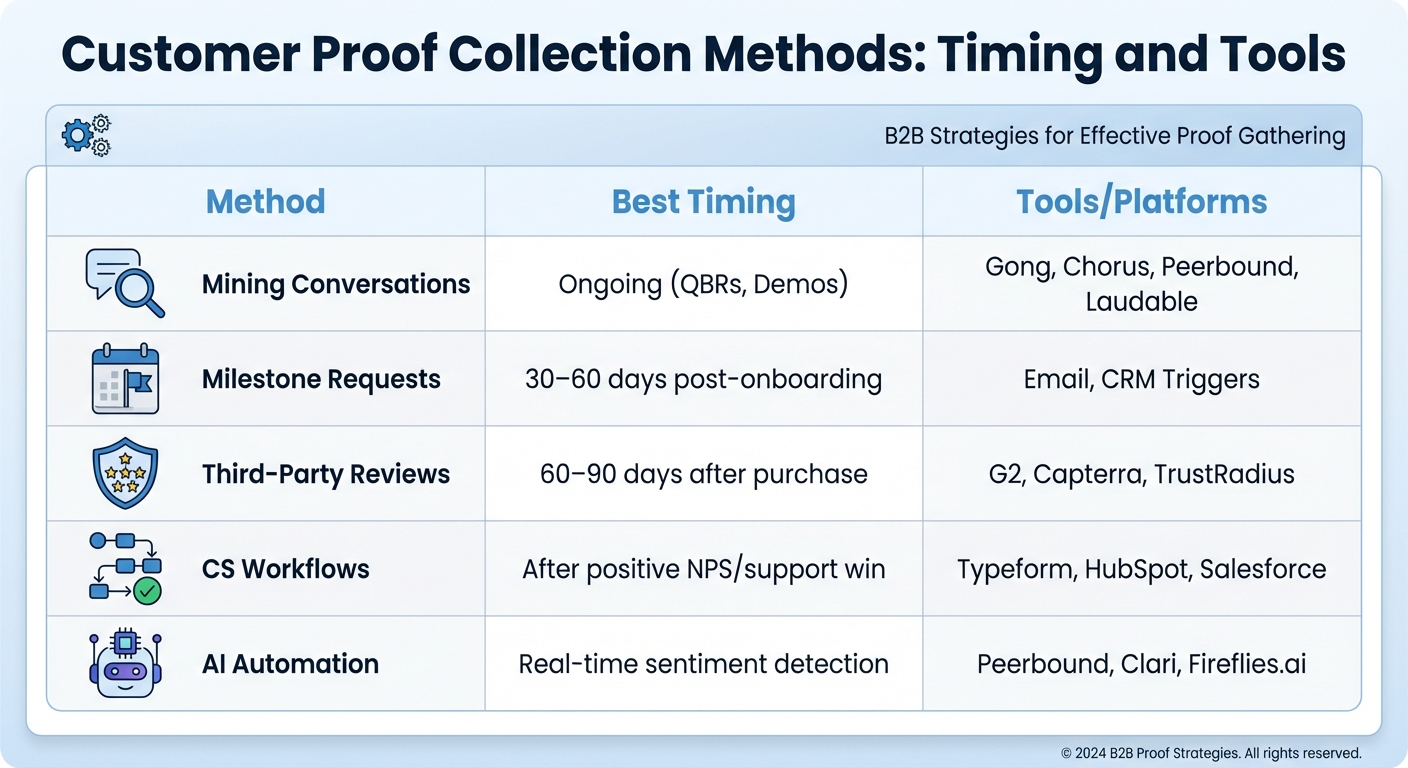
Customer Proof Collection Methods: Timing and Tools Guide
Don’t wait around for customer proof to magically appear - capture those wins as soon as they happen. Memories fade fast, so timing is everything.
Work closely with your sales and customer success teams to pinpoint clients who’ve achieved measurable results. Focus on those hitting key milestones, representing your target industries, or offering that extra brand clout to boost credibility. The goal? Build a library of proof that covers a range of buyer personas and use cases.
The best time to ask for proof is when customers are feeling the impact of your product - think big wins like hitting ROI goals, completing a smooth implementation, or achieving a stellar Net Promoter Score (NPS). Take Asana, for example. In January 2026, they secured a glowing testimonial from Deloitte right after leadership saw real-time visibility improvements that slashed weekly status meetings from 5 hours to just 30 minutes.
Make the process easy for everyone with a draft-and-approve system. Pull testimonials from emails, recorded calls, or presentation decks, and send them to the customer for a quick review and sign-off.
5 Methods for Gathering Customer Proof
-
Mine Existing Conversations
Tools like Gong or Chorus can help you dig through recorded sales calls and customer success meetings. Search for keywords like “game-changer,” “love,” or “saved us X hours” to find proof you already have without scheduling new interviews. -
Request Testimonials at Milestone Moments
Set up automated prompts in your CRM to request testimonials 30–60 days after onboarding or right after a key performance indicator (KPI) is met. -
Incentivize Third-Party Reviews
Encourage customers to leave reviews on platforms like G2 or Capterra 60–90 days after purchase. Sweeten the deal with $25 gift cards or charitable donations. These reviews not only boost SEO but also influence the decisions of 90% of software buyers. -
Conduct Structured Interviews
Schedule 30–45 minute recorded sessions with your top customers. Use a Problem-Solution-Outcome framework to guide the conversation. For instance, HubSpot used this approach with Caspian Studios to document a 300% increase in qualified leads over six months. -
Use AI Tools to Surface Success Stories
Platforms like Peerbound and Fireflies.ai can automatically detect positive sentiment in real time, flagging moments that are worth capturing. This turns proof collection into a continuous process.
Timing and Tools for Proof Collection
Here’s a quick breakdown of when and how to collect proof:
| Method | Best Timing | Tools/Platforms |
|---|---|---|
| Mining Conversations | Ongoing (QBRs, Demos) | Gong, Chorus, Peerbound, Laudable |
| Milestone Requests | 30–60 days post-onboarding | Email, CRM Triggers |
| Third-Party Reviews | 60–90 days after purchase | G2, Capterra, TrustRadius |
| CS Workflows | After positive NPS/support win | Typeform, HubSpot, Salesforce |
| AI Automation | Real-time sentiment detection | Peerbound, Clari, Fireflies.ai |
Align Proof Collection with Your Workflow
To keep the momentum going, weave proof collection into your existing workflows. Marketing should oversee the strategy and maintain a central repository, while sales and customer success teams focus on timing and relationships. A dedicated Slack channel (like #customer-wins) can keep everyone in the loop - team members can drop quick story leads or voice notes as they happen.
Organize your proof in your CRM by tagging it with details like industry, company size, persona, and use case. This way, sales reps can find relevant examples in under two minutes.
"If reps can't find proof in less than 2 minutes, it doesn't exist."
Break long-form case studies into smaller, reusable pieces - quotes, stats, and snippets - that fit seamlessly into different stages of the buyer journey.
For RevBoss users, integrate proof collection directly into outreach workflows. For example, when a prospect responds positively to an email campaign or books a meeting via LinkedIn, flag that interaction. Once they become a customer, follow up to gather proof. This creates a cycle where your best campaigns generate the proof that powers future campaigns.
Step 2: Turn Customer Proof into Campaign Assets
Take the customer proof you’ve gathered and turn it into assets that grab attention and convert leads. A single 45-minute customer interview can provide enough material for over 10 marketing pieces - think case studies, video clips, quote cards, LinkedIn posts, and sales slides.
The trick lies in modular design. Instead of creating one static PDF, break your proof into smaller, reusable parts. Pull out 3–5 snappy quotes, highlight 2–3 key stats, and create a one-paragraph summary. Use formats that match each stage of the buyer's journey: short video clips for awareness, in-depth case studies for evaluation, and ROI-focused stats for decision-making.
To make your proof adaptable across formats, use the "Challenge-Solution-Results" framework. Start with the specific problem your customer faced, explain how your product provided the solution, and finish with measurable outcomes. Replace vague phrases like "boosted efficiency" with concrete data, such as "cut support tickets by 45% in three months". Case studies with specific metrics can lead to 43% higher close rates compared to those with only qualitative feedback.
Once you've nailed down the proof points, repackage them into different formats that resonate with various buyer personas.
Create Different Formats for Campaigns
Not all buyers consume content the same way. Executives might prefer video testimonials featuring their peers, while analytical buyers lean toward detailed case studies. Meanwhile, operators and managers focus on time savings and efficiency.
Here’s how you can repurpose your proof:
- Video Testimonials (30–60 seconds): Edit customer interviews into short clips for LinkedIn, email signatures, or landing pages. Always include subtitles since 85% of social media videos are watched without sound. For example, Slack used a video testimonial from an enterprise CIO in a 2024 campaign, doubling their enterprise trial sign-ups.
- Written Case Studies (1,500–3,000 words): Stick to the Challenge-Solution-Results format and include numbers upfront to grab attention. Add sections on the customer’s industry, company size, pain points, implementation timeline, and results. These work well as gated content or sales tools.
- Quote Cards and Social Graphics: Turn the most striking customer quotes into branded images for LinkedIn or Instagram. Pair each quote with a metric or result for extra impact.
- Success Metrics Infographics: Visualize data with charts showing before-and-after results, percentage improvements, or time saved. These are ideal for buyers who prefer quick, scannable content.
- Objection-Handling Stories: Create short, focused testimonials that address common objections.
| Format | Best Channel | Buyer Stage | Complexity |
|---|---|---|---|
| 30-second Video Clip | LinkedIn, Email | Awareness | High |
| Quote Card | Instagram, LinkedIn | Awareness | Low |
| Written Case Study | Website, Sales Deck | Consideration | Medium-High |
| Metrics Infographic | Homepage, Pricing Page | Decision | Medium |
| Objection Story | Sales Calls, Email | Decision | Low |
Build Monthly Content Plans
Use these tailored assets to create a monthly content plan that keeps your brand top of mind across multiple channels.
For RevBoss users, customer proof can fuel a LinkedIn content strategy. Aim to produce 8–12 LinkedIn posts per month that highlight real results without coming across as overly promotional.
Organize your proof library around different themes and dedicate one week each month to each theme. For example:
- Week 1: Share a snippet from a case study, like a manufacturing client reducing lead response time from 6 hours to 45 minutes. Pair it with a quote card and link to the full case study.
- Week 2: Post a 30-second video testimonial from a SaaS founder who secured 15 qualified meetings. Pin the post for visibility.
- Week 3: Publish an infographic summarizing key client results.
- Week 4: Highlight a testimonial that addresses a common objection, giving proper client attribution.
Stick to a simple format: start with a hook, tell a brief story, share measurable results, and end with a soft call to action.
"If you can show your prospects that you HAVE done something before, they will be less inclined to check underneath every stone for HOW you do it."
- Andy Stauffer, Founder & CEO, Proofmap
RevBoss users can streamline this process by integrating content planning into their weekly strategy calls. Use the RevBoss platform to organize proof by industry, company size, and use case. Tagging assets with relevant keywords makes it easier to find the perfect story for each post during content creation.
Step 3: Launch Multi-Channel Campaigns
Put your customer proof to work by deploying it across the platforms your buyers frequent, tailoring each channel to a specific stage of the funnel. Email marketing boasts a median ROI of 122% - over four times higher than social media or paid search. On the other hand, LinkedIn shines for creating awareness and fostering peer-level conversations that email alone can't achieve.
When distributing proof, consider where your buyer is in their journey. Use customer logos and impressive stats on LinkedIn to build awareness. Share detailed ROI case studies through email for prospects weighing their options. Save peer references and video testimonials for those critical decision-stage discussions. B2B companies that incorporate testimonials into outbound efforts see response rates rise by an average of 32%, but the key is ensuring the proof directly addresses the prospect's specific concerns or challenges.
Now, let’s break down how to match each type of proof with the right channel.
Select the Right Marketing Channels
Each channel - LinkedIn, email, and direct outreach - has its own strengths when it comes to sharing customer proof. LinkedIn is ideal for targeted updates, allowing you to segment by industry or job role instead of blasting your entire network. When sharing a client success story, don’t just state the result. Ask a question to spark engagement. For example, instead of saying, "Our client cut response times by 45%", try, "What’s the biggest bottleneck slowing your sales team’s response times?" This approach invites interaction.
Email campaigns work best when segmented by industry or funnel stage. Use subject lines that focus on ROI, such as "How [Brand] boosted revenue by 41%", to grab attention and drive open rates. For direct outreach - whether through LinkedIn messages or personalized emails - you can address specific objections with concise one-pagers or short video clips. Adding just five reviews to a profile can boost conversion rates by 270%, so even a snippet from a case study in your outreach can make a huge difference.
Here’s a quick guide to pairing proof assets with the right channels:
| Channel | Best Format | Primary Goal | Key Metric |
|---|---|---|---|
| Carousel posts, CEO insights | Awareness & Engagement | Engagement rate, Shares | |
| Segmented newsletters, Signatures | Lead Nurturing | Click-through rate (CTR) | |
| Direct Outreach | One-pagers, Video snippets | Overcoming Objections | Meeting conversion rate |
| Paid Ads | Quote overlays, Video hooks | Retargeting | Cost per lead (CPL) |
By aligning your customer proof with the strengths of each channel, you'll create a strategy that consistently generates interest and meeting requests.
Execute Campaigns with RevBoss Tools
RevBoss makes it easy to manage and activate customer proof across multiple channels. Start by tagging your assets by industry, company size, and use case. This way, you can quickly grab the right story during strategy meetings or campaign launches.
For LinkedIn, plan 8–12 monthly posts that showcase different proof formats. One week, it might be a quote card; the next, a 30-second video testimonial or an infographic with key metrics. RevBoss’s audience growth tools connect you with prospects who match your ideal customer profile, ensuring your proof reaches people facing similar challenges. For outreach campaigns, weave customer proof into your sequences: add a logo bar to your email signature, include a case study snippet in your third message, and share a peer review quote in your fifth.
RevBoss also supports event-focused campaigns, helping you amplify proof around trade shows or webinars. Before an event, send targeted messages to attendees with case studies relevant to their industry. Afterward, follow up with a video testimonial that addresses a common objection you heard during the event. This keeps your proof timely and relevant, increasing the odds of securing a meeting.
The RevBoss platform keeps everything organized, allowing you to see which proof assets are driving the most engagement. Use its audience targeting features to tailor stories - manufacturing clients get manufacturing success stories, while SaaS founders see SaaS wins. By combining personalization with consistent multi-channel outreach, you can turn customer proof into a reliable engine for generating meetings.
Step 4: Measure and Optimize Campaign Performance
Tracking the right data points can turn guesswork into actionable insights. Start by monitoring pipeline influence - how many opportunities have interacted with at least one piece of customer proof. This metric helps you understand if your proof is reaching prospects during key decision-making moments. Another critical metric is funnel velocity: Prospects who engage with case studies move through the sales cycle 25% faster than those who don’t. Even more telling, prospects who spend over 3 minutes on a case study are 40% more likely to request a sales meeting. Metrics like time-on-page and full-read rates are essential to gauge how effectively your proof drives engagement and, ultimately, meetings.
Don’t stop at engagement - evaluate how your sales team is using these assets. Measure sales enablement adoption by tracking how frequently reps share specific case studies or testimonials during their conversations. If certain assets aren’t being used, it could mean they’re either hard to find or not addressing key objections. To fix this, tag your proof assets in your CRM by industry, company size, or persona. This allows your team to quickly identify which stories resonate with different audience segments. Additionally, compare win rates between opportunities exposed to tailored case studies and those given generic materials. This type of analysis can reveal how much impact your proof really has. Armed with these insights, you can run targeted A/B tests to refine your campaigns further.
Key Metrics to Track
Focus on four main areas:
- Engagement: Metrics like time-on-page, click-through rates, and video watch times.
- Sales Usage: Data on asset downloads, CRM mentions, and reference call volumes.
- Conversion: Win rate uplift, meeting bookings, and reply rates.
- Velocity: Reduction in sales cycle length and time-to-close.
Use tools like tracking links or heatmaps to pinpoint which parts of your case studies - whether it’s the ROI section or the technical implementation details - drive the most contact requests.
"You are basically just running experiments as a marketer. If you are going to run the experiment, you need to be able to see the results of that, and that is what campaign ROI reporting is all about."
Regularly review your proof library to keep it fresh. Retire assets from churned customers and update materials that are more than 12–18 months old. Outdated proof can hurt your credibility faster than having no proof at all.
Use A/B Testing to Refine Campaigns
A/B testing is a powerful way to fine-tune your campaigns and turn customer success stories into meeting opportunities. Experiment with different formats to see what resonates most. For example, compare case studies that feature specific, measurable metrics with those that rely on general praise - stories with hard numbers close 43% more deals. You can also test different messaging approaches, such as focusing on problems ("Spreadsheets were no longer scalable") versus benefits ("We saved $180,000 annually").
Visual elements play a big role, too. Adding client logos can boost conversions by 43%, and pairing testimonials with logos can increase conversions by up to 84%. Try testing case studies with named executives and photos versus anonymous testimonials - named content often keeps prospects engaged for an additional 4.2 minutes.
For video content, compare polished, high-production clips with raw, unfiltered proof like Slack screenshots or customer-made walkthroughs. Authenticity often wins. Tailor your proof to the buyer’s stage in the funnel: short, punchy content works best for awareness-stage prospects, while decision-stage buyers tend to prefer detailed ROI breakdowns. Finally, integrate proof into your email sequences. Start subtly with a client logo in your signature, then introduce a quantified case study snippet by the third email touchpoint.
Conclusion: Turn Customer Wins into Meetings
Customer proof is the bridge between your bold marketing claims and the trust buyers need to engage with you. With 76% of B2B buyers insisting on clear proof before even considering a vendor, your case studies, testimonials, and success metrics aren't just nice to have - they're essential. The difference between a cold prospect ignoring your pitch and one booking a meeting often boils down to whether you've shown them real evidence that you’ve solved their specific problem before.
The process is simple: gather, refine, share, and track your proof to drive results. Companies that adopt structured frameworks for case studies report 3.2x faster sales velocity and a 37% reduction in sales cycle length. It's not that their products are inherently better - they’ve simply removed doubt from the buyer’s decision-making process, making it easier to say "yes."
RevBoss takes this a step further by embedding proof into every part of your outreach strategy. From transforming executive insights into LinkedIn posts to crafting campaigns that highlight specific customer successes, RevBoss ensures that your proof assets are always working for you. Their tools make sure case studies don’t gather dust in a folder - they show up in your emails, social media interactions, and follow-ups after events. By combining content creation with precise audience targeting, you can turn customer proof into a powerful engine for booking meetings.
Take a fresh look at your proof library and see how it stacks up against your messaging and campaign goals. Audit your assets to spot any gaps where you're making claims without backing them up. Then, fill those gaps with detailed customer stories. Use this proof across your website, email campaigns, and social media. The aim isn’t to be flawless - it’s to keep building momentum. Every win you document today sets the stage for tomorrow’s opportunities to connect with prospects.
FAQs
What customer proof should I collect first?
Start by collecting real-world examples that highlight measurable success and tackle challenges similar to those your clients face. Look for testimonials, case studies, or key performance metrics that clearly show how your product or service delivers results. Emphasize specific, tangible outcomes to make your examples both relatable and impactful.
How do I turn one customer win into multiple assets fast?
To make the most of a customer success story, start by conducting an interview to gather the essential details - key outcomes, measurable KPIs, and impactful quotes. Use a standardized case study template to keep things consistent and professional. From there, break the story into smaller assets like testimonials, standout snippets, and a full-length case study for deeper dives.
Take it a step further by using AI tools to generate additional content such as social media posts, engaging visuals, or presentation slides. By building a library of reusable assets, you can simplify marketing and sales efforts, saving time while ensuring your message hits the mark.
How can I measure if proof is booking meetings?
To figure out if proof is helping to drive meetings, keep an eye on how tools like testimonials or case studies influence your sales pipeline. Track meetings that can be directly tied to these assets, using tools like UTM parameters to trace their impact. Sales teams should also log when they share proof points and note whether it leads to follow-up meetings. A boost in qualified meetings or higher engagement rates can signal that these materials are working effectively.