The Enablement Layer: Assets Every Campaign Needs to Convert

Your sales team isn’t closing deals? It’s not them - it’s your system. The missing link? An enablement layer: a set of tools, content, and data that bridges your pitch to the buyer’s decision. Without it, reps waste time, messaging gets messy, and deals slip away.
Here’s what you need to fix it:
- Case Studies: Show measurable results with real stories. Specificity wins trust - numbers like "40% cost reduction in 90 days" beat vague claims.
- Testimonials: Quick, direct feedback builds credibility. Use customer quotes tied to outcomes like "saved 10 hours weekly."
- Sales Scripts: Structured, flexible scripts keep calls on track and boost conversions. Permission-based openers and discovery questions are key.
- AI Personalization: Scale outreach with tailored messages based on real-time signals like job changes or funding updates.
Why it matters: 60-70% of B2B content goes unused, and reps spend 30% of their time hunting for resources instead of selling. A solid enablement layer solves this, closing deals faster and with less friction.
Let’s dive into how to build these assets and integrate them into your campaigns.
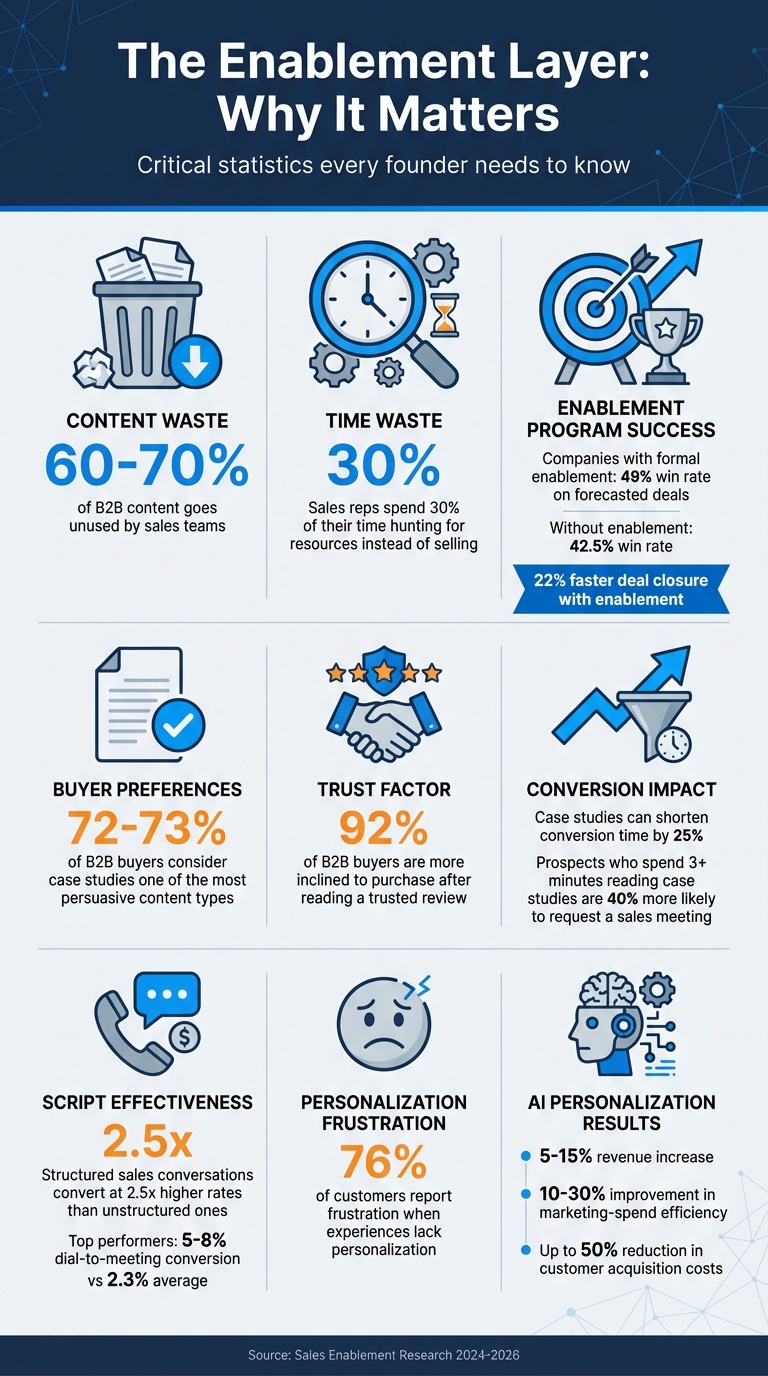
Sales Enablement Layer: Key Statistics and Impact Metrics
Your best sales asset isn’t a pitch...it’s a story | B2B Sales Content Ep.3 (The Case Study)
sbb-itb-9354cf2
Case Studies: Showing Results Through Customer Stories
Case studies are more than just testimonials - they're proof in action. Instead of relying on promises or pitches, they show potential customers what your solution has already achieved for others. It's no surprise that 72% to 73% of B2B buyers consider case studies one of the most persuasive content types when deciding on a purchase.
What separates a case study that drives results from one that gets overlooked? Specificity. Broad claims like "boosted efficiency" don't cut it. But when you say, "reduced onboarding time by 40% in 90 days", you're offering something concrete and believable. Real company names, measurable outcomes, and clear timelines make all the difference between fluff and credibility.
To make your case study even more compelling, explain how you achieved the results. For instance, if you helped a company cut costs by 30%, outline the key changes that led to that success. This not only builds trust but also reassures prospects that they can replicate those results.
Of course, numbers only tell part of the story. Emotions play a big role, too. Sharing the journey - what the customer struggled with, their "aha!" moment, and the relief they felt after solving the problem - lets prospects imagine themselves experiencing the same transformation. Case studies can shorten conversion time by an average of 25%, and prospects who spend over 3 minutes reading one are 40% more likely to request a sales meeting.
Here’s a simple framework to create case studies that resonate.
How to Structure a Case Study
A strong case study follows this structure: Context → Problem → Solution → Outcome. Start with an attention-grabbing headline, such as "How [Client] Cut Onboarding Time by 40%." Within the first 200 words, highlight the challenge and the result. This ensures readers quickly know if the story applies to them.
- Context: Set the stage by describing the customer's company size, industry, and the roles of stakeholders involved. This helps prospects see themselves in the story.
- Problem: Go deeper than surface-level issues. Explain the root cause and how it impacted the business - whether it was lost revenue, wasted time, or missed opportunities.
- Solution: Briefly explain what you implemented and the specific features or strategies that made a difference. Keep it concise but clear enough for readers to understand.
- Outcome: Deliver the proof. Use percentages like "reduced costs by 20%" instead of just dollar amounts, as percentages help prospects relate the results to their own budget.
For maximum impact, pair key metrics with customer quotes. For example:
"We increased our MQL-to-discovery-call conversion ratio from 55% to 70–75%, above benchmark."
This blend of hard data and real voices builds instant credibility.
Add a scannable executive summary at the top with 3–4 key stats for busy decision-makers. Including video testimonials can also make a big difference - replacing text reviews with video on landing pages can boost conversion rates by up to 80%.
Where to Use Case Studies in Your Campaigns
Case studies are versatile tools that can address doubts and objections at every stage of the buyer's journey. The key is matching the right story to the right moment.
For top-of-funnel awareness, use broad industry-focused stories in social media posts, homepage features, and blogs. Keep these short and scannable - ideal for grabbing attention without requiring a download. In the mid-funnel consideration phase, showcase case studies specific to your product category on product pages, email sequences, and webinars. For bottom-of-funnel decision-making, use detailed ROI-focused stories in proposals, pricing pages, and sales conversations.
In cold emails, highlight a single, relevant metric with a "micro-case" snippet. For example, "We helped a SaaS company like yours cut churn by 22% in 90 days". This approach delivers instant proof without requiring the prospect to click through to a full document. For follow-up emails, attach a relevant case study as a helpful resource instead of a generic "just following up" message.
On landing pages, embed case studies directly on product or service pages rather than hiding them in a separate section. Use a specific, measurable result in the hero section to immediately build trust. On pricing pages, address ROI concerns head-on by showing how other customers justified the investment.
Train your sales team to reference case studies during live conversations or vendor evaluations. Integrate them into your CRM so reps can quickly pull up the right story when objections arise. For instance, if a prospect says, "This sounds too good to be true", a rep can share a case study detailing the rollout process and results.
| Funnel Stage | Placement | Format |
|---|---|---|
| Awareness | Social Media, Homepage, Blog Posts | Micro-snippets, Video Testimonials |
| Consideration | Product Pages, Email Drips, Webinars | One-page Summaries, Slide Decks |
| Decision | Proposals, Pricing Pages, Sales Calls | Full-length PDFs, ROI Calculators |
| Post-Purchase | Renewal Conversations, Upsell Emails | Strategic Transformation Narratives |
Customer Testimonials: Building Trust with Real Feedback
Case studies provide in-depth narratives, but testimonials deliver quick, compelling validation. Much like case studies, customer testimonials are a crucial part of your marketing toolkit, offering social proof that complements data-driven efforts. They help bridge the gap between interest and trust by showcasing real-world success. Research highlights this impact: 92% of B2B buyers are more inclined to purchase after reading a trusted review, and 88% of decision-makers say peer recommendations heavily influence their choices.
The beauty of testimonials lies in their directness. A single, well-crafted sentence can address doubts more effectively than paragraphs of copy. For example, when a prospect reads a testimonial like "saved 10 hours a week", it immediately reduces perceived risks by providing measurable results. It’s no surprise that 9 out of 10 shoppers trust testimonials and reviews as much as personal recommendations.
The Importance of Authenticity
Authenticity is everything. Avoid vague statements like "Great product!" and instead focus on testimonials that share specific challenges and outcomes. As Mohamad Birakdar, Editor at Hotjar, puts it:
"The biggest mistake other companies make with their testimonials collection is that they sacrifice authenticity for positivity".
Timing also plays a key role. The most impactful testimonials are often collected during "golden moments" - right after a customer reaches a milestone or receives excellent support. This ensures the feedback is both detailed and enthusiastic.
What Makes a Testimonial Stand Out?
The best testimonials follow a simple structure: Problem → Solution → Result. Start by outlining the issue that led the customer to seek help, explain how the product or service solved it, and finish with measurable outcomes. This format helps prospects visualize their own potential success.
Specific details make testimonials far more effective. For instance, "cut onboarding time by 50%" is much more persuasive than a general statement. Well-crafted testimonials can increase sales by up to 270% and boost conversion rates by 34% on sales pages.
Adding credibility is equally important. Include the customer’s full name, company, and title, along with a high-quality headshot or video. These trust signals can increase a prospect’s confidence in your business by 72%. Maintaining the customer’s natural voice is another key factor. If they describe your product as a "total game-changer", keep that phrasing intact. Damon Chen, Founder of Testimonial, emphasizes:
"Your marketing copy makes a promise, but a testimonial delivers the proof".
To gather impactful testimonials, use a straightforward approach: ask about obstacles that almost prevented the purchase, the results achieved, the most valuable feature, and whether they’d recommend the product - and why.
For website testimonials, aim for 50–100 words. For videos, keep them between 60–90 seconds - 68% of viewers will watch a business-related video if it’s under a minute. Edit for clarity but retain the unique tone that makes the testimonial feel genuine.
Using Testimonials Across Marketing Channels
Once you’ve collected strong testimonials, use them strategically across your marketing efforts. On landing pages, place them near call-to-action buttons, pricing tables, or the hero section to encourage conversions. After all, 74% of consumers consult at least two review sites before making a purchase decision.
For LinkedIn ads, try carousel formats that highlight a pain point, include a customer quote, and emphasize ROI. For example, SaaS Hero reported that their client TripMaster added $504,758 in Net New ARR over a year by adopting a testimonial-focused strategy.
In email campaigns, embed concise testimonials with headshots and logos. Even a snippet like "Saved me 15 hours/week" in the subject line can boost open rates. Video testimonials are particularly effective on homepages and product pages - 66% of prospects prefer watching a testimonial video to reading one. Enable autoplay and let customers share measurable results in their own words. Notably, 84% of people trust video testimonials as much as personal recommendations.
From an SEO perspective, treat testimonial pages as valuable content. Provide full transcripts for video or audio testimonials and use review schema markup to boost search visibility.
Finally, align testimonials with specific buyer concerns. If pricing is a common objection, feature testimonials that highlight ROI. If complexity is an issue, showcase feedback about smooth onboarding. Sean D'Souza, Author of The Brain Audit, advises:
"The best way to create persuasive testimonials is to tap into the concerns of your potential customers, and then tell success stories that directly address those concerns".
| Channel | Testimonial Format | Best Practice |
|---|---|---|
| Landing Pages | Short quotes with headshots | Place near CTAs and pricing tables |
| LinkedIn Ads | Carousel with pain-quote-ROI | Include company logos for credibility |
| Email Campaigns | 1-2 sentence snippets | Use in subject lines and email footers |
| Homepage | 60-second video testimonials | Enable autoplay, focus on outcomes |
| Product Pages | Industry-specific quotes | Match testimonials to visitor segments |
Always obtain written consent before publishing a customer’s name, photo, or story. FTC regulations impose penalties of up to $53,088 per violation for misrepresentation, so proper authorization protects both your business and your customers.
Sales Scripts: Guiding Founder-Led Sales Conversations
When it comes to founder-led sales, having a script is like having a roadmap - it simplifies what could otherwise be a complicated process while keeping the conversation genuine. A staggering 71% of B2B buyers say that sellers talk more about their own solutions than the buyer’s actual needs. A well-crafted script flips that narrative, steering the conversation toward discovery, value, and handling objections - all without feeling forced or robotic.
The impact of structured sales conversations speaks for itself. They convert at rates 2.5 times higher than unstructured ones. Top-performing teams using these frameworks see dial-to-meeting conversion rates between 5% and 8%, compared to the 2.3% average for generic outreach. As Butch Hodson, author of Sales Lab Scripting, puts it:
"A script with a 40% close rate that 80% of your team can execute will beat a 70% close rate script that only 10% of reps can use - every time".
The trick is to use scripts as flexible guides rather than rigid instructions. This allows you to maintain your natural voice while ensuring consistency across sales calls, websites, and marketing materials. It’s a crucial step, especially when 69% of B2B buyers notice discrepancies between vendor websites and sales reps’ messaging. A structured approach ensures alignment and builds trust - both of which are key to successful sales.
Core Components of a Sales Script
An effective sales script is built around six critical elements. These components ensure your conversations are purposeful and lead to meaningful outcomes.
Start with a permission-based opener that acknowledges the interruption and earns the prospect’s attention. For instance, instead of asking, "Is this a bad time?" - which can reduce meeting booking rates by 40% - try saying, "I know I’m interrupting your day; do you have 30 seconds for me to explain why I’m calling?" This small shift can extend call duration by 30% to 40%.
Next, include a relevance statement that ties your outreach to a specific event or situation, like recent funding or market expansion. Follow this with a value hypothesis that focuses on outcomes rather than features. For example, you could say, "Teams in similar situations have significantly reduced their ramp time using this approach."
Your script should also feature discovery questions to uncover pain points and decision-making dynamics. A question like "What happens to your growth plans if this bottleneck isn’t resolved this quarter?" encourages prospects to articulate their challenges. When objections come up, rely on the LAER sequence: Listen, Acknowledge, Explore, and Respond. Research shows that top-performing reps pause five times longer after hearing an objection than their average peers.
Finally, close with a clear call-to-action that secures the next step. Use specific asks like, "Does it make sense to block 15 minutes Thursday to see if this is a fit?" Starting with a reason-based opener, such as "The reason for my call is...", can double your success rate compared to diving straight into a pitch.
| Script Component | Purpose | Example |
|---|---|---|
| Permission-Based Opener | Earns the right to continue | "Got 30 seconds so I can tell you why I’m calling?" |
| Relevance Statement | Connects to a specific trigger | "I noticed you recently expanded into EMEA..." |
| Value Hypothesis | States impact without pitching | "Teams like yours reduced ramp time using this approach." |
| Discovery Questions | Surfaces pain and identifies key players | "Who else gets involved when evaluating solutions like this?" |
| Objection Response | Addresses blockers with proof | "Fair concern. Here’s how [Customer] handled that..." |
| Next-Step Ask | Secures a clear commitment | "Can we schedule 15 minutes Thursday to explore fit?" |
Adapting Scripts for Different Buyers
Different buyers care about different things, so one-size-fits-all scripts won’t cut it. For example, a CFO might focus on ROI and cost savings, while a VP looks for streamlined workflows and productivity boosts. Meanwhile, end-users prioritize ease of use. To tailor your script, start by creating detailed profiles for each buyer type - documenting their key pain points, triggers, and goals.
When addressing a CFO, highlight cost efficiency and financial impact. For a VP, emphasize operational improvements. To make your message resonate even more, develop industry-specific materials like one-pagers or case studies tailored to their world.
Ken Yarmosh, a founder and sales expert, explains it perfectly:
"Scripts make you sound like everyone else. Frameworks help you sound like yourself while progressing conversations toward the right outcome".
Use tools like Battle Cards to prep for common objections specific to each role. For instance, if a prospect brings up budget concerns, you might ask, "If we solved the budget issue, is there anything else holding you back?" This approach helps uncover deeper blockers instead of stopping at surface-level objections. Keep in mind that 80% of successful sales require at least five follow-ups, yet nearly half of reps give up after the first "no".
During discovery calls, aim for a 40% talk and 60% listen ratio. Your script should guide you to ask insightful questions and actively listen, rather than dominate the conversation. Jessie Johnson, Principal Analyst at Forrester, sums it up well:
"Relevant doesn’t mean standardized sales messaging or pitches. Today’s sales scripts won’t land if they are read word-for-word and aimed at every lead".
AI-Driven Personalization: Customizing Campaigns at Scale
AI-driven personalization is transforming how businesses engage with their audiences by making large-scale campaigns feel personal. Consider this: 76% of customers report frustration when their experiences lack personalization. But let’s face it - manually researching each prospect and creating tailored messages for everyone is simply not practical. That’s where AI steps in, cutting the time spent on drafting outreach from 15–30 minutes to just 30 seconds–2 minutes, all while maintaining quality.
The payoff is real. Companies using AI for personalization have reported 5% to 15% increases in revenue and 10% to 30% improvements in marketing-spend efficiency. Some have even slashed customer acquisition costs by as much as 50%. Ameya Deshmukh, Head of Marketing Innovation at EverWorker, sums it up perfectly:
"Personalization isn't a campaign; it's an operating system".
The Power of Signal-Based Triggers
AI takes personalization beyond basic merge tags, leveraging signal-based triggers like funding updates, job changes, tech stack modifications, LinkedIn activity, or hiring trends to craft messages that are contextually relevant. By combining multiple signals, reply rates can soar from the average 3.43% to an impressive 25% to 40%.
How AI Enhances Personalization
AI transforms personalization into an automated, continuous process. It tracks real-time signals across various data sources to create messages tailored to each prospect’s unique situation. Instead of treating your database as a single, broad audience, AI enables micro-segmentation, treating each lead as its own "segment of one" with a personalized value proposition.
For example, in early 2026, a B2B lead generation agency applied a segment-first automation strategy to a database of 10,000 leads. They divided these leads into 12 micro-segments based on specific pain points like "Scaling Pains" or "Compliance Issues." AI then generated 10,000 personalized videos, each featuring the prospect’s website in the background. This approach boosted reply rates from 1.5% to 8% and cut operational hours by 60%.
AI also continuously A/B tests variations, adjusting in real-time based on micro-behaviors such as hover time on calls-to-action or scroll depth. Predictive personalization uses both historical and live data to anticipate user actions, delivering hyper-relevant messages at the exact moment they’re most likely to engage.
This evolution moves beyond basic automation to what some call AI Workers - systems capable of interpreting goals, adapting to signals, and executing end-to-end processes across platforms. As Ameya Deshmukh explains:
"The winning approach is to apply AI to end-to-end processes (e.g., 'turn buying signals into account-specific plays') so outputs show up where your team already works".
To ensure AI-generated content stays on-brand, businesses should rely on a "source of truth" library filled with approved messaging frameworks, claims, and case studies. This minimizes errors and maintains consistency. For added control, tiered approvals can allow low-risk content like microcopy to be auto-published, while high-stakes claims undergo human review.
Using RevBoss for AI-Powered Campaigns
RevBoss simplifies AI-driven personalization, eliminating the manual workload while delivering high-quality results. The platform analyzes prospect data to pinpoint role-specific challenges and industry terms, creating messages that align with intent signals. This approach feels like one-to-one communication but scales to reach hundreds of prospects.
To get started, focus AI efforts on high-intent triggers - such as visits to pricing pages, onboarding sequences, or re-engagement with returning prospects. RevBoss integrates these signals into workflows, automatically generating account briefs that summarize a prospect’s business model, recent initiatives, and pain points into a concise paragraph for sales teams.
For founder-led teams, RevBoss supports a tiered personalization strategy:
- Tier 1: Deeply researched, multi-signal AI insights for strategic accounts.
- Tier 2: Single-signal personalization for priority accounts.
- Tier 3: Segment-level AI variants for broader audiences.
This ensures resources are allocated effectively, applying the right level of effort where it matters most.
Additionally, RevBoss helps repurpose content by extracting "sellable atoms" from webinars or whitepapers to create tailored email sequences and discovery questions. With 63% of marketers now using AI for content creation and 80% of workers saying generative AI improves their work by handling first drafts, the efficiency gains are undeniable.
| Approach | Time per Email | Daily Output | Avg. Reply Rate | Scalability |
|---|---|---|---|---|
| Manual Research | 15–30 min | 15–25 | 12–20% | Low |
| Template + Merge Fields | 2–5 min | 50–80 | 5–9% | Moderate |
| AI + Signal-Based | 30 sec–2 min | 100–200+ | 15–25% | High |
Despite these benefits, only 5% of sales teams personalize every email they send, even though 73% of B2B decision-makers say personalization is critical when evaluating vendor outreach. By adopting AI-driven personalization with RevBoss, you gain a competitive edge in a market that increasingly values tailored engagement.
Next, let’s explore how to integrate these tools into a streamlined enablement layer.
Implementation Checklist: Building Your Enablement Layer
Creating an enablement layer doesn't have to be complicated. Start by focusing on the four key pillars: Content (scripts, decks, case studies), Training (onboarding, workshops), Tools (CRM, sequencing), and Data (buyer personas, competitive intel). Begin by auditing your current resources, identifying gaps where your team resorts to workarounds or where prospects lack the support they need.
Once you've got a clear picture, it's time to define the specific assets that will make up this layer.
Required Assets for Your Enablement Layer
An effective enablement layer includes both internal-facing and customer-facing assets. Internal-facing tools are designed to prepare your team, such as battlecards for competitor comparisons, sales playbooks with repeatable strategies, call libraries, email templates, and persona documents. On the other hand, customer-facing tools aim to guide prospects toward making informed buying decisions. These include data-driven case studies, ROI calculators, one-pagers, sales decks, mutual action plans, and business case templates.
When crafting case studies, use this 7-point checklist: include executive quotes, numerical ROI, implementation timelines, industry context, tech ecosystem details, multi-stakeholder perspectives, and competitive comparisons. This is crucial because 76% of B2B buyers expect concrete evidence before engaging with vendors, and case studies that include specific metrics result in 43% higher close rates compared to those that rely solely on qualitative feedback.
How to Integrate These Assets into Your Campaigns
After defining your assets, the next step is integration. Store everything in a centralized, searchable content library equipped with AI tagging. This ensures your team can quickly locate materials like objection handlers or case studies when needed. Take personalization to the next level by grouping leads based on behavior and technology stack using CRM data, rather than relying solely on industry segmentation. Tools like RevBoss can automate this process, matching the most relevant case studies or proof points to specific buyer scenarios.
"Sales enablement is the process of giving your sales team everything they need to close more deals faster. That means the right content, tools, training, and data at every stage of the buyer's journey."
Transform static case study PDFs into dynamic "evidence walls" that can be embedded into landing pages, emails, and sales decks. Use mutual action plans to turn pitches into actionable checklists with assigned tasks and deadlines, eliminating guesswork during the closing stages.
Rolling out an AI-enhanced enablement layer typically takes around 10 weeks. The timeline includes asset assessment (Weeks 1-2), a pilot phase (Weeks 7-8), and full production scaling (Weeks 9-10).
This structured approach ensures that every interaction in founder-led campaigns is supported by the right asset at the right time.
Conclusion
Creating an enablement layer isn’t about churning out endless content - it’s about delivering the exact resource a prospect needs, right when they need it. Here’s a telling stat: companies with formal enablement programs boast a 49% win rate on forecasted deals, compared to 42.5% for those without. Plus, they close deals 22% faster. That’s the difference between a founder scrambling to handle objections on the spot and a team armed with proven tools that seal the deal.
Here’s another eye-opener: 60-70% of B2B content never gets used by sales teams. Why? Poor organization and assets buried behind too many clicks. If your team can’t find a case study or objection handler within 30 seconds, they’ll wing it instead - and that’s rarely a winning strategy.
This highlights a critical point: a streamlined enablement layer isn’t just nice to have - it’s essential.
"Sales enablement isn't about having more content. It's about giving reps the right content, at the right time, to close more deals."
FAQs
Which enablement asset should I create first for faster conversions?
Case studies are a fantastic way to establish trust and demonstrate success. They highlight real-life results, offering concrete examples that resonate with your audience. By sharing these stories, you not only build confidence but also create a compelling reason for others to take action.
How do I measure if my enablement layer is actually working?
To gauge how well your enablement layer is performing, keep an eye on a few critical metrics. Start with content usage rates, sales activity, and engagement with enablement assets. For example, check if at least 80% of your sales reps are using essential content weekly. Also, track how often that content gets shared with prospects and how actively training materials are being utilized.
Beyond usage, dive into metrics that reflect outcomes. Look for signs like shorter sales cycles, higher win rates, and faster pipeline velocity. These numbers can help pinpoint what’s working and where you might need to make adjustments. Regular reviews of these metrics are key to keeping your enablement strategy on track.
What data signals should I use to personalize outreach with AI?
To make outreach more personal using AI, hone in on buyer signals - specific data points that hint at what a prospect needs, wants, or is working on. These signals could include things like recent job changes, funding announcements, hiring patterns, tech upgrades, or even activity on social media. AI tools take this information and turn it into customized messages, often weaving in real-time updates about the prospect's business or challenges they might be facing. This level of personalization grabs attention and makes your outreach stand out in a sea of emails, significantly improving your chances of getting a response.