Events as a Pipeline Program: Pre-Event, Onsite, Post-Event

Events can be a goldmine - or a money pit. The difference? Treating them like a structured sales pipeline. Here’s the playbook:
- Pre-event: Plan ahead. Pre-book 50%-70% of meetings before the event starts. Target top accounts with personalized outreach. Use tools to streamline scheduling and data collection.
- Onsite: Don’t just chat - secure follow-ups on the spot. Equip your team with key details on high-value prospects. Use real-time notifications and scheduling tools to lock in meetings.
- Post-event: Follow up fast. Leads contacted within 48 hours are far more likely to convert. Segment leads (hot, warm, cold) and prioritize outreach. Track metrics like pipeline impact and ROI.
The key is discipline at every stage. Most companies fail because they don’t follow up (80%-95% of leads are ignored!). Be the exception, not the rule. Tools like RevBoss can help automate the heavy lifting, from pre-event outreach to post-event follow-ups, saving time and turning events into revenue machines.
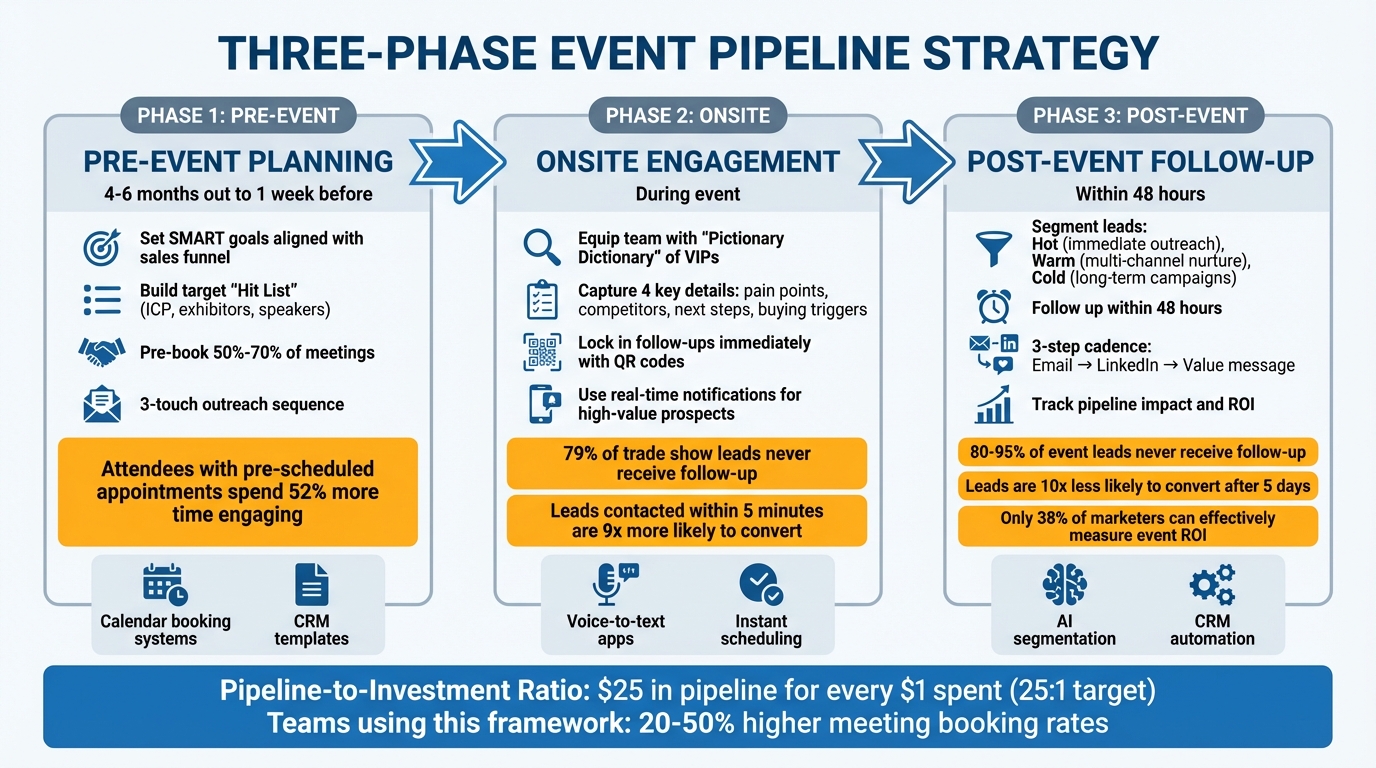
Event Pipeline Strategy: Pre-Event, Onsite, and Post-Event Action Framework
B2B Event Marketing: Best Practices for Events in 2025
sbb-itb-9354cf2
Pre-Event Planning: Prepare Before You Arrive
Laying the groundwork before an event can make all the difference. Research shows that attendees with pre-scheduled appointments spend 52% more time engaging with exhibitors, making preparation a key factor in success.
Set Clear Goals and Metrics
Start by defining your objectives using the SMART framework. Align your goals with your sales funnel to ensure every stage is covered. For example:
- Top-of-funnel: Track metrics like new registrations and Marketing Qualified Leads (MQLs).
- Mid-funnel: Focus on conversion rates from MQL to Sales Qualified Leads (SQL) and demo requests.
- Bottom-of-funnel: Measure closed-won revenue and pipeline velocity.
Here are some real-world examples of measurable outcomes:
- NOLAvate Black (March 2025): Achieved double the annual revenue, 7.5-hour average attendee engagement, and 40,000 unique post-event impressions.
- European Forum Alpbach: Facilitated over 2,000 networking connections and brought in 4,000 online attendees from 100 countries in three weeks.
"Start at the top and work your way down. What are your business goals that you're trying to achieve? Let that create your goals for the entire year. That way, you know what your true north is."
Assign specific roles within your team to stay organized. For example, a "Pipeline Czar" can ensure your strongest prospects book follow-up meetings before leaving your booth. Use tools like automated booking systems and standardized CRM templates to streamline data collection, from registrations to follow-ups.
Once your goals are locked in, shift your focus to identifying and engaging with your top-priority accounts.
Find and Warm Up Your Target Accounts
Building a strong attendee list is critical. Start by creating a "Hit List" by cross-referencing exhibitor rosters, speaker lineups, and your Ideal Customer Profile (ICP). Pay special attention to local prospects, companies headquartered near the venue, and previously engaged or closed-lost contacts. Many teams now use intelligence platforms to predict attendees weeks in advance by analyzing social signals and historical data.
Personalization is key. Use LinkedIn, email, SMS, and AI tools to tailor outreach efforts. Keep an eye out for recent company news or funding announcements to make your messages relevant. For VIPs or local attendees, SMS and phone calls can significantly boost attendance - sometimes accounting for up to 65% of participants in regional events.
Instead of generic booth invites, offer exclusive experiences like private dinners or product previews to entice high-value attendees. Start planning at least three months in advance to build your target list, enrich your data, and craft a thoughtful outreach strategy. Tools that enrich LinkedIn profiles with details like role, company size, and location can help you prioritize effectively.
These steps lay the foundation for a seamless and successful event experience.
Book Meetings Before the Event
Once your goals are set and your target accounts are engaged, focus on securing meetings ahead of time. Begin outreach 4–6 months in advance, ramping up efforts four weeks before the event to lock in calendar bookings. Every communication should include a direct link for scheduling, making it simple for prospects to choose a time.
A three-touch sequence works well:
- First touch: Send an introductory message to confirm attendance.
- Second touch: Offer a VIP invite or special perk to encourage meeting bookings.
- Final touch: Check in to confirm availability and finalize details.
Reference recent company updates or challenges in your outreach to make the conversation more relevant. Additionally, configure your calendar to restrict bookings to event dates, avoiding scheduling conflicts.
Hold a team kickoff meeting a few weeks before the event to align on target accounts, outreach strategies, and pipeline goals. Use registration forms with conditional logic to gather key details like role, company size, and pain points. This helps you identify high-priority attendees for one-on-one meetings. You can also offer trial or beta access on the registration page to engage prospects with high intent before the event even starts.
| Outreach Phase | Timing | Primary Goal | Recommended Channel |
|---|---|---|---|
| Early Awareness | 4–6 Months Out | Save the date; arrange chats | |
| Targeted Sprints | 4 Weeks Out | Secure meeting bookings | Email / LinkedIn |
| Logistics/Reminders | 1 Week Out | Confirm booth location | Email / SMS |
| Final Check-in | 1–2 Days Out | Fill last-minute slots | SMS / LinkedIn |
Onsite Engagement: Make the Most of Face Time
Making an impact at events hinges on how well you handle in-person interactions. With 79% of trade show leads never receiving any follow-up, the competition isn’t as fierce as you might think. This is your chance to stand out by being intentional, prepared, and quick to act.
Equip Your Team with Context and Insights
Walking into a conversation without context is like showing up to a test unprepared - it wastes time and opportunities. Your team needs to know who they’re talking to and why it matters. Create a "Pictionary Dictionary" - a cheat sheet with photos and key details about priority decision-makers to help your team recognize and engage them right away. Pair this with a ranked "Hit List" that includes names, titles, companies, and why each person is important.
Plan a kickoff call 2–3 weeks before the event to align on key accounts, team roles, and outreach strategies. Assign someone as the Pipeline Czar to ensure high-value leads don’t slip through the cracks. This person acts as the booth gatekeeper, steering conversations toward meaningful next steps.
"Think of them as Gandalf at the booth entrance: 'You shall not pass… without scheduling your next meeting!'"
Train your reps to capture four key details after every conversation: the prospect’s pain points, competing solutions they’re considering, agreed-upon next steps, and buying triggers. Use tools like voice-to-text apps to record this information quickly - ideally within 60 seconds.
"A rep who walks into a conversation knowing the prospect's challenges, tech stack, and recent funding round doesn't need to 'qualify' in the traditional sense. The qualification happened in the preparation."
Armed with this information, your team can immediately focus on securing follow-up meetings while interest is still high.
Lock in Follow-Up Meetings Right Away
Leads contacted within 5 minutes are 9x more likely to convert. Don’t wait - secure commitments on the spot. As you’ve emphasized in pre-event outreach, quick follow-up is critical. Configure scheduling tools to show availability only during the event, and give your reps personal QR codes for instant booking.
Create a streamlined process: have SDRs qualify leads on the floor and book them directly into an AE’s calendar. This ensures proper attribution and a smooth handoff. Sweeten the deal by offering perks like VIP swag or access to exclusive dinners for prospects who schedule meetings while still at the booth. To keep things running smoothly, build in 5–10 minute breaks between meetings to avoid overlaps and give reps a breather.
"Trade show excitement typically lasts only 24-48 hours. I've found that a simple, personal email sent the same night works better than a perfect, carefully crafted message sent a week later."
Leverage Live Outreach During the Event
Beyond face-to-face chats, use live outreach to keep the momentum going. Set up instant notifications via Slack or your CRM to alert your team the moment a high-value prospect checks into the event or attends a specific session. This allows your reps to engage them immediately. AI tools can also analyze real-time data - like booth visits or poll responses - to highlight "priority guests" for your team.
Capture summaries of booth conversations instantly using voice-to-text apps and feed them directly into your CRM. Automate follow-ups based on attendee actions, such as sending a personalized email or LinkedIn message right after someone attends a demo. This approach ensures you’re turning interest into action while it’s still fresh.
"The companies winning at events aren't just the ones with the biggest booths or the best swag. They're the ones who've solved that crucial last mile - turning 'great to meet you' into 'let's continue this conversation next week.'"
Timing is everything. Studies show that timely evaluations can boost event ROI by up to 45%. With the average B2B follow-up taking 36–72 hours, many miss the window of peak interest. By activating live outreach during the event, you stay ahead of the curve and maximize every opportunity.
Post-Event Follow-Up: Convert Leads into Pipeline
The event is over, but the real work begins now. Up to 80% of event leads never receive follow-up, meaning there's a golden opportunity to outmaneuver your competition.
Segment and Prioritize Leads Within 48 Hours
Timing is everything - buyer interest fades fast, and delays can send the wrong message. Start by categorizing your leads based on their engagement level and alignment with your Ideal Customer Profile (ICP). Leads are 10× less likely to convert if follow-up takes more than five days, so act quickly.
"The first 48 hours after an event are when your execution defines that impact. Conversations turn into meetings. Meetings turn into proposals. Proposals turn into opportunities."
Break your leads into three categories:
- Hot leads: These are your most interested prospects - people who requested a demo or asked in-depth questions. They need immediate, personalized outreach from your sales team.
- Warm leads: These attendees showed interest by visiting your booth or attending sessions. A multi-channel nurture sequence works best here. Start with an email within 24 hours, follow it up with a LinkedIn connection request the next day, and send a follow-up email by day three.
- Cold leads: These match your ICP but had limited interaction. Add them to your long-term marketing campaigns for future engagement.
Leverage AI tools to save time. Instead of spending hours manually sorting leads and personalizing messages, let AI handle tasks like summarizing booth notes or generating tailored outreach in minutes. Automate badge scan data to flow directly into your CRM, triggering instant follow-up workflows and eliminating delays caused by manual uploads [28,30].
Once your leads are organized, focus on keeping the conversation going with sustained, personalized engagement.
Keep Contacts Engaged with Ongoing Outreach
Not every lead will convert right away, and that’s perfectly fine. The goal is to stay on their radar without overwhelming them. Add all event contacts to ongoing outreach workflows, such as quarterly email campaigns, LinkedIn interactions, or content sharing to maintain visibility.
For no-shows, send a "what you missed" email featuring session recordings or event highlights to rekindle their interest [31,32]. For moderately engaged leads, use data enrichment tools to gather additional context, like recent company news or leadership changes, to make follow-ups more relevant. A three-step, multi-channel cadence works well:
- Start with a personalized email referencing topics discussed at the event.
- Follow up with a LinkedIn connection request.
- Send a value-driven message a few days later.
This approach ensures you remain top of mind while offering meaningful value. And of course, track your efforts to refine your strategy.
Track Pipeline Impact and ROI
Measuring event success isn’t a one-and-done task - it’s a continuous process. Even though 95% of marketers believe in-person events create business value, only 38% can effectively measure ROI. Don’t rely on guesswork.
Focus on three pipeline categories:
- Direct pipeline: New opportunities generated within 30–90 days of the event.
- Accelerated pipeline: Existing deals that advanced within 30 days.
- Influenced pipeline: Opportunities influenced by attendees.
To gauge success, calculate your Pipeline-to-Investment Ratio by dividing the total event pipeline by event costs. For instance, a 25:1 ratio means you generated $25 in pipeline for every $1 spent.
Beyond pipeline, track metrics like email open rates, click-through rates, and meeting-set rates from your follow-up campaigns [3,25]. Set up real-time alerts in Slack or your CRM to notify sales reps when high-intent leads engage with post-event content [26,28]. This lets you act while the lead’s interest is still fresh.
"Calculating event pipeline and ROI metrics isn't a one-time exercise but an ongoing discipline."
Make sure your measurement window aligns with your sales cycle. If you’re selling enterprise SaaS with a 6–12 month cycle, don’t evaluate success after just 30 days. Use these insights to fine-tune your strategy for future events - analyze what worked, what didn’t, and where you can improve.
How Founder-Led Businesses Can Scale Events with RevBoss
For founders, juggling strategy, content, outreach, follow-ups, and closing deals can feel like a never-ending marathon. Most founder-led businesses don’t have the luxury of a full-scale marketing team to handle every detail. That’s where RevBoss steps in, offering a streamlined way to scale your event-driven pipeline without running yourself into the ground. Their integrated solutions tackle these challenges directly.
RevBoss Content, Coaching, and Activation Program
RevBoss's $4,000/month Content + Coaching + Activation program is designed to supercharge your event strategy. It starts with a multi-week LinkedIn content plan tailored to your Ideal Customer Profile (ICP). Instead of relying on generic emails, this program creates a personal LinkedIn campaign built around your profile. Why? Because people respond to personal invitations - not just a company logo in their inbox.
Weeks before your event, RevBoss identifies and connects with your ICP based on title, location, industry, and company size. The goal? To have your calendar packed with meetings before you even step into the event. This approach has already helped over 1,000 clients succeed across various formats, from executive dinners to regional trade shows. It’s a seamless way to integrate event planning into your overall pipeline strategy.
Save Time with AI Tools
Personalizing and segmenting outreach manually can eat up as much as 20 hours. RevBoss cuts that down to just 30 minutes using AI-driven workflows. Their custom GPTs not only preserve your executive voice but also dive deep into researching target companies. Madison Sofield, an AI social and content specialist at Tomorrow.io, highlighted the impact of these tools:
"With these tools, we've gone from a three-week video turnaround to four days".
She also pointed out:
"A lot of founder-led companies are doing founder-led marketing, and they can't be in every channel".
RevBoss takes it a step further by repurposing event content. A single presentation can be transformed into weeks of social posts, blogs, and email sequences, keeping your brand visible long after the event wraps up. It’s all about maximizing efficiency while sticking to the event strategy.
Scale Without a Big Marketing Team
Scaling doesn’t have to mean hiring a massive team. RevBoss uses automation to help founders generate a consistent event-driven pipeline. Their automated follow-up engines address a common problem: up to 80% of event leads never get meaningful follow-up. AI-powered tools take over prospecting and multi-channel outreach, leaving you free to focus on closing deals.
Teams using these methods have reported 20–50% higher rates of booked meetings from the same event investment. Additionally, the platform captures real-time conversation data and crafts personalized follow-ups that reference specific pain points discussed during meetings . These AI-powered solutions link conversations directly to pipeline movement, making it easier to measure event ROI .
With RevBoss, you’re not just attending events - you’re turning them into a measurable, scalable growth engine.
Conclusion
Making events successful requires a well-organized plan. From warming up accounts and scheduling meetings ahead of time to following up promptly - ideally within 48 hours - each step turns your event efforts into a revenue-generating machine, as outlined earlier.
This structured approach tackles common pitfalls in event processes. Tools like RevBoss streamline the heavy lifting by automating tasks like prospecting, segmentation, and multi-channel outreach. What used to take 12–20 hours can now be done in just 30 minutes. With their $4,000/month Content + Coaching + Activation program, they cover everything - from pre-event LinkedIn campaigns to AI-driven post-event follow-ups - so you can focus on closing deals instead of drowning in spreadsheets.
FAQs
What’s the best way to choose the right events to attend?
To pick the best events, start by aligning your choices with your goals and the audience you want to reach. Consider key factors like the event format - whether it’s in-person, virtual, or hybrid - and the type of attendees it draws. Prioritize events that attract the kind of prospects you’re aiming for, help you build your pipeline, and fit well with your overall strategy. Take a look at how similar events have performed in the past and ensure they align with your market focus to boost engagement and get the most out of your investment.
How do we qualify event leads fast without slowing down booth conversations?
Combine AI-powered workflows with a solid lead qualification system to sort event leads faster and smarter. Real-time data capture, enrichment, and segmentation streamline the process, allowing you to focus on meaningful conversations. By weaving in targeted questions naturally during discussions, you can gauge a lead’s buying intent without breaking the rhythm. This approach ensures you spot high-potential leads quickly while keeping booth interactions lively and impactful.
What’s the simplest way to measure event ROI and pipeline impact?
The easiest way to gauge event ROI and its impact on your pipeline is by leveraging attribution frameworks that tie event activities directly to revenue results. Prioritize tracking the qualified pipeline generated from the event by integrating your CRM and using attribution models. Instead of just focusing on attendance or engagement, measure how many leads actually turn into opportunities and revenue. By maintaining clear attribution from the planning stage through post-event follow-up, you’ll gain precise and actionable insights.