The Follow-Up Operating System: Preventing Leads From Going Cold

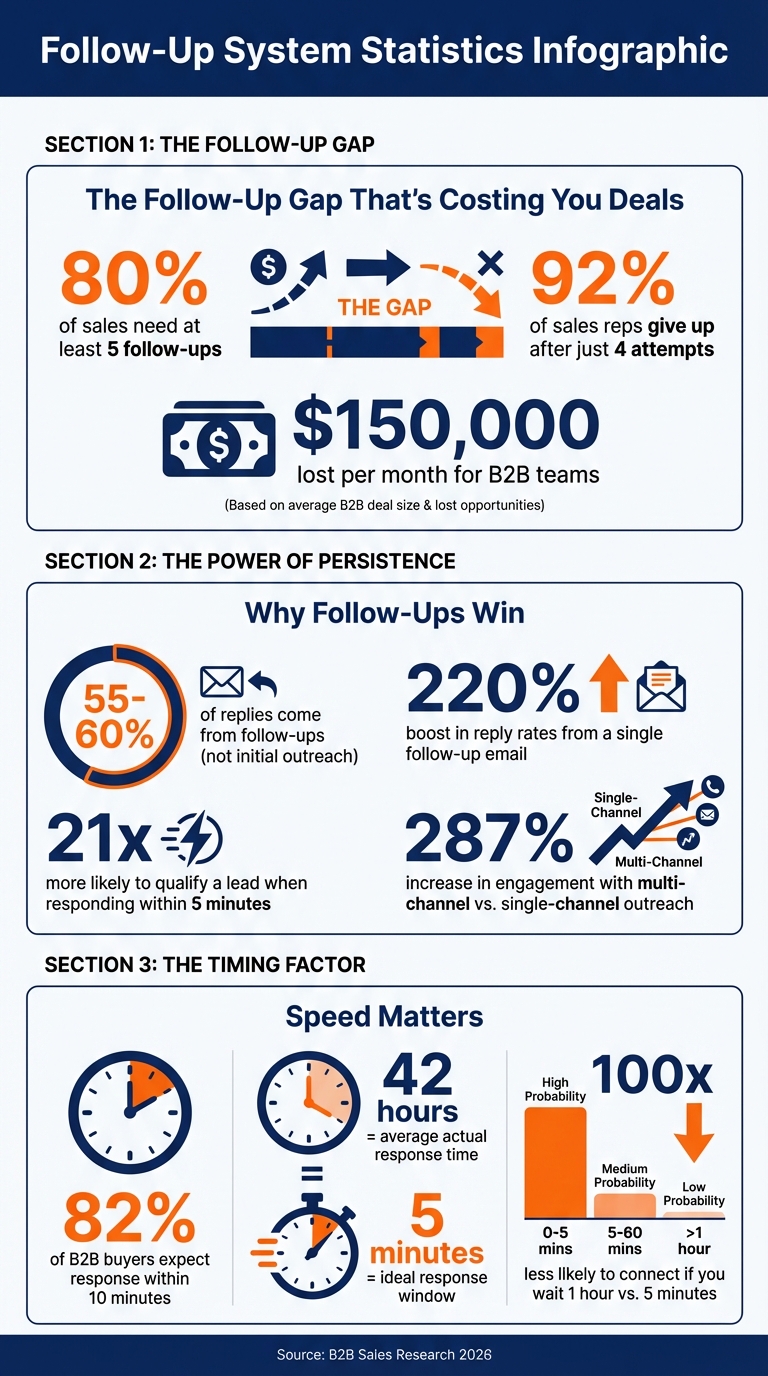
If your leads are ghosting you, it’s not because they lost interest - it’s because you didn’t follow up effectively. Here's the hard truth: 80% of sales need at least five follow-ups, but nearly half of salespeople give up after just one attempt. That’s leaving money on the table - around $150,000 per month for B2B teams, to be exact.
The fix? A structured follow-up system. Think automation, segmentation, and personalization. Respond fast (ideally within 5 minutes), ditch those vague "just checking in" emails, and use tools like RevBoss to keep your outreach consistent across multiple channels like email and LinkedIn.
Key stats you need to know:
- 55%–60% of replies come from follow-ups.
- A single follow-up email can boost reply rates by 220%.
- Responding within 5 minutes makes you 21x more likely to qualify a lead.
Follow-Up Statistics: Why 5+ Touchpoints Win Sales
How to Follow Up with Leads (Without Being Pushy)
sbb-itb-9354cf2
Why Leads Go Cold
Leads don’t just lose interest - they lose momentum. When a prospect first engages, their motivation is at its highest. But that enthusiasm has a short lifespan, often just 24 to 48 hours. If you don’t act quickly, they get swept back into their daily grind, and your solution becomes just another task buried under competing priorities.
"Most leads don't go cold because prospects lose interest. They go cold because something in your process failed them."
Timing is everything. While 82% of B2B buyers expect a response within 10 minutes, the average response time is a staggering 42 hours. This delay can tank a lead’s value, dropping it to less than 5%. Responding within five minutes makes you 21 times more likely to qualify that lead, but wait an hour, and your chances plummet - you’re 100 times less likely to connect. To avoid this, a structured, multi-touch system is essential.
Generic follow-ups only make matters worse. A vague "just checking in" email forces prospects to recall the context and figure out next steps themselves. Craig Pateman from SmlBiz Blueprint puts it bluntly: "Silence isn't rejection - it's decision avoidance. Time passes. Context fades. Competing priorities take over".
Then there’s the complexity factor. B2B purchases often involve 6 to 10 decision-makers, and 77% of buyers describe the process as "very complex or difficult". When your messaging fails to address key concerns or add fresh value, prospects disengage. In fact, 35% of deals stall because the value proposition isn’t clear. This highlights the importance of consistent, multi-channel outreach to keep the conversation alive.
Why Multiple Touchpoints Matter
Building trust takes time and repetition. B2B buyers rarely make impulsive decisions - they need to see your name and message multiple times, across various channels, before they feel ready to engage. Research shows that 55% of replies in cold email campaigns come from follow-ups, with even a single follow-up boosting reply rates by 220%.
Problems with Manual Follow-Up
Relying on manual follow-ups introduces inconsistency - the very thing you’re trying to avoid. Without a system in place, two identical leads can have vastly different outcomes simply because one received quicker attention. A 2026 study of 114 B2B companies by Workato found that none responded within the critical five-minute window, with the average response time sitting at nearly 12 hours.
Semir Jahic, CEO of Salesmotion, sums it up well: "Losing leads is not a market problem. It is an execution problem". Without automation to ensure timely responses and maintain context, even the best strategies can fall apart.
Core Components of a Follow-Up System
To sidestep the challenges of manual follow-ups, build a system that combines segmentation, automation, and personalization. These three elements work together to ensure no lead is overlooked while keeping the human connection that drives results. Let’s dive into each component, starting with segmentation.
How to Segment Your Leads
Start by grouping your leads based on their role and potential value. Use firmographic data like industry, company size, and job title, alongside behavioral data such as email opens, visits to pricing pages, or specific resource downloads.
A lead scoring system can help prioritize your efforts. Assign points to both actions and characteristics - for example, visiting a pricing page might earn a lead a certain number of points, while a C-suite title adds even more weight. This scoring creates tiers like Hot, Warm, and Cold, which dictate the intensity of your follow-up. Research shows that connecting with C-level executives becomes more likely with persistence, improving from 39% on the first call to 93% by the third.
Leverage signal-based triggers to automate timely responses. For instance, if a lead downloads a whitepaper or visits your pricing page, they can automatically be funneled into a sequence tailored to their position in the buyer’s journey.
A great example of segmentation in action is Meritt, a recruitment solutions provider. In 2025, they slashed their email bounce rate from 35% to under 4% by refreshing their data every seven days. This improvement allowed their automated follow-ups to consistently reach valid inboxes, boosting their weekly pipeline from $100,000 to $300,000.
Once your leads are segmented, the next step is automating your follow-up process.
Setting Up Automated Follow-Up Sequences
Automation ensures no lead is left waiting. But clean data is critical - verify email addresses before launching any sequence. High bounce rates (above 2%) can damage your domain’s reputation and hurt deliverability.
Set up behavioral triggers for key actions, such as a new lead assignment, a lead staying in "Contacted" status for over three days, or a visit to your pricing page. Use a structured cadence, like reaching out on Day 1, Day 3, Day 7, and Day 10. Research indicates that 93% of responses come in by Day 10.
Incorporate stop-on-reply logic to immediately pause automation when a lead engages. This ensures no awkward double-messaging. Configure your CRM to remove engaged leads from sequences and set up alerts (via tools like Slack or CRM task notifications) to flag high-priority manual follow-ups.
Each touchpoint should bring fresh value - share case studies, actionable insights, or specific solutions. Avoid the generic "just checking in" emails. As the team at Prospeo advises:
"The biggest lift comes from banning 'checking in.' Replace it with 'here's the specific thing that breaks for teams like yours right now'".
With automation covering the basics, you can focus on personalization to create deeper connections.
Personalizing Your Outreach
The level of personalization should match the deal’s value. For small- to mid-sized opportunities, use light personalization - reference one or two key details, like the lead’s role or company situation. This takes only 30–90 seconds per lead. For larger deals worth $15,000 or more annually, invest more time (6–10 minutes) in detailed, research-backed personalization.
Context is key. Avoid generic openers and instead reference specifics, such as the lead’s challenges, role, or industry trends. Keep detailed fields in your CRM - like pain_hypothesis, trigger, and last_touch_summary - to build on past interactions.
AI can help you scale relevance without sacrificing authenticity. Use an "input-only" rule, ensuring AI pulls from verified data only.
"AI personalization in 2026 isn't about faking personal attention - it's about scaling genuine relevance. The best AI follow-ups feel helpful, not automated."
Finally, balance your outreach with the 60/40 rule: 60% of your message should provide value (like insights, case studies, or workflow tips), while 40% should focus on persuasive calls to action. This approach keeps leads engaged without overwhelming them. Notably, small businesses respond 8.4% better on a second follow-up compared to the first.
Tools and Technology for Scaling Follow-Up
Technology simplifies follow-ups by turning them into repeatable, automated processes. Platforms can handle outreach, track engagement, and provide actionable data, allowing your team to run multi-channel campaigns without getting overwhelmed. A great example of this is RevBoss, which automates lead nurturing across multiple channels.
Using RevBoss for Audience Building and Lead Nurturing
To make follow-ups more efficient, tools like RevBoss help automate and personalize the process. RevBoss is built to generate demand by fostering relationships before pitching a sale. It creates LinkedIn audiences tailored to your ideal customer profile (ICP) and nurtures leads with consistent, low-pressure engagement. By the time you reach out directly, your prospects are already familiar with your brand.
RevBoss offers two main packages:
- Core System ($3,500/month): Covers LinkedIn content creation, ICP connections, and activation campaigns.
- Full Stack System ($4,500+/month): Adds email newsletters and outreach, creating a comprehensive multi-channel nurturing workflow.
This setup ensures your brand stays visible across platforms. Over its 10+ years in business, RevBoss has worked with more than 1,000 clients and holds a 4.6 G2 rating.
The platform uses "event-driven asks" to track prospect intent, triggering follow-ups based on actions like profile visits or content engagement. It also integrates with your CRM to seamlessly populate your sales funnel with leads and syncs with sales team calendars to streamline scheduling. As Tooba Durraze, Founder of Amoeba.AI, shared:
"RevBoss has had a direct impact on our sales. We drove a ton of leads for our beta launch."
Measuring and Improving Follow-Up Performance
Automated outreach is just the start - measuring every touchpoint is key to refining your strategy. Focus on metrics tied to revenue, like Meetings Booked and Positive Reply Rate, rather than surface-level stats like open rates. For example, top-performing companies book meetings with 78% of their qualified leads, compared to a median of 62%. Bridging that gap should be your priority.
Analytics can help you pinpoint where engagement drops off. Research shows that 70% of responses typically come between the 2nd and 4th emails in a sequence. If replies aren’t coming in by Step 4, it’s time to tweak your messaging. Sequences with 4–7 follow-ups achieve a 33% reply rate, compared to just 25% for sequences with 1–3 touches.
Monitor reply latency - the time it takes for a prospect to respond. Faster replies often indicate higher intent. Keep bounce rates under 2% to protect your domain reputation, and log "stall reasons" in your CRM to trigger targeted follow-ups. Alina McComas highlights the importance of data analysis:
"Studying the data allows you to identify where the bottlenecks in the sales process occur. It enables you to go beyond what you think is happening and confirm where that friction in the sales process lives."
Experiment with A/B testing for subject lines and timing at specific steps to refine your approach. Calculate revenue per recipient by linking specific follow-up steps to closed deals - this reveals the true ROI of each touchpoint. These insights help you fine-tune your strategy and secure engaged leads that convert into customers.
Multi-Channel Follow-Up Strategies
Expanding on segmentation and automation, incorporating multiple channels into your follow-up strategy can significantly boost engagement. Relying on a single channel often limits interaction, whereas a multi-channel approach has been shown to increase engagement by up to 287% compared to single-channel outreach. The secret lies in seamlessly coordinating LinkedIn, email, and newsletters so that each channel reinforces the others without overwhelming your leads.
Coordinating LinkedIn, Email, and Newsletters
Each platform has its strengths when it comes to nurturing leads. Email is perfect for detailed communication - use it to share case studies, outline your value propositions, or provide tailored solutions to specific issues. LinkedIn, on the other hand, is ideal for building professional connections. Use it to send connection requests, visit profiles, and engage with your prospect’s content. Meanwhile, newsletters work best for long-term nurturing, offering industry insights and updates to leads who aren’t quite ready to make a purchase.
Timing and structure are everything. For example, in early 2026, Giorgio Pierantoni, CEO of Iprov (Cosmobile), implemented a multi-channel strategy aimed at CEOs and Marketing Managers at companies with over $4M in revenue. By combining LinkedIn and email messaging tailored to this audience, the company created a reliable flow of warm leads. This allowed their executive team to focus on closing deals rather than chasing prospects.
Here’s a simple structure for the first three weeks:
| Week | Emails | Focus | |
|---|---|---|---|
| Week 1 | 2–3 emails | 1 interaction (connection request) | Introduce your value proposition and begin discovery |
| Week 2 | 1–2 emails | 2 engagements (likes/comments) | Share industry insights and demonstrate thought leadership |
| Week 3 | 1 email | 1 message | Highlight success stories and social proof |
Start strong by reaching out within 24 hours. Send a personalized welcome email within one hour of lead activity, follow it up with a LinkedIn connection request 4–6 hours later, and share a relevant resource within 18–24 hours. This early engagement maximizes the chance of capturing your lead’s attention when they’re most interested.
Every interaction should bring something new to the table - whether it’s a case study, an insight, or a targeted question. Skip the generic “just checking in” messages. If you don’t get a response after three emails, switch to a different channel to protect your email domain reputation. For leads that aren’t ready to engage, move them into a long-term nurture plan with monthly newsletters or updates to keep your brand on their radar without being intrusive.
This strategy complements the automation and personalization techniques discussed earlier, ensuring consistent and meaningful engagement with your leads.
When and How Often to Follow Up
Once your channels are aligned, timing becomes the next critical factor. Research suggests the best times to follow up are Tuesday through Thursday, between 10:00 AM and 2:00 PM. For high-level executives, Saturday afternoons can also be effective.
Interestingly, 55% of replies to cold email campaigns come from follow-ups rather than the initial message. Most responses - around 70% - happen between the second and fourth emails in a sequence. To strike the right balance, send your first follow-up 2–3 days after the initial contact, the second 4–5 days later, and the third about a week after that.
The intensity of your follow-up cadence should match the lead’s intent. High-intent leads, like those who request a demo, benefit from a more aggressive schedule - follow up within 24 hours, then again on day 3 and day 7. Low-intent leads, such as those who download a whitepaper, can be nurtured over several weeks with informative content.
A great example comes from Meritt, a client of Prospeo, who revamped their CRM sequences in 2025. By adopting a 7-day refresh cycle and improving email accuracy to 98%, they reduced their bounce rate from 35% to under 4%. This change tripled their weekly pipeline from $100,000 to $300,000. It’s a clear reminder that clean, accurate data is essential for effective follow-up. Aim to keep your bounce rate below 2% to maintain your domain reputation.
Finally, ensure your automated sequences pause the moment a lead replies or schedules a meeting. There’s nothing more off-putting than receiving a redundant “just checking in” email after you’ve already confirmed a call.
Conclusion
A structured follow-up system can turn disappearing leads into a steady, reliable sales pipeline. Consider this: 80% of sales require at least five touchpoints to close, yet 92% of sales reps stop after just four attempts. That gap between persistence and giving up is where opportunities are either lost or seized.
To close this gap, focus on three key strategies: segment your leads based on their intent and behavior, automate repetitive tasks to avoid manually tracking every interaction, and personalize your outreach at scale with real, relevant context. Using multiple channels - like email, LinkedIn, and newsletters - can boost engagement by 287% compared to sticking with just one. Timing also plays a huge role: responding within five minutes can make your conversion rates soar by over eight times.
RevBoss's Audience System simplifies this process. It automates LinkedIn content, builds an audience rich with your ideal customer profile (ICP), and runs activation campaigns to turn warm connections into qualified conversations. By connecting content, connections, and campaigns, it keeps your follow-up efforts organized and repeatable - without needing to hire a full SDR team upfront.
"Inconsistent follow-up is where most B2B deals die. Process saves them."
- Peter Emad, GTM Expert @ SalesCaptain
Peter Emad’s words highlight a critical truth: consistency is what keeps B2B deals alive. The founders succeeding in 2026 won’t just be the ones working harder - they’ll be the ones who’ve built systems that transform cold leads into meaningful conversations in just 60 to 90 minutes a day. Clean data, disciplined follow-up schedules, and value-driven messaging create the kind of momentum that scales pipelines and drives revenue. By adopting this follow-up framework, you can turn cold leads into lasting business growth.
FAQs
What should I send instead of a “just checking in” follow-up?
Instead of sending a bland "just checking in" message, take the opportunity to craft follow-ups that genuinely add value and spark the prospect's interest. You could share a relevant article, offer insights that align with their challenges, or ask a thoughtful question that ties back to your previous conversations. Another idea? Provide updates that are directly relevant to their goals or industry.
The key is to keep your communication personalized and meaningful. Skip the generic or guilt-laden phrases - they don’t do anyone any favors. Instead, show that you’re invested in their success by offering something useful or engaging that nudges them toward a response.
How many touchpoints is too many before I stop following up?
Most sales experts agree that it takes between 5 and 8 follow-up touchpoints to close a deal, with 80% of sales happening after at least five interactions. However, going beyond eight touchpoints can backfire, potentially annoying prospects and reducing your chances of success. The key is to make every follow-up count by offering something valuable each time, ensuring you keep your leads interested without overwhelming them.
What’s the simplest automation setup to respond within 5 minutes?
When a lead submits a form or inquiry, the most straightforward system uses AI-driven tools to send instant messages. These tools typically respond within 30 to 120 seconds, ensuring a fast initial connection. By integrating AI with CRM automation workflows - programmed with behavioral triggers - you can set up automated follow-ups to kick in right after capturing the lead. This approach ensures responses are sent within 5 minutes, maintaining the lead's interest and engagement.