Getting Discovered by AI Search: How to Write B2B Content That Shows Up in ChatGPT-Style Answers

Want your B2B content to show up in AI answers like ChatGPT? Here’s the deal: AI search doesn’t rank pages like Google. It pulls and cites concise, trusted snippets. If your content isn’t built to be “retrieval-worthy,” you’re invisible to half of B2B buyers who now use AI for vendor research. Worse? AI-driven traffic converts 2.4x better than traditional organic search.
Here’s the playbook:
- Structure matters: Use clear headings, 200–400 word blocks, and direct answers upfront.
- Data wins: Original research and stats are 40% more likely to get cited.
- Be specific: Replace generic claims with verifiable, detailed info.
- Use schema markup: Organize content with JSON-LD to boost AI citations by 2.8x.
Key takeaway? If AI can’t trust, extract, and cite your content, you’re out of the game. Start creating content that AI loves - before your competition does.
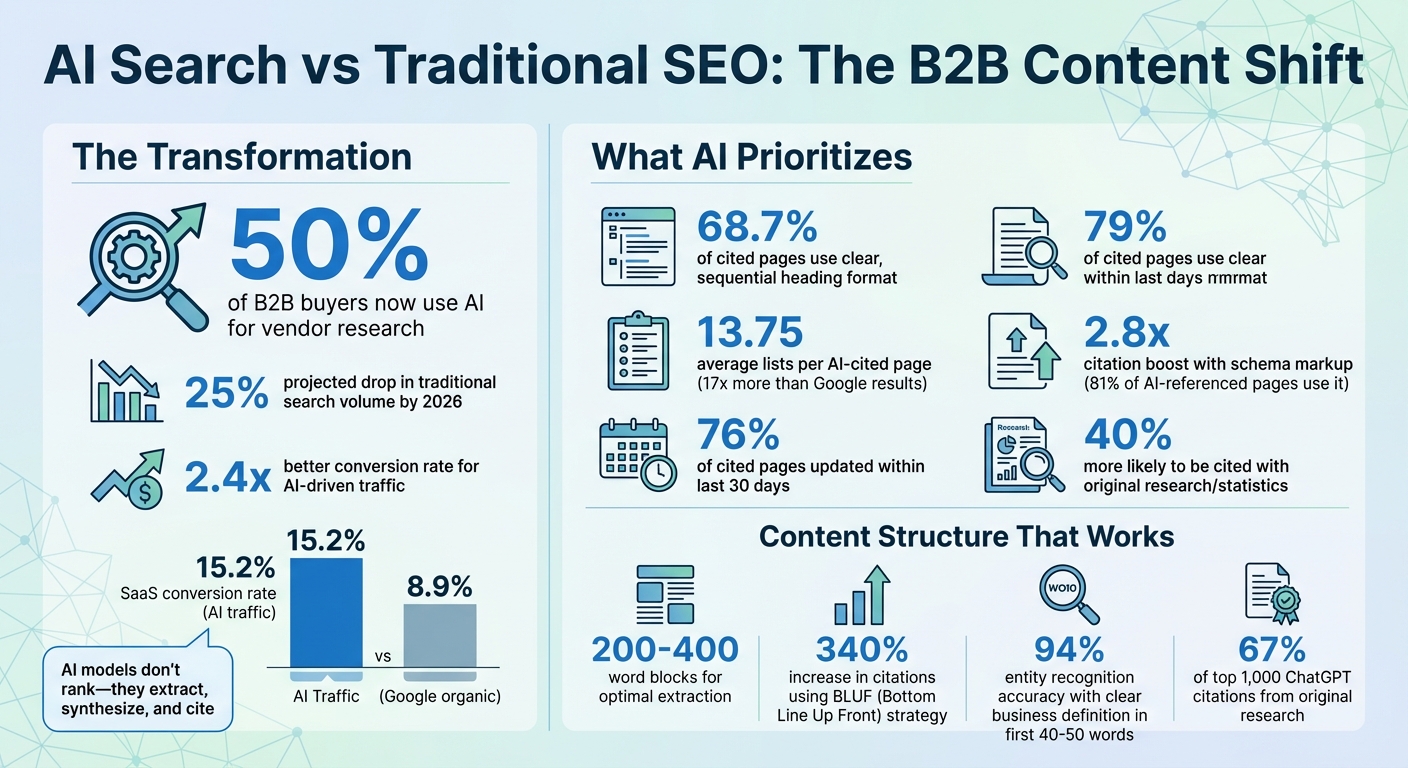
AI Search vs Traditional SEO: Key Statistics for B2B Content Optimization
Beyond Keywords: B2B Writing for Generative AI & GEO–Janet Driscoll Miller
sbb-itb-9354cf2
How AI Search Selects Content
AI search takes a different approach compared to traditional search engines. Instead of ranking pages, it pulls together, synthesizes, and cites specific pieces of information to craft a single, conversational response. While traditional SEO aimed for the coveted top spot, AI search is about making your content easy for AI to find, trust, and quote - essentially becoming "retrieval-worthy."
This shift in focus is profound. As Kevin Fincel, Founder of Geol.ai, puts it:
"The winner isn't always the page in position #1 - it's the page the model can trust, extract, and justify."
To increase the chances of being cited, content creators must align their strategies with how AI evaluates and selects information. This sets the stage for understanding how models like ChatGPT process and cite content.
How ChatGPT Processes Content
ChatGPT uses a dual-process system called Retrieval-Augmented Generation (RAG). This method combines its pre-trained knowledge with real-time browsing to deliver precise answers. When a user submits a query, the model breaks it into smaller sub-queries (a process called query fan-out) to locate the most relevant snippets of information across the web.
Instead of reading entire articles, the model scans for concise, self-contained blocks of 200–400 words that directly address specific sub-questions. Content that includes clear headings and starts with a direct 40–60-word response tends to perform best .
Structure is everything: 68.7% of pages cited by ChatGPT follow a clear, sequential heading format. Additionally, these pages average 13.75 lists per page - 17 times higher than standard search engine results.
AI models also create a "consensus view" by cross-referencing multiple independent sources. They prioritize information that is defensible - meaning it can be verified using trusted datasets like Wikipedia, Reddit, and niche industry forums . Among these, Wikipedia and Reddit dominate as the most frequently cited sources across platforms.
These methods of extraction and cross-referencing highlight why authority and relevance are critical for content to be selected by AI.
Why Authority and Relevance Matter
AI models prioritize trustworthy answers, and authority in this context depends on three factors: topical depth, consistent entity representation, and third-party validation.
Topical depth goes beyond surface-level summaries. AI looks for content with "semantic coverage", meaning it includes not just the primary answer but also supporting details and related subtopics commonly found in high-quality data . A short, shallow 500-word post often falls short because the model favors dense, well-researched content that demonstrates expertise.
Consistency in entity representation is also key. Using canonical names consistently across your website, LinkedIn, and directories helps AI models build a clear knowledge graph of your brand or entity . Vague references - like "it" or "this platform" - can confuse the model and reduce your chances of being cited.
Third-party validation acts as a "truth vote." AI models rely on external consensus from high-authority platforms like Wikipedia, G2, and niche forums to confirm the credibility of your content . As Rick Kranz, Founder of AI Marketing Automation Lab, explains:
"Generic, rehashed content won't be cited; AI favors original, well-validated content."
In August 2024, a B2B SaaS company adopted an Answer Engine Optimization (AEO) strategy using the CITABLE framework - Clarity, Intent, Third-party validation, Authority, Latest info, Block-structure, and Entity graph. This approach led to a dramatic increase in AI-referred trials, jumping from 550 to over 2,300 in just four weeks - a 600% boost in citations across ChatGPT, Claude, and Perplexity.
Staying current is equally important. Seventy-six percent of pages cited by ChatGPT had been updated within the last 30 days. In competitive B2B industries, content that isn't refreshed at least quarterly is three times more likely to lose its AI citations over time . Maintaining authority requires regular updates to stay relevant in the ever-changing landscape of AI-generated answers.
Writing Content for AI Search
To create content that AI can easily extract and cite, you need to rethink how you structure and present information. The aim isn't just to rank high in search results but to make your content "retrieval-worthy." This means crafting material that AI models trust, extract, and quote with confidence.
Structure Content for Easy Answer Extraction
AI models prefer concise blocks of 200–400 words that directly address specific queries. To improve the chances of your content being cited, place a clear, standalone answer right after your introduction or under each H2 heading. This "BLUF" (Bottom Line Up Front) strategy can increase citation likelihood by 340%.
It's also important to clearly define your business entity early on. Within the first 40–50 words, include your full legal name, industry category, location, and core offering. This boosts entity recognition accuracy from 71% to 94%. AI models use "entity salience scores" to gauge how central your brand is to the content. Higher scores - above 0.7 - are linked to 3.2x better retrieval rates.
When writing headings, frame them as natural language questions. For instance, instead of "Our Approach to Lead Generation", use "How Do B2B Companies Generate Qualified Leads?" This mirrors how users phrase queries in AI tools. Additionally, content cited by ChatGPT tends to include an average of 13.75 list sections per page - over 17 times more than traditional Google results. Keep paragraphs short (2–4 sentences) to ensure ideas are easy to skim.
Avoid vague claims and focus on specific, verifiable data. As Rick Kranz, Founder of AI Marketing Automation Lab, puts it:
"AI engines don't need another generic remix of what already ranks. If your content is commodity text, the model already knows it - so it won't cite you."
Use Data, Frameworks, and Original Research
Original research is a key differentiator that can elevate your content's credibility. AI systems can't generate new knowledge - they rely on sources that provide unique insights. Sixty-seven percent of ChatGPT's top 1,000 citations come from original research, first-hand data, or academic sources.
Types of proprietary data that perform well include customer data analysis, industry surveys, internal performance benchmarks, comparative testing, and unique public data analysis. Content featuring specific statistics is 40% more likely to be cited than general qualitative statements. Long-form content exceeding 2,000 words also gets cited three times more often due to its density of facts.
Creating your own frameworks, like the CITABLE methodology, can further set your content apart. These frameworks act as "truth banks", offering insights not found elsewhere. Make every claim quotable - 1–2 sentences with clear metrics and attributed sources.
Third-party validation also enhances your authority. AI systems are 6.5x more likely to cite your brand when external sources, such as Reddit, G2, or industry publications, confirm your information.
Add Comparison Tables for B2B Decisions
Tables are goldmines for AI engines because they present structured data in a format that's easy to extract. Content with tables and lists is 2.5x more likely to be picked up by AI models.
B2B buyers often search for "X vs Y" comparisons when evaluating vendors. AI models extract data directly from HTML table rows to create these side-by-side analyses. Use semantic HTML tags (<table>, <th>, <td>) instead of images or JavaScript layouts to improve extraction rates by 65%.
Position comparison tables prominently - ideally right after question-based headings. Ensure table cells are self-explanatory, with specific product names or metrics like "99.9% SLA" or "$49/month", rather than vague terms like "high uptime" or "affordable".
For B2B SaaS content, focus on tables that compare pricing tiers, API limits, integration options, and feature sets across team sizes. These structured elements address the detailed questions buyers ask AI tools during their decision-making process. Nearly 80% of URLs cited by AI include at least one list or table.
These strategies set the stage for further technical improvements, which will be explored in the next sections.
Using Structured Data for AI Discoverability
Structured data acts as a translator between human-readable content and AI systems. While your content might make perfect sense to people, AI models need it in a standardized format to process it effectively. This is where schema markup, particularly JSON-LD, comes into play. It organizes your information in a way that tools like ChatGPT can easily interpret and use.
Here’s the kicker: pages that include structured data see a 2.8x boost in AI citation rates, with 81% of AI-referenced pages using schema markup. It’s not just about being found - it’s about being trusted.
Structured data also eliminates confusion. For example, the word "Apple" could mean either the fruit or the tech company. Schema markup clarifies this by tagging entities like organizations, products, or individuals, leaving no room for misinterpretation. Plus, pages using three or more schema types are 13% more likely to be cited in AI-generated answers. Once your entities are clearly defined, the next step is implementing actionable schema for your B2B content.
Add Schema Markup for Key B2B Elements
Schema markup strengthens the connection between your structured content and AI systems. Start with site-level schema, like Organization and Person, to establish your brand’s authority. This foundational step increases your chances of earning a Knowledge Panel by 3.7x, which signals strong entity recognition. After that, layer in page-level schema types like FAQ, Article, or Product to add precision.
JSON-LD is the go-to format for schema implementation. It’s Google’s preferred choice because it keeps content organization separate from design, making it easier to scale across templates.
Here’s a quick example of an Organization schema:
{
  "@context": "https://schema.org",
  "@type": "Organization",
  "@id": "https://yourcompany.com/#organization",
  "name": "Your Company Name",
  "url": "https://yourcompany.com",
  "logo": "https://yourcompany.com/logo.png",
  "sameAs": [
    "https://www.linkedin.com/company/yourcompany",
    "https://www.crunchbase.com/organization/yourcompany"
  ]
}
The "sameAs" property is vital because it links your brand to authoritative third-party sources like LinkedIn or Crunchbase, reinforcing your credibility.
For B2B content, here’s how schema types align with specific needs:
| B2B Content Type | Recommended Schema Elements | Purpose for AI |
|---|---|---|
| Pricing Pages | Product, Offer, price, priceCurrency | Provides direct answers to pricing queries |
| Comparison Content | Product, brand, AggregateRating, Review | Summarizes pros/cons and feature comparisons |
| Case Studies | Article, Person (Author), Review, Organization | Showcases authority and client success |
| Technical Guides | HowTo, HowToStep, FAQPage | Extracts step-by-step instructions |
For FAQPage schema, align your content with conversational questions and keep answers concise - just 1–3 sentences. AI models often pull these snippets verbatim to answer user queries. Here’s a sample:
{
  "@context": "https://schema.org",
  "@type": "FAQPage",
  "mainEntity": [{
    "@type": "Question",
    "name": "How do B2B companies generate qualified leads?",
    "acceptedAnswer": {
      "@type": "Answer",
      "text": "B2B companies generate qualified leads through targeted outbound campaigns, content marketing, and account-based strategies that focus on key decision-makers."
    }
  }]
}
Depth matters too. Instead of marking up a single entity, create nested relationships. For instance, link a Product to its Manufacturer, then to the Organization, and finally to a specific Person with credentials.
One golden rule: ensure content parity. Your schema markup must match the visible on-page content exactly. If your JSON-LD lists a price of $49/month, that exact figure must appear on the page. Failing to do so could result in penalties or loss of citation eligibility.
Optimize Metadata for AI Search
Metadata plays a crucial role in how AI interprets your content. Before diving into your page, AI systems often analyze metadata to decide if your content is worth retrieving. Unlike traditional SEO, AI-focused search requires direct and clear entity signaling. Structure your title tags like this: "[Primary Entity]: [Action/Outcome] for [Audience]." For example, "CRM Platform: Pipeline Management for B2B SaaS" immediately communicates relevance.
Here’s how metadata goals shift when optimizing for AI:
| Element | Traditional SEO Goal | AI Search (AEO) Goal |
|---|---|---|
| Title Tag | Maximize click-through rate with curiosity | Clearly identify entities for relevance |
| Meta Description | Create an emotional hook to drive clicks | Provide a factual summary for confidence |
| Open Graph | Optimize social share appearance | Offer structured context for AI crawlers |
For meta descriptions, use the "Bottom Line Up Front" (BLUF) format. Write direct, factual summaries instead of promotional phrases. Instead of "Discover the best CRM for your team", try: "B2B CRM platform with pipeline automation, email tracking, and native Salesforce integration. Serves 500+ SaaS companies with 10–100 employees."
Alt text for images should also be factual and entity-rich. For example, instead of keyword-stuffing, describe a dashboard screenshot like this: "RevBoss email campaign analytics dashboard showing 42% open rate and 8% reply rate for Q1 2026."
Don’t forget to include freshness signals in your Article schema by adding "datePublished" and "dateModified" fields. Content updated within the last three months averages 6 citations, compared to 3.6 for older content.
Finally, test your schema implementation with tools like Google’s Rich Results Test and the Schema Markup Validator to ensure everything is compliant.
As Ethan Smith and Alex Halliday, CEOs of Graphite and AirOps, explain:
"AI search inserts a new visibility broker between brands and their next customer."
Structured data helps you get a foot in the door with this broker. While it makes your content readable for AI, it’s the quality of your writing and data that ultimately earns citations.
How RevBoss Can Help Build AI-Optimized Content
Creating content that AI models trust takes more than solid writing - it requires a strategy that builds credibility across key platforms. RevBoss focuses on establishing third-party validation on platforms like LinkedIn, industry forums, and professional networks, which AI models prioritize heavily. Tools like ChatGPT weigh these external signals more than what you say about yourself on your own website.
The landscape is changing fast: nearly half of B2B buyers now rely on AI for vendor research instead of traditional search engines. This shift means your content needs to show up not just on Google but also in conversational AI answers from tools like ChatGPT and Perplexity. RevBoss bridges this gap by connecting your on-site content to a broader, AI-friendly online presence.
RevBoss LinkedIn Content + Audience Program
AI models are increasingly drawn to content that demonstrates expertise rather than generic marketing fluff. That’s where the RevBoss LinkedIn Content + Audience Program comes in. Starting at $1,500/month, this program includes weekly strategy calls, 8–12 LinkedIn posts per month, and audience growth workflows - all designed to build trust and authority in the places AI models look for it.
RevBoss takes your expertise and transforms it into consistent, impactful content that positions you as a thought leader. But it doesn’t stop at posting. The program actively grows your ideal customer base through connection and engagement workflows, creating a community consensus that AI platforms interpret as a strong signal of authority.
When your LinkedIn posts spark meaningful discussions and are shared by peers in your industry, it generates the kind of third-party validation that AI models consider credible.
Integrated Content and Audience Workflows
Consistency across platforms is key to maintaining a strong, recognizable brand in the eyes of AI systems. RevBoss addresses this by unifying LinkedIn, email, and outreach campaigns into one seamless strategy. Their Combined Content program, priced at $2,500/month, ensures your messaging stays aligned across all platforms.
This integration is especially important because AI platforms don’t share visitor data. You can’t always tell who’s finding you through conversational AI or what queries are driving traffic your way. RevBoss tackles this challenge with a unified intent activation system. By combining AI-optimized content with intent detection and outbound engagement, they help turn anonymous AI-driven traffic into qualified leads.
Here’s how it works: LinkedIn content builds your visibility and authority, email newsletters deliver deeper insights to keep your audience engaged, and outreach campaigns identify potential buyers and prompt meaningful conversations. The RevBoss platform ties all of this together, consolidating content, audience data, and campaign performance into one streamlined system.
These workflows are designed to turn AI-sourced traffic into real sales opportunities.
Why Choose RevBoss for B2B Marketing
AI-driven traffic tends to convert at higher rates because it brings in visitors who are already pre-qualified and highly targeted. RevBoss programs are built to capture this traffic through expertly crafted content, audience growth that reinforces credibility, and activation campaigns that turn warm leads into sales.
Their all-in-one Content + Coaching + Activation program, priced at $4,000/month, includes LinkedIn and email content creation, direct outreach, event support campaigns, and marketing asset development. Offered on a month-to-month basis with discounts for term agreements, this package also includes access to the RevBoss platform, which connects all your content, connections, and campaigns into a repeatable system.
For B2B companies looking to stand out in AI-generated answers, RevBoss provides the tools and strategy needed to build trust and authority across trusted networks and third-party sources.
Conclusion
The transition from traditional search to AI-driven answer engines is fundamentally changing how B2B buyers find vendors. Currently, half of B2B buyers rely on AI for vendor research, and traditional search volume is projected to drop by 25% by 2026. This shift means unstructured content risks being overlooked by a significant portion of potential buyers.
To thrive in this evolving landscape, businesses must go beyond basic keyword strategies and focus on creating content with semantic depth, credible authority signals, and structured formats. AI models like ChatGPT utilize Retrieval-Augmented Generation (RAG) to pull concise, 200–400 word sections that directly address user questions. This makes it crucial to organize your content for seamless extraction, back it with verified data and citations, and ensure validation from trusted sources like G2, Reddit, or industry publications.
The payoff for these adjustments is clear. Traffic referred by AI converts 2.4× to 2.6× better, with SaaS conversion rates hitting 15.2%, compared to 8.9% for traditional Google organic traffic. These leads come pre-qualified, armed with insights from the AI’s synthesis process, making them far more valuable than standard organic traffic.
An integrated approach is key to capturing these opportunities. Companies like RevBoss streamline this process by combining LinkedIn content, email newsletters, and outbound campaigns into a cohesive strategy. Starting at $1,500 per month, their services cover everything from content creation to audience expansion and lead activation, all aimed at building the authority signals that AI prioritizes.
AI-driven search is already reshaping the B2B world. The question is whether your content strategy will evolve quickly enough to meet buyers who are increasingly guided by AI insights.
FAQs
How can I tell if AI tools are citing my content?
To find out if AI tools are referencing your content, take a closer look at the sources mentioned in their answers. These tools tend to pull information from content that ranks well due to factors like domain authority, structured data, and how recent the content is. To boost the likelihood of being cited, make sure your content is well-optimized with proper schema markup and signals that establish credibility. It’s also a good idea to keep an eye on AI-generated responses for citation panels or source lists to confirm your content’s visibility.
What schema markup should a B2B site add first for AI visibility?
B2B websites should kick things off by implementing schema markup for FAQs, How-To guides, and essential entity data. These structured data elements make it easier for AI to interpret and reference your content, boosting the likelihood of being cited in generative search results. Focusing on these areas can significantly enhance visibility within AI-powered search tools.
How often should I update pages to keep showing up in AI answers?
To keep your pages relevant in AI-generated answers, make it a habit to update your content regularly. Frequent updates signal freshness and improve visibility. Use technical tools like the dateModified schema and <lastmod> tags to clearly indicate when changes were made. These signals help AI systems identify and prioritize your most current information.