Sales and Marketing Campaign Handoffs: What Good Looks Like

When marketing and sales don’t work together, leads - and money - fall through the cracks. Here’s the deal: only 8% of companies have strong sales-marketing alignment, and the lack of coordination costs U.S. businesses $1 trillion annually. Fixing the handoff process can mean 38% higher win rates, 67% better conversion rates, and 19% faster growth.
Key Takeaways:
- Define MQLs and SQLs: Agree on what makes a lead ready for sales. Use scoring systems like BANT (Budget, Authority, Need, Timing).
- Share Context: Sales needs more than an email address. Include engagement history, pain points, and source data.
- Set SLAs: Speed matters - respond to hot leads in under an hour. Automate alerts and track follow-ups.
- Use Automation: Route leads instantly to the right reps with tools like HubSpot or Slack integrations.
- Feedback Loops: Sales must accept or reject leads with reasons logged. Marketing adjusts based on this data.
- Recycle Leads: Not ready doesn’t mean never. Send rejected leads back to marketing for nurturing.
Metrics to Watch:
- MQL-to-SQL conversion: Healthy range is 35%-45%.
- Lead response time: Under 5 minutes is ideal.
- SQL acceptance rate: Aim for 80%-90%.
- Closed-won rates: The ultimate test of handoff success.
Bottom line: Clear definitions, fast responses, automation, and feedback loops aren’t just nice-to-haves - they’re the difference between wasted leads and a growing pipeline.
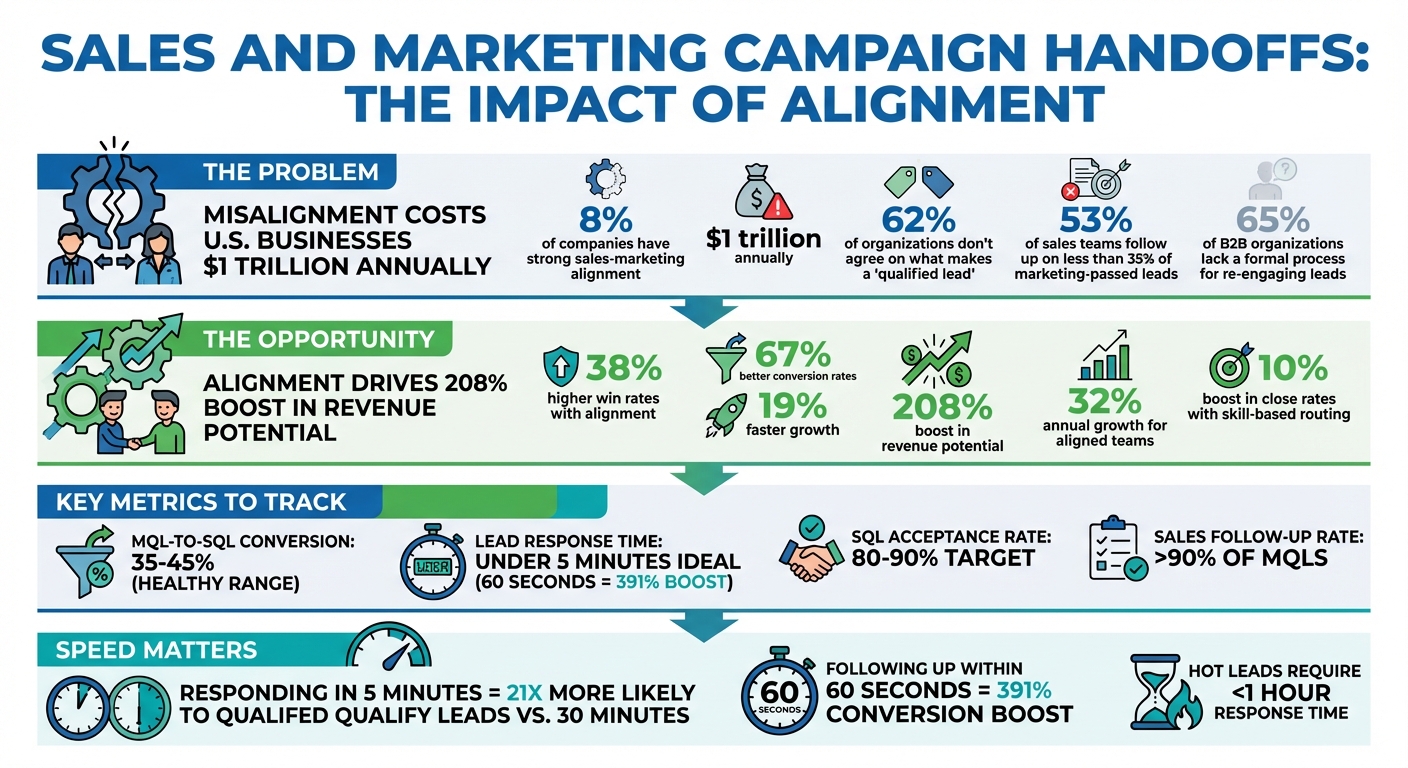
Sales and Marketing Alignment Statistics and Impact Metrics
Lead hand-off mistakes that are leaking revenue (and how to plug them)
sbb-itb-9354cf2
Core Components of Effective Sales and Marketing Handoffs
Transitioning leads smoothly from marketing to sales is no small task. When done right, it can boost conversion rates significantly. But if things go wrong, expect qualified prospects to slip away while the blame game starts. To avoid this, focus on three key elements: clear lead readiness criteria, complete context, and defined response rules.
Setting MQL Criteria and Handoff Triggers
Before handing off leads, marketing and sales need to agree on what "qualified" actually means. This requires defining Marketing Qualified Leads (MQLs) and Sales Qualified Leads (SQLs) in terms that both teams understand and trust. An MQL usually shows early interest - maybe they’ve downloaded a whitepaper, attended a webinar, or match your ideal customer profile. SQLs, on the other hand, are ready for direct sales engagement, showing intent through actions like requesting a demo or engaging deeply with product content.
A lead scoring system can help here. Combine firmographic details (e.g., job title, company size, industry) with behavioral signals (e.g., visits to pricing pages, downloads of comparison sheets, demo requests). For instance, when a lead hits a score threshold - say, 50 points - it’s time for a handoff.
Take TeamBuilding as an example. In 2020, they implemented a BANT-based scoring system (Budget, Authority, Need, Timing) to qualify leads more effectively. The result? They grew their team from 3 to 12 members and tripled their monthly revenue during a major business shift. This disciplined approach to lead qualification is a game-changer, especially for founder-led businesses struggling with alignment.
Another critical step is the Sales Accepted Lead (SAL) stage, where sales must accept or reject an MQL within a set timeframe, typically 24 hours. This checkpoint ensures accountability and provides feedback to marketing for better targeting. Aim for an MQL-to-SQL conversion rate of 35% to 45%. If you’re falling short, it’s time to revisit your criteria.
What Information to Include in Every Lead Handoff
Sales needs more than just a name and email to do their job well - they need context. A proper handoff includes a detailed lead profile, starting with basics like verified contact details (email, phone number, job title, role, and seniority). Add firmographic data such as company name, industry, size, annual revenue, location, and tech stack to confirm the lead fits your Ideal Customer Profile.
Engagement history is equally important. Sales reps need to know what actions the lead has taken - whether they’ve visited key pages like pricing or product comparisons, downloaded specific content, or attended webinars. This gives them insight into where the lead is in their buying journey and what topics matter most.
For example, Applied Ceramics moved from manual lead tracking to an automated HubSpot system that flagged leads based on buy signals. This shift eliminated guesswork, providing sales reps with complete context at the moment of handoff. Instead of cold calls, reps knew exactly why they were reaching out and what to discuss.
Include the current lead score and a breakdown of the actions that triggered it. If a demo request pushed the lead over the threshold, that’s obvious. But if smaller actions added up, sales needs to see the full picture. Don’t forget to document any pain points or needs the prospect has shared, as well as the source and attribution - which campaign, channel, or touchpoint brought them in. This data not only helps sales tailor their approach but also gives marketing insights for optimizing future efforts.
As Adam Statti from RevPartners puts it:
"Context is the difference between a 'hang-up' and a 'discovery call.'"
Setting Communication Rules and Response Time Agreements
Speed matters - a lot. Following up within the first 60 seconds can boost conversion rates by up to 391%. Yet, many sales teams struggle with prompt responses, leaving potential revenue on the table.
The solution? A formal Service Level Agreement (SLA). This document outlines what each team is responsible for: marketing commits to delivering a set number of qualified leads, and sales agrees to follow up within a defined timeframe and provide feedback on lead quality. These aren’t suggestions - they’re measurable commitments.
SLAs should include tiered response times based on lead priority:
| Lead Priority | Response Time Goal | Action Required | Escalation Point |
|---|---|---|---|
| Hot (Ready to Buy) | < 1 hour | Immediate sales outreach | Escalate to manager after 2 hours |
| Warm (Active Interest) | < 4 hours | Personalized follow-up | Escalate to team lead after 6 hours |
| Nurture (Early Stage) | < 24 hours | Automated engagement | Escalate to marketing after 48 hours |
Automated alerts can help enforce these timelines. For instance, if a high-priority lead hasn’t been contacted within 2 hours, a manager gets notified. This ensures accountability without micromanagement.
Consider FMG, which faced a sudden influx of nearly 1,000 leads from a single webinar. Their custom HubSpot automation ensured leads were routed to the right reps immediately, avoiding manual delays. This worked because clear rules, defined response times, and supporting technology were already in place.
Using Automation to Improve Handoff Workflows
For founder-led businesses aiming to streamline operations, automation serves as the bridge between marketing signals and sales engagement. Manual handoffs often introduce delays and lose critical context, but automation steps in to ensure qualified leads are assigned instantly and with all the necessary details.
The purpose here isn’t to replace human judgment - it’s to remove the friction caused by delays and inconsistencies that can derail momentum. When a lead hits your qualification criteria, automation ensures it’s routed to the right representative, complete with context, so the clock starts ticking on your response commitments right away.
Automated Lead Assignment and Alerts
Once a lead qualifies, your system should instantly know where it needs to go. Intelligent routing relies on predefined rules - like territory, industry, company size, or product focus - to match leads with the rep best equipped to handle them.
Take Veracode as an example. They simplified their territory management with a drag-and-drop lead assignment tool. When team changes occurred, the system reassigned leads across the board in just minutes, saving hours of manual effort.
Routing becomes even more effective when high-value leads are sent to your top-performing reps. If a senior rep consistently converts leads at twice the rate of a junior teammate, it only makes sense to prioritize them for those opportunities.
Don’t forget to implement availability checks. A "Vacation Mode" feature ensures leads don’t languish in the inbox of someone who’s out of office. Instead, they’re automatically reassigned to the next qualified rep.
Real-time alerts are another critical piece. By integrating your CRM with tools like Slack or Microsoft Teams, you can notify reps instantly with lead details, direct links, and even AI-generated summaries. Alfresco, for instance, used skill-based routing aligned with its account-based selling strategy and saw a 10% boost in close rates. The combination of the right rep, the right timing, and the right context is what makes automation so effective.
Automated SLA monitoring adds another layer of accountability. If a rep hasn’t updated a lead’s status within a specified timeframe, the system escalates the issue to a manager. This kind of routing and tracking is central to platforms like RevBoss, ensuring no lead slips through the cracks.
How the RevBoss Platform Tracks Handoffs
Building on these automation principles, the RevBoss platform takes transparency and accountability to the next level. It unifies content, audience growth, and activation campaigns into a single workflow, providing both sales and marketing teams with full visibility into lead activity. For instance, when a prospect interacts with LinkedIn content or responds to an email campaign, that engagement feeds directly into the handoff process.
The platform also injects critical context into the handoff. Instead of forcing sales reps to dig through endless activity logs, it highlights key engagement signals - such as which posts were commented on, which emails were opened, or when a website visit occurred - right at the moment of handoff. This allows reps to start conversations as informed advisors rather than wasting time piecing together clues.
Transparency is further enhanced through detailed audit trails. You can see exactly when a lead qualified, how it was routed, and how long it’s been waiting for follow-up. For lean, founder-led teams, this level of visibility is crucial to ensuring every lead gets the attention it deserves.
Additionally, the platform supports closed-loop recycling by automatically returning “not ready” leads to nurturing campaigns, keeping potential revenue in play.
"The handoff isn't a moment. It's a gap. And the size of that gap directly determines how many of your marketing-generated leads turn into pipeline."
With effective automation, that gap shrinks to almost nothing, keeping your pipeline moving seamlessly.
Building Feedback Loops Between Sales and Marketing
Feedback loops are the secret sauce that turns raw data into actionable insights, making your sales and marketing efforts smarter over time.
Sure, automation can get leads to the right place fast, but it won’t tell you whether those leads are any good or help refine your qualification process. That’s where feedback loops step in. Without clear communication between sales and marketing, both teams end up working in the dark. Marketing assumes they’re generating high-quality leads, while sales assumes marketing is out of touch. The result? Leads don’t convert, and no one knows why.
The solution isn’t cramming more meetings into everyone’s calendar. Instead, you need a structured system where feedback flows naturally and gets acted on quickly. Companies that nail this alignment grow 19% faster and close deals at 67% higher rates. The key is treating alignment as an ongoing process, not a quarterly chore. Feedback loops create a constant cycle of improvement, helping both sides refine lead qualification and nurturing efforts.
"Alignment isn't a meeting. It's a habit."
When feedback loops are in place, marketing stops guessing and starts optimizing based on real outcomes. Sales stops griping about bad leads and starts contributing to solutions. And those leads that aren’t ready today? They don’t vanish - they’re nurtured until the timing is right.
Collecting Sales Feedback on Lead Quality
Step one? Make feedback non-negotiable. Introduce a Sales Accepted Lead (SAL) stage in your CRM that requires sales to either accept or reject every lead. If a lead is rejected, sales must select a reason from a dropdown menu - options like "Bad Fit", "No Interest", or "Timing" give marketing concrete data instead of vague complaints.
This isn’t about finger-pointing; it’s about fine-tuning. Considering 62% of organizations admit sales and marketing don’t even agree on what makes a “qualified lead”, a system like this is essential. Track your MQL-to-SAL rate every month. If it’s less than 80-90%, your qualification criteria need work.
Use rejection data to adjust your lead scoring process quarterly. For example, if “Bad Fit” is a common rejection reason, your Ideal Customer Profile (ICP) filters need tightening. If “Timing” is the issue, tweak your nurturing sequences to better align with buying cycles. Shift your scoring focus from soft engagement metrics (like email opens) to stronger intent signals, such as visits to your pricing page or demo requests.
Hold a weekly 25-minute revenue huddle with sales, marketing, and RevOps. Review sales-accepted leads, pinpoint where things went wrong, and test one fix - whether it’s tweaking routing, scoring, or messaging. For founder-led businesses where the founder handles sales, this ensures the qualification process stays in sync with real-world selling conditions.
| Metric | Purpose | Target Indication |
|---|---|---|
| MQL-to-SAL Rate | Tracks alignment on lead quality | Aim for >80-90%; lower rates mean misalignment |
| Rejection Reason Breakdown | Highlights marketing’s targeting or scoring issues | High "Bad Fit" % suggests ICP filters need adjusting |
"The focus needs to be on generating the right leads that are interested and ready to engage because better-quality leads equal lower acquisition costs."
How to Recycle Unqualified Leads
Feedback doesn’t just highlight problems - it also helps you repurpose leads that aren’t ready to buy yet.
A rejected lead isn’t necessarily a dead end. The trick is knowing the difference between “Not Now” and “Never.” A lead rejected due to budget or timing constraints still has potential, unlike one that’s completely misaligned with your ICP.
Add a "Back to Marketing" button in your CRM - a one-click tool that sends rejected leads back to marketing with the rejection reason automatically logged. This simple workflow prevents sales from hanging onto leads they’ll never pursue. For founder-led teams where time is tight, it also avoids bottlenecks caused by untouched leads.
Set up automated safety nets for stale leads. If a lead sits idle for 45-60 days with no activity, the system should automatically send it back to marketing for nurturing. This ensures potential opportunities don’t fall through the cracks.
When recycling leads, share behavioral data with marketing - like which emails they opened or how far they got before dropping off. Then, tailor your nurturing strategy based on why they were rejected. For example:
- Leads lost to "Pricing" could get ROI case studies.
- Leads lost to "Timing" might receive industry updates to stay on their radar.
- Leads flagged for "Feature Missing" should be notified about relevant product updates.
Shockingly, 65% of B2B organizations lack a formal process for re-engaging leads that aren’t sales-ready. By building a recycling system, you gain an edge. These leads are already familiar with your brand, making them cheaper to convert than starting from scratch.
"One of the most important aspects of RevOps is thinking more cyclical."
Think of "Closed-Lost" as just another stage in the lifecycle, not a dead-end. With the right feedback loops and recycling strategies, you’re not just fixing handoffs - you’re creating a revenue machine that gets smarter with every cycle.
Tracking and Improving Handoff Performance
If you don’t measure it, you can’t fix it. Tracking handoff performance isn’t about drowning in data; it’s about spotting where leads get stuck, lost, or ignored. Misalignment between sales and marketing costs B2B companies over $1 trillion each year, much of it due to handoffs that seem fine on paper but fail in reality.
Growth depends on how seriously companies monitor handoff metrics. Aligned teams experience 38% higher sales win rates and 67% better conversion rates. But alignment doesn’t happen by chance - it takes consistent tracking and acting on what the numbers reveal.
Key Metrics for Handoff Performance
Start with the MQL-to-SQL conversion rate, which measures how well your lead scoring predicts sales readiness. A healthy rate falls between 35% and 45%.
Lead response time is another critical metric. Responding to a lead within 5 minutes makes you 21 times more likely to qualify them compared to waiting 30 minutes. Even better, responding in the first 60 seconds can boost conversion rates by up to 391%. Despite this, 53% of organizations report that sales teams follow up on less than 35% of marketing-passed leads.
Your SQL acceptance rate shows how many MQLs sales confirms as valid opportunities. If sales rejects more than 10–20%, it’s a sign your scoring model needs work. Use the reasons for rejection to refine your model regularly.
Pipeline velocity tracks how quickly marketing-sourced leads move through the sales process compared to other lead sources. If these leads take significantly longer to close, it could mean the handoff is incomplete or the leads aren’t as qualified as expected.
Lastly, don’t overlook the closed-won rate by lead source. This metric is the ultimate test of handoff success. If marketing generates plenty of MQLs, but few convert to revenue, the handoff isn’t effective. Focus on campaigns and channels that produce leads with higher close rates.
| Metric | Healthy Benchmark | What It Reveals |
|---|---|---|
| MQL-to-SQL Conversion | 35-45% | Accuracy of your scoring model |
| Lead Response Time | < 5 minutes | Faster responses boost qualification rates |
| SQL Acceptance Rate | > 80-90% | Agreement on what counts as "qualified" |
| Sales Follow-up Rate | > 90% of MQLs | Whether leads are being actively pursued |
"A regular meeting cadence between marketing, business development, and sales is essential for maintaining a feedback loop and creating a culture of accountability across teams."
Once you’ve set these metrics, the next step is to identify breakdowns and take corrective action.
Finding and Fixing Handoff Problems
When a metric flags a problem, dig into the details to find out where things are going wrong. Use SLA timers to measure each step, such as time to first contact, scheduling meetings, and identifying decision-makers. If leads sit in "New" status for days, take a closer look at your routing logic or alert systems.
Dive into historical logs to uncover process failures. These logs provide a step-by-step view of how leads move through your system. If leads often end up with the wrong rep, you can use this data to fix routing issues instead of relying on anecdotal complaints.
Run stopwatch tests to see how long it takes reps to complete basic tasks like logging a call, creating an opportunity, or reviewing a lead’s history. If these tasks take too long, your CRM might be overly complicated. Streamline workflows or automate repetitive tasks to save time.
Set up contingency routing in your automation. For example, if a lead comes in while a rep is on vacation or overwhelmed, the system should automatically assign it to a backup. Add pause steps that wait 30–60 minutes before triggering a Slack or email alert if the lead remains untouched. These safeguards help prevent leads from going cold.
Hold biweekly pipeline reviews with both sales and marketing. Use these meetings to analyze which MQLs convert, identify bottlenecks, and gather feedback on lead quality. Keep the focus on collaboration - not blame - and work together to refine the process.
Finally, calculate the cost of inaction. Quantify how much slow follow-up and inefficient processes are costing your business. Use these numbers to make a case for fixing handoff issues at the executive level.
"Time kills all deals."
Conclusion: Building a Framework for Better Sales and Marketing Alignment
Only 8% of companies report strong alignment between sales and marketing, yet achieving this integration can lead to a 208% boost in revenue and 32% annual growth. To make this a reality, alignment has to be part of your core operations - not an afterthought.
Start by clearly defining and standardizing processes. Collaboratively create definitions for marketing-qualified leads (MQLs) and sales-qualified leads (SQLs). Set up formal service level agreements (SLAs) that include specific response times, and automate lead handoffs to eliminate manual errors. A safety net should also be in place to return disqualified leads to marketing, along with clear reasons for rejection. As Adam Statti from RevPartners says:
"If your system doesn't force alignment, it won't happen".
Regular updates are key. Review strategies every 30–90 days, hold go-to-market meetings to analyze funnel performance, and refine lead scoring to ensure high-priority leads are genuinely ready for sales. These adjustments keep the system responsive and effective.
Automation tools can make this framework actionable. Platforms like RevBoss help by tracking lead handoffs, automating routing, and giving sales teams the insights they need to act fast. When you combine clear definitions, automated workflows, and consistent feedback, alignment becomes second nature, not an exception.
The stakes are high for inaction. Misalignment can cost companies 10% or more of annual revenue, and over half of organizations struggle with broken handoffs, with sales following up on less than 35% of marketing-passed leads. By refining your handoff process, you can reclaim lost revenue and set the stage for sustained growth.
FAQs
How do we set MQL and SQL definitions both teams trust?
To establish trust between teams, start by working together to define clear and shared criteria for Marketing Qualified Leads (MQLs) and Sales Qualified Leads (SQLs). Frameworks like BANT (Budget, Authority, Need, Timing) can help ensure everyone is on the same page. Document these definitions to avoid confusion, set up Service Level Agreements (SLAs) for follow-ups, and monitor key metrics such as the MQL-to-SQL conversion rate. Regular check-ins and periodic reviews are essential to keeping both teams aligned and fostering a collaborative environment.
What’s the minimum info sales needs in a lead handoff?
Sales teams thrive on having the right information at their fingertips. At a minimum, they need the lead's qualification status, some context about their interests or needs, and key details that help them prioritize and tailor their outreach effectively. Without these essentials, the handoff from marketing to sales can feel like passing a blank note.
To keep things smooth, establish clear lead qualification standards. This could include factors like budget, decision-making authority, timeline, and how well the lead aligns with your product or service. These criteria ensure sales knows exactly who they're dealing with and how to approach them.
Equally important is setting response time expectations. Leads tend to cool off fast, so a quick follow-up - ideally within a few hours - can make all the difference. By combining clear qualification standards with speedy responses, you create a seamless transition that sets both your sales team and the lead up for success.
How do we enforce fast follow-up without adding meetings?
Fast follow-up becomes much easier with automation and well-defined processes. Automated alerts and workflows - like SLA protocols - can ensure leads are responded to quickly, often within minutes. By automating lead management and tracking responses, you can maintain speed and accountability without relying on constant meetings. For example, setting up alerts when a lead qualifies or moves to a new stage keeps the momentum going and boosts conversion rates, all without adding more meetings to the calendar.