The Trust Flywheel: How “Know-Like-Trust” Becomes Leads and Referrals in B2B

In B2B, trust drives growth - it’s that simple. The Trust Flywheel is a system where trust fuels leads, referrals, and revenue. At its core is the Know-Like-Trust (KLT) framework:
- Know: Be visible to the right audience. Show up where your ideal customers are, define your niche, and educate them.
- Like: Build personal connections. Share your story, engage authentically, and focus on adding value - not selling.
- Trust: Prove your expertise. Use case studies, testimonials, and measurable results to show you're reliable and capable.
Founders play a key role here - people trust people, not faceless brands. By consistently creating content, engaging meaningfully, and showcasing results, you can turn trust into leads and referrals. Keep the cycle spinning by staying personal, timely, and focused on solving problems.
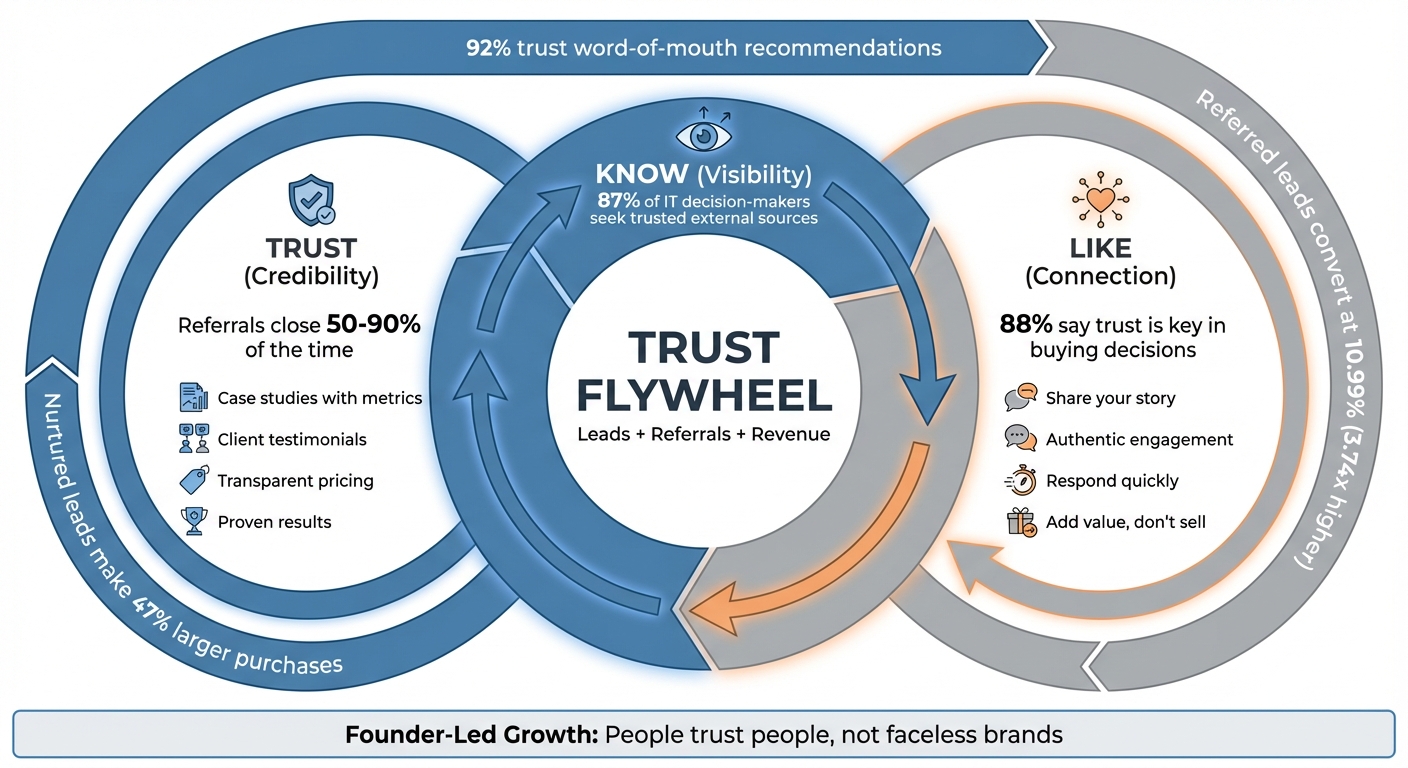
The Trust Flywheel: Know-Like-Trust Framework for B2B Lead Generation
Why Is It So Hard to Instill Trust in B2B Marketing?
sbb-itb-9354cf2
The 3 Stages of Know-Like-Trust
The Know-Like-Trust (KLT) framework guides prospects from initial awareness to meaningful engagement and, ultimately, conversion. This approach creates a cycle of growth, which is essential given that 81% of customers trust recommendations from family and friends more than advice from businesses.
Any friction in this process can derail the entire cycle. Each stage builds on the previous one, so moving prospects smoothly between them is key. The challenge lies in avoiding overwhelming your audience or jumping into sales too soon. Here’s how each stage works.
Stage 1: Know - Making Yourself Visible
The first stage is all about visibility and positioning. This is where you aim to get noticed by your Ideal Customer Profile (ICP) by clearly defining who you serve - and who you don’t. It’s not about reaching everyone; it’s about showing up in the right places for the right audience.
Tactics like guest appearances on industry podcasts, writing SEO-driven blog posts, and using professional visuals can help establish your presence. The focus here is on educating rather than pitching. Considering that 87% of IT decision-makers seek information from trusted external sources before engaging with vendors, your content should answer their questions before they even know to ask.
Crystal Lee Butler, MBA and Founder of Crystal Marketing Solutions, highlights the importance of clarity:
"Lack of clarity leads to assumptions and objections that may work against you".
Defining your "Anti-ICP" - the people or businesses you don’t serve - can be just as important as defining your target audience. This specificity helps attract the right prospects while filtering out those who aren’t a good fit. It ensures your visibility efforts are effective, setting the stage for a deeper connection.
Stage 2: Like - Building a Personal Connection
Once you’re on their radar, the Like stage is about creating an emotional connection. This involves authenticity, storytelling, and responsiveness. The goal is to shift from "I’ve heard of them" to "I like and relate to them."
Share your personal journey, your reasons for doing what you do, and behind-the-scenes content that shows the human side of your brand. Forget overly polished personas - people connect with authenticity. This stage is about "out-caring" your competition, whether that means engaging in meaningful conversations, responding quickly to comments, or genuinely addressing your audience’s concerns.
Avoid pushing for sales too early. Focus on adding value through educational content and open dialogue. Trust starts with feeling understood, and 88% of consumers globally say trust is a key factor in their buying decisions. Once you’ve built this connection, it’s time to prove you’re the real deal.
Stage 3: Trust - Demonstrating Credibility
The Trust stage is where prospects decide if they’re ready to move from observing to investing in your offer. This is the conversion phase, and it hinges on proving your reliability through results, testimonials, and data.
To build trust, use case studies with measurable outcomes (e.g., "Reduced onboarding time by 40%"), client testimonials, and data-backed success stories. A "Problem-Action-Outcome" structure for case studies can make your claims more convincing. Social proof, like reviews and endorsements, becomes a critical asset here.
Transparency is equally important. Be upfront about pricing, timelines, and what’s expected from the client during the process. This openness helps reduce doubts and builds confidence. For high-ticket B2B offers, where decisions involve significant investments, consistency and clarity are crucial.
Trust isn’t built overnight - it’s earned through repeated demonstrations of your expertise and care. When done right, this stage not only converts prospects but also feeds back into the awareness phase, keeping the Trust Flywheel spinning.
How Founders Can Build the Trust Flywheel
Founders play a crucial role in building trust for B2B businesses. Buyers are more likely to trust individuals than faceless brands. During the early stages of growth, a founder’s personal brand often outshines the company’s page in terms of engagement and reach. To make the most of this, it’s essential to move from a simple "content strategy" (posting frequently) to a "trust strategy" (demonstrating your expertise and values).
For founder-led companies, personal branding enhances every part of the Know-Like-Trust (KLT) cycle. By leaning into this, founders can create and sustain a trust flywheel. Here’s how to make it work long-term.
Creating Content That Builds Awareness
Strengthening the "Know" phase starts with building awareness. Stay visible across multiple platforms and focus on a few key themes that showcase your expertise. For instance, if your focus is on "building in public" and "ABM" (account-based marketing), your content should consistently highlight these topics.
Take Adam Holmgren as an example. In January 2026, he used his personal LinkedIn presence to secure the first 50 customers for Fibbler. By focusing his content on "building in public" and "ABM", Holmgren built trust within his network. To expand beyond his European audience, he utilized LinkedIn Thought Leader Ads to reach the U.S. market. This approach turned his personal credibility into a scalable brand engine that continued to generate leads as the business grew.
Your content should aim to educate, not sell. Share personal successes, client stories, and lessons learned. Utilize SEO on your website and include relevant keywords in social media comments to boost discoverability. Participate in podcasts, write blog posts, and engage in online communities where your ideal customers are active.
RevBoss offers content solutions starting at $1,500/month to help founders maintain their personal brand without overwhelming their schedules.
Engagement Tactics That Build Connection
Once you’ve established visibility, the next step is creating genuine connections to strengthen the "Like" phase. Engage personally with comments, emails, and messages to show you’re approachable. Use your posts to ask questions and encourage two-way conversations instead of just broadcasting your thoughts.
Share your personal "why" stories - talk about what motivated you to become a founder and the experiences that shaped your perspective. Drop the overly polished image; people connect better with authenticity than with a corporate persona. Being open about your challenges and failures can encourage others to be real with you, fostering deeper relationships.
In competitive markets, the "people factor" often sets you apart. Demonstrating that you care about customer success can make all the difference. Regularly check in with your current customers to gather feedback and uncover new pain points, which can inspire fresh solutions. Keep in mind that nurtured leads tend to make purchases that are 47% larger than those from non-nurtured leads.
Sharing Results That Build Trust
The final stage, "Trust", hinges on showing measurable results. Share case studies using a clear "Problem-Action-Outcome" format, including concrete metrics like "Reduced onboarding time by 40%". Design your offerings to provide easily shareable proof, such as ROI dashboards or success metrics, which your customers can use to promote your brand organically.
To ensure trust extends beyond your personal brand, use "Memory Engines" - distinctive visual elements like specific colors or mascots that tie your voice to your company. For example, Adam Holmgren used "The Pink Lion" mascot and unique brand colors in his personal content, helping his audience associate Fibbler with his expertise.
RevBoss tools can assist in creating campaigns that showcase proven results and turn happy clients into referral sources. By continuously highlighting outcomes, you can keep the trust flywheel spinning, converting trust into leads and referrals. These strategies create a self-sustaining cycle that drives growth over time.
Converting Trust into Leads and Referrals
You've laid the groundwork - people know you, like you, and trust you. But turning that trust into actual leads and referrals? That’s where the real magic happens. As Simon Bowen puts it:
"The currency of the purchase is not trust, it's belief".
Your prospects must believe your solution is the answer to their problem. To make this leap, your outreach needs to stay personal and relevant, building on the credibility you’ve already earned.
Timing and context are everything. Don’t sit around waiting for trust to magically turn into leads. Instead, use trigger-based prospecting. Look for signs like funding announcements, product launches, or hiring sprees - these often signal that a company might need your services. Once you spot these triggers, craft tailored, insightful messages that reference the event. For example, instead of sending a generic "Just checking in" email, try recording a short video explaining how you helped another company handle a similar situation. This approach directly ties into the Know-Like-Trust framework, making your outreach actionable.
Referrals operate differently but are equally powerful. They close 50% to 90% of the time because they come with pre-established trust. Make it easy for clients or partners to refer you by providing clear ICP guidelines and simple tools for introductions. Ask for referrals at natural points, like right after completing a successful project or during a positive feedback call. Keep your referrers updated on how their referral is progressing - this not only shows appreciation but also encourages them to refer you again. After all, 92% of people trust word-of-mouth recommendations above all other forms of advertising, and referred leads often close at over 70%.
Using Event-Driven Campaigns and Direct Outreach
Once trust is established, it’s all about reaching out at the right moment. Event-driven campaigns are great for this. When someone attends your webinar, downloads a guide, or comments on your LinkedIn post, they’re signaling interest. Use that moment as your entry point. Instead of cold pitching, refer back to the specific content they engaged with. For instance, “I noticed you downloaded our ABM playbook last week. I’d love to hear what stood out to you.”
A multi-channel approach works best here. Combine LinkedIn interactions, email, and community engagement to stay on their radar before making a direct ask. This method aligns with the preference of 63% of B2B buyers, who value a human touch over automated systems.
For direct outreach, skip the hard sell and lead with value. If a prospect goes quiet, follow up with something useful - a resource, a relevant success story, or even a short personalized video. Use subject lines that show you’ve done your homework, like “Noticed your new product launch - here’s something that might help,” instead of generic ones like “Quick question”. This thoughtful, context-driven approach cuts through the noise, especially in a world where 77% of B2B buyers say their purchases are complex due to information overload. Every interaction keeps your pipeline growing and your trust flywheel spinning.
Choosing the Right RevBoss Plan for Lead Generation
RevBoss offers tailored plans to help you convert trust into tangible results. Here’s a breakdown:
| RevBoss Plan | Price (Monthly) | Key Tactics | Pipeline Impact |
|---|---|---|---|
| LinkedIn Content + Audience | $1,500 | Weekly strategy calls, 8-12 LinkedIn posts/month, audience growth workflows | Builds trust and positions you as an authority within your ICP |
| Email Newsletter + Audience | $1,500 | Weekly strategy calls, bi-weekly newsletters, newsletter growth workflows | Keeps you top-of-mind with consistent engagement |
| Combined Content (LinkedIn + Email) | $2,500 | Integrated LinkedIn and email content workflows | Expands your reach across multiple channels |
| Content + Coaching + Activation | $4,000 | Everything above, plus direct outreach (email and LinkedIn DMs), event campaigns, and sales offer development | Turns your audience into qualified leads ready for sales conversations |
The Content + Coaching + Activation plan is ideal for businesses ready to go beyond building trust. It includes direct outreach, event-driven campaigns for webinars and trade shows, and workflows to identify buying intent. This plan takes care of the heavy lifting - like data enrichment and scheduling - while keeping your outreach personal and effective.
For those just starting, the LinkedIn Content + Audience plan at $1,500/month provides a solid foundation. As your audience grows, you can scale up to include activation campaigns that turn trust into a thriving pipeline. All plans are month-to-month, with discounts available for term agreements, giving you the flexibility to adapt as your needs evolve.
Keeping the Flywheel Spinning for Continued Growth
Once you've turned trust into leads and referrals, the challenge is to keep the momentum going. The flywheel thrives on consistent effort to maintain its speed. You need to keep pushing (through content, campaigns, and referrals) while cutting out anything that slows you down. As Jon Dick, VP of Marketing at HubSpot, explains:
"Friction kills flywheels. We've made investments that systematically target our biggest points of friction: great free software as an entry point, channels that help people connect now instead of later, a sales process that solves for prospects".
Consistency across teams is non-negotiable. If marketing, sales, and customer success teams send conflicting messages, trust crumbles. Every interaction - from a LinkedIn post to a contract renewal - should reinforce the same narrative. With an average of 11 stakeholders involved in a B2B purchase, it's critical to equip your main contact with tools like "internal champion kits." These kits can include summaries and risk assessments to help them rally support within their organization.
Think in loops, not lines. Instead of treating lead generation as a one-way street, create referral loops where happy customers bring in new ones. The data is compelling: referred leads convert at 10.99%, which is 3.74 times higher than the average. Use the 1-1-1 follow-up method - check in 1 day, 1 week, and 1 month after asking for a referral to maintain momentum. Timing is everything here. Ask for referrals during "Moments of Delight", like after a smooth onboarding process or when a client achieves a big milestone.
Measure what drives growth. Forget vanity metrics like the number of emails sent or calls made. Instead, focus on trust-based indicators that predict revenue, such as referral-sourced pipelines, repeat meeting rates, and how often meetings turn into opportunities. As SalesHive puts it:
"Trust isn't a soft skill you hope for at the end of a deal - it's a pipeline asset you build, measure, and protect in every touchpoint".
To keep that trust translating into growth, regularly update your buyer personas - at least every three months - to stay in sync with changes in technology or market conditions. Lean on intent data, like repeated visits to your pricing page, to offer helpful resources instead of applying pressure to close.
Stay personal, even as you scale. Customers value genuine interactions, so while automation can handle repetitive tasks like scheduling, save your personal touch for meaningful, trust-building conversations. Employee-generated content and peer recommendations remain powerful tools for fostering authentic connections. The flywheel spins fastest when every interaction - whether it's a LinkedIn comment, a referral request, or a sales call - reinforces the Know-Like-Trust cycle.
Conclusion: Making the Trust Flywheel Work for Your Business
The Know-Like-Trust framework isn’t some one-off marketing hack - it’s a long-term trust-building strategy that grows stronger the more you stick with it. As we’ve touched on earlier, founder-led approaches focus less on churning out endless content and more on creating meaningful connections and showcasing expertise. This steady effort ties together every phase of your marketing journey.
By committing to the Know-Like-Trust stages, you’re creating a system that not only brings in leads but also keeps them coming through referrals. With 92% of people trusting word-of-mouth recommendations over other forms of advertising, this isn’t just about generating leads - it’s about building a machine where your happy customers become your best marketers. With consistent effort, in as little as 3 to 6 months, you can turn complete strangers into loyal clients. And once the flywheel starts spinning, it feeds itself. Every case study, every referral, every piece of content adds momentum.
Start small: dedicate 90 days to focus on one stage at a time. Share your expertise to get Known, tell compelling stories to become Liked, and showcase real results to earn Trust. As you build momentum, these actions will naturally drive your business forward. And from there, let trust take over - drawing clients in, turning them into advocates, and keeping the cycle in motion.
FAQs
How do I know which KLT stage I’m in?
To figure out where you stand in the Know-Like-Trust (KLT) framework, take a close look at how your audience interacts with your brand. If they’re simply aware that you exist, you’re in the Know stage. If they’re engaging with your content and finding it relatable, you’ve moved into the Like stage. Finally, when they view you as credible and dependable, you’ve reached the Trust stage.
What should I post to build trust without selling?
To earn trust without coming across as salesy, focus on crafting content that genuinely connects with your audience. Share behind-the-scenes glimpses, personal stories, or insights that highlight your values and personality. Provide helpful resources, address common questions, or share success stories that reflect your expertise. Engaging in a sincere way through comments or social interactions can deepen relationships, making your audience feel valued and naturally fostering trust over time.
When is the best time to ask for referrals?
The perfect moment to request referrals is right after you've earned the client’s trust and proven your worth. This usually happens when they’re genuinely pleased with your work and comfortable endorsing you. Aim to align your ask with moments of positive feedback or the successful completion of a project - these are the times when they’re most likely to say yes.